
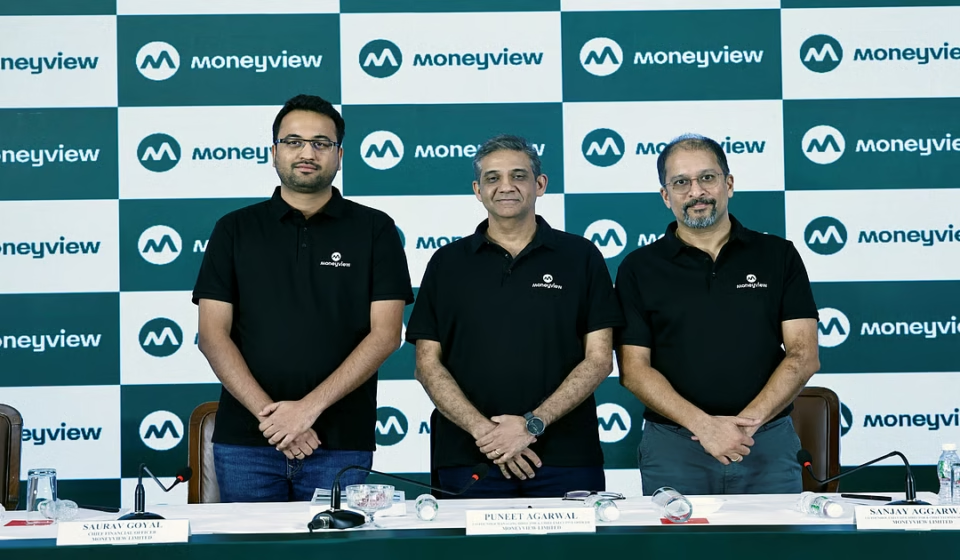
Moneyview Shares Soar 64% on Debut: Inside the ₹1,092 Crore IPO

By the FinanceChecks.com Editorial Team | Published October 1, 2026 | Last reviewed October 1, 2026 | 7-minute read
Digital lending platform Moneyview gave its investors a genuinely good morning on Thursday, October 1. The stock listed on the BSE at ₹55.61, a 64% jump over its ₹34 issue price, and on the NSE it opened at ₹55, up nearly 62%. For anyone who got an allotment, that’s the kind of single-day return most people spend years chasing in the market. And the stock didn’t stop there, it kept climbing through the morning, touching ₹62 at one point, which took total gains to roughly 82% from the issue price in under an hour of trading.
Here’s what actually happened, why the listing went this well, and what the people who weren’t lucky enough to get shares in the IPO should think about now.
The Numbers, Quickly
Moneyview’s IPO was sized at around ₹1,092 crore, with a price band of ₹32 to ₹34 per share. At the top of that band, the company was valued at roughly ₹5,985 to ₹6,000 crore going in. By the time trading opened, that valuation had jumped to about ₹9,788.6 crore, or just over $1 billion, purely on the strength of the listing pop.
Demand for the IPO was intense almost from the start. The offer was fully subscribed on day one, driven largely by retail and non-institutional investors, and by the time bidding closed, the overall subscription stood at somewhere between 98 and 102 times, depending on which exchange’s data you’re looking at. Big institutional investors leaned in even harder, subscribing roughly 230 times their allotted quota. The retail portion alone was covered close to 20 times over. Before the public issue even opened, Moneyview had already pulled in ₹327.5 crore from anchor investors, the early vote of confidence that often sets the tone for how a listing goes.
The IPO itself was a mix of a fresh issue, around ₹750 crore, and an offer for sale of just over 10 crore shares worth about ₹342 crore, meaning existing shareholders cashed out a portion of their stake alongside the company raising new capital.
What Moneyview Actually Does
If you’re not familiar with the name, Moneyview runs a digital lending business, offering personal loans and related credit products largely through its app, with underwriting built around alternative data and a tech-first lending model rather than the traditional branch-heavy approach older NBFCs rely on. Its FY26 numbers show a company growing fast on the revenue side, income jumped 43% year-on-year to ₹3,404 crore, though profit growth was far more modest, which is a detail worth sitting with rather than skipping past.
A chunk of the fresh capital raised is earmarked for strengthening the lending engine itself. The company has said around ₹325 crore will go toward loan disbursals under its DLG, or default loss guarantee, arrangements, and another ₹250 crore is planned as an investment into its NBFC subsidiary to shore up its capital base, a third of the fresh issue tied directly into that subsidiary. In plain terms, this is a company using IPO money to lend more aggressively and strengthen the balance sheet behind that lending.
Why Did It List So Strong?
A few things lined up well for Moneyview. The sheer scale of oversubscription, especially from institutional investors at over 230 times, signalled real conviction from the kind of buyers who do their homework before committing serious money. Fintech and digital lending have also been a genuinely hot pocket of investor interest lately, and a company showing 43% revenue growth gives that story some real backing rather than just narrative.
It also helped that the price band itself, ₹32 to ₹34, was on the conservative side relative to the growth numbers being shown. When an IPO is priced with some room to run, a strong listing pop tends to follow almost mechanically once demand outstrips supply by this much.
Should You Buy Now, After the Pop?
This is the question everyone who missed the allotment is actually asking, and it’s worth being honest that there’s no clean answer. Several market analysts covering the stock on listing day struck a cautious note here, essentially saying the listing gains are real and worth celebrating if you got in early, but that chasing the stock after an 80%-plus pop in under an hour is a very different decision than buying the IPO itself was.
The gap between revenue growth and profit growth is the specific thing worth paying attention to before deciding anything. A company growing income 43% while profits “barely moved,” as one report put it, isn’t necessarily a red flag on its own, lending businesses often reinvest heavily in growth, but it does mean the valuation now sitting near ₹9,800 crore is pricing in a lot of future execution, not just what the company has already proven it can do.
| What We Know | What It Suggests |
|---|---|
| 64% BSE listing premium, up to 82% intraday | Very strong demand, likely overshooting fair value in the near term |
| Institutional subscription over 230x | Serious conviction from investors who typically do deep diligence |
| FY26 revenue up 43% to ₹3,404 crore | Genuine, fast top-line growth |
| Profit growth far slower than revenue | Worth understanding before paying post-listing prices |
| IPO proceeds going largely into lending capital | Company is doubling down on growth, not de-risking |
None of this is a buy or sell call, it’s simply the shape of the decision anyone looking at this stock today is actually facing.
You May Also Like To Read About:
The Bigger Picture
Moneyview’s debut lands at an interesting moment. It’s listing on a day when the broader market is actually having a rough session elsewhere, with the Sensex and Nifty both under pressure from oil prices and FII selling. That a single IPO can post an 80%-plus gain while the benchmark indices are falling is a useful reminder that individual stock stories and market-wide sentiment often move on completely separate tracks, even on the same trading day.
For India’s broader IPO market, a listing like this is a genuinely good sign. Strong debuts tend to feed investor appetite for the next round of IPOs in the pipeline, and a fintech lender pulling in triple-digit institutional oversubscription suggests there’s real capital still looking for growth stories in this space, even with markets choppy elsewhere.
Frequently Asked Questions
1. At what price did Moneyview shares list? Moneyview listed at ₹55.61 on the BSE, a 64% premium over its ₹34 issue price, and at ₹55 on the NSE, up about 62%.
2. How much was Moneyview’s IPO, and what was the price band? The IPO was sized at around ₹1,092 crore, with a price band of ₹32 to ₹34 per share.
3. How many times was the Moneyview IPO subscribed? Overall subscription ranged between roughly 98 and 102 times across reported data, with institutional investors subscribing around 230 times their quota and the retail portion covered close to 20 times.
4. What does Moneyview do? Moneyview is a digital lending platform offering personal loans and related credit products through a tech-first, app-based lending model.
5. What will Moneyview do with the IPO proceeds? A significant portion is going toward strengthening its lending business, including capital for loan disbursals under default loss guarantee arrangements and an investment into its NBFC subsidiary.
6. Is it a good idea to buy Moneyview shares after the listing pop? That depends on your own risk appetite and research. The stock’s revenue is growing fast, but profit growth has been far slower, and buying after an 80%-plus listing gain is a very different bet than subscribing to the IPO was. This isn’t investment advice, just the trade-off worth understanding.
Disclaimer
This article is for general informational purposes only and does not constitute investment advice or a recommendation to buy, sell or hold any security. Figures are based on publicly available listing data, exchange disclosures and news reporting as of October 1, 2026, and stock prices can move significantly after publication. Readers should conduct their own research or consult a SEBI registered investment adviser before making investment decisions. FinanceChecks.com is not a SEBI registered investment adviser and is not affiliated with Moneyview.
Last reviewed and fact-checked on October 1, 2026 by the FinanceChecks.com Editorial Team.

Shuchi founded Finance Checks after spending 16+ years working in corporate, managing operations and distribution. She managed her own finances, learned and read regularly and helped people make sense of their savings, loans, insurance, and investments.
She started this site to offer the kind of clear, honest financial guidance she wished was more available when she was learning to manage her own money. Every article is researched personally, checked against official sources such as the Reserve Bank of India, SEBI, or the Income Tax Department, and revisited whenever regulations or figures change. She is upfront about how the site earns money through ads and select affiliate partnerships, and she does not let either influence what she actually recommends to readers.