

Stock Market Crash: ₹9.5 Lakh Crore Gone in an Hour, What Triggered It

By the FinanceChecks.com Editorial Team | Published October 1, 2026 | Last reviewed October 1, 2026 | 8-minute read
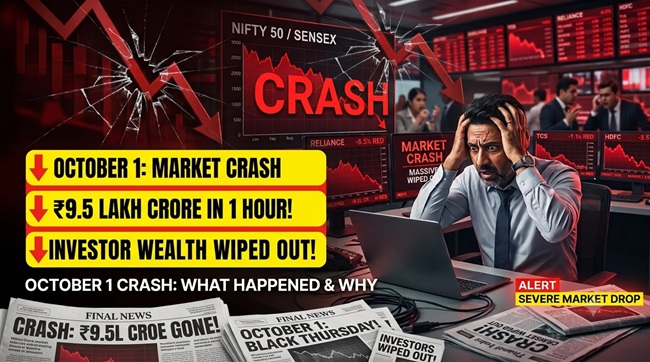
If you checked your portfolio around mid-morning on Thursday, October 1, and felt a small jolt of panic, you weren’t imagining things. Indian markets had one of their roughest sessions of the year, with the Sensex tumbling past 1,000 points at its lowest point and the Nifty slipping below the 22,300 mark for the first time since early April. In the space of a little over an hour, close to ₹9.5 lakh crore of investor wealth simply evaporated from the books, at least on paper. That’s not a typo. It’s roughly what some mid-sized economies produce in a year, gone before most people had finished their morning chai.
By the time the closing bell rang, the market had clawed back a good chunk of that loss. But the session still ended in the red for the fourth straight day, and it’s worth understanding exactly what happened, why, and whether it should actually change anything about how you’re investing.
What Actually Happened on October 1
The morning opened on shaky ground and got shakier fast. The Sensex hit a fresh calendar-year low, and the Nifty briefly dipped under 22,300, a level nobody had seen since April 2. At the worst point of the day, 41 of the 50 stocks on the Nifty were trading in the red. That’s not a sector-specific wobble, that’s a broad, across-the-board sell-off.
Volatility spiked right alongside it. India’s VIX, essentially a gauge of how nervous traders are feeling, jumped over 16% to touch 15.69, a clear sign that this wasn’t routine profit-booking but something closer to genuine anxiety playing out in real time.
The market did recover some ground through the afternoon, pulling back roughly 600 points from its lowest level of the day. Even so, the Sensex closed about 571 points lower, and the Nifty settled around 22,422. Depending on exactly when you measured the market capitalization, the wealth wiped out ranged from roughly ₹8.7 lakh crore to the nearly ₹9.5 lakh crore figure reported at the session’s sharpest point, a difference that mostly comes down to timing rather than any disagreement about the scale of the fall.
Why Did the Market Fall So Hard?
A few forces converged at once, and none of them are particularly new, which is partly why this feels like the continuation of a trend rather than a one-off shock.
Crude oil kept climbing. Brent crude pushed close to the $100 mark, driven by the ongoing tension in West Asia. For a country that imports the vast majority of its oil, that’s never just an energy story, it’s an inflation story, a rupee story, and eventually a corporate earnings story too, since higher input costs squeeze margins across several sectors at once.
Foreign investors kept selling. FIIs have been net sellers for a stretch now, and today was no exception. When foreign money heads for the exit at the same time oil prices are climbing, the two pressures tend to feed off each other.
Rate hike fears crept back in. A few analysts flagged growing concern that persistently high oil prices could eventually force the RBI’s hand on interest rates, even though nothing official has been signalled. Markets often react to the possibility of bad news well before the news itself arrives.
Liquidity was thinner than usual. With a long weekend coming up, some of the usual trading volume simply wasn’t there, which tends to exaggerate price swings in both directions. A sell order that might barely move the needle on a normal Tuesday can hit harder when fewer buyers are around to absorb it.
Where the Damage Was Worst
Autos took the hardest hit by a wide margin. Bajaj Auto was the single biggest loser on the Nifty, down as much as 8.8% at one point in the session. Mahindra & Mahindra and Maruti Suzuki weren’t far behind, both sliding over 4% during the worst of the trading. Tata Steel, Grasim Industries, Eicher Motors and UltraTech Cement all posted losses in a similar range, and the broader Nifty Auto index ended the day down about 3%.
| Stock | Approximate Intraday Fall |
|---|---|
| Bajaj Auto | Down ~8.8% |
| Mahindra & Mahindra | Down ~4%+ |
| Maruti Suzuki | Down ~4%+ |
| Tata Steel | Down 3-3.5% |
| Grasim Industries | Down ~2.6% |
| Eicher Motors | Down ~2.5% |
| UltraTech Cement | Down 3-3.5% |
Not every sector had a bad day, though. IT stocks were the clear outlier, with the Nifty IT index actually rising around 2% while everything else fell. Infosys, TCS, HCL Technologies, HDFC Bank and Kotak Mahindra Bank all closed higher, a reminder that even on a rough day for the headline indices, money doesn’t disappear, it often just rotates somewhere else.
Is This the Start of Something Bigger, or Just a Rough Day?
It’s genuinely hard to say with any confidence, and anyone claiming certainty either way is guessing louder than the facts justify. What we do know is that this wasn’t an isolated event. It’s the fourth consecutive day of losses, and it follows a pattern that’s been building for a couple of weeks now, elevated oil prices, steady FII outflows, and a market that was already trading cautiously ahead of the RBI’s upcoming policy meeting.
That said, a sharp single-session fall, even one erasing ₹9.5 lakh crore, doesn’t automatically signal a prolonged downturn. Markets have shaken off worse single days before and gone on to recover within weeks or months. They’ve also, occasionally, been the first domino in a longer correction. The honest answer is that nobody, including the analysts quoted across today’s coverage, can tell you with confidence which of those two this will turn out to be.
What This Means If You’re an Everyday Investor
If you’re running SIPs toward a long-term goal, days like this are uncomfortable to watch but rarely worth acting on. A falling NAV means your fixed monthly contribution buys more units, not fewer, and interrupting that because of one rough week tends to hurt more than it helps over a multi-year horizon.
If you hold individual stocks, particularly in auto or metals, it’s worth distinguishing between a stock falling because the whole market is falling, and a stock falling because something specific and lasting has changed about that company. Today looks overwhelmingly like the former. Auto stocks got hit hardest largely because higher oil prices and rate-hike fears directly affect car affordability and financing costs, not because Maruti or Mahindra reported anything company-specific overnight.
If you’re sitting on cash and wondering whether this is a buying opportunity, that’s a fair question, but it’s also one that depends entirely on your own time horizon and risk appetite, not on anything this article can responsibly tell you. Trying to call the exact bottom of a correction is a well-known way to lose money confidently.
A Quick Word on the Headline Number
That ₹9.5 lakh crore figure is real, but it’s worth understanding what it actually measures. It’s notional, the combined market capitalisation of every listed company falling together within a window of trading, not money that physically left anyone’s bank account. Unless you sold at the exact low point of the day, that “loss” existed only on a screen and reversed itself partially within hours, the same way a portfolio’s value can swing based on where you check it. That doesn’t make the headline meaningless, it reflects genuine, broad-based selling pressure, but it’s a measure of sentiment and scale, not a precise tally of money that’s gone for good.
Frequently Asked Questions
1. Why did Indian stock markets crash on October 1, 2026? A combination of rising crude oil prices nearing $100 a barrel, sustained foreign investor selling, growing concerns about a possible RBI rate hike, and thinner trading volumes ahead of a long weekend.
2. How much money did investors actually lose? Market capitalisation fell by roughly ₹8.7 to ₹9.5 lakh crore at the session’s worst point, though the market recovered some ground by the close. This figure is notional and reflects the combined paper value of listed companies, not realised losses for every individual investor.
3. Which stocks fell the most? Bajaj Auto was the biggest loser on the Nifty, down as much as 8.8% intraday, followed by Mahindra & Mahindra, Maruti Suzuki, Tata Steel, Grasim Industries and UltraTech Cement.
4. Did any sector do well today? Yes. IT stocks bucked the trend, with the Nifty IT index rising around 2%. Infosys, TCS, HCL Technologies, HDFC Bank and Kotak Mahindra Bank all closed in the green.
5. Should I stop my SIP because of this crash? For most long-term investors, no. A single sharp fall, even a large one, doesn’t typically justify pausing a SIP aimed at a goal several years away, since lower prices mean more units bought for the same contribution.
6. Is this the start of a bigger market correction? It’s genuinely uncertain. This is the fourth straight day of losses and fits a pattern of recent pressure from oil prices and FII selling, but a short sell-off doesn’t automatically predict a longer downturn, and no analyst can say with real confidence which way this goes.
Disclaimer
This article is for general informational purposes only and does not constitute investment advice or a recommendation to buy, sell or hold any security. Market figures, stock movements and commentary reflect information available at the time of writing on October 1, 2026, and can change rapidly over the course of a trading session. Readers should conduct their own research or consult a SEBI registered investment adviser before making investment decisions. FinanceChecks.com is not a SEBI registered investment adviser.
Last reviewed and fact-checked on October 1, 2026 by the FinanceChecks.com Editorial Team.

Shuchi founded Finance Checks after spending 16+ years working in corporate, managing operations and distribution. She managed her own finances, learned and read regularly and helped people make sense of their savings, loans, insurance, and investments.
She started this site to offer the kind of clear, honest financial guidance she wished was more available when she was learning to manage her own money. Every article is researched personally, checked against official sources such as the Reserve Bank of India, SEBI, or the Income Tax Department, and revisited whenever regulations or figures change. She is upfront about how the site earns money through ads and select affiliate partnerships, and she does not let either influence what she actually recommends to readers.