

Quick Answer
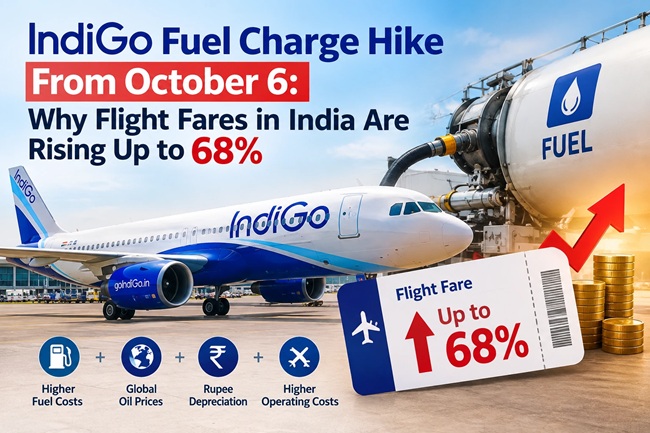
IndiGo, India’s largest airline, has raised its fuel charges for new bookings made from 12:01 am on 6 October 2026. Domestic charges now run from Rs 375 for flights up to 500 km to Rs 1,300 for those above 2,000 km, an increase of roughly Rs 100 to Rs 350 per sector. The trigger is jet fuel: domestic ATF rose by Rs 16 a litre, about 13.2%, from Rs 121 to around Rs 137 from October 1. Meanwhile, average one-way fares between September 1 and November 10 are up 68% on Delhi-Hyderabad, 51% on Mumbai-Kolkata, 39% on Delhi-Goa and 37% on Mumbai-Bengaluru.
Table of Contents
- What exactly did IndiGo announce?
- The new charges, bracket by bracket
- What is ATF, and why does it control your ticket price?
- Why are fares up 68% when seats barely dropped?
- How much extra will you actually pay?
- International flights: the new charges
- Has this happened before? What history tells us
- 10 practical ways to pay less
- Who is affected, and who isn’t
- FAQ
- Disclaimer and sources
1. What Exactly Did IndiGo Announce?
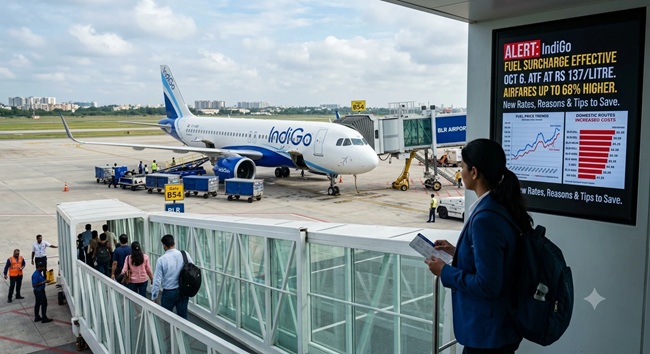
On Monday, 5 October, IndiGo said it would raise fuel charges on both domestic and international flights. The revised charges apply to all new bookings from 0001 hours on October 6, 2026. If you bought your ticket before that, the new charge does not apply to you.
IndiGo says the new charges were set lower than the actual rise in fuel costs, to limit the burden on passengers. In other words, the airline is absorbing part of the increase, though the cost to you still goes up.
This is not a one-off. It is the third time this year IndiGo has raised fuel charges, after increases in March and April 2026.
2. The New Domestic Charges, Bracket by Bracket
The fuel charge is a flat amount per passenger, per sector (one takeoff-to-landing leg), based on distance. Here are the figures reported from IndiGo’s announcement:
| Flight distance | Charge since April | New charge from 6 Oct | Increase |
|---|---|---|---|
| Up to 500 km | Rs 275 | Rs 375 | Rs 100 |
| 501-1,000 km | Rs 400 | Rs 600 | Rs 200 |
| 1,001-1,500 km | Rs 600 | Rs 900 | Rs 300 |
| 1,501-2,000 km | Rs 800 | Rs 1,150 | Rs 350 |
| Above 2,000 km | Rs 950 | Rs 1,300 | Rs 350 |
(Source figures: the route-wise table of April and new charges; increases calculated by us.)
Layman example: If you fly roughly 1,250 km, such as Delhi to Hyderabad, you fall in the Rs 900 bracket. Compared with the April charge of Rs 600, that is Rs 300 more per person each way. A family of four on a round trip would pay about Rs 2,400 extra from this change alone. Distances are approximate, so confirm your bracket at checkout.
3. What Is ATF, and Why Does It Control Your Ticket Price?
ATF (Aviation Turbine Fuel) is jet fuel. Think of it as the petrol of an aircraft, except an airline burns an enormous amount of it.
- It is the biggest cost for airlines. ATF makes up almost 40 per cent of an airline’s operating expenses. outlooktraveller
- Oil companies revise the price on the first of every month. This time, it was the third straight monthly increase, after rises of Rs 5 per litre in August and Rs 6.28 in September. freepressjournal
- IndiGo says ATF prices are at roughly their highest levels in a decade, with West Asia developments adding to the pressure. swarajyamag
Simple analogy: Imagine your monthly auto-rickshaw fare suddenly rose because petrol went up 13%. The driver can’t absorb that forever, so he adds a small extra charge. A fuel surcharge works the same way.
Base fare vs fuel charge: The base fare is the airline’s basic price for the seat. The fuel charge is a separate line added on top, linked to fuel costs. Because it is listed separately, an airline can remove it later without redoing its whole pricing.
You May Also Like To Read About:
You May Also To Read About:
- Nykaa Shares Jump 6% On Strong Q2 FY27 Business Update
- Bhavish Aggarwal Pledges 4.32% Ola Electric Stake To Fund Rights Issue Subscription
- PhysicsWallah Exits Direct Student Lending, Sells ₹96 Cr Loan Book to Auxilo
- CGST, SGST and IGST: The Difference, Which One You Need to Apply, and What Changes If You Operate in Multiple States or Do Export-Import
- Amazon Great Indian Festival and Flipkart Big Billion Days in Oct 2026: Which Debit or Credit Card Can Help You To Save More
- Swiggy Gets a Fresh ₹300 Crore Vote of Confidence From SBI MF
4. Why Are Fares Up Up to 68% When Seats Barely Dropped?
This is the question most people ask, and the answer is not just fuel.
- Capacity fell only slightly. Total seat capacity has fallen by only 1.2%. So there is no nationwide seat shortage. 10bmnews
- Demand clusters on specific days and routes. Festive travel, weddings and holidays make everyone want the same flights.
- Dynamic pricing. Airlines sell seats in price “buckets”. When cheap buckets sell out, the next bookings automatically cost more. A small supply squeeze on a busy route can empty cheap buckets fast.
- Fuel lifts the floor. Higher costs mean even the cheapest bucket starts at a higher level.
Together these explain why increases differ so much by route, from 37% on Mumbai-Bengaluru to 68% on Delhi-Hyderabad. The figures are averages of one-way fares over the 1 September to 10 November period, as reported by the Economic Times.
5. How Much Extra Will You Actually Pay?
Roughly, think of three layers:
- Fuel charge increase: Rs 100-350 per person per sector for most domestic trips.
- Higher base fares: driven by demand and fewer cheap seats on certain routes.
- Taxes and fees: these are usually charged on top, so the final total can rise slightly more than the surcharge alone.
Always judge by the final payable amount at checkout, not the fare shown in search results.
6. International Flights: The New Fuel Charges
For overseas travel the amounts are much larger:
- SAARC routes: Rs 1,000 for up to 500 km, and Rs 3,000 for longer SAARC routes. freepressjournal
- Southeast Asia, GCC, Middle East, North and East Asia: Rs 5,500.
- Africa: Rs 6,000.
- Europe: Rs 10,000.
These come from the reported breakdown of IndiGo’s international fuel charges. If you are planning a trip abroad, factor this in early. freepressjournal
7. Has This Happened Before? What History Tells Us
Yes, and the outcome is useful to know. In 2023, IndiGo began charging a fuel surcharge of Rs 300 to Rs 1,000 on 6 October and withdrew it on 4 January after ATF prices dropped. So these charges tend to follow fuel prices. If jet fuel eases, relief is possible. It is not guaranteed, and it depends on global oil prices and geopolitical events. tribuneindia
8. 10 Practical Ways to Pay Less
- Book as early as you can. The new charge applies to new bookings, and last-minute fares usually cost the most.
- Compare the final fare on the airline site and two other apps.
- Fly midweek. Tuesday and Wednesday are often cheaper than Friday and Sunday.
- Try early-morning or late-night flights. Less popular timings carry lower fares.
- Check nearby airports or one-stop itineraries on expensive routes.
- Use fare alerts so you can buy when prices dip.
- Choose trains for short distances where the journey time is acceptable.
- Avoid peak festive dates if your plans are flexible.
- Travel light and skip add-ons you won’t use, since extras add up.
- Watch for ATF changes on the 1st of each month, which signal when airlines may revise charges.
9. Who Is Affected, and Who Isn’t?
- Affected: anyone buying a new IndiGo ticket from 6 October onward, domestic or international.
- Not affected: passengers who already hold a confirmed ticket purchased before the cut-off.
- Other airlines: fares there may also rise because they face the same fuel costs. Check each airline’s current fares and charges directly.
10. Frequently Asked Questions (FAQ)
What is the IndiGo fuel charge from October 6, 2026?
For domestic flights it ranges from Rs 375 to Rs 1,300 per passenger per sector, depending on distance. This is an increase of about Rs 100 to Rs 350 over the earlier April charges.
When does the new IndiGo fuel charge start?
It applies to all bookings made from 12:01 am on 6 October 2026.
Will my already-booked IndiGo ticket cost more?
No. The revised charge applies only to new bookings made on or after the effective time.
Why did IndiGo increase the fuel charge?
Because ATF prices rose sharply. They went up about 13.2% on 1 October to around Rs 137 per litre, the third monthly increase in a row.
What is a fuel surcharge in simple words?
It is an extra amount added to your ticket to cover the airline’s rising fuel costs. It is separate from the base fare.
Which routes have seen the biggest fare increases?
According to reported data, Delhi-Hyderabad (68%) and Mumbai-Kolkata (51%) lead, followed by Delhi-Goa (39%) and Mumbai-Bengaluru (37%).
Are flights becoming scarce in India?
Not significantly. Total seat capacity is down only about 1.2%, so price rises come mainly from fuel costs and concentrated demand.
Will flight prices come down?
They might if fuel prices fall. In the 2023-24 episode, IndiGo withdrew its surcharge when ATF eased, but there is no guarantee this time.
How can I find the cheapest IndiGo fare?
Book early, fly midweek, compare the final price, set fare alerts and stay flexible on dates.
Is the fuel charge refundable if I cancel?
Refund rules depend on the fare type and airline policy. Check the cancellation terms on your booking before paying.
How much is the IndiGo fuel charge for international flights?
It ranges from Rs 1,000 on short SAARC routes to Rs 10,000 for Europe, with Rs 5,500 for Southeast Asia, the Gulf and East Asia.
Do other airlines also charge fuel surcharges?
Several Indian carriers have used fuel-linked charges in past fuel spikes. Check your airline’s website for its current policy.
The Bottom Line
The headline is a small surcharge, but the real story is bigger: fuel at decade-high levels, demand bunched into festive weeks, and pricing systems that react instantly. Understand those three forces and you can plan trips smartly instead of simply absorbing the increase.
Disclaimer
This article is for general information only and is not travel, financial or legal advice. Airfares, fuel charges, taxes and policies change frequently and may differ by route, date and booking channel. Figures are drawn from news reports and airline statements available on 5 October 2026, and we have not independently verified every number. Please confirm current prices and terms on the airline’s official website or app before booking. We are not affiliated with IndiGo or any other airline.
Sources
Reports on IndiGo’s announcement and charge tables (Inkl/HT-syndicated report, Free Press Journal, Swarajya, Newstrack, 5 Oct 2026); Economic Times fare data as carried by 10bmnews.com (5 Oct 2026); Outlook Traveller on the March 2026 charge; The Tribune on the January 2024 withdrawal. Link each to its original page when you publish.

Shuchi founded Finance Checks after spending 16+ years working in corporate, managing operations and distribution. She managed her own finances, learned and read regularly and helped people make sense of their savings, loans, insurance, and investments.
She started this site to offer the kind of clear, honest financial guidance she wished was more available when she was learning to manage her own money. Every article is researched personally, checked against official sources such as the Reserve Bank of India, SEBI, or the Income Tax Department, and revisited whenever regulations or figures change. She is upfront about how the site earns money through ads and select affiliate partnerships, and she does not let either influence what she actually recommends to readers.