
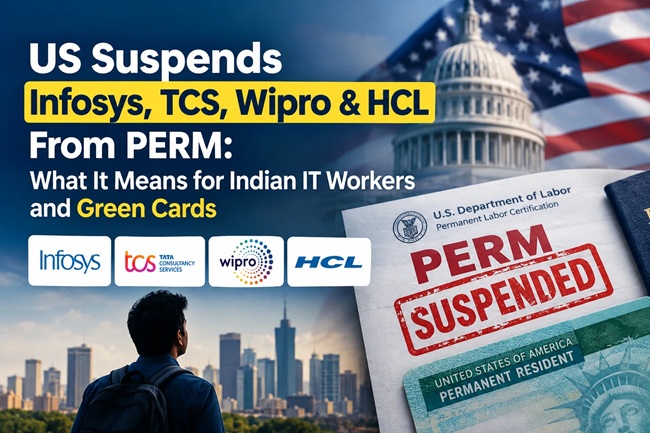
US Suspends Infosys, TCS, Wipro & HCL From PERM: What It Means for Indian IT Workers and Green Cards

The US government has suspended several major technology companies, including Infosys, Tata/TCS, Wipro, HCL Technologies and Cognizant, from the Permanent Labour Certification (PERM) programme. Microsoft, Adobe and Capgemini are also among the companies affected. The move could create another hurdle for foreign workers, particularly Indian IT professionals pursuing employment-based US green cards.
The latest decision marks a significant escalation in the Trump administration’s scrutiny of foreign-worker programmes in the United States.
US Labour Secretary Keith Sonderling announced the suspension on October 8, 2026, alongside Vice President JD Vance and the head of the US Anti-Fraud Task Force.
The Department of Labor said it will not accept new or process pending PERM applications involving the affected companies.
But there is an important distinction for Indian professionals:
This does not mean that employees of Infosys, TCS, Wipro or HCL are automatically losing their H-1B visas.
Instead, the immediate issue is the potential disruption of the PERM-based pathway toward employment-based permanent residency, or a US green card.
Which IT Companies Have Been Suspended From PERM?
The US Labour Department’s action covers several major technology and IT-services companies.
The companies named include:
- Infosys
- Tata/Tata Consultancy Services (TCS)
- Wipro
- HCL Technologies
- Cognizant
- Capgemini
- Microsoft
- Adobe
The first six are major players in the IT-services and outsourcing industry, while Microsoft and Adobe are major US technology companies.
The announcement says the Department of Labor will stop accepting new PERM applications and will not process pending applications involving these companies.
What Is PERM and Why Does It Matter?
PERM stands for Permanent Labor Certification.
It is a US Department of Labor process generally used by employers seeking to sponsor eligible foreign workers for employment-based permanent residency.
Before an employer can normally move ahead with certain employment-based green-card cases, it must establish that there are not sufficient qualified, willing and available US workers for the relevant position and that hiring the foreign worker will not adversely affect the wages and working conditions of similarly employed US workers.
Once the PERM process is completed, an employer can generally move to the next stages, including an immigrant petition with US Citizenship and Immigration Services.
For an Indian professional working in the US on an H-1B visa, PERM can therefore be an important part of the longer journey from temporary employment status toward permanent residency.
Does This Mean Infosys or TCS Employees Will Lose Their H-1B Visas?
No.
This is one of the most important points to understand.
The PERM suspension is not the same thing as cancelling existing H-1B visas.
An H-1B visa and the PERM process serve different purposes.
H-1B
The H-1B programme allows US employers to employ eligible foreign workers in specialty occupations on a temporary basis.
PERM
PERM is generally associated with the employer-sponsored process for obtaining permanent residency.
Therefore, an employee can potentially remain on H-1B status even if their employer’s ability to pursue a PERM application is suspended.
However, for employees who were depending on their employer to start or continue the PERM process, the suspension could result in delays and additional uncertainty around their green-card plans.
Why Did the US Suspend These Companies?
The Trump administration has intensified its scrutiny of US immigration and foreign-worker programmes.
The administration has accused some companies of using foreign-worker programmes in ways that disadvantage American workers.
During the announcement, US officials cited concerns about the use of foreign labour and alleged abuse of immigration programmes.
US Vice President JD Vance separately criticised Microsoft, pointing to layoffs of American employees alongside the company’s use of H-1B visas and green-card processes.
The administration’s broader argument is that US companies should prioritise American workers where qualified workers are available.
However, allegations made by officials should not be treated as established wrongdoing by every company named in the suspension.
The companies have been caught up in a broader government action and investigation, and the full facts and consequences may develop further.
How Many Workers Could Be Affected?
The potential scale is significant.
According to Labour Secretary Sonderling, the companies named in the action had collectively sought almost 3 million foreign workers since 2009.
He also said they had received more than 230,000 H-1B visa approvals and over 100,000 permanent labour certifications during that period.
These figures represent historical activity across the companies and should not be interpreted as the number of people currently affected by the suspension.
The US government has not publicly provided a precise number of employees whose individual green-card cases will ultimately be affected.
What Does the PERM Suspension Mean for Indian IT Professionals?
The impact will depend heavily on an individual’s immigration stage.
1. Indian IT workers already on H-1B
For someone currently working in the US on H-1B status, the suspension does not automatically cancel the H-1B.
The immediate concern is more about their employer’s ability to pursue the PERM stage of a green-card case.
2. Employees waiting for their employer to start PERM
This group could face greater uncertainty.
If an employee was expecting the employer to initiate PERM soon, the suspension could delay the start of that process.
3. Employees with pending PERM applications
The Department of Labor has said it will not process pending PERM applications involving the affected companies.
That could create delays until the suspension is clarified, lifted or otherwise resolved.
4. Employees who already have an approved PERM
An important distinction is that the latest reports describe a suspension of new and pending PERM processing.
It does not mean every previously approved PERM certification has suddenly become invalid.
The precise impact on an individual case depends on its stage and the employer’s circumstances.
Employees should therefore obtain case-specific advice from a qualified US immigration attorney rather than assuming that the suspension automatically affects their immigration status.
Why Is This Particularly Important for Indians?
Indian professionals have historically been among the largest groups using employment-based US immigration pathways, particularly in technology and IT services.
Large Indian IT companies such as Infosys, TCS, Wipro and HCL have significant US operations and have historically sponsored foreign workers.
That means changes to the H-1B and employment-based green-card ecosystem can have a disproportionately large impact on Indian technology professionals.
The latest PERM suspension comes after several other immigration-policy changes and proposals that have increased uncertainty around the US pathway for foreign technology workers.
This Is Different From the $100,000 H-1B Payment Rule
Another point that could easily create confusion is the difference between the latest PERM action and the administration’s separate H-1B measures.
The H-1B programme and PERM programme are not the same.
The administration previously introduced a $100,000 payment requirement for certain new H-1B petitions involving workers outside the US, subject to specified conditions and exceptions. The policy was subsequently extended into 2027, according to current reporting.
The latest announcement concerns PERM and employment-based permanent residency, rather than simply imposing a new fee on existing H-1B holders.
Could This Affect Indian IT Companies Financially?
Potentially, although the immediate financial impact remains difficult to quantify.
Indian IT companies rely heavily on the US market for revenue.
If immigration restrictions make it harder or more expensive to move skilled employees to the US or retain foreign workers over the long term, companies could face pressure to rethink their workforce strategies.
Possible responses could include:
- Hiring more US-based employees
- Increasing local delivery centres
- Moving more work to India or other offshore locations
- Using alternative immigration pathways where legally available
- Increasing investments in automation and AI
- Rebalancing global staffing models
However, it would be premature to conclude that the latest PERM suspension will immediately hit the revenues or profitability of Infosys, TCS or Wipro.
The business impact will depend on the duration of the suspension, its final scope and how companies respond.
Indian IT Stocks Could Also Remain Sensitive
The news has already attracted attention from investors.
US-listed ADRs of Indian IT companies came under pressure after the announcement. Wipro ADRs, Infosys ADRs and Cognizant shares were reported lower in US trading following the news.
That market reaction reflects investor concerns about the potential impact of tighter US immigration policies on the business models of companies with substantial US exposure.
But a one-day market move should not be interpreted as proof of a long-term earnings impact.
Investors will likely watch for:
US policy clarity + duration of the suspension + client demand + hiring costs + visa availability + company guidance.
What Should Indian IT Workers in the US Do Now?
If you work for one of the affected companies and are pursuing a green card, the most sensible approach is to first understand where your case currently stands.
Consider asking your employer’s immigration team or attorney:
- Has my PERM application already been filed?
- Is my PERM application pending?
- Has my PERM already been approved?
- What happens to my case under the current suspension?
- Does the suspension affect my I-140 or later stages?
- Are there alternative legal pathways available in my circumstances?
- What happens if my H-1B validity period approaches its limit?
Do not make major decisions about resigning, changing employers or leaving the US based solely on headlines.
Immigration consequences can be highly case-specific.
What Happens Next?
The biggest unanswered question is how long the PERM suspension will last.
Current reports do not establish a definitive end date for the suspension.
The companies, their employees and immigration lawyers will likely be watching for further guidance from the US Department of Labor and other US agencies.
There could also be legal or administrative challenges depending on how the policy is implemented.
For Indian technology professionals, the immediate takeaway is therefore not that the US has “cancelled green cards” for Infosys, TCS or Wipro employees.
Rather, the latest action creates another potential bottleneck in an already complex US employment-based immigration system.
US PERM Suspension: Key Points at a Glance
| Question | Answer |
|---|---|
| What is PERM? | US Department of Labor permanent labor certification process |
| Companies affected | Infosys, Tata/TCS, Wipro, HCL, Cognizant, Capgemini, Microsoft and Adobe |
| What has been suspended? | PERM processing for affected companies |
| Are existing H-1B visas automatically cancelled? | No |
| Does this automatically cancel approved green cards? | No |
| Can new/pending PERM applications be processed? | The Labour Department says it will not accept new or process pending applications involving the affected companies |
| Why the action? | US government allegations and investigations concerning foreign-worker programme abuse |
| Main concern for Indian workers | Potential delay or disruption to employer-sponsored permanent residency |
| Duration of suspension | Not clearly established in current reports |
FAQs: US PERM Suspension and Indian IT Workers
What is PERM in the US?
PERM, or Permanent Labor Certification, is a US Department of Labor process generally used by employers sponsoring eligible foreign workers for employment-based permanent residency.
Which Indian IT companies have been suspended from PERM?
The companies named include Infosys, Tata/TCS, Wipro and HCL Technologies, along with Cognizant and Capgemini. Microsoft and Adobe were also suspended from the programme.
Will H-1B employees of Infosys or Wipro lose their visas?
Not automatically. The PERM suspension is separate from the H-1B programme. The immediate issue concerns the employer-sponsored permanent residency process.
Does the suspension mean green cards have been cancelled?
No. The action does not mean that all green cards held by employees of the affected companies have been cancelled.
What happens to a pending PERM application?
The US Department of Labor has said it will not process pending PERM applications involving the affected companies while the suspension is in place.
Why are Indian IT companies being targeted?
US officials have raised allegations concerning the use and potential abuse of foreign-worker programmes and argued that American companies should give greater priority to US workers.
How many Indian workers could be affected?
There is currently no reliable public figure showing exactly how many current Indian employees will be affected. Historical figures cited by the US Labour Department cover millions of foreign-worker requests across the named companies since 2009 and should not be confused with current affected employees.
Can an affected employee still stay in the US on H-1B?
Potentially, yes. The PERM suspension itself does not automatically terminate H-1B status. However, an individual’s immigration situation depends on their specific visa, petition, employment and case history.
What should an affected Indian IT worker do?
Employees should check their individual case status with their employer’s immigration team or a qualified US immigration attorney before taking action.
Bottom Line
The US suspension of Infosys, TCS, Wipro, HCL, Cognizant, Capgemini, Microsoft and Adobe from the PERM programme is a significant development for the global technology industry.
For Indian IT professionals, however, the headline needs some context.
This is not an automatic H-1B cancellation. It is a suspension affecting the PERM process used by employers as part of the employment-based green-card pathway.
The biggest immediate concern is therefore delay and uncertainty around permanent residency, particularly for workers whose employers have pending or planned PERM applications.
For Indian IT companies, the development could also force another rethink of global staffing and US workforce strategies if the restrictions remain in place for an extended period.
The next major question is simple: How long will the PERM suspension last, and what additional immigration measures could follow?
As more guidance emerges from the US government, the practical impact on Indian IT workers and companies should become clearer.
Disclaimer
This article is intended for general informational and educational purposes only. It does not constitute legal, immigration, financial, investment or professional advice. US immigration rules can change rapidly, and the effect of a PERM suspension can vary depending on an individual’s visa status, employer, application stage and personal circumstances. Anyone directly affected should consult a qualified US immigration attorney or their employer’s authorised immigration counsel before making decisions about employment, travel, visa status or permanent residency.

Shuchi founded Finance Checks after spending 16+ years working in corporate, managing operations and distribution. She managed her own finances, learned and read regularly and helped people make sense of their savings, loans, insurance, and investments.
She started this site to offer the kind of clear, honest financial guidance she wished was more available when she was learning to manage her own money. Every article is researched personally, checked against official sources such as the Reserve Bank of India, SEBI, or the Income Tax Department, and revisited whenever regulations or figures change. She is upfront about how the site earns money through ads and select affiliate partnerships, and she does not let either influence what she actually recommends to readers.