
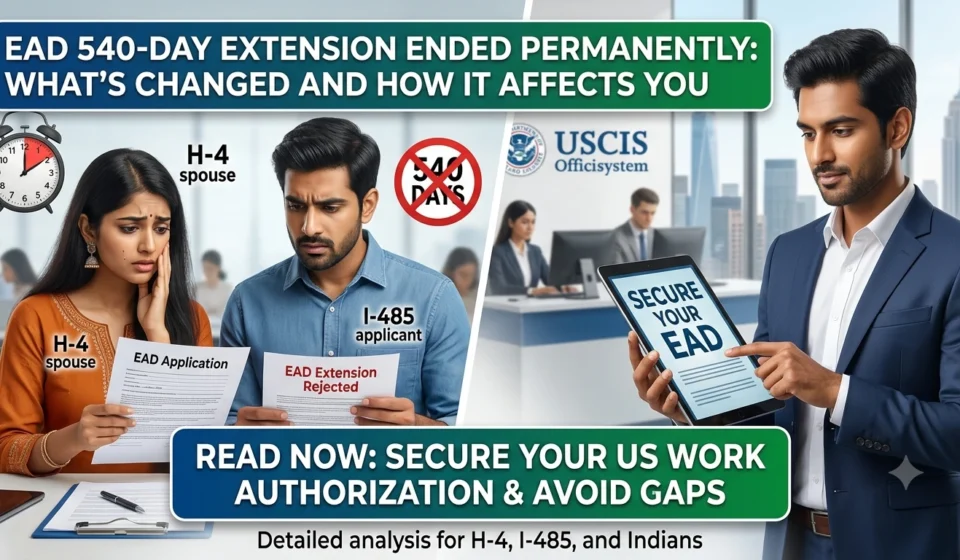

For years, filing your work permit (EAD) renewal on time meant you could keep working while USCIS took its time. That safety net is gone.
Under the new rule, anyone who files a timely EAD renewal on or after October 30, 2025 gets no automatic extension of employment authorization. If the renewal is approved, work authorization resumes on the start date of the new EAD.
The rule is no longer a temporary measure. DHS has now finalized it, adopting the 2025 interim rule without change, with publication in the Federal Register scheduled for October 14, 2026.
If your card expires before the new one arrives, you may have to stop working. That affects paychecks, health insurance and mortgages.
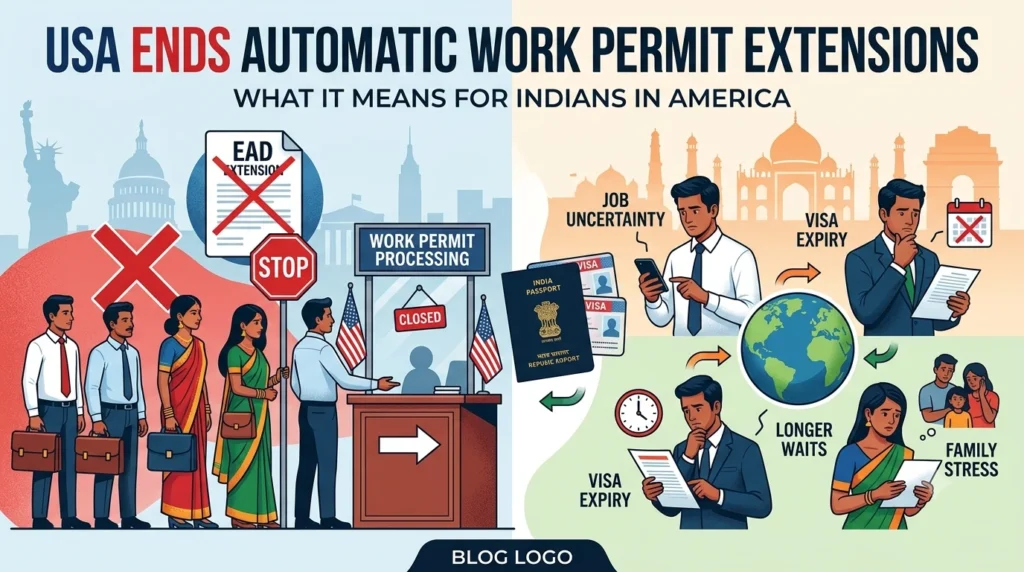
Key Takeaways on USA Ending Automatic Work Permit Extension
- What ended: The automatic extension of up to 540 days for timely-filed EAD renewals.
- Who is affected: Most people who need a new EAD card, including H-4 spouses, green card (I-485) applicants and certain asylum applicants.
- Who is not affected: People whose work authorization comes with their status, such as those whose status is valid, can keep working even if their EAD has expired. Renewals filed before October 30, 2025 keep the extension they already qualified for.
- Biggest risk: A gap between the old card’s expiry and the new card’s approval.
- Best defense: File as early as the rules allow, which is 180 days before expiry, and track dates obsessively.
What Is an EAD, and What Was the “Automatic Work Permit Extension”?
An Employment Authorization Document (EAD), also called a work permit, is the card (Form I-766) that proves you can legally work in the US. Many people need one separately from their visa:
- H-4 spouses of H-1B holders (the H-4 EAD)
- Green card applicants with a pending I-485 (the “combo card”)
- Asylum applicants
- L-2 and E spouses in some situations
- F-1 students on OPT (a different rule set, covered below)
Because USCIS processing is slow, DHS introduced the automatic extension so nobody lost a job over agency delays. The extension started in January 2017 at up to 180 days for certain categories. It was later expanded to 540 days to stabilize employment during prolonged backlogs.
Think of it as a grace period. You filed on time, so you kept working while USCIS caught up. The grace period no longer exists.
You May Also Like To Read About:
- US Suspends Infosys, TCS, Wipro & HCL From PERM: What It Means for Indian IT Workers and Green Cards
What Exactly Changed?
| Before October 30, 2025 | Now | |
|---|---|---|
| Timely renewal filed | Work allowed for up to 540 days after card expiry | No automatic extension |
| Work authorization resumes | Continued automatically | Only when the new EAD is approved |
| Employer’s role | Check receipt notice and category | Must see a new card or other valid authorization on the expiry date |
DHS’s stated reason is security. USCIS argued that an automatic extension grants the benefit without an eligibility determination, without completing vetting and screening checks, and without resolving derogatory information. In its press release, DHS said that reviewing a person’s background more often helps deter fraud and detect people with potentially harmful intent.
Important carve-out: Applications filed before October 30, 2025 still receive the automatic extension.
Why Indians Are Hit Harder Than Most
Three features of the Indian immigrant experience make this rule especially painful.
1. The green card backlog
Indian-born applicants in employment-based categories wait the longest, often many years, for green cards. That keeps them on EAD cards for long stretches. Each renewal cycle is now a possible work gap.
2. H-4 spouses
Many Indian families rely on the H-4 EAD to run on two incomes. Under the old rule, a timely renewal kept H-4 spouses working for up to 540 days past card expiry. Now the burden of avoiding a gap falls entirely on their calendar.
Processing times are the real danger. Standalone H-4 EAD applications took roughly 6 to 15.5 months depending on the service center as of July 2026. Because you can only file 180 days (about six months) before expiry, a slow service center can leave you without a card for months.
3. The backlog itself is huge
As of June 30, 2026, USCIS reported more than 432,000 pending EAD renewals that had been pending for at least six months, including over 91,000 pending for more than 18 months. A rule that depends on fast processing, applied to a system that isn’t fast, produces gaps.
Real-life scenario
Priya is an H-4 EAD holder in Texas. Her card expires on March 1. She files the renewal on the earliest allowed day, about September 2. Her service center takes 8 months. Under the old rule she’d have kept working. Under the new rule, she is off payroll from March 1 until the approval arrives in May, even though she did everything right.
Who Is Not Affected (Or Affected Differently)?
Status-based work authorization. Foreign nationals whose employment authorization is incident to their status continue to have work authorization while their status is valid, even if the EAD itself has expired. For example, E and L spouses can work with an I-94 annotated E-2S or L-2S, even without an EAD.
H-1B holders. Your work authorization comes from your approved petition, not an EAD. This rule doesn’t directly touch you. It does hit your H-4 spouse and any green card EAD you hold on the side.
F-1 OPT / STEM OPT students. These continue to benefit from separate rules, including the 180-day automatic STEM extension. Don’t assume this means no risk, though. Confirm your exact category with your school’s DSO.
Anyone who filed before October 30, 2025. You keep the extension you qualified for. One caution applies to TPS-based renewals. USCIS has interpreted certain earlier filings as getting an “up-to-540-day” extension rather than a guaranteed full 540 days.
Is There a Court Fight? Can It Be Reversed?
Yes, there is litigation, but no nationwide relief yet.
- On January 8, 2026, a group of H-4 visa holders sued in federal court, arguing the rule broke proper administrative procedure and asking the court to restore the automatic extension.
- At least one more suit followed in April 2026 in Washington, D.C., and a tracker lists three pending challenges with no nationwide order restoring the extension.
- In September 2026, a California federal court issued a limited injunction that blocks enforcement of the interim rule only against the plaintiffs in that case.
Bottom line: Unless you are a named plaintiff, don’t plan your finances around a lawsuit. As one immigration firm put it, if litigation restores the extension, that’s wonderful, but no family should plan its income around it.
Is the H-4 EAD itself being cancelled? A tracker notes the program is still active and no rule to rescind it has been published. Other commentary says a rescission proposal is reportedly under federal review. Treat that as a watch item, not a done deal.
7 Practical Steps to Protect Your Work Authorization
- Set a calendar alert at 210 days before expiry. That gives you a month to gather documents before the 180-day filing window opens.
- File on the first eligible day. USCIS recommends filing up to 180 days before your current EAD expires.
- Use premium processing where it exists. For an additional $1,500, USCIS promises a decision within 30 business days. It is not available in every category, and standalone H-4 EAD filings generally don’t qualify. H-4 spouses can often file the EAD together with the H-1B spouse’s premium-processed extension, which is usually much faster.
- Check whether you can work on another basis. An I-94, a valid status, or another pending approval may keep you authorized.
- Build a 3-to-6 month cash buffer if your household depends on an EAD-linked income.
- Talk to HR early. Employers must now watch expiry dates and need a new card or another source of work authorization by the expiration date. Raising it early lets them plan for leave or contracts.
- Know your escalation options. If your case runs long, an attorney can advise on case inquiries, congressional help and, in some cases, a delay lawsuit.
What This Means for US Employers and Indian Professionals Planning Careers
For employers, the rule means more I-9 monitoring and potential workforce disruptions. Employers may face temporary disruptions, more employee leave and added I-9 compliance obligations.
For individuals planning moves, consider:
- Timing a job change so it doesn’t coincide with an EAD renewal.
- Pursuing H-1B or other status-based work routes where eligible, since they don’t depend on a renewing card.
- Watching shorter card validity. Reports say USCIS has also cut the maximum EAD validity from five years to 18 months for certain categories, including adjustment applicants, which means more frequent renewals and more exposure to gaps. Check your own category’s validity.
Frequently Asked Questions (FAQ)
What is the automatic extension of EAD?
It was a rule that let people with a timely-filed EAD renewal keep working for up to 540 days after their card expired while USCIS processed the application. For renewals filed on or after October 30, 2025, it no longer applies.
When did the automatic EAD extension end?
For renewal applications filed on or after October 30, 2025. The government has now finalized the change, with Federal Register publication scheduled for October 14, 2026.
Does this affect H-4 EAD holders?
Yes. H-4 spouses who file a renewal on or after October 30, 2025 must stop working when the card expires unless the new card has been approved.
I filed my EAD renewal before October 30, 2025. Am I safe?
Generally you keep the extension you qualified for under the old rule. Check your receipt notice and consult an attorney, especially for TPS-based filings, where USCIS has issued tricky guidance.
Can I keep working if my EAD expires while my renewal is pending?
Not on the strength of the pending renewal alone. You can keep working only if you have another basis for authorization, such as status-based work authorization or an I-94 that allows it.
How early can I file my EAD renewal?
Up to 180 days before the current card expires.
Does this affect H-1B workers?
Not directly. H-1B work authorization comes from the approved petition and status, not from an EAD. It affects H-1B families through H-4 spouses and any green card EAD.
What about F-1 OPT and STEM OPT students?
They are governed by separate rules, including a 180-day STEM extension that continues. Confirm your details with your school’s DSO.
Can I pay for faster processing?
Sometimes. Premium processing is available in certain categories for $1,500, with a decision promised in 30 business days. It generally isn’t available for standalone H-4 EAD filings.
Is the H-4 EAD being cancelled?
No rule cancelling it has been published. Some reports say a possible rescission is under federal review. Watch official USCIS and Federal Register announcements.
Can the lawsuits bring the automatic extension back?
Possibly, but no nationwide order has done so yet. The California injunction protects only the named plaintiffs.
What happens to my employer if my card expires?
They generally cannot let you continue working without valid, documented authorization. This is why early communication with HR matters.
Final Thoughts
The end of the automatic EAD extension turns a paperwork formality into a financial planning problem. The rule hits hardest where the Indian community is most concentrated: long green card queues and dual-income H-4 households. The system won’t protect you from delays, so your calendar has to.
Your action list today: check your card’s expiry date, set the 210-day reminder, ask your attorney whether premium processing applies, and keep an emergency fund.
About This Article
- Sources: Federal Register notices, USCIS announcements, and published analyses from immigration law firms and HR bodies.
- Last fact-checked: October 14, 2026.
- Author and reviewer: [Add author name, bio and credentials here. Ideally have a licensed US immigration attorney review the piece before publishing.]
- Editorial policy: We update this article as rules and court decisions change.
Disclaimer
This article is for general informational and educational purposes only and does not constitute legal, immigration, tax or financial advice. Immigration rules, court orders and processing times change often, and your situation depends on your category, filing dates and status. The author is not a lawyer. Always consult a licensed US immigration attorney or your employer’s immigration counsel before making decisions about your work authorization. We are not affiliated with USCIS, DHS or any government agency. Fees and timelines mentioned are as reported at the time of writing.

Shuchi founded Finance Checks after spending 16+ years working in corporate, managing operations and distribution. She managed her own finances, learned and read regularly and helped people make sense of their savings, loans, insurance, and investments.
She started this site to offer the kind of clear, honest financial guidance she wished was more available when she was learning to manage her own money. Every article is researched personally, checked against official sources such as the Reserve Bank of India, SEBI, or the Income Tax Department, and revisited whenever regulations or figures change. She is upfront about how the site earns money through ads and select affiliate partnerships, and she does not let either influence what she actually recommends to readers.