

Top 10 Government Schemes for Senior Citizens in India (2026 Guide)

By Shuchi, FinanceChecks.com | Published 22 October 2026 | Category: Personal Finance & Government Schemes | Reading time: about 13 minutes
Mohan Lal, 68, retired from a clerk’s job in Kanpur four years ago. He has ₹14 lakh sitting in a savings account earning 4 percent, and he is quite proud of keeping it “safe”. Last winter his wife was admitted to hospital for a heart procedure, and the family paid the bill from that very account. Nobody in the family had told him that an Ayushman Vay Vandana card, free to anyone aged 70 and above, would cover up to ₹5 lakh a year for people like him in the next two years. Nobody had told him either that the post office would have paid him more than double his bank’s interest on the same money.
Mohan Lal is not careless. He is typical. Many retired Indians lose money every year, not because they invest badly, but because they never hear about what the government already offers them. Some schemes are well known, like the Senior Citizens’ Savings Scheme. Others are quiet, like the helpline that rescues elders from abuse, or the legal right to claim maintenance from children.
This guide covers ten schemes and benefits for senior citizens that are open as of October 2026, with current numbers, who can apply, where to apply, and the mistakes to avoid. I have also flagged one famous scheme that has closed, because many people still go looking for it.
Quick Answer
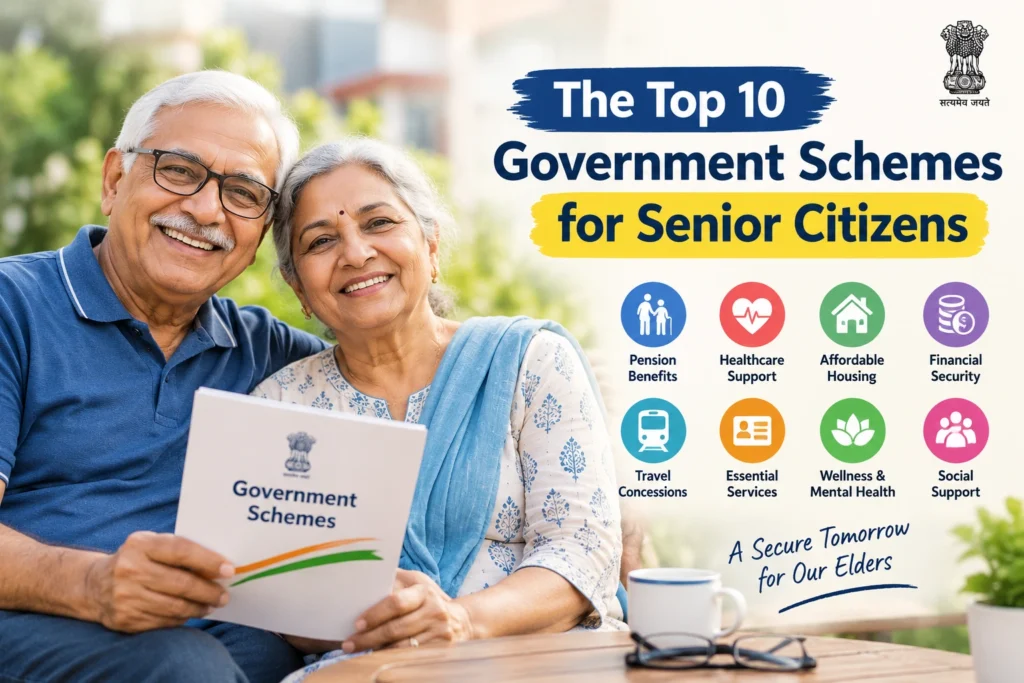
The most useful government schemes for senior citizens in India are the Senior Citizens’ Savings Scheme (8.2 percent a year for October to December 2026, up to ₹30 lakh), the Ayushman Vay Vandana card (free health cover up to ₹5 lakh a year for everyone aged 70 and above), the Indira Gandhi National Old Age Pension for people in below-poverty-line households, the Post Office Monthly Income Scheme (7.4 percent, open to all), income tax relief for seniors, the Rashtriya Vayoshri Yojana for free assistive devices, the Elderline helpline 14567, the Maintenance and Welfare of Parents and Senior Citizens Act, doorstep banking with the Jeevan Pramaan digital life certificate, and the National Pension System for those who can still join. The Pradhan Mantri Vaya Vandana Yojana is closed to new buyers.
About This Guide
This article is written by the editorial desk of FinanceChecks.com, an independent Indian personal finance publication, for senior citizens, their children and caregivers. Interest rates and scheme details were checked against Ministry of Finance announcements for the October to December 2026 quarter, National Health Authority and parliamentary replies on the Ayushman Vay Vandana card, Ministry of Rural Development and Ministry of Social Justice and Empowerment descriptions of pension and welfare schemes, and widely reported tax rules for FY 2026-27. Government schemes change often, and states add their own benefits, so use this guide as a map and confirm final details with the post office, bank or the relevant department before you apply. This is general information and not personal financial advice.
At a Glance
| Scheme or benefit | Who can use it | Main benefit | Where to apply |
|---|---|---|---|
| Senior Citizens’ Savings Scheme (SCSS) | Age 60 and above (with some exceptions for retirees) | 8.2 percent a year, paid quarterly, up to ₹30 lakh | Post office, authorised banks |
| Ayushman Vay Vandana card | Age 70 and above, no income test | Cashless cover up to ₹5 lakh a year per family | Ayushman app, beneficiary portal, Common Service Centres |
| Indira Gandhi National Old Age Pension | Age 60 and above, BPL households | Monthly central pension plus state top-up | Local social welfare office or panchayat |
| Post Office Monthly Income Scheme | Any adult | 7.4 percent a year, paid monthly | Post office |
| Tax relief for seniors | Age 60 and above | Higher TDS threshold, higher exemption in old regime | Bank, income tax filing |
| Rashtriya Vayoshri Yojana | Age 60 and above, BPL or low income, with age-related disability | Free assistive devices | Camps by district authorities |
| Elderline 14567 | All senior citizens | Free guidance, support and help in abuse cases | Phone helpline |
| Maintenance and Welfare of Parents and Senior Citizens Act | Parents and senior citizens | Legal claim for maintenance, protection of property | Maintenance Tribunal |
| Doorstep banking and Jeevan Pramaan | Mostly 70 and above, pensioners | Banking at home, digital life certificate | Bank, Jeevan Pramaan app or post office |
| National Pension System (NPS) | Adults up to age 70 | Market-linked pension savings | Banks, points of presence, online |
The Top 10 Government Schemes for Senior Citizens
1. Senior Citizens’ Savings Scheme (SCSS)
If I could recommend only one scheme for a retiree who wants steady income, it would be this one. SCSS is a government-backed savings scheme sold through post offices and authorised banks. For deposits made from 1 October to 31 December 2026, it pays 8.2 percent a year, a rate the government has kept unchanged for many quarters in a row. Interest is paid every quarter, which works out to ₹2,050 a quarter on every ₹1 lakh invested.
The scheme is open to those aged 60 and above, with some relaxations for retired civil and defence employees. The maximum deposit is ₹30 lakh. The tenure is five years, with an option to extend. Interest is taxable, and a deposit may qualify for a deduction under the old tax regime. The rate that applies on the day you open the account stays for the full tenure, so a higher rate today is locked in even if the government lowers the rate later.
What this means in rupees: ₹30 lakh in SCSS pays about ₹61,500 each quarter, or roughly ₹20,500 a month, before tax.
Who should be careful: because the principal is locked for five years with a penalty for early closure, do not put in money you may need for emergencies. Also check with the post office how deposits in joint accounts with a spouse count towards the limit.
2. Ayushman Vay Vandana card (health cover for 70 and above)
This is the most valuable benefit on the list for many families, and still the least claimed. Launched in October 2024 under Ayushman Bharat PM-JAY, it gives every Indian citizen aged 70 and above cashless treatment of up to ₹5 lakh a year at empanelled hospitals, whatever the person’s income. There is no upper age limit.
The cover works on a family basis. If the family is already covered by PM-JAY, members aged 70 and above receive an additional ₹5 lakh top-up that is reserved for them. Enrolment is free and uses Aadhaar-based e-KYC, through the Ayushman app, the National Health Authority beneficiary portal or a Common Service Centre. A helpline, 1800-110-770, was listed in a parliamentary reply for queries about the card.
Two points to check. People covered by CGHS, ECHS or Ayushman CAPF must choose between that scheme and the Vay Vandana card, as they cannot hold both. Those with only a private mediclaim policy or ESIC can add the card on top of their existing cover. Cover has conditions, and hospitals must be on the empanelled list, so confirm before admission.
3. Indira Gandhi National Old Age Pension (central pension scheme)
Part of the National Social Assistance Programme, this scheme gives a monthly pension to senior citizens from below-poverty-line households. The central contribution is ₹200 a month for ages 60 to 79 and ₹500 a month from age 80. States are encouraged to add their own amount, and many do, so what a person actually receives varies widely by state.
The central amount has barely changed in years and is small, so think of this as a safety net, not an income plan. Application is usually through the local panchayat, municipal office or district social welfare office, with proof of age, address and BPL status. Be aware that a source I consulted reports this scheme was renamed Pradhan Mantri Vridhavastha Pension Yojana in October 2026, with benefits unchanged. Check the name your state uses when you apply.
4. Post Office Monthly Income Scheme (MIS)
This is open to every adult, not only seniors, but it suits retirees who want a monthly credit. For October to December 2026 the rate is 7.4 percent a year, paid monthly. The investment limit is ₹9 lakh for a single account and ₹15 lakh for a joint account, with a five-year term.
On ₹9 lakh, the interest comes to about ₹5,550 a month before tax. Combined with SCSS, a retired person with ₹39 lakh could receive roughly ₹26,000 a month in interest (₹20,500 from SCSS and ₹5,550 from MIS), before tax. That is a rough illustration, not a recommendation, and it assumes all the money sits in fixed-rate schemes. Remember that fixed income loses buying power over the years as prices rise, so many retirees keep a portion of their money in assets that can grow.
5. Income tax relief for senior citizens
Tax rules for seniors are friendlier than for most people, though the details depend on the regime you choose. The key points for FY 2026-27 are these.
Banks are not required to deduct TDS on interest income from a senior citizen until it crosses ₹1 lakh in a year, double the ₹50,000 limit for others. Since 1 April 2026 the Income-tax Act, 2025 applies, and the TDS provision on interest has moved to a new section number, so forms and references may look different from earlier years. For those who owe no tax, a declaration form lets you avoid TDS altogether, and the new act has changed the form’s name, so ask your bank which form they now require.
Under the old regime, the basic exemption limit is ₹3 lakh for ages 60 to 79 and ₹5 lakh from age 80, and seniors can claim a deduction on interest income from deposits and a higher limit on health insurance premiums. Under the new regime, the slabs are the same for all ages, there is no age-based higher limit, and a standard deduction on pension is available. Which regime is better depends on your income and deductions, so compare both before you file.
6. Rashtriya Vayoshri Yojana (free assistive devices)
Run by the Ministry of Social Justice and Empowerment, this scheme gives free assisted-living devices such as walking sticks, wheelchairs, hearing aids, spectacles and dentures to senior citizens who suffer from age-related disabilities. It is meant for those from below-poverty-line families or those with monthly income up to ₹15,000.
Devices are usually distributed at camps organised by district authorities, with assessment on site. Ask at your district social welfare office or the Ministry’s website for upcoming camps. Since there is no cost to the beneficiary, anyone asking for payment is a warning sign.
7. Elderline: the national helpline 14567
Elderline is a toll-free national helpline for senior citizens under the Ministry of Social Justice and Empowerment, offering information, guidance, emotional support and help with abuse and rescue cases. It runs under the Atal Vayo Abhyuday Yojana, which also gives grants to NGOs that run old age homes and continuous care homes.
Dial 14567 if an elder is being neglected, harassed or cheated, or simply needs guidance on pensions and benefits. Save the number on the phone of every senior in your family. In a crisis, people rarely remember numbers.
8. The Maintenance and Welfare of Parents and Senior Citizens Act, 2007
This is a law, not a scheme, but it may be the most powerful protection a senior has. Parents and senior citizens who cannot maintain themselves can apply to a Maintenance Tribunal for monthly maintenance from their children or, in some cases, relatives who will inherit their property. The Act asks tribunals to decide quickly, generally within 90 days, and you do not need a lawyer to file.
The Act also lets a senior citizen who has transferred property to children on the condition of care approach the tribunal to cancel the transfer if the children fail to provide basic needs. Many seniors sign over property trustingly and then regret it, so this provision matters. Rules, maximum amounts and procedures vary by state, so ask your district administration or the local sub-divisional magistrate’s office.
9. Doorstep banking and the Jeevan Pramaan digital life certificate
Public sector banks offer doorstep banking for senior citizens aged 70 and above and for persons with disabilities, covering services such as cash pick-up and delivery, cheque pick-up and life certificate submission. A small fee usually applies, and availability depends on your branch, so check with your bank.
Pensioners can submit their annual life certificate digitally through Jeevan Pramaan, using a smartphone app, biometric device or a visit by a postman or bank staff, instead of travelling to the bank. Central government pensioners usually submit the certificate in November, with those aged 80 and above often allowed from 1 October. It is that time of year now, so check the deadline for your pension, because a missed certificate can stop the pension.
10. National Pension System (NPS) for late starters
NPS is a market-linked pension system regulated by PFRDA. Adults can join up to age 70, and may continue investing up to age 75, so even someone in their early sixties who has leftover savings can use it. A part of the money must usually be used to buy an annuity at exit, and returns are not guaranteed.
NPS is not for everyone. A senior who needs guaranteed monthly income is better served by SCSS or MIS. But a healthy 62-year-old with a long horizon and spare savings may want a slice in a market-linked product, partly as protection against inflation. Read the current exit and annuity rules before you decide.
A Closed Scheme You May Still See Advertised: PMVVY
The Pradhan Mantri Vaya Vandana Yojana, a pension scheme run by LIC with a 7.4 percent assured return, stopped accepting new enrolments on 31 March 2023. People who already hold a policy continue to get their pension for the full 10-year term. If an agent or website offers you a “new PMVVY policy” today, treat it as a red flag. Senior citizens looking for similar income can look at SCSS or LIC and other annuity plans, after comparing the returns.
A Simple Age-Wise Checklist
Here is a quick way to see where you stand. Tick the boxes that apply.
For anyone 60 and above: check whether you qualify for SCSS and MIS, make sure your bank has your senior citizen status for higher FD interest and the TDS threshold, and save Elderline 14567.
For anyone 70 and above: enrol for the Ayushman Vay Vandana card, ask your bank about doorstep banking, and set up the Jeevan Pramaan certificate if you draw a pension.
For anyone 80 and above: confirm that the higher central pension of ₹500 is being paid if you are eligible, and check the old regime’s ₹5 lakh exemption limit when filing taxes.
For those in low-income households: ask about the old age pension, Rashtriya Vayoshri Yojana camps and any state scheme.
Common Mistakes to Avoid
The mistakes I see most often are keeping large sums in a savings account at 3 to 4 percent while SCSS pays 8.2, putting all savings in one scheme with a five-year lock-in, never enrolling in the Ayushman card because “we have a private policy”, signing over property to children without a written understanding, and missing the annual life certificate deadline for a pension.
The costliest mistake is falling for a scam. Fraudsters target seniors with calls that promise a new government pension scheme for a registration fee, or an Ayushman card for a small payment, or a KYC update link. Government enrolment for these schemes is free. Never share an OTP, PIN or Aadhaar details with a caller, and apply only through the post office, the bank or official portals. After the recent bank data leak reports, copying your details into a scammer’s script has become easier, so be even more careful.
My Take
I have spoken to many retirees over the years, and the pattern is the same: they are careful with money and careless with information. A scheme that pays 8.2 percent is not hard to understand. The problem is that nobody sits down with a senior and explains it.
If you are the child of a retired parent, the most useful thing you can do this week is not to buy them a gift. It is to sit with them for an hour, check their Aadhaar-linked mobile number, enrol them for the health card, review where their savings sit, and save Elderline on their phone. If you are a senior yourself, ask for help without embarrassment. These schemes exist for you, and claiming them is not a favour.
I would also say this plainly: do not chase the highest rate at the cost of safety. Government-backed schemes are valuable precisely because they are boring.
Frequently Asked Questions
1. What is the best government scheme for senior citizens in India? For steady income, the Senior Citizens’ Savings Scheme is widely considered the strongest option, with 8.2 percent a year for October to December 2026 and a ₹30 lakh limit. For health protection, the Ayushman Vay Vandana card is the most valuable for people aged 70 and above. The best choice depends on your needs and age.
2. What is the current SCSS interest rate? The Ministry of Finance has kept the SCSS rate at 8.2 percent a year for the October to December 2026 quarter. Rates are reviewed every quarter, but the rate applicable when you open the account stays for the full tenure.
3. Who is eligible for the Ayushman Vay Vandana card? Every Indian citizen aged 70 years or above is eligible, regardless of income. Enrolment uses Aadhaar e-KYC and is free. People covered by CGHS, ECHS or Ayushman CAPF must choose one scheme.
4. How much health cover does the Ayushman Vay Vandana card give? It provides up to ₹5 lakh per family per year for cashless treatment at empanelled hospitals. Families already covered by PM-JAY get an additional top-up for members aged 70 and above.
5. How much old age pension does the central government give? Under the Indira Gandhi National Old Age Pension scheme, the central assistance is ₹200 a month for those aged 60 to 79 and ₹500 a month for those aged 80 and above, for people in below-poverty-line households. States may add a top-up, so the amount you receive varies by state.
6. Is the Pradhan Mantri Vaya Vandana Yojana still available? No. PMVVY closed for new enrolments on 31 March 2023. Existing policyholders continue to receive their pension for the policy term.
7. Do senior citizens pay tax on interest income? Interest is generally taxable as part of your income. However, banks do not deduct TDS on interest until it crosses ₹1 lakh a year for seniors, and those whose total income is below the taxable limit can submit the prescribed declaration to avoid TDS.
8. What is the Elderline helpline number? Elderline is 14567, a toll-free national helpline for senior citizens that offers information, guidance, emotional support and help in cases of abuse.
9. Can a senior citizen claim maintenance from their children? Yes. Under the Maintenance and Welfare of Parents and Senior Citizens Act, 2007, parents and senior citizens who cannot maintain themselves can apply to a Maintenance Tribunal. You usually do not need a lawyer, and the Act expects a decision within about 90 days.
10. When should pensioners submit their life certificate? Central government pensioners usually submit it in November each year, and those aged 80 and above are often allowed from 1 October. Jeevan Pramaan lets you submit it digitally. Check the deadline for your own pension, since a missed certificate can stop payments.
Disclaimer
This article is for general information and education only. It is not financial, legal or tax advice. Interest rates, limits, eligibility and procedures change, and states may offer different benefits, so confirm details with the post office, your bank or the relevant government department before you invest or apply. Investments are subject to the terms of each scheme, and market-linked products such as NPS carry risk.

Shuchi founded Finance Checks after spending 16+ years working in corporate, managing operations and distribution. She managed her own finances, learned and read regularly and helped people make sense of their savings, loans, insurance, and investments.
She started this site to offer the kind of clear, honest financial guidance she wished was more available when she was learning to manage her own money. Every article is researched personally, checked against official sources such as the Reserve Bank of India, SEBI, or the Income Tax Department, and revisited whenever regulations or figures change. She is upfront about how the site earns money through ads and select affiliate partnerships, and she does not let either influence what she actually recommends to readers.