
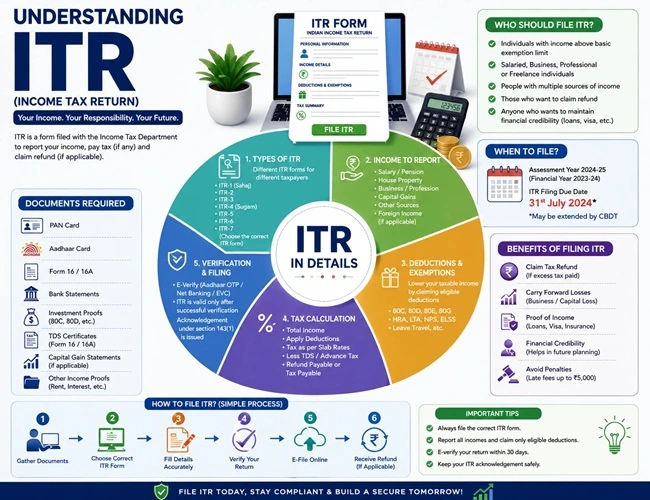
Your First Salary, Your First ITR: A No-Nonsense Guide to Income Tax, Sections, and Smart Tax-Saving in 2026

You got your first salary slip, did the happy dance, and then saw a line called TDS quietly eating into your number. A few months later someone in the office WhatsApp group says “bro have you filed your ITR yet” and you nod along while having absolutely no idea what they mean.
If that sounds familiar, you are exactly who this guide is for.
We are going to break down income tax filing, the income tax slabs for this year, the famous “sections” everyone keeps mentioning at office lunch tables, and where you can actually put your money so you legally pay less tax. No jargon left unexplained, no scary chartered-accountant language. Just plain talk, real numbers, and a few stories you will probably relate to.
Grab your coffee. By the end of this, you will know more about your own taxes than most people twice your age.
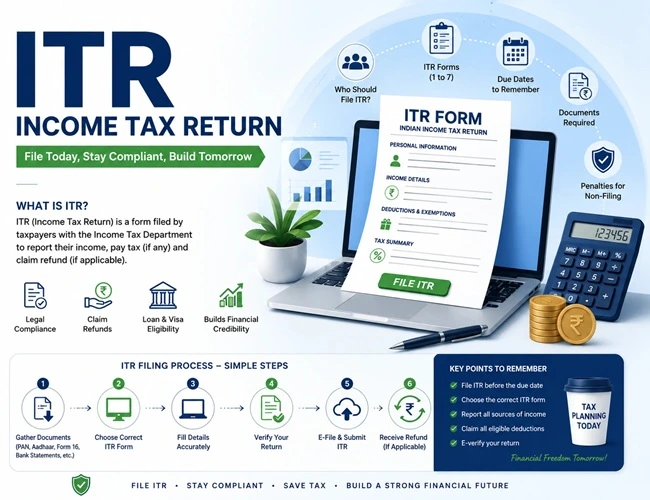
First Things First: What Even Is an ITR?
ITR stands for Income Tax Return. Think of it as a yearly report card you submit to the Income Tax Department, telling them exactly how much you earned, from where, how much tax was already cut from your salary (that is your TDS), how much you invested to save tax, and whether you owe the government more money or the government owes you a refund.
A lot of freshers assume that since their company already deducts TDS every month, they do not need to file a return. This is one of the most expensive myths in personal finance. TDS is just an advance estimate. Filing the ITR is how you formally close the loop, claim deductions you may not have submitted proof for to your HR, and get back any extra tax you paid. It is also the document that visa officers, loan officers, and credit card companies ask for when you want to prove your income.
Also worth knowing: the financial year (FY) is when you earn the money, and the assessment year (AY) is the year you file the return for that income. So income earned between April 2025 and March 2026 falls under FY 2025-26, and you file the return for it in AY 2026-27. This is the filing season most of you are dealing with right now, in the middle of 2026.
One more thing before we move on. From the 1st of April 2026, India has rolled out a brand new Income Tax Act, 2025, replacing the six-decade-old Income Tax Act of 1961. The good news is that for the return you are filing right now, for income earned in FY 2025-26, the old 1961 Act and its familiar section numbers like 80C and 80D still apply in full. The new Act only kicks in for income earned from April 2026 onward, which you will file next year. The limits and benefits are staying the same, only the section numbers are being renamed under the new law. So nothing you read below becomes useless next year, you might just see a new section number attached to the same old benefit.
Old Regime vs New Regime: The Decision That Decides Everything
Before you can talk about tax slabs, you need to understand that India currently gives you a choice between two tax systems.
The new tax regime has lower slab rates but lets you claim almost no deductions. It is the default option, meaning if you do not actively choose otherwise, this is what applies to you.
The old tax regime has higher slab rates but allows a long list of deductions and exemptions, things like your house rent allowance, your insurance premiums, your provident fund contributions, and your home loan interest.
You are allowed to switch between the two every year when you file your return, as long as you do not have business income (salaried folks get this flexibility every single year, no questions asked).
New Tax Regime Slabs for FY 2025-26 (AY 2026-27)
| Annual Income | Tax Rate |
|---|---|
| Up to Rs 4,00,000 | Nil |
| Rs 4,00,001 to Rs 8,00,000 | 5% |
| Rs 8,00,001 to Rs 12,00,000 | 10% |
| Rs 12,00,001 to Rs 16,00,000 | 15% |
| Rs 16,00,001 to Rs 20,00,000 | 20% |
| Rs 20,00,001 to Rs 24,00,000 | 25% |
| Above Rs 24,00,000 | 30% |
Under this regime, salaried employees get a flat standard deduction of Rs 75,000 straight off their gross salary, no investment or proof required.
Here is the part that genuinely changes the game for most young earners. There is a rebate under Section 87A that fully wipes out your tax if your taxable income (after the standard deduction) does not cross Rs 12,00,000. This rebate can go up to Rs 60,000. Put together with the standard deduction, this effectively means a salaried person earning up to roughly Rs 12,75,000 a year pays zero income tax under the new regime. Zero. Not a low amount, actually zero.
Old Tax Regime Slabs for FY 2025-26 (AY 2026-27)
| Annual Income | Tax Rate |
|---|---|
| Up to Rs 2,50,000 | Nil |
| Rs 2,50,001 to Rs 5,00,000 | 5% |
| Rs 5,00,001 to Rs 10,00,000 | 20% |
| Above Rs 10,00,000 | 30% |
The standard deduction here is Rs 50,000, and the Section 87A rebate only applies if your taxable income stays under Rs 5,00,000, capped at Rs 12,500.
On top of the slab tax, everyone pays a 4% Health and Education Cess on the total tax amount, in both regimes. High earners crossing Rs 50 lakh, Rs 1 crore, and Rs 2 crore also attract additional surcharge, but if you have just joined corporate life, that is a future-you problem, not a today problem.
To get the regular updates on Income Tax and Tax Planning , Subscibe to Financechecks.com
So Which One Should You Actually Pick?
Here is the honest, unglamorous truth that most blogs will not tell you straight: for the vast majority of people earning under roughly Rs 12 to 13 lakh a year, the new regime wins by a mile, simply because of that Rs 12 lakh rebate cliff.
Let’s actually run the numbers so this is not just a claim.
Say your gross salary is Rs 10,00,000. Under the new regime, after the Rs 75,000 standard deduction, your taxable income is Rs 9,25,000. Tax works out to roughly Rs 32,500, but since this is under the Rs 12 lakh threshold, the entire amount gets wiped out by the Section 87A rebate. Your final tax bill: zero.
Now suppose you went with the old regime instead, and you were disciplined enough to invest the full Rs 1,50,000 under Section 80C, claimed Rs 25,000 for health insurance, and put another Rs 50,000 into NPS. After the Rs 50,000 standard deduction and these deductions, your taxable income drops to Rs 7,25,000. Tax on that comes to around Rs 59,800 after cess. Even with all that effort and all that money locked away in investments, you would still be paying close to Rs 60,000 more than someone who simply chose the new regime and did nothing at all.
This is exactly why a huge number of salaried Indians, especially those early in their careers, are now better off with the new regime, with zero forced savings and zero paperwork.
The old regime starts pulling ahead only once your income climbs higher, typically above Rs 15 to 18 lakh, and only if you are genuinely claiming a large basket of deductions, especially a home loan interest deduction along with HRA and the usual 80C and 80D investments. If you are renting a house in a metro and paying a big chunk of it as rent, or you have taken a home loan, do the maths both ways before deciding. Do not just assume the new regime is always better, run your specific numbers, ideally using the income tax department’s own online calculator, before locking in your choice.
Which ITR Form Is Actually Yours?
This trips up a lot of first-time filers. You do not get to “choose” a form for fun, the form depends on your income type.
- ITR-1, also called Sahaj, is for resident individuals with salary or pension income, income from up to two house properties, and other small income like savings account interest, as long as total income does not cross Rs 50 lakh. This covers most fresh corporate employees.
- ITR-2 is for individuals who have capital gains (say you sold some mutual funds or stocks), own multiple properties, have foreign income or foreign assets, or simply earn above Rs 50 lakh, but who do not have any business or professional income.
- ITR-3 is for individuals running a business or a profession where income is calculated normally, not on a presumptive basis.
- ITR-4, called Sugam, is for freelancers, consultants, and small business owners who opt for presumptive taxation, plus they can also have salary income and one house property on the side.
- ITR-5, 6, and 7 apply to firms, LLPs, companies, and trusts, which is unlikely to concern you unless you are running your own registered business.
- If you are a salaried employee who also dabbled in stock trading or mutual fund SIPs last year and booked some gains by selling, you will most likely need ITR-2, not ITR-1. This is the single most common mistake among young, market-curious professionals.
Deadlines You Genuinely Cannot Afford to Miss
For FY 2025-26 (AY 2026-27), here is the filing calendar:
- Salaried individuals and others filing ITR-1 or ITR-2, with no audit requirement: the due date is 31st July 2026.
- Business owners and professionals filing ITR-3 or ITR-4 who do not need an audit: 31st August 2026.
- Taxpayers requiring a tax audit: 31st October 2026.
- Cases involving transfer pricing reports: 30th November 2026.
If you miss your deadline, you can still file what is called a belated return until 31st December 2026, but you will pay a late fee under Section 234F, Rs 1,000 if your income is under Rs 5 lakh, and Rs 5,000 if it is above that. You will also lose the ability to carry forward certain losses, and interest starts piling up on any unpaid tax. If you spot a mistake after filing, you can file a revised return until 31st March 2027. There is also an updated return option (ITR-U) that stays open for four years from the end of the assessment year, but that comes with its own additional tax cost and is meant as a last resort, not a planning tool.
The smart move is simple: do not wait for July to end. File in May or June once your Form 16 arrives from your employer, usually by mid-June. Early filers get refunds faster and skip the portal crashes that happen every single year in the final week.
The Real Reason People Talk About “Sections”: Tax-Saving Deductions Under the Old Regime
If you decide the old regime makes sense for you, here is your toolkit. Remember, none of these apply if you pick the new regime, except where specifically mentioned.
- Section 80C is the most talked-about section in Indian personal finance, and for good reason. It lets you claim a deduction of up to Rs 1,50,000 on a combined basis across a wide range of investments and expenses. This single section covers your EPF contribution, PPF deposits, ELSS mutual funds, life insurance premiums, five-year tax-saving fixed deposits, National Savings Certificates, Sukanya Samriddhi Yojana deposits, the principal portion of your home loan EMI, and even tuition fees for up to two children. The cap is Rs 1.5 lakh total, not per investment, so spreading money across five different 80C products does not get you five separate limits.
- Section 80CCD(1B) gives you an extra Rs 50,000 deduction, over and above the 80C limit, exclusively for your own contribution to the National Pension System, Tier-I account. This is the one section every salaried person should know by heart, because it effectively raises your total deduction room to Rs 2,00,000 just by adding NPS into the mix.
- Section 80CCD(2) covers your employer’s contribution to your NPS account. This one deserves special attention because it is available in both the old regime and the new regime, which makes it one of the few deductions new-regime taxpayers still get. The percentage cap depends on your employer type and your chosen regime: government employees can have up to 14% of basic salary plus dearness allowance contributed and claimed as a deduction in either regime, while private sector employees get up to 10% under the old regime and up to 14% under the new regime. Either way, this sits completely separate from your own contribution limits. If your company offers this as part of a flexible benefits structure, it is genuinely free tax saving, ask your HR about it.
- Section 80D rewards you for having health insurance. You can claim up to Rs 25,000 for premiums paid for yourself, your spouse, and your children. If you are also paying premiums for your parents, you get an additional Rs 50,000 if they are senior citizens, or Rs 25,000 if they are not, taking your potential total to Rs 75,000 or even Rs 1,00,000 in some cases. A small amount within this limit, up to Rs 5,000, can also cover preventive health check-ups.
- Section 80E lets you deduct the entire interest paid on an education loan taken for higher studies, for yourself, your spouse, or your children, with no upper monetary cap, for a period of eight years from when you start repaying.
- Section 80G covers donations made to eligible charitable institutions and relief funds, with the deduction percentage (50% or 100% of the donated amount) depending on which organisation you donate to.
- Section 24(b) allows a deduction of up to Rs 2,00,000 on interest paid on a home loan for a self-occupied property. This is usually the single biggest deduction available to anyone who has bought a home.
- Section 80TTA gives individuals below 60 a deduction of up to Rs 10,000 on interest earned from a savings bank account. Section 80TTB is the senior citizen version of this, raising the limit to Rs 50,000 and extending it to fixed deposit interest as well.
- And of course, the House Rent Allowance exemption under Section 10(13A), for anyone living in rented accommodation, is one of the biggest tax breaks available to salaried employees, calculated based on your actual rent, your basic salary, and the city you live in.
You May Also Like:
- Tax Planning for Salaried Employees: A Complete Guide to Saving More of What You Earn (FY 2026-27)
- New HRA Rules 2026: Bengaluru, Pune, Hyderabad and Ahmedabad Finally Get the 50 Percent Exemption
Where Should You Actually Put Your Money? A Walkthrough of the Main Schemes
Knowing the sections is one thing, picking the right product is another. Here is an honest rundown of the popular options, what they actually offer right now, and who they suit best.
- Public Provident Fund (PPF) currently earns 7.1% per annum, fully tax-free at every stage, deposit, growth, and withdrawal. It comes with a 15-year lock-in, though partial withdrawals open up from the seventh year. This is about as safe as investing gets in India, backed entirely by the government. Ideal if you want a guaranteed, boring, dependable corner of your portfolio.
- Employees’ Provident Fund (EPF) is currently earning 8.25% per annum for FY 2025-26, and most of you are already contributing to this automatically through your salary. The interest is tax-free as long as you stay employed for at least five continuous years with EPF-registered employers. You do not need to do anything extra here, it is already working for you.
- Equity Linked Savings Scheme (ELSS) mutual funds are the only market-linked option under Section 80C, and they come with the shortest lock-in of the lot, just three years. Returns are not guaranteed since they are invested in the stock market, but historically ELSS funds have delivered stronger long-term returns than most other 80C options. Gains above Rs 1,25,000 in a financial year are taxed at 12.5% as long-term capital gains. This suits younger investors who can handle some volatility and do not need the money immediately.
- National Pension System (NPS) is built specifically for retirement and gives you that valuable extra Rs 50,000 deduction under 80CCD(1B). You choose your own mix of equity, corporate bonds, and government securities, and the scheme is regulated by the PFRDA. The catch is liquidity, a large chunk of your NPS corpus stays locked until you turn 60, and on retirement, part of it must compulsorily go into an annuity. Treat this as a true long-horizon retirement tool, not a short-term tax hack.
- Sukanya Samriddhi Yojana (SSY) is currently offering 8.2% per annum, the highest among small savings schemes, and is meant exclusively for a girl child below the age of 10, opened by a parent or legal guardian. It is fully tax-free at every stage too. If you have a young daughter, this is genuinely one of the best risk-free options on the table.
- National Savings Certificate (NSC) currently offers 7.7%, with a five-year lock-in, and is a solid, low-drama, government-backed fixed-income option.
- Senior Citizens Savings Scheme (SCSS) offers 8.2% with a maximum investment of Rs 30 lakh, meant for those above 60. If you are managing tax planning for your parents, this is worth knowing about even if it is not for you directly.
- Five-year tax-saving fixed deposits at banks and post offices qualify under 80C too, though unlike PPF, the interest earned on these is fully taxable, which makes them one of the least efficient 80C options if you are in a high tax bracket.
- ULIPs (Unit Linked Insurance Plans) combine life insurance with market-linked investing, and qualify under 80C as well, but they typically come with higher charges than a plain ELSS fund or term plan bought separately. Most financial planners suggest keeping insurance and investment separate rather than bundling them.
- A simple rule of thumb that financial advisors swear by: buy life insurance only if someone financially depends on you, and choose a pure term plan, not an investment-linked one, since term insurance gives you the highest cover for the lowest premium, leaving more room for actual wealth-building investments elsewhere.
How Much Should You Actually Invest to Save the Most Tax?
This is where most explainers go vague, so let’s get specific with real numbers.
If you are in the old regime and sitting in the 30% tax bracket, every rupee you shift into a deduction saves you roughly 31 paise after cess (30% plus 4% cess works out to 31.2%). So fully using the Rs 1,50,000 limit under Section 80C alone saves you close to Rs 46,800 in tax. Add the extra Rs 50,000 NPS deduction under 80CCD(1B), and you save another roughly Rs 15,600, bringing your combined 80C plus NPS tax saving to about Rs 62,400. Stack on Section 80D, say Rs 25,000 for your own health cover and Rs 50,000 for your senior citizen parents, that is another Rs 75,000 in deductions, saving roughly Rs 23,400 more.
Put together, that is Rs 2,75,000 worth of deductions through just three sections, translating into close to Rs 85,800 of actual tax saved in a year, for someone in the highest bracket. Add a home loan with Rs 2,00,000 of annual interest under Section 24(b), and you are looking at total deductions of Rs 4,75,000 and tax savings nudging close to Rs 1,48,200.
If you are in the 20% bracket instead, the same Rs 1,50,000 in Section 80C saves you about Rs 31,200, since your effective rate works out to roughly 20.8% with cess.
The honest caveat here, and it matters: none of this is worth doing just for the sake of “saving tax” if it pushes you toward investments that do not fit your actual goals, or if, after running the comparison, the new regime would have left you with a lower tax bill anyway with zero lock-in. Tax saving should always be the side benefit of good financial planning, never the main reason you pick an investment. A PPF account you are forced into purely for tax reasons, when you actually wanted liquidity, is not a smart move, no matter how attractive the deduction looks on paper.
Filing Your ITR: The Actual Steps
Once you know your numbers, the filing process itself is fairly mechanical.
Start by logging into the income tax e-filing portal using your PAN as your user ID. Download or check your Annual Information Statement (AIS) and Form 26AS, these show all the income and TDS data the department already has against your PAN, collected from your employer, banks, and other sources. Cross-check this against your own Form 16 and bank statements, mismatches here are one of the biggest reasons people get notices later.
Pick the correct ITR form based on your income type, as covered above. Choose your tax regime for the year, since salaried individuals can pick afresh every year. Fill in your income details, most of it will be pre-filled from your AIS and Form 16 data, but always verify rather than blindly trust it. Claim your deductions under Chapter VI-A if you have gone with the old regime. Let the portal compute your final tax liability, and either pay any balance tax due or note your expected refund.
Finally, submit and e-verify your return, ideally through Aadhaar OTP, since an unverified return is treated as if it was never filed at all. You get 30 days to e-verify after submission, do not let this slip.
Common Mistakes Freshers Make
- Assuming TDS deduction means you are done and do not need to file at all.
- Forgetting to report interest earned on your savings account, which is taxable income too, even if small.
- Choosing the old regime out of habit or because a senior colleague swears by it, without actually running your own numbers.
- Submitting investment proofs to HR late and then forgetting to claim those same deductions while filing the actual return, where you still legally can.
- Mixing up the financial year and assessment year while selecting the form on the portal.
- And probably the most common one of all: starting the filing process on the 30th of July.
In Closing
Filing your ITR is not some bureaucratic chore designed to confuse you, it is one of the few financial documents that genuinely puts the power back in your hands. It decides whether you get a refund or a notice, whether your loan application sails through or gets stuck, and whether your hard-earned money goes toward instruments that actually grow your wealth or just sits idle losing value to inflation.
The biggest shift in 2026 is simple: for most people starting their careers, the new tax regime with its Rs 12 lakh effective tax-free threshold has made tax planning genuinely easier. You do not need to force yourself into five different investment products just to save tax. But if you do have a home loan, dependents, or a higher income, the old regime with its deductions still has real, calculable value, you just need to run the numbers rather than guess.
Either way, the goal is the same: know your numbers, file on time, and let your investments work for your actual life goals, not just for a smaller tax bill.
Frequently Asked Questions
Do I need to file an ITR if my entire tax was already deducted as TDS? Yes. TDS being deducted does not exempt you from filing if your total income crosses the basic exemption limit. Filing is also how you claim deductions you may not have submitted proof of to your employer, and how you get any excess TDS refunded.
I am a fresher with a salary under Rs 5 lakh. Do I still need to file? If your gross total income before deductions is above the basic exemption limit for your chosen regime, yes, you should file, even if your final tax works out to zero after rebate. It also helps build a clean financial track record for future loans and visas.
Can I switch between the old and new regime every year? If you are salaried with no business income, yes, you can choose afresh every single year when filing your return. If you have business or professional income, switching back to the new regime after opting for the old one is allowed only once in your lifetime.
Which is better for someone earning around Rs 8 to 10 lakh a year, old or new regime? For most people in this range without a home loan, the new regime usually works out cheaper or equal, mainly due to the Rs 12 lakh rebate threshold. Still, run both calculations with your actual numbers before deciding, since individual deductions can shift the answer.
Is the Rs 1.5 lakh limit under Section 80C available in the new tax regime too? No. Section 80C, along with most other Chapter VI-A deductions, is available only if you choose the old tax regime. The new regime allows only a handful of benefits, mainly the standard deduction and the employer’s NPS contribution under Section 80CCD(2).
What happens if I miss the ITR filing deadline? You can still file a belated return until 31st December of the assessment year, but you will pay a late fee under Section 234F and interest on any unpaid tax, and you may lose the ability to carry forward certain losses to future years.
I sold some mutual funds or stocks last year. Can I still use ITR-1? Generally no. Capital gains from selling shares or mutual fund units typically require ITR-2, not ITR-1, even if your only other income is salary.
Is the interest earned on my savings account taxable? Yes, it is taxable as income from other sources, though Section 80TTA lets individuals below 60 claim a deduction of up to Rs 10,000 on such interest under the old regime.
Do I have to invest the full Rs 1.5 lakh under Section 80C to benefit? No, the deduction applies proportionally. Investing Rs 80,000 gets you a deduction of Rs 80,000, not the full Rs 1.5 lakh. The Rs 1.5 lakh is simply the ceiling, not a minimum requirement.
Is NPS a good idea for someone in their twenties? NPS can be a strong long-term retirement tool, especially because of the extra Rs 50,000 deduction under 80CCD(1B), but remember your money stays largely locked until age 60, with partial annuitisation required at exit. It works best as one part of a broader retirement plan, not your only investment.
Disclaimer
This article is written for general educational and informational purposes only and reflects publicly available tax rules, slab rates, and scheme details applicable around mid-2026 for Financial Year 2025-26 (Assessment Year 2026-27). Tax laws, interest rates on small savings schemes, and government policies are revised periodically and may change after this content is published. Nothing in this article constitutes professional tax, legal, investment, or financial advice, and it should not be treated as a substitute for personalised guidance from a qualified Chartered Accountant, registered tax practitioner, or SEBI-registered investment advisor. Investment products, including mutual funds and market-linked schemes mentioned here, are subject to market risks, and past returns do not guarantee future performance. Please verify current rates, limits, and rules on the official Income Tax Department website or with a qualified professional, and assess your own financial situation, before making any tax-related or investment decision.

Shuchi founded Finance Checks after spending 16+ years working in corporate, managing operations and distribution. She managed her own finances, learned and read regularly and helped people make sense of their savings, loans, insurance, and investments.
She started this site to offer the kind of clear, honest financial guidance she wished was more available when she was learning to manage her own money. Every article is researched personally, checked against official sources such as the Reserve Bank of India, SEBI, or the Income Tax Department, and revisited whenever regulations or figures change. She is upfront about how the site earns money through ads and select affiliate partnerships, and she does not let either influence what she actually recommends to readers.



-
-
-
-
-
-
Show Comments[…] Guide to Income Tax, Sections, and Smart Tax-Saving in 2026 […]
[…] ITR 2026 Update […]
[…] Income Tax Rules 2026, notified in final form by the CBDT on March 20, 2026 and effective from April 1, 2026, finally fix […]
[…] Your First Salary, Your First ITR: A No-Nonsense Guide to Income Tax, Sections, and Smart Tax-Saving… […]
[…] Your First Salary, Your First ITR: A No-Nonsense Guide to Income Tax, Sections, and Smart Tax-Saving… […]
[…] ITR Explained in Details […]