
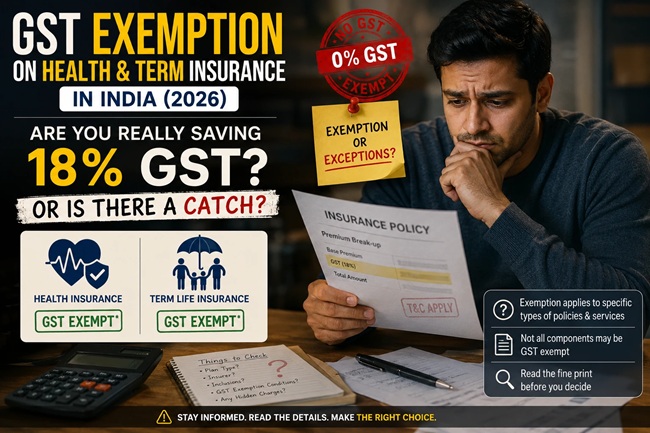
GST Exemption on Health and Term Insurance in India (2026): Did You Actually Get the Full 18% Discount?

Your health insurance renewal notice probably looks a little different this year. There’s no GST line item anymore, and the total amount due seems lower than what you paid last time. Good news, right? Mostly, yes. But here’s a fair question that almost nobody outside the tax world is asking out loud: is your premium actually 18 percent cheaper, or did the insurer adjust something else on their end to make up for it?
This isn’t a conspiracy theory. It’s a real, documented tension that’s been playing out since the GST exemption kicked in, with the government on one side saying the full benefit has been passed on, and at least one state-level complaint claiming otherwise. We’re going to walk through exactly what changed, what it should be saving you, where the genuine grey area lies, and most importantly, how you can check your own renewal notice to see whether you got the real deal or something slightly less than advertised.
GST Exemption on Health and Term Insurance in India: What Actually Changed, In Plain Terms
At the 56th GST Council meeting in September 2025, the government decided to remove GST entirely from individual life and health insurance premiums. This took effect from September 22, 2025, and it’s still the policy as of mid-2026.
Before this, every health or life insurance premium you paid had an 18 percent GST tacked on top. A ₹20,000 base premium became ₹23,600 once GST was added. After the exemption, that same ₹20,000 base premium is simply ₹20,000. No tax, no extra line item, no calculation needed.
This applies to a fairly wide set of products: individual health insurance, family floater plans, senior citizen health covers, term insurance, endowment policies, and ULIPs, as long as they’re bought by an individual rather than through an employer. It’s worth being precise about who this benefit doesn’t cover, because the gap trips people up constantly.
Who Doesn’t Get This Benefit
Group health insurance, the kind your employer provides as part of your salary package, still attracts the full 18 percent GST. So does motor insurance, home insurance, and pretty much every other general insurance product on the market. If you’re comparing your individual health plan’s renewal notice against your company-provided health cover and wondering why one shows GST and the other doesn’t, that’s the reason. It’s not an error on anyone’s part. The exemption was specifically carved out for individual retail policies, not corporate or commercial ones.
How Much Should You Actually Be Saving
Let’s run the numbers properly so you know what to expect on your own renewal.
If your base health insurance premium is ₹25,000, you should be saving ₹4,500 a year compared to what you’d have paid with GST added. At ₹50,000, that’s ₹9,000 back in your pocket. At a base premium of ₹1,00,000, which isn’t unusual for a good family floater plan with decent coverage, you’re looking at ₹18,000 saved annually, every single year you renew.
Over a 20 or 30 year term insurance policy, which is how most people structure their life cover, this adds up to a genuinely substantial amount. A ₹20,000 annual term premium that used to cost ₹23,600 with GST now saves you ₹3,600 a year, which works out to well over a lakh in total savings across a typical 30 year term, just from this one change.
These aren’t small numbers, and to the government’s credit, the broader market response backs this up. Retail health insurance premiums grew sharply in the months after the exemption kicked in, with several large insurers reporting strong year on year growth in individual health policy sales, partly attributed to people finding cover more affordable and partly to existing policyholders simply paying less to keep their current coverage running.
You May Also Like:
Here’s the Part Worth Actually Paying Attention To
GST being removed from your premium is a tax change. Whether the rupee amount on your renewal notice drops by exactly 18 percent is a separate question, and the answer isn’t quite as clean as the headline suggests.
When an insurer’s product becomes GST exempt, that insurer loses something too. They can no longer claim Input Tax Credit on the GST they pay for their own business expenses tied to selling that policy, things like agent commissions, advertising, software systems, and customer support. Before the exemption, they could offset some of that cost against the GST they collected from you. Now that there’s no GST being collected on the policy at all, that offset disappears, and the cost sits squarely with the insurer.
This has created two very different stories depending on who you ask. In a Lok Sabha reply in early 2026, the government stated that according to IRDAI, all health and life insurers had confirmed they had not revised premiums upward after the exemption, and that the full benefit had been passed on to policyholders. IRDAI had reportedly recorded the prevailing premium rates as of September 3, 2025, specifically to use as a benchmark for monitoring this.
At the same time, in that very same parliamentary exchange, a Member of Parliament alleged that insurance companies in Rajasthan and other states had quietly raised base premiums by 8 to 12 percent right after the GST removal, effectively clawing back a chunk of the benefit through the back door. That’s a serious claim, and it hasn’t been independently verified one way or the other in a way that settles the matter cleanly. Separately, independent industry trackers monitoring the market through early 2026 have noted that while most insurers appear to have held base premiums steady, some insurers may have partially adjusted base prices upward to offset their own cost increase, which sits somewhere between the two extremes of “everyone passed it on fully” and “everyone quietly hiked prices.”
So where does that leave you? With one honest, useful takeaway: don’t assume your renewal automatically reflects the full 18 percent saving just because the GST line has disappeared. Check it.
How to Actually Check If You Got the Real Benefit
This takes about five minutes and it’s worth doing once a year at renewal time.
Pull out last year’s premium receipt or policy document and look specifically at the base premium, the amount before GST was added, not the total you paid. Then look at this year’s renewal notice and find the equivalent base premium figure. If your coverage, sum insured, and policy terms are identical to last year, that base number should be roughly the same, maybe adjusted slightly for your age or standard annual premium escalation if your policy has one built in. What you’re watching for is a base premium that’s jumped well beyond what age-based escalation alone would explain, since that’s the signal that the insurer may have built the GST loss back into the base price rather than passing the saving through cleanly.
If the math doesn’t add up and your base premium has risen sharply with no clear explanation in the renewal notice, you have every right to ask your insurer directly for a breakdown. You can also raise it through IRDAI’s Integrated Grievance Management System if you don’t get a satisfactory answer, since the regulator has explicitly said it’s tracking this exact issue.
What This Means for Your Section 80D Deduction
There’s a smaller, less talked about side effect of this change worth knowing if you claim health insurance premiums under Section 80D.
The deduction is based on the actual premium you pay, up to ₹25,000 for individuals and ₹50,000 for senior citizens. Since GST no longer sits on top of your premium, the total amount you’re paying out of pocket is lower than before for the same coverage. If you were previously paying close to the cap including GST, you might now be paying a slightly lower total amount, which technically means a marginally smaller deduction claim in rupee terms, even though your actual cash outflow has also dropped by more than that. Net financial position still comes out ahead. It’s just a structural shift worth being aware of rather than a reason to worry, and if your premium situation is more complex, it’s worth a quick check with a tax advisor during filing season.
Should You Use This as a Reason to Buy More Cover or Switch Insurers
If your budget for insurance hasn’t changed but your premium has dropped, you’ve effectively got headroom you didn’t have before. This is a genuinely good moment to look at whether your existing sum insured is still adequate given how fast healthcare costs have been rising, or whether a small top-up plan now fits within what you were already comfortably spending.
Switching insurers purely because of GST treatment doesn’t make much sense, since the exemption applies identically across every insurer for individual policies. What it has done is make pricing easier to compare, since you’re no longer trying to mentally adjust for different GST treatment when stacking quotes side by side. If you were already due for a comparison shop at renewal time, this is as good a moment as any, just don’t let “GST is now zero” be the only factor driving the decision.
GST Exemption on Health and Term Insurance in India: Conclusion
The GST exemption on individual health and term insurance is real, it’s significant, and for most people it genuinely does mean a lower premium this year than last. But “GST removed” and “you personally saved the full 18 percent” aren’t automatically the same statement, and there’s enough genuine disagreement between official monitoring and on-the-ground allegations that it’s worth five minutes of your own checking rather than taking either side’s word for it. Compare your base premium, not your total. If the numbers look off, ask your insurer for a clear breakdown before you renew on autopilot.
GST Exemption on Health and Term Insurance in India: Frequently Asked Questions
When did GST on health and life insurance premiums actually become zero? The exemption took effect from September 22, 2025, following the decision at the 56th GST Council meeting. It applies to premium payments made on or after this date, including renewals on existing policies.
Does this GST exemption apply to my company-provided health insurance? No. The exemption is specifically for individual policies bought by you directly. Group or employer-provided health insurance continues to attract 18 percent GST.
I already paid GST on my premium before September 2025. Can I get a refund? No. The exemption only applies going forward from the effective date. There’s no refund mechanism for GST already paid on premiums before September 22, 2025.
Are senior citizen health insurance plans included in this exemption? Yes. Individual senior citizen health insurance, along with family floater plans, critical illness covers sold as part of an individual policy, and standard term insurance, all fall under the same zero GST treatment as regular individual health plans.
How do I know if my insurer actually passed on the full saving instead of adjusting the base price? Compare your base premium, the amount before tax, on this year’s renewal against last year’s base premium for identical coverage. If it’s jumped noticeably more than your normal age-based increase would explain, ask your insurer for a clear breakdown of the change.
Is this exemption permanent, or could GST be reintroduced on insurance later? As things stand through 2026, this is the current policy with no indication of reversal. That said, GST rates and exemptions are decided by the GST Council and can be revised in future meetings, so it’s sensible to stay updated rather than assume it’s locked in forever.
Does the GST exemption affect my claim settlement amount? No. GST has never applied to insurance claim payouts, only to the premiums you pay. This exemption changes what you pay to buy or renew a policy, not what you receive when you make a claim.
What about top-up or super top-up health insurance plans? Individual top-up and super top-up health plans are treated the same as regular individual health insurance and fall under the zero GST exemption, provided they’re bought as standalone individual products rather than through a group scheme.
Will my insurer increase my premium next year to recover the GST they’re losing out on? There’s no way to predict individual insurer behaviour with certainty, and this is exactly the grey area discussed above. The safest approach is to check your renewal notice every year against the base premium rather than assuming either a guaranteed saving or a hidden hike.
Disclaimer
This article is intended for general informational and educational purposes only and does not constitute tax, legal, or financial advice. GST rates, exemptions, and insurance regulations are subject to change based on future GST Council decisions, government notifications, and IRDAI circulars, and the information here reflects the position understood as of June 2026. Figures and savings examples used in this article are illustrative and may not match your specific policy terms, insurer, or premium structure. Reports regarding individual insurer pricing behaviour mentioned in this article are based on publicly available statements, including parliamentary replies and industry monitoring reports, and represent disputed or partially verified claims rather than confirmed facts about any specific insurance company. Before making decisions related to insurance purchases, renewals, or tax deductions under Section 80D, please verify current terms directly with your insurer and consult a qualified chartered accountant or tax advisor for guidance specific to your situation. Finance Checks does not guarantee the accuracy, completeness, or timeliness of the information provided and is not liable for any financial decisions made based on this article.

Shuchi founded Finance Checks after spending 16+ years working in corporate, managing operations and distribution. She managed her own finances, learned and read regularly and helped people make sense of their savings, loans, insurance, and investments.
She started this site to offer the kind of clear, honest financial guidance she wished was more available when she was learning to manage her own money. Every article is researched personally, checked against official sources such as the Reserve Bank of India, SEBI, or the Income Tax Department, and revisited whenever regulations or figures change. She is upfront about how the site earns money through ads and select affiliate partnerships, and she does not let either influence what she actually recommends to readers.



[…] GST Exemption on Health and Term Insurance in India (2026) […]
[…] GST Exemption on Health and Term Insurance in India (2026) […]
[…] GST Exemption on Health and Term Insurance in India (2026) […]
[…] GST Exemption on Health and Term Insurance in India (2026) […]