

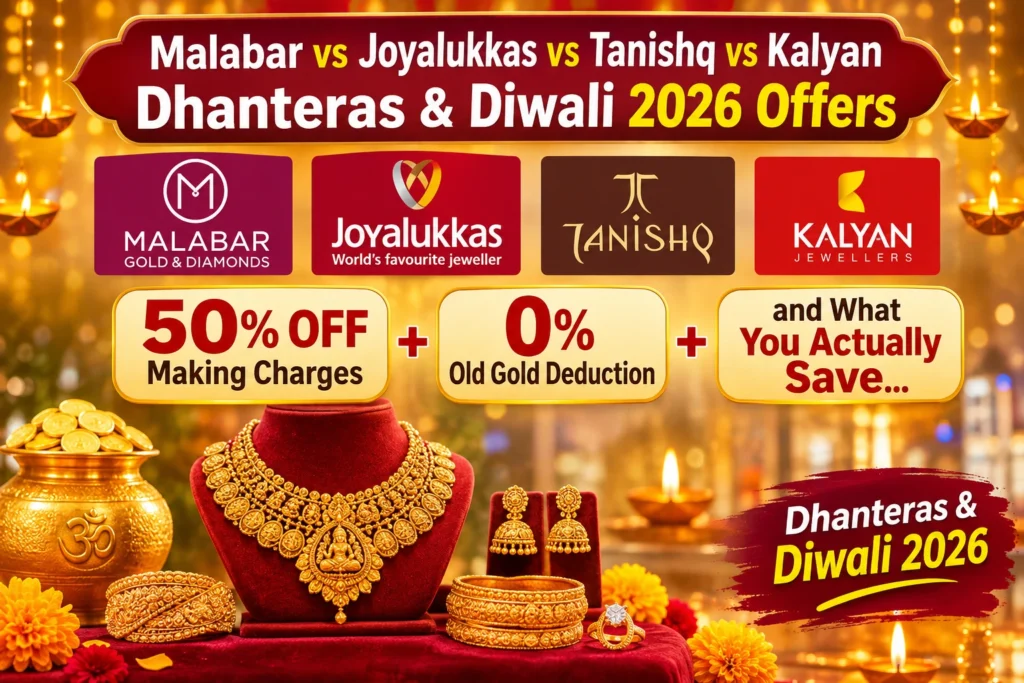
Malabar vs Joyalukkas vs Tanishq vs Kalyan Dhanteras & Diwali 2026 Offers: 50% Off Making Charges, 0% Old Gold Deduction and What You Actually Save

By Shuchi, FinanceChecks.com | Published 6 November 2026 | Category: Personal Finance | Reading time: about 6 minutes
Four of India’s biggest jewellers have announced festive gold offers for Dhanteras and Diwali 2026. The headline numbers look very different: 50% off making charges at one, up to 30% at another, a flat ₹301 per gram at a third and up to 40% at the fourth. But a bigger percentage does not always mean a lower bill. This guide compares the offers, shows what you could actually save with a worked example, and lists what to ask before you pay. It is a comparison of published offers, not an endorsement of any jeweller.
Quick Answer
Joyalukkas advertises the biggest headline discount, a flat 50% off making charges, valid until 8 November. Kalyan Jewellers offers up to 40% off value addition charges, Malabar Gold & Diamonds offers up to 30% off value addition charges until 15 November, and Tanishq offers a ₹301 per gram shagun discount on making charges, with slab-based extras until 8 November. Joyalukkas, Kalyan and Tanishq (for 22-carat gold and below, according to one report) advertise 0% deduction on old gold exchange, and Joyalukkas and Malabar offer gold rate protection with a 10% advance. The best deal is the one with the lowest final bill after the jeweller’s own making charge rate, GST and exchange terms, so ask each shop for an itemised estimate.
About This Guide
This article is written by the editorial desk of FinanceChecks.com, an independent Indian personal finance publication. It compares offers reported on 4 to 6 November 2026 by The Hans India, Kotak Neo and Goodreturns, and an earlier roundup by DealsShutter. Offers, validity dates and conditions change by store and city, so confirm in writing with your jeweller. This is educational content and not a recommendation to buy from any brand.
The Offers Side by Side
| Jeweller | Making charge or value addition offer | Gold rate protection | Old gold exchange | Validity |
|---|---|---|---|---|
| Joyalukkas | Flat 50% off making charges on gold, diamond, platinum, gemstone and silver jewellery, and on gold and silver bullion | Book with a 10% advance | 0% deduction | Online offer valid until 8 November 2026 |
| Malabar Gold & Diamonds | Up to 30% off value addition charges on gold, uncut and gemstone jewellery, and up to 30% off diamond value | Book with a 10% advance | Check store terms | 9 October to 15 November 2026 |
| Tanishq | ₹301 per gram shagun discount on making charges on eligible gold jewellery, plus extra slab-based discounts that one report puts at 0% to 20% on making charges, and up to 35% on diamond value and making charges | Check store terms | 0% deduction on eligible 22-carat and below, 2% for 9 to 18 carat, according to one report | 10 October to 8 November 2026 |
| Kalyan Jewellers | Up to 40% off value addition charges, and a chance to win prizes worth ₹50 crore | Check store terms | 0% deduction | Check store. A coin offer on Instamart is valid until 31 December 2026 |
This is just a guide not the final buying decision instructions. Please refer to relevant sites for more details.
Why a Bigger Percentage Does Not Always Mean a Bigger Saving
A percentage discount applies to the jeweller’s own making charge, and that charge differs by brand and by design. According to Goodreturns, Tanishq’s making charges range from about 8% to 28% of gold value, Malabar’s from about 13% to 26%, and some others charge 15% to 20%. A 50% discount on a high base can still leave you paying more than a 30% discount on a lower base. A fixed ₹301 per gram discount helps more on plain, low-making-charge pieces and less on heavily worked jewellery.
A Worked Example: What Could You Save?
Take 10 grams of 22-carat jewellery priced at ₹13,400 per gram, so the gold value is ₹1,34,000. For illustration only, assume every jeweller charges the same 15% making charge, which is ₹20,100. In real life, each jeweller sets its own rate.
| Jeweller | Offer applied | Making charges after discount | Saving |
|---|---|---|---|
| Joyalukkas | 50% off | ₹10,050 | ₹10,050 |
| Kalyan | 40% off | ₹12,060 | ₹8,040 |
| Malabar | 30% off | ₹14,070 | ₹6,030 |
| Tanishq | ₹301 per gram, plus an assumed extra 20% off making charges | ₹13,070 | ₹7,030 |
On this assumption, the saving ranges from about ₹6,000 to about ₹10,000 on a ₹1.34 lakh purchase. GST of 3% applies to the gold value and 5% to the making charges, so a lower making charge also lowers GST slightly. Now imagine the jewellers charge different base rates: a 50% discount on 22% making charges, for example, leaves ₹14,740 to pay, which is more than a 30% discount on 15%. That is why you should always compare the final itemised bill.
Old Gold Exchange: Read the Fine Print
A “0% deduction” offer means the jeweller does not cut anything from the value of your old gold at exchange. It does not mean you get the market price for any gold. Ask:
- How will the purity be tested, and can you watch the test?
- Is the value based on today’s rate, and on which purity?
- Is stone and wastage value excluded?
- Is the 0% deduction valid only on a minimum purchase, or only for certain karats?
One report says Tanishq’s 0% deduction applies to 22-carat and below, with a 2% deduction on 9 to 18 carat, while another describes it differently. Ask the store for the current terms in writing.
Gold Rate Protection: How It Works
With a rate protection scheme, you pay an advance (10% at Joyalukkas and Malabar, according to reports) and lock the booking-day gold rate for a fixed period. You pay the lower of the booked rate and the billing-day rate, at least in typical schemes. Check the booking window, the balance payment deadline, whether the advance is refundable and whether the protection covers all products.
What to Ask Before You Pay
- An itemised estimate: gold rate, weight, making charge percentage, discounts, GST and total.
- The gold rate used, and whether it matches the day’s published rate.
- Minimum purchase conditions attached to a discount or gift.
- Validity dates and whether the offer is online-only, in store only or both.
- Hallmark and HUID, and a bill showing gold value and making charges separately.
- Buyback and exchange terms, including deductions at resale.
- Whether offers can be combined with other promotions or card discounts.
- Return and warranty policy for studded jewellery.
Common Mistakes to Avoid
The usual mistakes are comparing only discount percentages, ignoring the base making charge, buying because of a free gift that costs more than it is worth, not checking the gold rate used, missing the validity date, paying a large advance without reading the terms and treating a prize draw as part of the saving. A ₹50 crore prize pool, for example, means very little for any one customer. Another is rushing: festive pressure helps the seller, not you.
My Take
Joyalukkas has the boldest headline and Malabar the longest validity, but I would not choose a jeweller from an advertisement. The sensible approach is to decide what you want to buy, visit two or three stores or their websites, ask for an itemised estimate for the same piece or weight and compare the final bills. Include the exchange value if you are trading in old gold.
If you are buying purely as an investment, remember that jewellery carries making charges that you do not get back. Coins, bars and gold ETFs usually cost less. For jewellery you will wear, a good discount is welcome, but a design you love and a jeweller you trust matter just as much.
Frequently Asked Questions
1. Which jeweller has the best Dhanteras 2026 offer? It depends on the final bill. Joyalukkas advertises the largest making charge discount at 50%, Kalyan up to 40%, Malabar up to 30% and Tanishq ₹301 per gram plus slab-based extras. Ask each for an itemised estimate for the same piece.
2. Until when are the Dhanteras and Diwali 2026 jewellery offers valid? Reports say Joyalukkas’s online offer runs until 8 November, Tanishq’s from 10 October to 8 November and Malabar’s from 9 October to 15 November. Kalyan’s validity was not clear in the reports, so check with the store.
3. What does 0% deduction on old gold exchange mean? It means the jeweller does not deduct a charge from the value of your old gold. You still need to check how purity is tested, what rate is used and whether any conditions apply.
4. How does gold rate protection work? You pay an advance, typically 10%, and lock the gold rate on booking day. You usually pay the lower of the booked rate and the rate on the billing day, within a fixed period.
5. Are making charges negotiable? Often there is room, especially on high-value purchases and during festivals. Compare shops, ask for the percentage in writing and check whether the discount applies to the making charge or to the total bill.
Disclaimer
This article is for general information and education only. It is not investment, tax or legal advice and does not recommend any jeweller. Offers, validity dates and terms come from press reports and brand announcements, differ by store and city, and may change. Confirm all details with the jeweller in writing before you pay. Examples are illustrations based on assumed making charges.
Sources Consulted
The Hans India, “Dhanteras 2026: Here are the gold offers from various stores” and “10 things to know about gold and silver coin offers on Instamart and major jewellers” (5 and 6 November 2026). Kotak Neo, “Dhanteras, Diwali 2026 gold jewellery offers and discounts.” Goodreturns, “Dhanteras Gold Making Charges 2026: Tanishq vs Malabar vs BHIMA vs Senco vs CaratLane.” DealsShutter, “Dhanteras 2026: Best Gold and Silver Offers” (24 October 2026).

Shuchi founded Finance Checks after spending 16+ years working in corporate, managing operations and distribution. She managed her own finances, learned and read regularly and helped people make sense of their savings, loans, insurance, and investments.
She started this site to offer the kind of clear, honest financial guidance she wished was more available when she was learning to manage her own money. Every article is researched personally, checked against official sources such as the Reserve Bank of India, SEBI, or the Income Tax Department, and revisited whenever regulations or figures change. She is upfront about how the site earns money through ads and select affiliate partnerships, and she does not let either influence what she actually recommends to readers.