
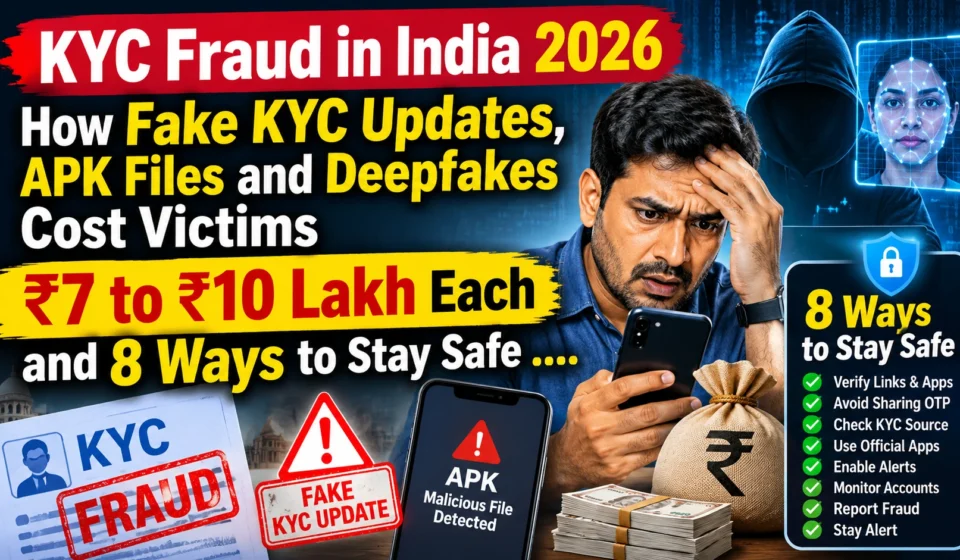
KYC Fraud in India 2026: How Fake KYC Updates, APK Files and Deepfakes Cost Victims ₹7 to ₹10 Lakh Each, and 8 Ways to Stay Safe

By Shuchi, FinanceChecks.com | Published 14 November 2026 | Category: Banking Insurance and Loans (Fraud Awareness) | Reading time: about 6 minutes
Know Your Customer (KYC) was designed to keep banks safe from fraud. Today, it has become one of the main tools fraudsters use. Some trick you into “updating KYC” and take over your phone. Others steal your documents to open accounts, take loans or run money through accounts in your name. This guide explains the main types of KYC fraud, shares cases reported by police in 2026 and gives a practical checklist to protect yourself.
Quick Answer
KYC fraud takes several forms: fake “KYC update” messages and calls that push a malicious APK app, misuse of your Aadhaar and PAN to open mule bank accounts, SIM cards or loans, forged documents and fake firms used to open accounts, deepfake videos that bypass face checks during e-KYC, and misuse of document photocopies. Cases reported in 2026 include a ₹7.46 lakh loss in Ahmedabad and a ₹9.96 lakh loss by a senior citizen after installing fake bank KYC apps, and a Mumbai case where 91 fake gas-company KYC apps defrauded 2,993 people of ₹63.69 crore. To stay safe, never install an APK or click KYC links on WhatsApp or SMS, update KYC only through your bank’s official app or branch, lock your Aadhaar biometrics, check which SIMs and loans are in your name, and report fraud on 1930 immediately.
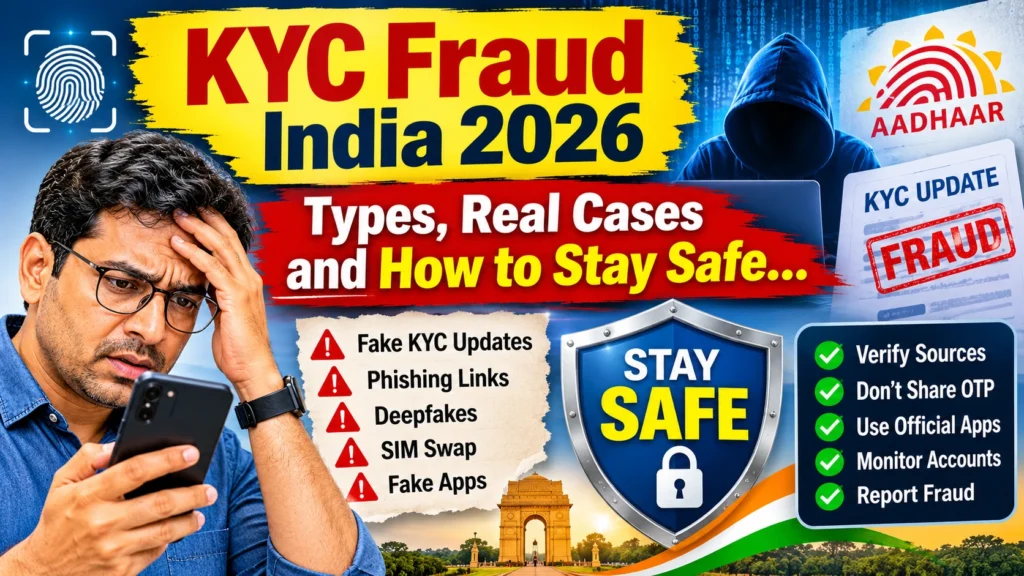
About This Guide
This article is written by the editorial desk of FinanceChecks.com, an independent Indian personal finance publication. Cases come from police-reported incidents covered by The420.in, Bizzbuzz, Country and Politics, India Today and fraud-briefing summaries published between June and November 2026, and national figures come from I4C data cited by Deccan Herald. Case details are as reported and alleged, and amounts can change as investigations continue. I do not name victims. This is educational content and not legal advice.
Why KYC Is a Fraud Target
KYC links your identity to your bank accounts, SIMs, loans and wallets. Once a criminal has your Aadhaar, PAN, photo and a working phone number, they can try to log in to your accounts, open new ones or apply for loans. According to the Indian Cyber Crime Coordination Centre (I4C), reported cyber fraud cases rose from about 24 lakh in 2023 to about 36 lakh in 2024, and losses were expected to reach ₹1.2 lakh crore in 2025.
You May Also Like To Read About:
- Top 10 Things to Teach Your Elderly Parents About Digital Fraud (Before a Scammer Does)
- RBI Digital Fraud Rules From 1 January 2027: Up to ₹25,000 Back, But Only If You Report Within 5 Days
- PNB Greater Noida Fraud: Is Your Fixed Deposit Safe? What Happened, What PNB Says and 10 Checks to Do Today
- ₹14 Crore Banking Fraud: 187 Unauthorised Transfers Reported — Is UPI the Next Target?
- Online Scams in India 2026: 67% Get No Money Back—Shopping, Job and Lottery Fraud Warning
Types of KYC Fraud
| Type | How it works | What it costs you |
|---|---|---|
| 1. Fake KYC update message or call | A WhatsApp, SMS or call claims your account will be blocked unless you update KYC. It sends a link or an APK file | Your phone is taken over, and money is drained |
| 2. Fake bank or utility KYC apps | An APK disguised as a bank, gas or telecom “KYC update” app gains access to your messages and OTPs | Loss of savings, credentials stolen |
| 3. Mule accounts opened in your name | Your stolen or sold Aadhaar and PAN are used to open bank accounts that move scam money | Police notices, frozen accounts, legal trouble |
| 4. Fake loans and cards | Fraudsters use your KYC to take instant loans or credit cards | Credit score damage, recovery calls |
| 5. Forged documents and fake firms | Fake Aadhaar, PAN or company papers open accounts that hold stolen money | Hard to trace, enabling large frauds |
| 6. Deepfake and AI e-KYC bypass | AI-generated videos from photos fool face-liveness checks in e-KYC | Loans taken in your name without your knowledge |
| 7. SIM misuse and swap | A SIM is issued or swapped using your documents, so OTPs reach the fraudster | Account takeover |
| 8. Photocopy and agent misuse | Documents given to a shop, agent or app are copied or sold | Identity misuse months later |
KYC Fraud Reported Cases in 2026
Ahmedabad: fake Bank of India KYC app, ₹7.46 lakh. According to the police complaint, a 37-year-old woman received a WhatsApp message claiming to be from her bank, asking her to update KYC. It carried an app file named “BOI Pan Card Update.apk”. After she installed it, multiple transactions totalling ₹7.46 lakh were made from her account, starting 19 May 2026. At the time of reporting, no arrests had been made.
Senior citizen: fake IOB “Aadhaar update” app, ₹9.96 lakh. A senior citizen opened a WhatsApp message to complete KYC for his nationalised bank account and was prompted to install an “Aadhaar update” APK. Soon after entering details, he received alerts of six debits totalling ₹9.96 lakh, savings he had kept for medical expenses. Police are tracing the sender and the accounts that received the money.
Mumbai: 91 fake gas-company KYC apps, ₹63.69 crore. Mumbai Police arrested a 26-year-old school teacher from Jharkhand who allegedly created and sold 91 malicious APK files disguised as Mahanagar Gas “KYC update” notices to organised gangs. The apps defrauded 2,993 victims of ₹63.69 crore, and police seized 967 more unreleased APKs, which they said averted an estimated ₹1,000 crore of further fraud.
Ahmedabad: deepfake e-KYC loan racket. Police busted a gang that allegedly used AI-generated “eye-blink” deepfake videos made from photos taken from social media to fool Aadhaar’s facial-liveness check and obtain instant personal loans from banks and lending apps. The case was registered on 10 April 2026, and seven people had been arrested by early May.
Delhi and Gujarat: fake documents and mule accounts. Delhi Police arrested two men who ran a website selling fake Aadhaar, PAN and voter ID documents, and who allegedly opened accounts through a fake firm and routed fraud proceeds through 197 mule accounts. Separately, Gujarat Police’s “Operation Mule Hunt 2.0” from 2 June 2026 reportedly led to 238 arrests, 118 FIRs and the identification of 1,326 mule accounts, through which ₹2,562 crore of cyber fraud proceeds was traced.
Coimbatore: three frauds, ₹7.79 lakh. Three residents lost a combined ₹7.79 lakh through a fake traffic-challan app, an insurance refund call and a fraudulent bank KYC call, according to cybercrime police.
Red Flags of a Fake KYC Message
| Red flag | Why it is suspicious |
|---|---|
| A WhatsApp or SMS from an unknown number asking you to update KYC | Banks do not run KYC through random chat messages |
| An APK file or a link to install an app | Official apps come only from the Play Store or App Store |
| “Your account will be blocked today” | Urgency is a standard scam tool |
| A request for OTP, PIN or card details | A genuine KYC update never needs these |
| A fee for KYC | KYC updates are free |
| An app named after a bank, gas company or telecom firm | Fraudsters copy trusted names |
| A call from a “bank officer” who knows some of your details | Leaked data makes scripts convincing |
8 Ways to Stay Safe from KYC Fraud
- Never install an APK or tap a KYC link sent on WhatsApp, SMS or email. Delete it and block the sender.
- Update KYC only through your bank’s official app, net banking or branch. Type the website address yourself or use the app you already have.
- Never share an OTP, PIN, CVV or password, and never let a caller guide you through your phone screen.
- Lock your Aadhaar biometrics on the UIDAI portal or the mAadhaar app, and check your Aadhaar authentication history for uses you do not recognise.
- Check the SIM cards registered in your name on the Department of Telecommunications’ TAFCOP portal, and report any you do not use.
- Review your credit report regularly for loans or cards you did not take, and use your income tax portal’s annual information statement to spot unknown transactions.
- Limit who gets your documents. Give a photocopy only when needed, write “For [purpose] only, [date]” across it, and prefer masked Aadhaar where accepted. Do not send documents on WhatsApp to strangers.
- Keep your registered mobile number and email current with your bank, and switch on alerts for every transaction.
If Your KYC Has Been Misused
- Call your bank at once using its official number to block cards, UPI and net banking.
- Report on 1930 and at cybercrime.gov.in, and keep screenshots, the APK name, the sender’s number and transaction details.
- File an FIR if accounts or loans were opened in your name.
- Tell lenders and credit bureaus about loans you did not take, and ask for them to be disputed and corrected.
- Remove the APK and secure your phone. Uninstall unknown apps, run a security scan, and change banking passwords from a clean device.
- Lock Aadhaar biometrics and review SIMs in your name.
- Report to your Aadhaar helpline if you think your Aadhaar was used without permission. The UIDAI helpline is 1947, so confirm it on the UIDAI site.
- Under RBI’s rules effective 1 January 2027, eligible individuals with a small loss may claim compensation if they report within five days, so act fast.
Common Mistakes to Avoid
The usual mistakes are trusting a message because it uses your bank’s name, installing an app “just to check”, sharing documents on WhatsApp, ignoring unknown SIMs or loans, leaving old phone numbers on bank records, hesitating to report because of embarrassment, and clicking links forwarded by friends whose phones may already be compromised. Another is assuming that fraud always means losing money at once. Misused KYC can show up months later as a loan or a police notice.
My Take
Many people think KYC fraud means a suspicious call. The cases from this year show something larger: a school teacher selling 91 fake apps, deepfake videos that fool face checks, and thousands of mule accounts opened with other people’s documents. The common thread is that your identity documents have become a product that criminals trade.
That means the strongest protection is dull and regular: install nothing from a message, use only official channels, lock your Aadhaar biometrics and check your SIMs and credit report a couple of times a year. Share this with your parents too, because older relatives are among the most frequent victims.
Frequently Asked Questions
1. What is KYC fraud? It is fraud that uses the KYC process, such as fake “KYC update” messages that steal money or stolen identity documents used to open accounts, SIMs or loans in your name.
2. Do banks ask customers to update KYC on WhatsApp? No genuine bank asks you to install an app or complete KYC through a link sent by an unknown number. Update only through the bank’s official app, website or branch.
3. What is an APK file scam? Fraudsters send an app file, often named after a bank, gas company or traffic department, that you install outside the official app store. It can read your messages and OTPs and give them access to your accounts.
4. How can I check whether my Aadhaar or PAN is being misused? Check your Aadhaar authentication history on the UIDAI portal, your SIMs on the TAFCOP portal, your credit report for unknown loans, and the annual information statement on the income tax portal.
5. What should I do if I lose money in a KYC scam? Call your bank, report on 1930 and at cybercrime.gov.in, save evidence, remove the app and file an FIR. Report within hours, since quick action helps police freeze funds.
Disclaimer
This article is for general information and education only. It is not legal or financial advice. Cases are as reported by police and the press and are alleged, and figures may change as investigations proceed. Helpline numbers, portals and rules can change, so confirm them on official sites. If you have lost money, contact your bank and the police immediately.
Sources Consulted
The420.in, “Cyber Fraudsters Use Fake Bank KYC Update to Steal Lakhs” (8 June 2026) and “Three Coimbatore Cyber Frauds Cost Victims Lakhs Through APK, Insurance And KYC Lures.” Bizzbuzz, “Fake KYC app dupes Ahmedabad woman out of ₹7.46 lakh” (8 June 2026). Country and Politics, “Senior citizen clicks fake bank KYC link, loses Rs. 9.96 Lakhs” (18 August 2026). KYCKART fraud briefings of 14 June, 6 July and 30 July 2026, summarising reports on the Mumbai Police APK case, Delhi Police IFSO’s fake-document network and Gujarat’s Operation Mule Hunt 2.0. Social Engineering Examples case library and India Today reports on the Ahmedabad deepfake e-KYC loan racket. Deccan Herald, “How India’s e-KYC boom is fueling a new wave of data scams,” citing I4C data.

Shuchi founded Finance Checks after spending 16+ years working in corporate, managing operations and distribution. She managed her own finances, learned and read regularly and helped people make sense of their savings, loans, insurance, and investments.
She started this site to offer the kind of clear, honest financial guidance she wished was more available when she was learning to manage her own money. Every article is researched personally, checked against official sources such as the Reserve Bank of India, SEBI, or the Income Tax Department, and revisited whenever regulations or figures change. She is upfront about how the site earns money through ads and select affiliate partnerships, and she does not let either influence what she actually recommends to readers.