
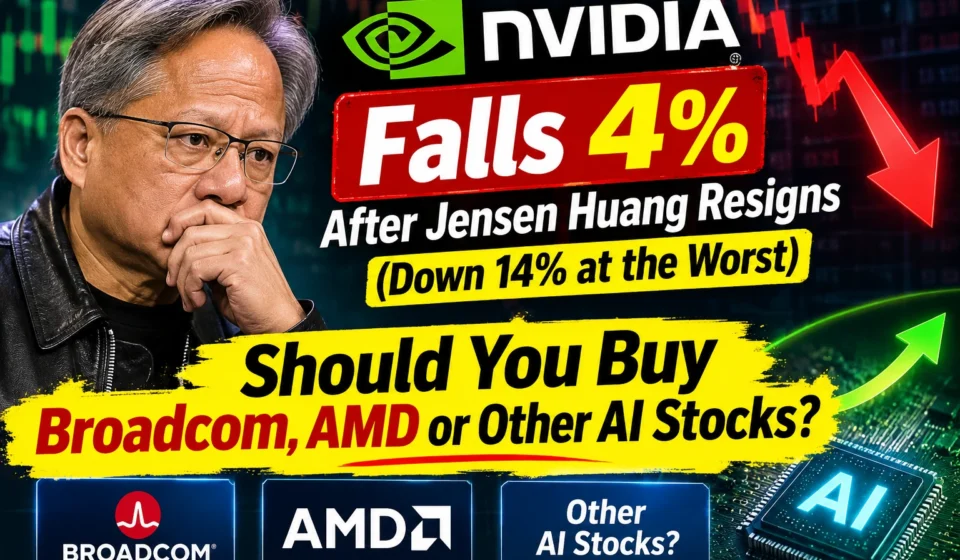
Nvidia Falls 4% After Jensen Huang Resigns (Down 14% at the Worst): Should You Buy Broadcom, AMD or Other AI Stocks?

By Shuchi, FinanceChecks.com | Published 13 November 2026 | Data as of the close on Thursday, 12 November 2026 | Category: Stock Market | Reading time: about 6 minutes
Nvidia, the company at the centre of the global AI boom, lost its founder and chief executive on Thursday, 12 November 2026, and its shares swung wildly. Rival chipmakers Broadcom and AMD rose, while others such as Micron fell. Many Indian investors who hold US tech through funds or direct accounts are asking whether this is a time to sell Nvidia, buy its rivals or do nothing. This article sets out the verified facts, how markets reacted, what analysts say and a way to think about it. It is not a recommendation to buy or sell any stock.

Quick Answer
Jensen Huang resigned as Nvidia’s president, CEO and board member with immediate effect, after reports of personal misconduct and an independent investigation linked to concerns about China’s access to Nvidia chips. CFO Colette Kress is interim CEO, and a board chair, Harvey C. Jones, will lead the search for a permanent successor. Nvidia shares fell as much as about 14% at the open before closing down 4.34%, and the stock has lost more than 20% in November. Broadcom rose about 5% and AMD about 2% to 5% as investors treated the turmoil as an opening for rivals, but analysts call that rally fragile, and Micron, Marvell and Intel fell. Whether to buy other AI stocks depends on your goals and risk tolerance, and rivals are not a risk-free hedge because the whole sector depends on the same AI spending.
About This Guide
This article is written by the editorial desk of FinanceChecks.com, an independent Indian personal finance publication. It uses reports from CNBC, CNN, Quartz, The Hill, Forbes, Yahoo Finance, Motley Fool and Rolling Out published on 11 and 12 November 2026. Several details of the underlying personal allegations are still being reported, and some outlets describe the exit as a resignation while one reports a board ouster. I have kept to financial facts and attributed claims to their sources. I am not a SEBI-registered research analyst or a US-registered adviser, and nothing here is advice to buy, sell or hold any security.
What Happened
| Item | Detail |
|---|---|
| Announcement | On the morning of Thursday, 12 November, Nvidia said Jensen Huang had resigned as president, CEO and board member, effective immediately |
| Background | Reports in major newspapers described personal misconduct, and Forbes reported that the board had announced an independent investigation, including into a relationship with an alleged foreign spy. Lawmakers had called for his resignation, according to CNBC |
| Interim leadership | CFO Colette Kress is interim CEO while remaining CFO. Analyst Dan Ives expects the interim period to last about a year |
| Board | Harvey C. Jones, former Synopsys chief, is the board’s first chair and will lead the CEO search, looking at internal and external candidates |
How Nvidia’s Stock Moved
| Measure | Figure |
|---|---|
| Premarket | Down about 10% to 12% |
| Intraday low | About $148.80, down roughly 14% from Wednesday’s close |
| Thursday close | Down 4.34% |
| November so far | Down more than 20% |
| Market value lost since the scandal broke | Nearly $750 billion, according to Quartz |
| Market ranking | Briefly dropped below Microsoft in market value, according to Forbes |
The stock had already slid before the resignation, on speculation that Huang’s position was under threat.
What Analysts Are Saying
- Bernstein cut its price target on Nvidia by half, from $400 to $200.
- Citigroup lowered its target from $285 to $225.
- Dan Ives of Wedbush said the stock would be worth about $225 without Huang at the helm.
- Jim Cramer of CNBC said the exit “had to happen” and called Kress a good interim choice.
- Many analysts expect a “leadership overhang” to weigh on the shares for some time.
- One analyst compared the moment to Apple after Steve Jobs, a reminder that great companies can survive a founder’s exit, but the transition is the risk.
Analysts also point out what has not changed: Nvidia’s software ecosystem, customer relationships and technology lead remain strong, at least for now.
Why Did Broadcom and AMD Rise, and Micron Fall?
Broadcom was the top gainer in the S&P 500 on Thursday, trading near $363, up about 5%, and AMD rose about 2% to 5% to around $565, helped by a William Blair upgrade to Outperform. The logic was simple: if Nvidia stumbles, its closest competitors might win more business.
But the picture was mixed. Micron, Marvell, Intel and Dell fell in the same session. And analysts describe the rally in rivals as fragile for a reason: neither company’s own business changed on Thursday. The gains rest on a competitive opportunity, not on better earnings.
The Risk Most People Miss: AI Stocks Move Together
Nvidia has funded cloud providers, suppliers and AI labs. If a new leader pulled back from that spending, it could hurt the entire AI boom, including Broadcom, AMD and memory makers. That means buying “other AI stocks” may not diversify you away from the risk. It can increase your exposure to the same theme.
Should You Buy Other AI Stocks? A Framework, Not Advice
I cannot tell you to buy or sell. Here is how to think about it.
| If you are… | Points to consider |
|---|---|
| Holding Nvidia directly | Decide whether your reason for owning it has changed. A leadership change is not the same as a broken business, but it adds uncertainty. Avoid acting only because of the price drop |
| Thinking of buying Broadcom or AMD because Nvidia fell | A short-term pop in rivals is not a reason by itself. Look at their own earnings, valuations and customers |
| Holding a Nasdaq 100 or US tech fund | You already own Nvidia and many AI stocks. Check how much of the fund sits in a few names before adding more |
| An Indian investor with only Indian stocks and SIPs | This news does not require a change in your plan, though Indian IT stocks can follow US tech sentiment |
| Investing for under five years | AI stocks are volatile, so be careful with money you will need soon |
Questions to ask before you buy any AI stock:
- Why do I want to own it, and what would make me sell?
- How much of my portfolio is already tied to AI?
- Is the price based on earnings I can see, or on hope?
- Can I handle a 30% fall without panic?
- Do I understand the extra costs and rules of investing abroad?
What Indian Investors Should Keep in Mind
- Access. Indian residents can invest in US stocks through the RBI’s Liberalised Remittance Scheme, and many hold US tech through mutual funds or ETFs. Fund houses have limits on overseas investing, so availability varies.
- Costs and tax. Foreign investments involve currency conversion, possible tax collected at source on remittances above limits, and different capital gains rules. Check the current rules or ask a tax professional.
- Rupee effect. Returns in rupees depend on both the stock and the dollar-rupee rate.
- Concentration. If your portfolio already includes US tech through several funds, you may hold more Nvidia than you realise.
Common Mistakes to Avoid
The usual mistakes are selling in a panic at the lowest point, buying rivals only because “Nvidia’s loss is their gain”, assuming a famous founder’s exit means the company will fail, ignoring concentration in tech funds, using leverage, and following social media tips about AI stocks. Another is forgetting that leadership news is only one input. Earnings, competition, regulation and AI spending trends matter more over years.
My Take
Founder transitions are among the hardest events for a company to handle, and markets rarely price them calmly. The Nvidia story has two parts: a leadership crisis that is real, and a business that, so far, has not shown damage. The next few quarters, and the choice of a permanent CEO, will tell us more than one day of trading.
For most investors, my advice is to avoid making a big decision on a day when headlines are loudest. If you want exposure to AI, think about how much you can afford to lose, spread it across time and across themes, and keep your core portfolio diversified.
Frequently Asked Questions
1. Why did Nvidia’s share price fall? Jensen Huang resigned as CEO and board member on 12 November 2026 after reports of personal misconduct and an investigation. The stock fell as much as about 14% at the open and closed down 4.34%, and has lost more than 20% in November.
2. Who is running Nvidia now? CFO Colette Kress is interim CEO while remaining CFO. Harvey C. Jones, a former Synopsys chief, is the board’s first chair and will lead the search for a permanent CEO.
3. Did Broadcom and AMD rise because of Nvidia’s fall? Both rose on 12 November, Broadcom by about 5% and AMD by about 2% to 5%, as investors saw an opening for rivals. Analysts say the rally is fragile, and other chip stocks such as Micron fell.
4. Should I buy AI stocks after Jensen Huang’s resignation? That depends on your goals, risk tolerance and existing holdings. AI stocks tend to move together, so rivals are not a hedge against a sector downturn. This is general information, not advice.
5. What are analysts’ price targets on Nvidia now? Bernstein cut its target from $400 to $200, Citigroup from $285 to $225, and Wedbush’s Dan Ives said the stock would be worth about $225 without Huang. Targets can change quickly.
Disclaimer
This article is for general information and education only. FinanceChecks.com and its author are not SEBI-registered research analysts or investment advisers, and nothing here is a recommendation to buy, sell or hold any security. Details of the events involving Nvidia’s leadership are as reported by news organisations and may change. Share prices and analyst targets change continuously. Investments are subject to market risk, and investing abroad adds currency and regulatory risks. Consult a SEBI-registered investment adviser before making decisions.
Sources Consulted
CNBC, “Nvidia stock closes down over 4% after CEO Jensen Huang announces resignation” and live updates (12 November 2026). CNN, “CFO Colette Kress to serve as interim leader after Nvidia CEO Jensen Huang resignation.” Quartz, “Nvidia stock falls about 8% as CEO Jensen Huang steps down.” The Hill, “Nvidia stock falls nearly 15 percent after Huang resigns.” Forbes, “Nvidia Shares Sink As Rival Chipmakers Rise After Jensen Huang Resigns.” Yahoo Finance, “AMD, Broadcom stocks jump as Nvidia CEO Jensen Huang resigns.” Motley Fool, “Stock Market Midday, Nov. 12.” Rolling Out, “Broadcom jumps 5% as Nvidia loses Jensen Huang.”

Shuchi founded Finance Checks after spending 16+ years working in corporate, managing operations and distribution. She managed her own finances, learned and read regularly and helped people make sense of their savings, loans, insurance, and investments.
She started this site to offer the kind of clear, honest financial guidance she wished was more available when she was learning to manage her own money. Every article is researched personally, checked against official sources such as the Reserve Bank of India, SEBI, or the Income Tax Department, and revisited whenever regulations or figures change. She is upfront about how the site earns money through ads and select affiliate partnerships, and she does not let either influence what she actually recommends to readers.