

Maruti Suzuki Price Hike from 22 November: Which Cars Cost More, By How Much, and Should You Buy Now?

By the financechecks.com team | Updated 22 November 2026
If a Maruti Suzuki is on your shopping list, the sticker price just moved. Maruti Suzuki India has increased prices of select models effective 22 November 2026, citing sustained cost pressures. The increase is small on average, but it is the latest in a string of revisions this year, and it arrives as the country’s largest carmaker faces pressure on its profit margins.
Here is what you need to know before you book or take delivery.
What has Maruti Suzuki announced?
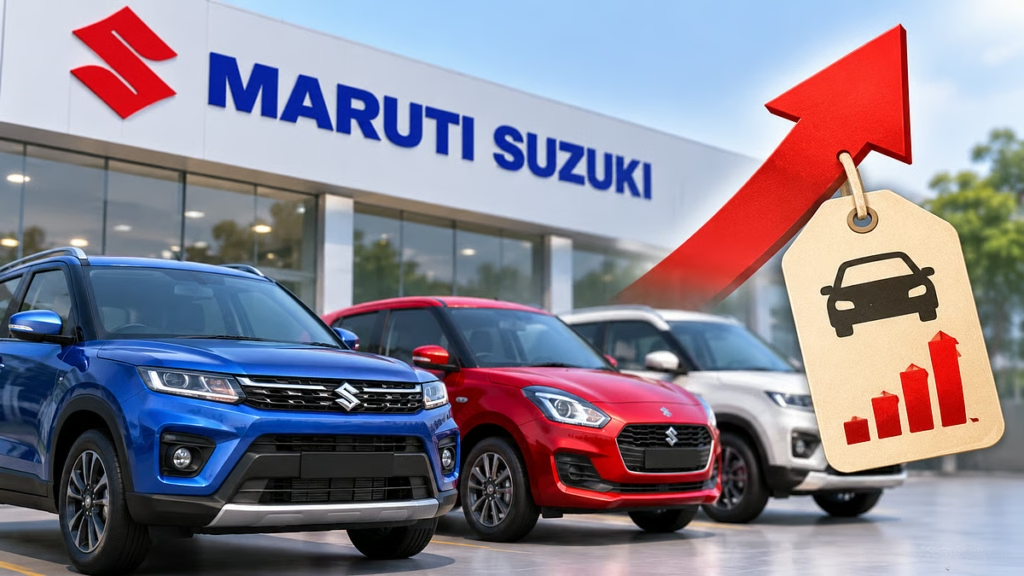
In an exchange filing on Sunday, 22 November 2026, the company said that, because of sustained cost pressures, it had decided to raise prices of select models with immediate effect. Key points:
- Effective date: 22 November 2026
- Estimated volume-weighted average increase: about 0.31%
- Company’s stance: it will pass on only a part of the higher costs to the market, while trying to minimise the impact on customers
To get the latest Personal Finance Updates, Follow us on Instagram and Youtube.
How much extra will you pay for new Maruti Suzuki?
A volume-weighted average of 0.31% is a very small number, but it is an average across the company’s sales, so individual models and variants may see different changes, and some may see none. Here is simple, illustrative maths for a 0.31% increase:
| Car price (ex-showroom) | Approx. increase at 0.31% |
|---|---|
| Rs 5 lakh | about Rs 1,550 |
| Rs 8 lakh | about Rs 2,480 |
| Rs 12 lakh | about Rs 3,720 |
| Rs 15 lakh | about Rs 4,650 |
These figures are only to give a sense of scale. They are not model-wise price changes. Check the exact revised ex-showroom price for your model and variant with your dealer or on the company’s website.
Remember that charges calculated as a share of the car’s price, such as insurance and some other on-road costs, can move slightly with the ex-showroom price too.
Why are Maruti Suzuki prices going up?
The company points to sustained cost pressures. Reports link this to higher input costs, partly arising from the West Asia conflict, and to an inflationary environment. The numbers tell the story:
- In the July to September quarter (Q2 of FY27), consolidated net profit reportedly fell about 26.36% to Rs 2,466.1 crore, even though revenue grew sharply on record quarterly sales volumes.
- Operating EBITDA margin reportedly slipped to about 9.4%, from 12.7% a year earlier.
- The company said it had worked to cut costs, including by moderating marketing spending, but still needed to pass on a portion of the increase.
- Domestic dispatches in April to September rose about 31.6% to 11.46 lakh vehicles, so demand has been strong, which makes the margin squeeze more notable.
It’s not the first hike this year
This is part of a pattern:
- Reports say there were three rounds of price increases in the first half of FY27, totalling a little over 1%.
- Media coverage describes this as the second price hike in three months, following an increase of up to Rs 20,000 on select models in September 2026.
Put together, buyers who delayed a purchase through the year have faced gradual but steady price creep.
Should you buy now or wait?
There is no one-size-fits-all answer, but here is how to think about it.
Reasons to buy sooner
- Prices have been drifting up through the year, and cost pressures have not eased according to the company’s own statement.
- If you have already shortlisted a model and your finances are ready, a delay could cost you a little more.
- Booking early can help lock in your preferred variant and colour, depending on the dealer’s terms. Ask about price protection and how the price on delivery is determined.
Reasons to wait or negotiate
- A 0.31% average change is small compared with the discounts and offers that dealers sometimes provide. Do not decide on the hike alone.
- Year-end offers, exchange bonuses and corporate benefits may offset the increase. Ask for the full on-road quote.
- If your current car is serviceable and you are not under time pressure, you can compare variants and financing at your pace.
7 smart steps for Maruti Suzuki buyers
- Get the updated ex-showroom price for your exact model and variant in writing.
- Ask whether your booked price is protected. Clarify if you pay the price at booking or at delivery.
- Compare on-road costs, including insurance, registration, handling charges and accessories.
- Negotiate on what you can control: exchange value, accessories, extended warranty and processing fees.
- Shop your finance and insurance. A lower interest rate can save far more than a 0.31% price change. Compare loan offers from banks and NBFCs, and compare insurance quotes before accepting the dealer’s package.
- Check the final invoice against the quote before you pay.
- Keep your budget realistic. Include the cost of fuel, servicing and insurance, not just the EMI.
What about existing bookings?
Whether a hike applies to a car you have already booked depends on the booking terms and the dealer’s policy. Ask your dealer in writing whether your booking price is fixed or subject to the price on the date of delivery.
Frequently asked questions
When did the Maruti Suzuki price hike come into effect? From 22 November 2026.
By how much have prices gone up? The company estimates a volume-weighted average increase of about 0.31%, but the change varies by model and some may be unaffected.
Which models are affected? The company’s filing says “select models” and has not, per reports, listed them. Check with your dealer for your model.
Why did Maruti raise prices? It cited sustained cost pressures, with reports pointing to higher input costs linked partly to the West Asia conflict.
Is this the first hike this year? No. Reports say there were three increases in the first half of FY27 alone, and another in September of up to Rs 20,000 on select models.
Will prices rise again? That is not known. The company has said cost pressures are sustained, but future decisions will depend on input costs and market conditions.
The bottom line
The 22 November increase is modest on paper, around 0.31% on average, but it is the latest step in a year of rising prices and shrinking margins at India’s largest carmaker. For buyers, the best response is not panic but preparation: get your exact quote, ask about price protection, compare financing and insurance, and negotiate the extras. Those steps can save you far more than the hike costs.
Disclaimer: This article is for general information and is not financial advice. Figures are based on media reports and the company’s exchange filing as of 22 November 2026. Model-wise prices vary, so please confirm current prices with your Maruti Suzuki dealer.
Sources: Maruti Suzuki India exchange filing of 22 November 2026, as reported by PTI, Business Standard, Zee Business and others.

Shuchi founded Finance Checks after spending 16+ years working in corporate, managing operations and distribution. She managed her own finances, learned and read regularly and helped people make sense of their savings, loans, insurance, and investments.
She started this site to offer the kind of clear, honest financial guidance she wished was more available when she was learning to manage her own money. Every article is researched personally, checked against official sources such as the Reserve Bank of India, SEBI, or the Income Tax Department, and revisited whenever regulations or figures change. She is upfront about how the site earns money through ads and select affiliate partnerships, and she does not let either influence what she actually recommends to readers.