
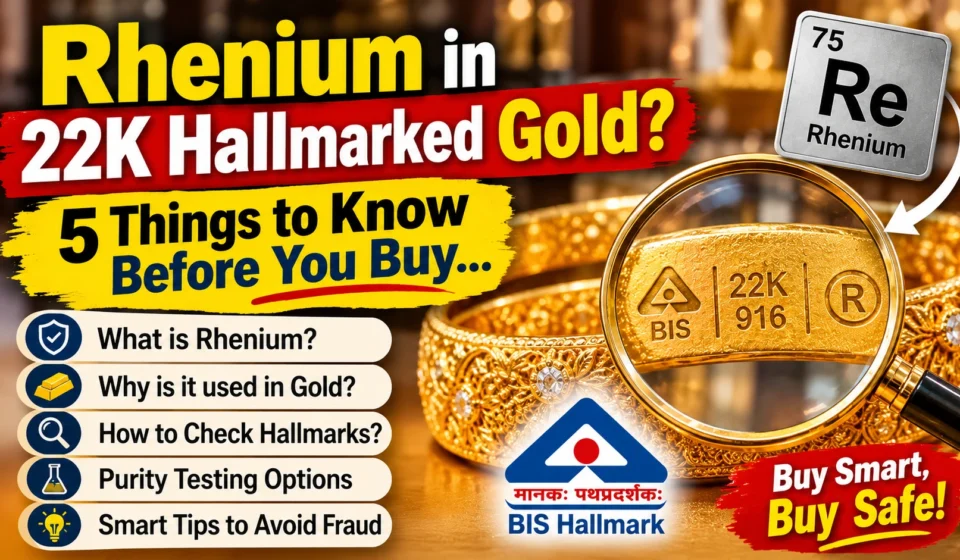
Rhenium in Hallmarked Gold? 5 Things Every Buyer Must Know About Hallmarks and Purity Testing

By the financechecks.com team | Updated 22 November 2026
For most Indian families, a hallmark on gold jewellery is the final stamp of trust. So a recent report has rattled buyers: a newspaper investigation in Jodhpur, Rajasthan reportedly found that gold mixed with rhenium, a rare and very dense metal, still received a 22-carat hallmark, even though its real gold content was far lower.
Before panic sets in, let’s separate what was reported from what is proven, and then look at what you can do to protect your money. Here are the five things to know.
1. What was reportedly found in Jodhpur?
The report comes from the Hindi daily Dainik Bhaskar, which worked with a local jeweller on an experiment. According to media coverage of it:
- About 1 gram of rhenium powder was mixed with about 7.83 grams of 24-carat gold.
- The finished ornament weighed roughly 9.58 grams.
- A showroom testing machine reportedly showed around 93.7% gold, with silver and copper, and did not flag rhenium.
- A hallmarking centre reportedly issued a 22-carat (916) hallmark.
- The newspaper estimated the real gold content at about 81.73%, closer to 20-carat quality.
Important caveat: this was a reported experiment. It does not by itself show how common such adulteration is, and it is not a finding by a regulator. Reports also say the jewellers’ association was set to take up the matter with the certifying agency, so official responses may follow.
2. What does a 22K hallmark actually promise?
A 22-carat mark means the piece is meant to contain 91.6% gold, which is why you see 22K916 stamped on jewellery. Under India’s BIS hallmarking system, a standard hallmark on gold jewellery includes:
- The BIS logo
- The purity grade, such as 22K916, 18K750 or 14K585
- A 6-character alphanumeric HUID (Hallmark Unique Identification) number
The hallmark is only as reliable as the test behind it.
You May Also Like To Read About:
- Fake Gold and Jewellery Scams in India: Real 2026 Cases and a Wedding-Season Checklist to Avoid Them
- Gold and Silver Prices Crash in November 2026: Why Are Rates Falling, What Happens Next and Should You Buy, Sell or Hold?
- Old Gold Exchange vs Remodelling in 2026: Which Costs Less? Charges, GST and a Rupee Example
- How to Invest in Gold Without Ever Holding Physical Gold: A Complete Guide
- How Much Gold Can Your Family Legally Keep at Home Without Proof?
3. Why could rhenium slip past a test?
Rhenium is extremely dense, which is why it is described as a way to add weight without adding gold. The concern is that some testing methods may not identify it, depending on the equipment, calibration and the composition of the sample. Reports suggest that the machine readings in the experiment looked like a gold, silver and copper alloy.
Testing methods broadly fall into two groups:
| Method | How it works | Limitation |
|---|---|---|
| XRF (X-ray fluorescence) | Quick, non-destructive scan, widely used in showrooms | Reads mostly near the surface and depends on calibration and what the machine is set to detect |
| Fire assay (cupellation) | Destructive lab method that melts a small sample to measure gold content | Slower and costlier, but considered the reference method for accuracy |
Be careful with conclusions here. Whether a particular centre’s method can detect rhenium depends on its setup, and experts and regulators are best placed to say how well current checks cope. Treat anything stronger than that as unverified.
4. How much money could you lose?
Here is simple, illustrative maths using the reported figures.
- Real 22K gold should contain 91.6% gold. In a 10-gram ornament, that is about 9.16 grams of gold.
- At about 81.73% gold, the same 10-gram piece would hold roughly 8.17 grams.
- The shortfall is close to 1 gram of gold per 10 grams of jewellery, and you pay 22K prices for it.
One report put the loss at about Rs 14,700 per tola at the gold prices used in the investigation. Your actual loss would depend on the day’s rate, making charges and weight, so treat this as an estimate, not a fixed number.
The damage also shows up later. When you sell or exchange, a purity test at the other end can reveal lower gold content, and your payout drops with it.
5. How can you protect yourself? A buyer’s checklist
- Buy only hallmarked jewellery with the BIS mark, purity grade and HUID.
- Verify the HUID using the official BIS Care app or BIS verification tools. Confirm that the item description, purity and jeweller details match.
- Insist on a detailed bill that lists gold weight, purity, stone weight, making charges and the HUID.
- Buy from established, reputable jewellers, and prefer shops that offer a clear buyback or exchange policy in writing.
- Ask about the testing method. For high-value purchases, you can request independent testing at a BIS-recognised assaying and hallmarking centre.
- Check weight against density. Be wary of pieces that feel unusually heavy for their size, though this is not a reliable test on its own.
- Keep your invoices and hallmark details safe, since they are your proof if you ever need to raise a complaint.
- Report suspected problems to the jeweller first, then to BIS or the consumer authorities. Check current complaint channels on the official BIS and consumer affairs websites.
Should you stop buying gold?
No. Gold remains a long-standing store of value and a cultural staple, and the hallmarking system has brought far more transparency than the pre-hallmark era. The Jodhpur case is a reminder to verify rather than blindly trust, especially for large purchases. Gold coins and bars from trusted banks, refiners and mints, as well as digital options such as gold ETFs and sovereign-style instruments where available, are alternatives for investment-minded buyers who care less about wearing the gold.
Frequently asked questions
What is rhenium? A rare, very dense metallic element (atomic number 75), used mainly in industrial applications such as high-temperature alloys.
Was rhenium really found in hallmarked gold? A Dainik Bhaskar experiment in Jodhpur reportedly produced an ornament with rhenium that received a 22-carat hallmark. It is a media-reported experiment, not proof of widespread fraud.
Does a hallmark guarantee 100% purity? A hallmark certifies a declared purity grade after testing. It is a strong consumer safeguard, but no system is immune to error or deliberate fraud, so verifying the HUID and buying from trusted sellers still matter.
What does 22K916 mean? 22 carat, or 91.6% gold.
How do I verify a HUID? Use the BIS Care app or the official BIS verification option and enter the HUID printed on the piece.
Is fire assay better than an XRF machine? Fire assay is widely regarded as the more accurate reference method, while XRF is faster and non-destructive. Each has its place.
Should I get my old jewellery tested? If you are concerned, you can have it tested at a BIS-recognised hallmarking centre. Ask which method they use.
The bottom line
The rhenium report raises a fair question: can gold pass routine checks and still fall short of its hallmark? Until regulators and testing bodies respond, the smartest move is simple. Buy hallmarked gold, verify the HUID, demand a detailed bill, keep your records, and for big purchases, consider independent testing. A little checking can save you a lot of money.
Disclaimer: This article is for general information and is not financial, legal or investment advice. Details are based on media reports as of 22 November 2026, which describe a newspaper experiment and not an official finding. Please verify with BIS and your jeweller.
Sources: reporting by Dainik Bhaskar as covered by Gulf News, Goodreturns, Open Magazine, TopNews, The Morning Voice and others.

Shuchi founded Finance Checks after spending 16+ years working in corporate, managing operations and distribution. She managed her own finances, learned and read regularly and helped people make sense of their savings, loans, insurance, and investments.
She started this site to offer the kind of clear, honest financial guidance she wished was more available when she was learning to manage her own money. Every article is researched personally, checked against official sources such as the Reserve Bank of India, SEBI, or the Income Tax Department, and revisited whenever regulations or figures change. She is upfront about how the site earns money through ads and select affiliate partnerships, and she does not let either influence what she actually recommends to readers.