

PPF Account for Kids: How Parents Can Open It and Build a Big Fund

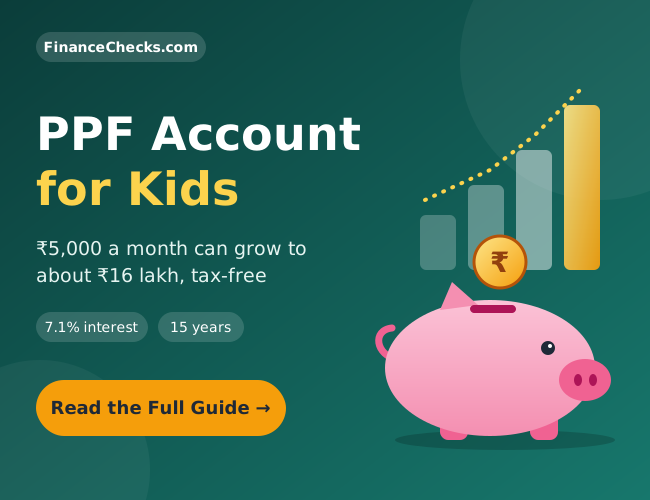
Quick Answer: A parent or legal guardian can open a PPF account in a kid’s name at any post office or authorised bank. You need the child’s birth certificate, your PAN and Aadhaar, photos and the account opening form. The minimum deposit is ₹500 a year and the maximum is ₹1.5 lakh a year (combined with your own PPF). The current rate is 7.1% a year, tax-free, for a 15-year term. At ₹5,000 a month, the account can grow to roughly ₹16 lakh in 15 years if the rate stays the same.
About This Guide: This guide is written by the FinanceChecks.com team and covers PPF rules for minors in India. The interest rate is based on the Finance Ministry’s notification for the October to December 2026 quarter. This is general information, not personalised financial advice.
If you want to save for your child’s education or future, the Public Provident Fund (PPF) is one of the simplest tools to start with. It is backed by the Government of India, the interest is tax-free, and the long lock-in keeps the money growing quietly in the background. Here is how a PPF account for kids works and how to open one.
Can You Open a PPF Account for a Kid?
Yes. A parent or legal guardian can open a PPF account on behalf of a minor, meaning a child under 18. Each child can have only one PPF account, and it cannot be opened as a joint account. The guardian operates the account until the child turns 18. After that, the child completes their own KYC and takes over.
Documents You Need To Open A PPF Account for Kid
Keep these ready before you visit the branch:
- Completed PPF account opening form
- Child’s birth certificate or school proof of age
- Guardian’s PAN card and Aadhaar card
- Address proof of the guardian
- Passport-size photos of the child and guardian
- Nomination details
- First deposit (at least ₹500)
Requirements can differ slightly between banks and post offices, so check the exact list with your branch. Many banks also allow online opening if you are already a customer.
You May Also Like To Read About:
How to Open the Account
Visit a post office or a bank that offers PPF, such as SBI, HDFC Bank or ICICI Bank. Ask for the PPF form for a minor, fill it in with the child’s details as the account holder and your details as guardian, attach the documents and make the first deposit. You will receive a passbook, or net banking access if you open it with a bank.
PPF Account for Kids: Key Rules at a Glance
| Feature | Details |
|---|---|
| Interest rate | 7.1% a year (October to December 2026), reviewed every quarter |
| Tenure | 15 years, extendable in blocks of 5 years |
| Minimum deposit | ₹500 a year |
| Maximum deposit | ₹1.5 lakh a year, combined with the guardian’s own PPF |
| Tax benefit | Deduction under Section 80C (old tax regime), tax-free interest and maturity |
| Loan | Available from the 3rd to the 6th year |
| Partial withdrawal | Allowed from the 7th year |
The government has kept the PPF rate at 7.1% for the October to December 2026 quarter, but it can change in future reviews.
How Much Can It Grow?
These are approximate figures, assuming a 7.1% rate throughout and a deposit made at the start of each year.
| Monthly savings | Yearly deposit | Approx. value after 15 years |
|---|---|---|
| ₹3,000 | ₹36,000 | ₹9.8 lakh |
| ₹5,000 | ₹60,000 | ₹16.3 lakh |
| ₹12,500 | ₹1,50,000 | ₹40.7 lakh |
If you open the account when your child is born, it matures around the time they finish school, just when college fees begin. You can then extend it for another 5 years to keep the fund growing.
Common Mistakes to Avoid
Missing the yearly minimum. If you skip the ₹500 deposit in a year, the account becomes inactive and you must pay a penalty to revive it.
Depositing after the 5th of the month. Interest is calculated on the lowest balance between the 5th and the end of each month, so deposits made after the 5th earn nothing for that month. Many parents deposit the full amount in April instead.
Crossing the ₹1.5 lakh limit. Your own PPF and your child’s account share this limit. Extra money is not counted and earns no interest.
Expecting early access. PPF is meant for the long haul. Withdrawals are restricted in the early years, so do not put in money you may need soon.
My Take
For most parents, PPF works best as the stable base of a child’s fund, not the whole plan. It gives certainty and tax-free returns, but 7.1% may not beat inflation by a wide margin over many years. If your goal is more than 15 years away, consider pairing PPF with a monthly SIP in an equity mutual fund for growth. If you have a daughter, also look at Sukanya Samriddhi Yojana, which currently offers a higher rate of 8.2%.
Frequently Asked Questions
1. What is the minimum age to open a PPF account for a child? There is no minimum age. You can open it from birth with the birth certificate.
2. Can both parents open separate PPF accounts for the same child? No. Only one PPF account is allowed per minor.
3. Does the deposit in my child’s PPF count towards my ₹1.5 lakh limit? Yes. The combined deposits in your account and your child’s account cannot exceed ₹1.5 lakh in a financial year.
4. Can I claim Section 80C on my child’s PPF deposits? Yes, the guardian can claim the deduction within the overall ₹1.5 lakh limit under the old tax regime.
5. What happens when my child turns 18? The child completes their own KYC and operates the account. The 15-year term continues from the original opening date.
Disclaimer: This article is for information only and is not financial advice. Interest rates and rules can change, so please confirm current details with your bank or post office before investing.

Shuchi founded Finance Checks after spending 16+ years working in corporate, managing operations and distribution. She managed her own finances, learned and read regularly and helped people make sense of their savings, loans, insurance, and investments.
She started this site to offer the kind of clear, honest financial guidance she wished was more available when she was learning to manage her own money. Every article is researched personally, checked against official sources such as the Reserve Bank of India, SEBI, or the Income Tax Department, and revisited whenever regulations or figures change. She is upfront about how the site earns money through ads and select affiliate partnerships, and she does not let either influence what she actually recommends to readers.