
SBI Slashes Bulk Fixed Deposit Rates: Does This Actually Change Anything for Your Savings?

Suresh has had a fixed deposit with SBI for the last three years, nothing fancy, just ₹5 lakh he’d rather not touch, sitting quietly and earning interest while he focuses on other things. When he saw the headline about SBI cutting FD rates this week, his first instinct was to log into his net banking app and check whether his own deposit had just gotten a smaller return. It hadn’t. The cut that made the news doesn’t touch deposits anywhere close to Suresh’s size, and understanding exactly why is the difference between reading a headline correctly and reacting to it unnecessarily.
This kind of banking news travels fast, and the word “SBI” alone is often enough to make ordinary depositors worry their own savings are affected, even when the specific change being reported has nothing to do with them. Here’s precisely what changed, who it actually touches, and what it might signal for the rest of us down the line.
Quick answer: SBI has cut interest rates only on bulk fixed deposits, those of ₹3 crore and above, effective 15 August 2026, reducing rates by 0.25% for tenures of 7 to 179 days and by 0.10% for 180 to 210 days, while leaving longer bulk tenures untouched. Regular retail fixed deposits, the kind most individual savers hold, remain completely unaffected by this specific change, continuing at their existing rates of 3.05% to 6.40% for general customers and 3.55% to 7.05% for senior citizens.
What SBI Actually Changed
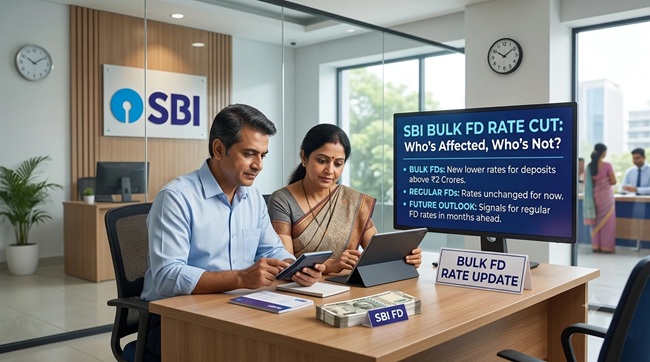
The revision that’s been making headlines applies specifically to what banks call bulk deposits, fixed deposits of ₹3 crore or more, typically placed by corporates, trusts, institutions, or occasionally very high-net-worth individuals rather than everyday retail savers. Effective 15 August 2026, SBI reduced the interest rate on these bulk deposits by 0.25%, or 25 basis points, for tenures ranging from 7 days to 179 days. For deposits held between 180 and 210 days, the cut is smaller, at 0.10%, or 10 basis points.
Deposits held for longer than that, from 211 days all the way out to 10 years, saw no change at all in this particular revision. After the cut, bulk deposit rates for general customers now range between 5.25% and 6.50% depending on the exact tenure, and the same percentage-point reductions were applied to senior citizens holding bulk deposits as well.
Why This Doesn’t Touch Your Regular Savings
Here’s the part that matters most if you’re an ordinary depositor: this revision applies exclusively to the bulk deposit category. If your fixed deposit is below ₹3 crore, which describes the overwhelming majority of individual savers in India, nothing about your existing FD or any new FD you open changes because of this announcement. SBI’s regular retail FD rates remain exactly where they were, ranging from 3.05% to 6.40% for general customers across various tenures, and from 3.55% to 7.05% for senior citizens, who continue to receive the usual additional benefit on top of the general rate.
So if you’re someone like Suresh, with a modest, individually-held fixed deposit well under the ₹3 crore threshold, this specific news doesn’t require you to do anything at all. Your existing FD continues earning exactly what it was promised at the time you opened it, and any new retail FD you open today would still get the same unchanged rates.
Why Banks Cut Bulk Rates Differently From Retail Rates in the First Place
This might seem like an odd distinction if you’ve never thought about it before, so it’s worth understanding why banks even separate these two categories. Bulk deposits come from a smaller number of large depositors, often corporates or institutions parking surplus funds for short periods, and banks have more flexibility to adjust rates on this segment quickly based on their current liquidity needs, meaning how much surplus cash the bank already has on hand relative to loan demand.
Retail deposits, on the other hand, come from millions of individual savers and tend to be far more rate-sensitive to depositor trust and competitive positioning against other banks. Cutting retail rates too aggressively or too frequently risks pushing ordinary depositors toward competing banks or other savings instruments entirely, so banks are generally more cautious and gradual with changes here compared to the bulk segment, where a shorter-term liquidity adjustment can be made and reversed more nimbly.
Follow us for Financial Updates on Instagram and Youtube
Does This Signal Retail FD Rates Will Fall Next
This is the genuinely useful question behind the headline, and it’s worth being honest that there’s no guaranteed answer, but there is a reasonable pattern worth watching. Bulk deposit rate movements have historically tended to move somewhat ahead of retail rate changes, since they respond faster to a bank’s immediate liquidity position and to broader interest rate trends set by the Reserve Bank of India’s monetary policy stance.
That said, a bulk rate cut doesn’t automatically mean a retail rate cut is imminent, and definitely not guaranteed to happen on any predictable timeline. Retail FD rates are influenced by a wider set of factors, including competitive pressure from other banks and non-banking financial companies, many of which are currently offering considerably higher rates, particularly small finance banks offering up to 8.30% to senior citizens on select tenures. If SBI moved its retail rates down too quickly while competitors held steady or higher, it risks losing retail deposit market share, which tends to make banks more deliberate about the timing and size of retail rate cuts compared to bulk adjustments.
What This Means If You’re About to Open or Renew an FD
If you currently hold a retail FD with SBI that’s maturing soon, this specific bulk deposit revision has no direct bearing on your renewal rate, since retail rates haven’t moved. That said, it’s still a reasonable moment to shop around before automatically renewing at whatever your existing bank offers. Comparing rates across banks before renewing a matured FD is generally a better practice than defaulting to renewal with the same bank, particularly since several smaller banks and finance companies are currently offering meaningfully higher rates than the larger public sector banks on comparable tenures.
It’s also worth factoring in your actual liquidity needs before locking into a longer tenure purely to chase a marginally higher rate. A fixed deposit that pays slightly less but matches when you’ll actually need the money is usually the more sensible choice over one that pays marginally more but leaves you needing to break it early.
The Penalty Detail Worth Knowing If You’re Sitting on a Large Deposit
Alongside this rate revision, SBI has also clarified its premature withdrawal rules specifically for bulk deposits: a 1% penalty now applies to premature withdrawals across all bulk deposit tenures, and this applies uniformly to both new deposits and renewed ones. If you happen to be someone managing funds at that scale, whether for a business, trust, or a very large personal deposit, this penalty clarification matters considerably more to your planning than the rate cut itself, since an early exit now carries a clearly defined cost regardless of which tenure you originally chose.
For the vast majority of retail depositors well below the ₹3 crore bulk threshold, this particular penalty rule simply doesn’t apply, and existing premature withdrawal terms on regular retail FDs remain governed by SBI’s standard retail deposit policy instead.
Common Mistakes People Make When They See News Like This
The most frequent mistake is assuming any SBI rate announcement automatically applies to your own deposit, without checking whether the news actually refers to the bulk category or the retail category, since headlines rarely spell out this distinction as clearly as the underlying announcement does.
Another common mistake is reacting to a bulk rate cut by rushing to break an existing retail FD out of a vague fear that rates are about to fall everywhere, when in reality retail rates may not move at all, or may move much later and by a smaller margin than the bulk segment did.
A third mistake, more relevant if you are managing a genuinely large deposit, is overlooking premature withdrawal penalty clarifications like this one simply because the headline focused on the interest rate change rather than the withdrawal terms, when for a large depositor, the penalty detail can matter just as much as the rate itself.
You May Also Like To Read About:
My Take
Headlines about “SBI slashing rates” are engineered to grab attention, and they usually succeed at making ordinary depositors nervous about deposits that were never actually part of the change being reported. If you’re holding a standard retail FD, this particular announcement changes nothing for you today. Where I’d actually pay attention is the broader pattern: bulk rate cuts tend to be an early signal, not a certainty, and if you have a large FD maturing in the next few months, it’s a reasonable moment to at least compare rates across a few banks before renewing, rather than assuming your current bank’s rate is still the most competitive one available to you.
Frequently Asked Questions
What is a bulk fixed deposit, and how is it different from a regular FD? A bulk fixed deposit refers to deposits of ₹3 crore or more, typically placed by corporates, trusts, or institutions, while regular retail FDs cover deposits below this threshold, which is what the vast majority of individual savers hold.
Does SBI’s recent rate cut affect my personal fixed deposit? Only if your deposit is ₹3 crore or above. If your FD is below this threshold, which applies to most individual depositors, your interest rate remains completely unchanged by this specific revision.
What exactly changed in SBI’s bulk FD rates? Effective 15 August 2026, SBI cut bulk FD rates by 0.25% for tenures of 7 to 179 days and by 0.10% for tenures of 180 to 210 days. Rates for tenures from 211 days to 10 years were left unchanged.
What are SBI’s current retail FD rates for general customers? As of this revision, SBI’s regular retail FD rates for general customers range from 3.05% to 6.40%, depending on the tenure, unaffected by the bulk deposit rate cut.
Do senior citizens get a better FD rate at SBI? Yes. Senior citizens continue to receive an additional interest benefit on regular retail FDs, with rates currently ranging from 3.55% to 7.05% depending on tenure, on top of the standard rate offered to general customers.
Does a bulk FD rate cut mean retail FD rates will fall soon too? Not necessarily, though bulk rate movements have historically tended to precede retail rate changes to some degree. Retail rates are also shaped by competitive pressure from other banks, so a bulk cut doesn’t guarantee a retail cut will follow on any fixed timeline.
Is there a penalty for withdrawing a bulk FD before maturity? Yes. SBI has clarified that a 1% penalty applies to premature withdrawals across all tenures for bulk deposits, applicable to both new and renewed deposits. This penalty is specific to the bulk deposit category above ₹3 crore.
Should I break my existing SBI FD because of this rate cut news? For most retail depositors, no, since this specific rate cut doesn’t apply to deposits below ₹3 crore. Breaking a retail FD prematurely typically comes with its own penalty and interest loss, so it’s rarely worth doing based on news that doesn’t actually affect your deposit category.
Are other banks offering better FD rates than SBI right now? In many cases, yes. Several smaller banks and non-banking finance companies are currently offering notably higher FD rates, including up to 8.30% for senior citizens on select tenures, making it worth comparing rates before renewing or opening a new fixed deposit.
Why do banks treat bulk deposit rates differently from retail deposit rates? Bulk deposits come from a smaller number of large depositors and allow banks more flexibility to adjust rates quickly based on short-term liquidity needs, while retail rates tend to change more gradually since they’re more closely tied to competitive positioning and depositor trust across a much larger customer base.
Disclaimer: This article is for general informational and educational purposes only and does not constitute financial or investment advice. Interest rates mentioned are accurate as of the date of publication and are subject to change by the bank at any time. Please verify current rates directly with SBI or your respective bank before making any fixed deposit decisions.

Shuchi founded Finance Checks after spending 16+ years working in corporate, managing operations and distribution. She managed her own finances, learned and read regularly and helped people make sense of their savings, loans, insurance, and investments.
She started this site to offer the kind of clear, honest financial guidance she wished was more available when she was learning to manage her own money. Every article is researched personally, checked against official sources such as the Reserve Bank of India, SEBI, or the Income Tax Department, and revisited whenever regulations or figures change. She is upfront about how the site earns money through ads and select affiliate partnerships, and she does not let either influence what she actually recommends to readers.