

Pixxel Raises $100 Million: India’s Biggest-Ever Spacetech Funding Round, Explained

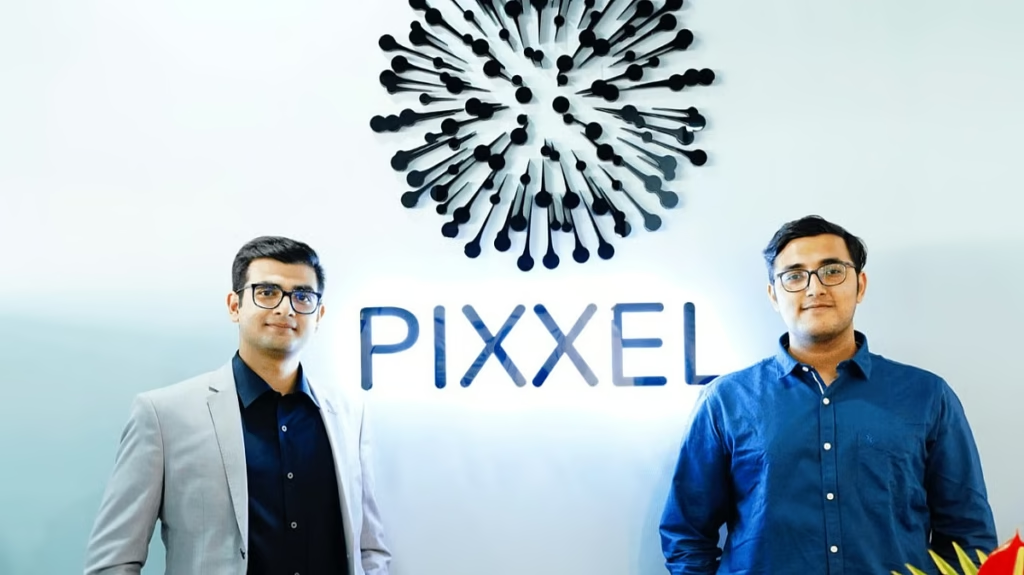
Bengaluru-based Pixxel has closed a $100 million Series C round, and it’s now officially the largest single funding round ever raised by an Indian space-technology company. The round was co-led by Temasek, Singapore’s state investment company, and Seraphim, a specialist spacetech investor, with new backers 360 ONE Asset and IMM Investment joining existing investors Radical Ventures and growX Ventures. This takes Pixxel’s total funding raised since inception to $195 million.
Quick Answer
Pixxel, an Earth observation and “planetary infrastructure” company, raised $100 million in a Series C round announced on September 7, 2026, co-led by Temasek and Seraphim, with participation from 360 ONE Asset, IMM Investment, Radical Ventures, and growX Ventures. The company started out building hyperspectral satellites, which capture far more detail about the Earth’s surface than standard satellite imagery, and has since expanded into Aurora, its Earth intelligence software platform, along with satellite manufacturing for both commercial and government customers. The fresh capital will fund four things: new satellite sensing capabilities including a constellation called Honeybee, continued development of Aurora, expansion of sovereign Earth-observation systems for governments, and increased satellite manufacturing capacity in India and the US.
What Pixxel Actually Does
Most satellite imagery you’ve seen, on Google Maps or in news coverage, is standard optical imagery: it shows you what something looks like. Pixxel’s core technology, hyperspectral imaging, captures data across many more wavelengths of light than a normal camera, which allows it to reveal information a regular image can’t, things like crop health, mineral composition, or methane leaks, invisible to the naked eye but detectable in the data. The company has deployed six satellites, called Firefly, which it describes as the world’s highest-resolution commercial hyperspectral constellation currently in orbit.
Around that core sensing capability, Pixxel has built out a broader business: Aurora, a software platform that turns raw satellite data into usable insights for customers, and a satellite manufacturing operation that builds spacecraft not just for itself but for other commercial and government space missions. The company has already secured contracts with NASA and the US National Reconnaissance Office, won multiple defence-innovation challenges run by India’s Ministry of Defence, and been selected to lead India’s first public-private Earth observation constellation, a 12-satellite project under IN-SPACe, India’s space sector regulator.
Get The Regular Startup Funding Update and Follow us On Instagram and Youtube.
Why This Round Is a Big Deal
Two things make this specific raise notable beyond its size. First, it’s genuinely the largest funding round any Indian spacetech company has closed, a meaningful marker for a sector that’s historically struggled to attract this scale of global institutional capital compared to, say, fintech or e-commerce. Second, the investor mix matters: Temasek is one of the world’s largest and most selective sovereign investment funds, and its participation, alongside a specialist space investor like Seraphim, signals that Pixxel is being evaluated by investors who deeply understand the sector, not just riding general enthusiasm for Indian startups.
The company plans to use the capital toward four specific priorities: expanding its sensing capabilities through a new satellite constellation called Honeybee alongside high-resolution optical imaging satellites, continuing to build out Aurora as its data-intelligence layer, growing its sovereign Earth-observation offerings for governments, and scaling up satellite manufacturing capacity across its India and US operations.
My Take
What stands out about Pixxel’s raise isn’t just the dollar figure, it’s the shift in what the company is actually selling. It didn’t start as a manufacturing company or a software company; it started with a single hyperspectral imaging product. This round funds the transition into what the company itself calls “planetary infrastructure,” sensors, software, and satellite manufacturing bundled together, sold to both commercial customers and sovereign governments. That’s a meaningfully more ambitious, and more defensible, business than a single-product satellite company, and it’s a useful example of how a genuinely narrow, technical starting point can expand into a much larger platform business once the underlying technology proves out.
Frequently Asked Questions
1. How much did Pixxel raise in this round? Pixxel raised $100 million in a Series C round, announced September 7, 2026, taking its total funding raised since inception to $195 million.
2. Who led Pixxel’s Series C round? The round was co-led by Temasek and Seraphim, with new investors 360 ONE Asset and IMM Investment, alongside existing backers Radical Ventures and growX Ventures.
3. What does Pixxel actually build? Pixxel builds hyperspectral imaging satellites that capture more detail about the Earth’s surface than standard imagery, along with Aurora, its Earth intelligence software, and satellite manufacturing for commercial and government customers.
4. Is this India’s largest-ever spacetech funding round? Yes, according to the company and multiple independent reports, this is the largest single funding round raised by an Indian space-technology company to date.
5. What will Pixxel do with the new funding? The capital will fund new satellite sensing capabilities (including the Honeybee constellation), further development of its Aurora software, expansion of sovereign Earth-observation systems for governments, and increased satellite manufacturing in India and the US.
Disclaimer
This article is intended for general informational purposes only and does not constitute investment advice regarding any private company. FinanceChecks.com is not affiliated with Pixxel, Temasek, Seraphim, or any investor mentioned. Figures are based on publicly reported company and investor disclosures as of September 7, 2026, and have not been independently audited.

Shuchi founded Finance Checks after spending 16+ years working in corporate, managing operations and distribution. She managed her own finances, learned and read regularly and helped people make sense of their savings, loans, insurance, and investments.
She started this site to offer the kind of clear, honest financial guidance she wished was more available when she was learning to manage her own money. Every article is researched personally, checked against official sources such as the Reserve Bank of India, SEBI, or the Income Tax Department, and revisited whenever regulations or figures change. She is upfront about how the site earns money through ads and select affiliate partnerships, and she does not let either influence what she actually recommends to readers.