
How to Get a Senior Citizen Card for Your Parents in India: Eligibility, Benefits, Documents and Online Application (2026 Guide)

My father turned sixty-two last year and still carries his old company ID card in his wallet out of habit, even though he retired four years ago. When I asked him why he never got a senior citizen card, he shrugged and said nobody had told him it existed, or what it actually does for him. That conversation is the reason this article exists. A lot of families assume the card is either automatic once you cross sixty, or that it is some optional formality that mostly matters for railway tickets. Neither is true, and if your parents are approaching or past sixty, it is worth spending twenty minutes understanding what this card is, what it genuinely gets you, and what it does not.
What a senior citizen card actually is
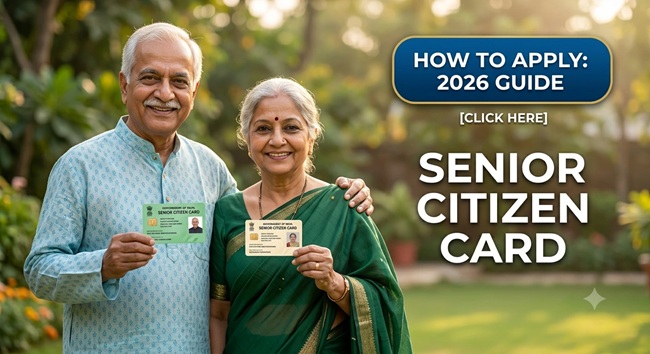
A senior citizen card, sometimes called a senior citizen certificate or senior citizen identity card depending on the state, is an identity document issued by a state government to residents who have crossed a certain age, usually sixty. It is not issued by the central government and there is no single national card that works uniformly across India. Each state runs its own scheme through its Revenue Department, e-District portal, or a designated welfare department, which is why the application process, the fee, and even the exact benefits differ depending on whether your parents live in Delhi, Maharashtra, Karnataka, Tamil Nadu, or anywhere else.
The card functions as proof of age and residence, and it is meant to sit alongside documents like Aadhaar or a voter ID card, not replace them. Most departments, hospitals, and banks will also accept Aadhaar or any government photo ID that shows date of birth as sufficient proof of senior citizen status, so the card is not strictly mandatory to access every benefit. What it does is make the process smoother, particularly with local state government offices, municipal services, and some private establishments that specifically ask for it.
Who is eligible for Senior Citizen Card
Eligibility is age based and nothing else. Your parents qualify if they meet these conditions.
They must be Indian citizens. They must be sixty years of age or above, though a small number of specific benefits under separate schemes use a different age, such as fifty-eight for women under some railway and transport concessions. They must be permanent residents of the state where they are applying, since the card is state issued and generally cannot be obtained from a state where someone is only temporarily staying. Employment status does not matter. It makes no difference whether your parent worked in a government job, ran a business, was self-employed, or never had a formal job at all. Income level also does not affect eligibility for the card itself, though it may affect eligibility for separate pension schemes that some people confuse with this card.
Non-resident Indians are generally not eligible to apply for this state issued card, since it requires proof of permanent residency within that state.
Documents your parents will need for Senior Citizen Card
Keep these ready before starting the application, whether online or offline, because incomplete submissions are the single biggest reason applications get delayed.
Proof of age is the most important one. A birth certificate is ideal, but if that is not available, a PAN card, passport, school leaving certificate, or Aadhaar card showing date of birth is usually accepted. Proof of identity, which is typically Aadhaar or voter ID. Proof of address or residence, which can be a ration card, utility bill, Aadhaar, or a residence certificate from the local authority. Two or three recent passport size photographs, since some state portals still ask for a physical copy even after online submission. A completed application form, which is available for download from the state’s e-District portal or the National Portal of India. In some states you will also need an income certificate or a self-declaration form, though this is not universal and is more common in states that link the card to certain welfare schemes.
If your parent has changed their name after marriage or through any legal process, carry a gazette notification or marriage certificate as supporting proof, since a mismatch in names across documents is a common reason applications bounce back.
Where and how to apply for Senior Citizen Card
There is no single central website that issues this card for the whole country, but the National Portal of India acts as a directory that links out to each state’s relevant department. If you search for the senior citizen identity card section on the National Portal, you will find state-wise links that redirect to the correct e-District or Sewa Kendra portal.
For an online application, the general steps look like this in most states. Go to your state’s e-District portal or the specific department website handling senior citizen services, sometimes listed under the Revenue Department or Social Welfare Department. Register or log in using a mobile number and Aadhaar based OTP verification. Select the senior citizen certificate or senior citizen identity card service from the list of citizen services. Fill in the application form with personal details, address, and date of birth exactly as it appears on the supporting documents. Upload scanned copies of the required documents, usually in PDF or JPEG format under a specified file size. Pay the application fee if applicable, which is often a nominal amount, sometimes as low as ten rupees, and in a few states it is entirely free. Submit the form and note down the application or reference number, since this is what you will use to track status.
For an offline application, visit the nearest Tehsildar’s office, Sub-Divisional Magistrate office, Common Service Centre, or Sewa Kendra depending on what your state calls its citizen service centre. Collect or download the application form, fill it manually, attach self-attested photocopies of the documents along with originals for verification, and submit it at the counter. You will usually be given an acknowledgment slip with a tracking number.
Processing time varies quite a bit by state and by how busy the local office is. Some states process it within a week if everything is in order, while others can take three to four weeks, particularly if physical verification of address is required. If there is unusual delay, the acknowledgment number lets you check status online or follow up at the same office.
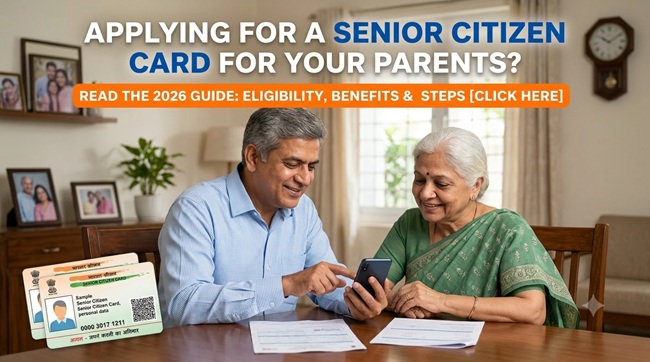
A practical tip if you are helping a parent apply from a different city: many state portals now allow a family member to complete the online form on the applicant’s behalf, as long as the Aadhaar based OTP verification goes to the parent’s own registered mobile number. If your parent does not use a smartphone or is not comfortable with the portal, doing it together over a phone call while you handle the typing works fine in most states, since the identity verification step is what actually matters, not who is physically typing.
What benefits Senior Citizen Card genuinely unlocks
This is where a lot of online content overstates things, so it helps to separate what the card itself does from what is a broader benefit tied to age rather than the card.
Banking and savings benefits are real and significant. Once your parent’s age is verified through any accepted proof, including this card, banks typically offer a higher interest rate on fixed deposits and recurring deposits compared to regular customers, usually an additional 0.25 to 0.5 percent depending on the bank. Post office schemes, including the Senior Citizen Savings Scheme, also require age proof and this card can serve that purpose alongside Aadhaar.
Income tax benefits are tied to age under the Income Tax Act rather than to the card specifically, but the card is useful supporting documentation. Under the old tax regime, the basic exemption limit is higher for those aged sixty to seventy nine compared to younger taxpayers, and it rises further for those above eighty, who are classified as super senior citizens. Section 80D allows a higher deduction on health insurance premiums for senior citizens, and Section 80TTB allows a deduction of up to fifty thousand rupees on interest earned from bank and post office deposits. Senior citizens without business income are also exempt from the requirement to pay advance tax.
Healthcare benefits differ by state but commonly include priority queues at government hospitals, discounted consultation or treatment charges at some government facilities, and in select states, subsidised or free treatment for specific conditions. Some private hospital chains also offer discounts to senior citizens who present valid age proof, though this varies by hospital and is not guaranteed everywhere.
Travel and transport benefits are the most misunderstood part of this topic, so it is worth being precise. Many state road transport corporations offer a percentage discount on bus fares for senior citizens, and this genuinely works with the card or any valid age proof. Indian Railways, however, suspended its general senior citizen fare concession in March 2020 during the pandemic, and as of 2026 the Railway Ministry has stated in Parliament that it has no current plans to restore it. What senior citizens still get on trains are non-fare benefits, such as a separate reservation counter at many stations, and automatic priority for lower berth allotment when berths are available, particularly useful since climbing to upper or middle berths becomes genuinely difficult for many older travellers. If you see articles claiming the railway fare discount has returned, treat that with caution and check directly on the IRCTC or Indian Railways website before your parents plan a trip around it, since this specific claim circulates frequently without an official notification behind it.
Some airlines have offered discretionary discounts for senior travellers in the past, but this is airline specific, changes often, and is not a standing entitlement the way the tax and banking benefits are.
Other smaller but genuinely useful benefits include priority hearing in some courts, discounted or waived charges on certain BSNL and MTNL landline services for those above sixty five, and in several states, priority processing for passport applications and other government services.
The Senior Citizen Card versus the pension: a common mix-up
One confusion worth clearing up directly. This card is not the same as an old age pension, and it is not the same as Ayushman Bharat or any state health insurance scheme. The card is an identity document that helps prove age and residency. A pension under schemes like the National Social Assistance Programme or various state old age pension schemes requires a separate application, has its own income eligibility test, and needs periodic life certificates to continue disbursement. Ayushman Bharat and its state variants, such as the ABHA health ID, provide actual health insurance coverage and also need to be applied for independently. Do not assume that getting this identity card automatically enrols your parent into any pension or health cover scheme, because it does not.
A quick note on validity and renewal for Senior Citizen Card
In most states this card does not have an expiry date once issued, since it is essentially a one-time identity document rather than something that needs annual renewal. If it gets lost or damaged, you can apply for a duplicate through the same e-District portal, Common Service Centre, or Tehsildar’s office that issued the original, usually by paying a small reissue fee.
Frequently asked questions about Senior Citizen Card
At what age can my parents apply for a senior citizen card? Sixty years is the standard threshold across nearly all states for the general card. A few specific benefits, such as certain transport concessions, use fifty-eight as the age for women, but the identity card itself is generally issued from sixty onward.
Can I apply for the card on my parent’s behalf if they are not comfortable using a computer or smartphone? Yes, in practice. You can fill the online form for them as long as the Aadhaar linked mobile OTP verification is completed using their own registered number, or you can visit the local Tehsildar office or Sewa Kendra together and submit a physical application.
Is there a fee for the senior citizen card? It varies by state. Many states charge a nominal fee, often around ten rupees, while some issue it free of cost. There is no standard national fee since each state sets its own.
How long does it take to get the card after applying? This depends heavily on the state and whether physical address verification is required. It can be as quick as a week in some states and take three to four weeks in others.
Does my parent need this card to get the higher fixed deposit interest rate at their bank? Not necessarily this specific card. Banks accept any valid government issued proof showing date of birth, including Aadhaar, PAN, or passport, to apply the senior citizen interest rate. This card is one accepted option among several, not the only one.
Is the railway fare concession for senior citizens available in 2026? No, not the general fare discount. It was suspended in March 2020 and has not been restored as of 2026, based on the Railway Ministry’s own responses in Parliament. Senior citizens do still get non-fare benefits like separate booking counters and priority for lower berth seats.
Is this card the same as an Ayushman Bharat card or a pension card? No. This is purely an identity document proving age and residency. Health insurance coverage under Ayushman Bharat and old age pension under central or state schemes are entirely separate applications with their own eligibility conditions.
Can a person who lives in one state but is originally from another state apply using the state they currently reside in? Generally yes, provided they can show proof of permanent residency in the state where they are applying, such as a long-standing address on Aadhaar, ration card, or a residence certificate from the local authority. Someone only temporarily staying in a state, such as on a short visit, typically cannot apply there.
What happens if the card is lost? You can apply for a duplicate or reissue through the same portal or office that issued the original card, usually with a small fee and a fresh set of the same supporting documents.
Do NRIs qualify for this card? No. The card requires proof of permanent residency within an Indian state, which non-resident Indians typically cannot provide in the way the application requires.
Is the card compulsory to access senior citizen benefits at hospitals, banks, or government offices? Not usually. Most institutions accept any valid age proof, including Aadhaar, PAN, passport, or voter ID. The senior citizen card is convenient and specifically recognised for state government services, but it is rarely the only accepted document.
A closing thought
If your parents are past sixty and do not yet have this card, it is a small administrative task that is easy to keep postponing, mostly because nobody explains clearly what it actually changes. It will not replace a pension, it will not bring back the railway discount, and it will not act as health insurance. What it will do is make interactions with state government offices smoother, support the interest rate benefits they are already entitled to at the bank, and serve as one more accepted proof of age when it matters. Given how little effort the application takes once the documents are in hand, it is worth doing sooner rather than later.
Disclaimer: This article is for general informational purposes only and does not constitute financial, tax, or legal advice. Senior citizen card eligibility criteria, application procedures, fees, processing timelines, and associated benefits vary by state and are subject to change by the respective state government departments and the Government of India from time to time. Railway concession status, tax provisions, and scheme details mentioned here reflect information available at the time of writing and may have been updated since. Readers are strongly advised to verify current rules, forms, and fee structures directly on the official National Portal of India, their respective state e-District portal, the Income Tax Department website, or by visiting the concerned government office before applying or making any financial decision based on this information. Neither the author nor this publication accepts responsibility for losses arising from reliance on outdated or state-specific details that may differ from what is described here.

Shuchi founded Finance Checks after spending 16+ years working in corporate, managing operations and distribution. She managed her own finances, learned and read regularly and helped people make sense of their savings, loans, insurance, and investments.
She started this site to offer the kind of clear, honest financial guidance she wished was more available when she was learning to manage her own money. Every article is researched personally, checked against official sources such as the Reserve Bank of India, SEBI, or the Income Tax Department, and revisited whenever regulations or figures change. She is upfront about how the site earns money through ads and select affiliate partnerships, and she does not let either influence what she actually recommends to readers.