


Let’s start with an uncomfortable truth that most people never sit down and actually calculate. If you keep your savings in a regular bank account or even a fixed deposit, there is a strong chance you are quietly losing money every single year, even though the number on your passbook keeps going up.
Here is why. A typical fixed deposit in India today pays somewhere in the range of five to seven percent a year, depending on the bank and tenure. Inflation, the rate at which prices for everyday things rise, has also been running somewhere around five to seven percent in recent years. When your money grows at roughly the same pace that prices are rising, your actual purchasing power, what your money can really buy, barely moves, and after you account for tax on that FD interest, it can easily go backward. This is the quiet thief that nobody warns you about clearly enough: inflation does not announce itself, it just slowly makes your money worth less.
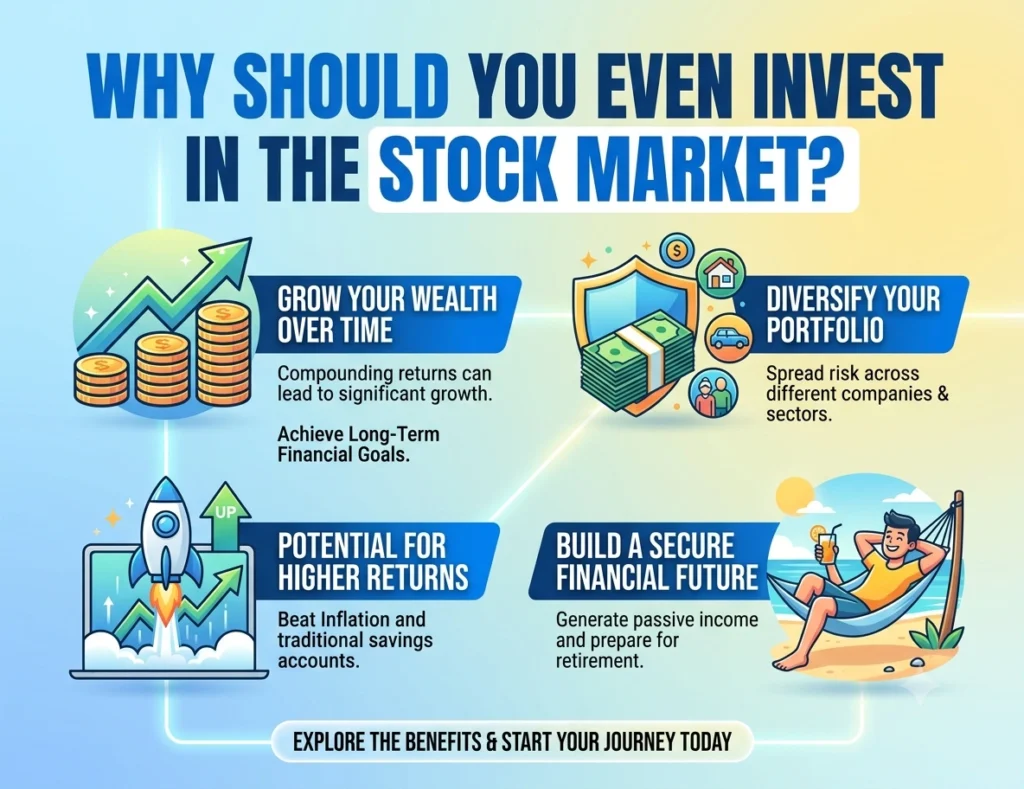
So what does the stock market actually offer instead?
When you buy a share, you are not lending money to anyone and waiting for a fixed interest payment. You are buying a piece of a business, and that business’s value, if it is run well, tends to grow over time as it earns more profit, expands, and becomes more valuable. Your investment grows along with it. There is no fixed promise here, and that is an important distinction; a fixed deposit promises you a specific number, while a stock simply gives you a share of whatever the business actually achieves, for better or worse.
Looking back over long stretches of history, India’s broad market, represented by the Sensex, has compounded at somewhere around fourteen to sixteen percent a year on average over multi-decade periods. That number deserves three immediate caveats, because it is exactly the kind of figure that gets misused. It is a long-term average built from individual years that swung wildly, some up thirty percent, some down twenty percent or worse. It reflects the past, not a promise about the future. And it assumes you stayed invested through the rough years instead of panic-selling, which, in practice, is the hardest part of investing for almost everyone.
Understand What Is Stock Market? Step By Step Guide For Stock Market in India
Stock Market Terms, Every Know Should Know About
A fair side-by-side look at where Indians typically park money
It helps to actually compare the common options honestly rather than assume one is simply “better.”
Fixed deposits give you safety and a guaranteed, known return, which makes them genuinely useful for money you cannot afford to risk. Their downside is that returns are modest and frequently fail to meaningfully beat inflation and tax combined.
Gold has been a trusted store of value in Indian households for generations, and it has delivered strong returns over the past several years as global uncertainty pushed prices up. It is reasonably liquid, especially in the form of gold ETFs or sovereign gold bonds rather than physical jewellery, and it tends to do well precisely when other investments are struggling, which makes it a useful hedge. Its downside is that gold does not generate any income on its own; it simply changes in price, and physical gold comes with making charges, storage worries and purity concerns.
Real estate can build significant wealth and gives you something tangible, but it demands a large amount of capital upfront, is difficult and slow to sell quickly if you need cash, and comes with ongoing costs like maintenance, property tax and, often, legal complications.
Equities, meaning stocks and equity mutual funds, have historically delivered the highest long-term growth potential among all of these, precisely because you are participating directly in business growth and economic expansion rather than earning a fixed rate. The cost of this potential is volatility; your investment’s value can swing significantly in the short term, and there is no guarantee attached to any of it.
The real trade-off nobody can avoid: risk versus reward
This is the single idea that underlies everything else in investing, so it is worth saying plainly. Generally, the investments with the highest potential long-term reward also carry the highest short-term uncertainty. There is no investment that offers high guaranteed returns with no risk; if anyone ever pitches you something that sounds like that, it is either misleading you or outright fraudulent.
What this means practically is that money you might need in the next year or two, your emergency fund, money for a wedding next spring, your child’s school fee due in six months, simply should not be sitting in stocks, because you might need to sell at exactly the wrong moment, during a downturn, and lock in a loss. Stocks are genuinely best suited to money you can comfortably leave alone for at least five years, ideally longer, so that short-term ups and downs have time to smooth out.
A simple illustration of compounding, purely hypothetical
Here is a purely illustrative example to show why time matters so much, with the explicit caveat that this is a simplified hypothetical, not a forecast or a promise of what will actually happen to your money.
Imagine someone invests ten thousand rupees a month into the broader equity market starting at age twenty-five, and simply continues that habit, undisturbed, until age fifty-five, a thirty-year stretch. If that money had compounded at a steady twelve percent a year, purely as an illustrative assumption and not a guarantee, the total amount invested over those thirty years would be around thirty-six lakh rupees, while the value of the investment, thanks to compounding, would be several times that figure. Compare that to the same monthly amount sitting in an account earning closer to six percent, and the gap over thirty years becomes enormous. The point of this example is not the specific numbers, which will never play out exactly this way in reality, but the underlying lesson: time in the market, combined with a reasonable growth rate, does far more heavy lifting than most people intuitively expect, and starting early matters more than almost anything else you will read in this entire series.
Before you invest a single rupee, get these basics sorted first
A genuinely important piece of advice that often gets skipped in excitement to “start investing.” Before you put money into the stock market, make sure you already have an emergency fund covering at least three to six months of expenses sitting somewhere safe and easily accessible, like a savings account or a liquid fund. Pay off any high-interest debt first, particularly credit card debt, since the interest you are paying there is almost certainly higher than any reasonable return you could expect from the market. And be honest with yourself about any money you will need within the next couple of years; that money belongs in a fixed deposit or similar safe option, not in stocks.
Invest in Stock Market : Quick recap
Money sitting idle in a regular savings account quietly loses real value to inflation over time.
Stocks represent ownership in growing businesses, which is why they have historically offered higher long-term growth potential than fixed deposits, though never any guarantee.
Fixed deposits, gold, real estate and equities each have a genuine place; the right mix depends on your own goals, timeline and comfort with risk, not on which one sounds the most exciting.
Higher potential reward always comes paired with higher short-term uncertainty; there is no exception to this rule worth believing.
Stocks suit money you can leave untouched for at least five years; never invest money you might need soon.
Time in the market is one of the most powerful and most underrated tools any investor has, which is why starting early, even with small amounts, matters enormously.
Sort your emergency fund and any high-interest debt before you put a single rupee into the market.
Now that you understand why people invest at all, the next chapter gives you the vocabulary you will need to actually follow along, since half of investing confidence simply comes from not feeling lost when someone uses a term like “P/E ratio” or “circuit breaker.”
Invest in Stock Market : Frequently Asked Questions
Is the stock market always better than a fixed deposit? Not always, and “better” depends entirely on what the money is for. For money you need safely available within the next one to two years, a fixed deposit is genuinely the more sensible choice, since you know exactly what you will get back and exactly when. For money you can leave untouched for five years or more, equities have historically offered meaningfully higher growth, but with no guarantee and real short-term ups and downs along the way. A thoughtful financial plan usually uses both, not one instead of the other.
How much of my savings should actually go into stocks? There is no single correct percentage for everyone, since it depends on your age, income stability, existing responsibilities and comfort with risk, but the chapters ahead on risk profiling and portfolio building will give you a proper framework to work this out for yourself rather than copying someone else’s number. As a starting principle, only money you do not need in the near term, and that you have already set aside an emergency fund ahead of, should be considered for the market at all.
What if I invest and the market crashes right after I put my money in? This happens to almost every investor at some point, including experienced ones, and it is one of the most psychologically difficult moments in investing. The historically sound response is to avoid panic-selling at a loss and instead stay invested if your goals and timeline have not changed, since markets have, over long periods, recovered from every downturn in India’s history so far. That said, this is a general historical pattern, not a guarantee about any future crash, and it is exactly why money you might need soon should never be in the market in the first place.
Is gold actually a safer investment than stocks? Gold tends to be less volatile day to day than individual stocks and often performs well during periods of global uncertainty or when equity markets are struggling, which is why many financial planners suggest holding a modest portion of a portfolio in gold as a cushion. However, gold generates no income or earnings on its own; its returns come purely from price appreciation. Calling one asset class flatly “safer” than another oversimplifies things, since each carries a different kind of risk, price risk for gold, business and market risk for equities, rather than one being risk-free and the other risky.
Is real estate a better long-term investment than the stock market? Real estate can build genuine wealth over time, and it offers a tangible asset many people find psychologically reassuring. It also has real downsides worth weighing honestly: it requires a large amount of capital upfront, is slow and difficult to sell quickly if you need cash, and comes with ongoing costs like maintenance, property tax and sometimes legal disputes over title. Stocks, by contrast, can be bought and sold within seconds and in much smaller amounts. Neither is universally “better”; they serve different purposes and many people hold both.
Does that 14 to 16 percent historical return mean I will get that every year? No, and this is worth repeating clearly. That figure is a long-term average calculated across many years, some of which were sharply positive and some sharply negative. In any single year, returns could be strongly positive, flat, or meaningfully negative. The average only tends to show up if you stay invested across a long enough stretch of time, riding out the bad years along with the good ones.
I can only invest a small amount, like five hundred or a thousand rupees a month. Is it even worth starting? Yes, genuinely. The earlier chapters on compounding exist specifically to make this point: the amount matters less than most beginners assume, and the habit of starting early and staying consistent matters more. Many mutual fund SIPs and even direct stock purchases today can be started with very small monthly amounts, and a small amount invested consistently for twenty or thirty years can grow into a meaningfully large sum precisely because of compounding, even if the monthly contribution feels modest today.
Should I pay off my home loan before I start investing, the way the chapter suggests for credit card debt? This is more nuanced than credit card debt. Credit card interest rates in India are typically extremely high, often well above any return you could reasonably expect from the market, which is why clearing that debt first is almost always the right call. A home loan, by contrast, usually carries a meaningfully lower interest rate, and in many cases also comes with tax benefits, so the comparison is closer and reasonable people make different choices here depending on their own comfort with carrying long-term debt while also investing. This chapter’s advice to clear high-interest debt first applies most strongly and clearly to things like credit cards and personal loans.
Is there ever a point where it is too late to start investing in the stock market? Practically speaking, no, though the earlier you start, the more time compounding has to work in your favour. Someone starting at forty-five still has a meaningful investing runway of fifteen to twenty years or more before typical retirement age, and equities can still play a useful role in that period, simply with a different mix of risk and time horizon than someone starting at twenty-five would use. The honest takeaway is to start now, with whatever amount you can manage, rather than waiting for a “better” time that may never feel like it has arrived.
Why does this chapter keep stressing that nothing here is a guarantee? Because a huge amount of harm in retail investing comes from people treating historical averages, illustrative examples or someone’s enthusiastic tip as though they were guarantees. Genuinely understanding and accepting that markets carry real, sometimes painful uncertainty is not a discouraging message; it is the single most protective mindset you can carry into investing, since it is what stops you from over-committing money you cannot afford to risk, or panicking and selling at exactly the wrong moment.
Disclaimer
This chapter has been written purely for general educational purposes, to help a complete beginner understand the broad reasoning behind investing in the stock market compared with other common options like fixed deposits, gold and real estate. It is not financial, investment, tax or legal advice, and nothing in it should be read as a recommendation about how much to invest, which asset class to choose, or what returns to expect. All historical return figures, interest rate ranges and the compounding example used in this chapter are illustrative, drawn from publicly available long-term historical data at the time of writing, and are not predictions or promises about future performance; actual returns for any asset class or individual investment will differ, sometimes significantly, and can be negative over both short and extended periods. Every individual’s financial situation, goals, obligations and risk tolerance are different, and the general guidance in this chapter, such as building an emergency fund or clearing high-interest debt first, may not fit every personal circumstance. Before making any actual financial decision, please consider speaking with a SEBI-registered investment adviser or a qualified financial planner who can assess your specific situation. Neither the author nor the publisher accepts any responsibility or liability for losses or consequences arising from reliance on the information in this chapter.

Shuchi founded Finance Checks after spending 16+ years working in corporate, managing operations and distribution. She managed her own finances, learned and read regularly and helped people make sense of their savings, loans, insurance, and investments.
She started this site to offer the kind of clear, honest financial guidance she wished was more available when she was learning to manage her own money. Every article is researched personally, checked against official sources such as the Reserve Bank of India, SEBI, or the Income Tax Department, and revisited whenever regulations or figures change. She is upfront about how the site earns money through ads and select affiliate partnerships, and she does not let either influence what she actually recommends to readers.



-
-
-
-
-
Show Comments[…] Read Our Next Chapter : Why You Should Invest in Stock Market of India […]
[…] Why Invest in Stock Market? […]
[…] Why Should You Even Invest in Stock Market? […]
[…] read our earlier post on what a mutual fund is, you already know that a fund pools money and invests it in stocks, bonds, or a mix of both, generating returns over time. Under the Growth option, every rupee of […]
[…] had been investing in stocks for almost a year, mostly on tips from a WhatsApp group and the occasional YouTube video. It worked […]