
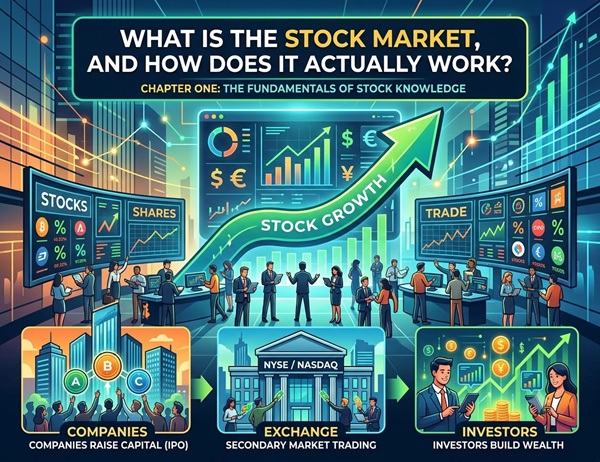

Picture a friend who runs a small but genuinely promising restaurant. Business is good, but she wants to open three more branches and just does not have the cash. She has two choices. She can go to a bank and borrow money, which means fixed monthly repayments whether business is good or bad. Or she can sell a slice of ownership in the restaurant itself to a few people who believe in what she is building, and use that money to expand. Those people now own a small piece of her restaurant. If it does well, their slice becomes more valuable. If it struggles, so does their investment.
That second option, at its core, is exactly what the stock market is. It is just done at a massive scale, with thousands of companies, millions of investors, and a tightly regulated system making sure everyone plays fair.
A share is simply a slice of ownership
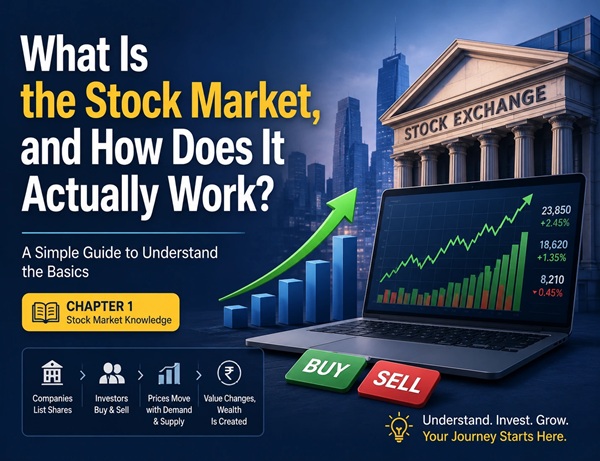
When a company sells a “share,” it is selling you a tiny, proportional slice of itself. Buy one share of a company and you genuinely own a sliver of that business, its factories, its brand, its future profits, all of it, in proportion to how many shares exist. A company like Tata Consultancy Services has billions of shares outstanding, so one share is an extremely small slice. A smaller, newer company might have far fewer shares, so your slice is proportionally larger.
This is the single most important thing to internalise before anything else in this series: you are not buying a lottery ticket or a number on a screen. You are buying a small ownership stake in a real, functioning business. Everything else in investing builds on that one idea.
Why companies bother selling shares at all
Companies need money to grow, build factories, hire people, develop new products, or pay off expensive debt. They have a few ways to raise that money. They can borrow from a bank, which has to be repaid with interest regardless of how the business performs. Or they can sell ownership stakes to investors through the stock market, which does not need to be repaid the same way, since investors are betting on the company’s future growth rather than lending it money.
When a company sells shares to the public for the very first time, that is called an Initial Public Offering, or IPO. From that point on, the company is “listed,” meaning its shares can be freely bought and sold by the public on a stock exchange.
Where all this actually happens: the exchanges
India has two major stock exchanges where shares are bought and sold: the National Stock Exchange, known as NSE, and the Bombay Stock Exchange, known as BSE, which is the oldest exchange in Asia. Think of an exchange as a massive, fully digital marketplace. It does not own any of the companies listed on it; it simply provides the infrastructure where buyers and sellers can find each other and trade safely, with prices set transparently by supply and demand in real time.
Between the two exchanges, India has well over 5,000 listed companies, spanning everything from giant banks and IT firms to small regional manufacturers, making it one of the largest stock markets in the world by total market value. Most retail investors in India end up trading mainly on NSE simply because it tends to have higher trading volume and tighter prices, but the same share is usually listed and tradeable on both.
Sensex and Nifty: the Stock Market’s pulse, not the market itself
You will hear “Sensex is up 400 points today” on the news constantly, and it is worth understanding exactly what that means. The Sensex is BSE’s benchmark index, built by tracking the 30 largest and most actively traded companies listed there. The Nifty 50 is NSE’s equivalent, tracking the 50 largest companies on that exchange. Neither index is something you directly own shares of; they are simply a calculated number meant to represent the overall mood and direction of the broader market, the way a thermometer represents temperature without being the weather itself.
When people say “the market went up,” they almost always mean one of these two indices moved up. It is a useful shorthand, but remember that an individual stock you hold can move in the completely opposite direction of the index on any given day. We will get into this more, but it is worth knowing now that there are also ways to invest directly in an index itself, through index funds and exchange-traded funds, which we will cover later in this series.
Who makes sure nobody cheats: SEBI
The Securities and Exchange Board of India, or SEBI, is the regulator that oversees the entire Indian securities market. Think of SEBI as the referee of this whole system. It sets the rules for how companies can raise money, how brokers must behave, what information companies are required to disclose to the public, and it has the power to investigate and penalise anyone who manipulates prices or misleads investors. Every legitimate stockbroker in India has to be registered with SEBI, and we will cover exactly how to verify this in a later chapter, because it is one of the simplest and most effective ways to protect yourself from fraud.
What actually happens when you click “buy”
Here is the part most beginners never get a clear picture of. Say you decide to buy ten shares of a company through your broker’s app. The moment you place that order, here is the journey it takes:
Your broker sends the order to the stock exchange. The exchange’s system instantly looks for a matching sell order from someone else willing to sell at that price. Once matched, the trade is “executed,” meaning the price is locked in for both of you. The exchange’s clearing corporation then steps in as a kind of trusted middleman, confirming the trade and making sure the buyer’s money and the seller’s shares genuinely change hands. This final step is called settlement.
India has actually become one of the fastest markets in the world on this front. Since early 2023, the standard settlement cycle for all stocks has been what is called T+1, meaning the shares show up in your demat account and the money moves out of your account one business day after the trade, rather than the two days it used to take. For the largest 500 or so companies by size, an optional same-day settlement called T+0 is now also available through many brokers, and regulators are actively piloting even faster, near-instant settlement. In plain terms: buying and selling shares in India today is faster, safer and more transparent than it has arguably ever been.
Two markets, not one: primary and secondary
One small but useful distinction. When a company first sells its shares to the public through an IPO, that happens in what is called the primary market, and the money raised goes directly to the company. After that, every single time you buy or sell that share on any regular trading day, you are doing it in the secondary market, where you are buying from or selling to another investor, not the company itself. The company does not receive any money from your day-to-day trading; it only benefited once, at the IPO stage. Almost everything covered in the rest of this series happens in the secondary market.
Stock Market : Quick recap
A share is a real, proportional slice of ownership in a company, not just a number on a screen.
Companies sell shares through an IPO to raise money without taking on debt.
NSE and BSE are India’s two stock exchanges, the marketplaces where shares are bought and sold.
Sensex and Nifty are indices that track groups of large companies and represent the market’s overall mood, not something you directly buy.
SEBI is the regulator making sure the whole system stays fair and transparent.
Settlement in India now happens in roughly one business day, with even faster options rolling out.
Most of your day-to-day buying and selling happens in the secondary market, between investors, not with the company itself.
Now that you know what the stock market actually is, the natural next question is the one that matters most for your wallet: why should you bother putting your money here at all, instead of a fixed deposit or gold? That is exactly what we cover next.
Read Our Next Chapter :
Stock Market: Frequently Asked Questions
Q. Is buying a share basically the same as gambling?
No, and this is one of the most important distinctions to get right early on. A bet on a coin toss has no relationship to anything real; the outcome is pure chance. A share is a legal claim on a real, ongoing business with revenue, employees, assets and a track record. Its price can certainly be volatile in the short term, and yes, you can lose money, but over the long run a share’s value is tied to how that actual business performs, not to luck. Treating the stock market like a casino, jumping in and out based on tips and excitement, is what makes it feel like gambling. Treating it as ownership in a business you understand is what makes it investing.
Q. Can I actually lose all my money in the stock market?
For a single stock, yes, it is possible, though not common. If a company you hold shares in goes bankrupt and is wound up, shareholders are the last in line to be paid after lenders, bondholders and other creditors, and often receive nothing. This is exactly why diversification, spreading your money across many companies and sectors rather than betting everything on one, matters so much, and we will cover this properly in the chapter on building a portfolio. For context, losing your entire investment in a well-diversified basket of large, established companies all at once is extremely unlikely, though declines in value during bad years are completely normal and should be expected.
Q. What is the difference between NSE and BSE, and does it matter which one I use?
NSE was established in 1992 and introduced electronic trading to India, while BSE, founded in 1875, is the oldest stock exchange in Asia and originally operated through an open outcry trading floor before going fully electronic itself. Today, both are modern, fully digital, SEBI-regulated exchanges, and the vast majority of companies you would want to invest in are listed on both. In practice, most brokers route your order to whichever exchange offers the better price at that exact moment, so as a beginner you generally do not need to actively choose between them; your broker’s app handles this in the background.
Q. How is the price of a share actually decided?
Purely by supply and demand, in real time, the same way a price gets decided at any auction. If more people want to buy a share than sell it at a given price, the price rises until enough sellers are tempted in. If more people want to sell than buy, the price falls until buyers step in. This happens continuously throughout the trading day as new information, company results, news, broader economic data, shifts how buyers and sellers value a business.
Q. What is the minimum amount of money I need to start in Stock Market?
There is no fixed minimum investment amount to start investing in shares themselves; many stocks trade at a price of a few hundred rupees or less, and you can buy as little as a single share if your budget is small. The real minimum cost to be aware of is opening a demat and trading account, which we cover in detail in a later chapter, and that process today is largely free or very low-cost with most Indian brokers.
Q. Is the stock market the same thing as trading in cryptocurrency or forex?
No. A share represents legal ownership in a real, regulated company that is required to disclose its financials and is overseen by SEBI. Cryptocurrency represents ownership of a digital asset with no underlying business, no earnings, and in India, no equivalent regulatory protection from a body like SEBI. Forex, or foreign currency trading, is a bet on the relative value of one currency against another. All three involve price movement and risk, but they are fundamentally different types of assets with very different levels of regulation and investor protection behind them.
Q. If I own shares in a company, do I get any say in how it is run?
Technically yes, in a limited way. Shareholders are typically entitled to vote on major company decisions, such as appointing directors or approving mergers, usually in proportion to how many shares they hold, and this is often done electronically these days rather than requiring you to attend a physical meeting. In practice, if you hold a handful of shares in a company with billions of shares outstanding, your individual vote has a negligible impact on the outcome, but the right itself is real and is one more way in which owning a share is fundamentally different from any other kind of financial product.
Q. Does the company actually know who owns its shares, like me personally?
Yes, in the sense that your name appears on the company’s official register of shareholders, maintained electronically through the depository system, NSDL or CDSL, that we mentioned earlier. This is also how companies know exactly who to send dividends to, and who is eligible to vote on company matters.
Q. What happens to my shares if my broker shuts down or goes out of business?
Your shares themselves are safe, because they are held in your own demat account with a depository, NSDL or CDSL, not inside your broker’s own books. Your broker is simply the intermediary that lets you place orders; it never actually holds your shares directly. This separation exists specifically to protect investors if a broker runs into financial trouble, and it is one of the more reassuring aspects of how the Indian market is structured. We will go into broker selection and safety checks in more depth in the chapter on opening your account.
Q. Is every Indian company listed on the stock market?
No, not at all. Only companies that have chosen to go public through an IPO, and that meet SEBI’s listing requirements around disclosure, governance and financial track record, are listed and tradeable. The vast majority of Indian businesses, including most small and medium enterprises, remain privately held and are simply not available for ordinary investors to buy shares in.
Q. Why does the news talk about Sensex and Nifty constantly instead of individual stocks?
Because indices give a quick, single-number snapshot of overall market direction that is easy to report and easy to compare day to day, the way a national weather report gives you one headline temperature instead of listing every city. It is useful shorthand for the broad mood of the market, but it is not a substitute for paying attention to how your own specific holdings are actually doing, since an individual stock can easily move opposite to the index on any given day.
Q. I still feel a bit overwhelmed. Is that normal at this stage?
Completely normal, and arguably a good sign rather than a bad one. Feeling slightly overwhelmed usually means you are taking this seriously enough to want to actually understand it, rather than diving in blindly. Nobody absorbs all of this in one sitting. Re-read this chapter once you have gone through the glossary in Chapter 3, and most of these ideas will click into place a second time around far more easily.
Disclaimer
This chapter, and this entire series, has been written purely for general educational purposes, to help a complete beginner understand how the Indian stock market works. It does not constitute financial, investment, tax or legal advice, and nothing in it should be treated as a recommendation to buy, sell or hold any particular share, fund or security. Facts regarding exchanges, settlement cycles, regulations and market structure have been checked against publicly available information at the time of writing, but rules, timelines and processes set by SEBI, NSE, BSE and the depositories can and do change, so please verify current details on the official websites of SEBI (sebi.gov.in), NSE (nseindia.com) and BSE (bseindia.com) before relying on them for any real decision. Investing in the stock market involves real risk, including the risk of losing some or all of your invested capital, and past performance of any company, index or asset class is never a guarantee of future results. Before making any actual investment decision, please consider consulting a SEBI-registered investment adviser who can take your personal financial situation into account. Neither the author nor the publisher accepts any responsibility or liability for losses or consequences arising from reliance on the information in this chapter.

Shuchi founded Finance Checks after spending 16+ years working in corporate, managing operations and distribution. She managed her own finances, learned and read regularly and helped people make sense of their savings, loans, insurance, and investments.
She started this site to offer the kind of clear, honest financial guidance she wished was more available when she was learning to manage her own money. Every article is researched personally, checked against official sources such as the Reserve Bank of India, SEBI, or the Income Tax Department, and revisited whenever regulations or figures change. She is upfront about how the site earns money through ads and select affiliate partnerships, and she does not let either influence what she actually recommends to readers.



[…] Understand What Is Stock Market? Step By Step Guide For Stock Market in India […]
[…] What is Stock Market? […]
[…] never actually sat down to learn what these numbers mean. If you’ve followed this series from understanding what the stock market is through opening your Demat account and placing your first trade, this post fills in the piece that […]
[…] you’ve followed this series from understanding what the stock market is through fundamental analysis, this is a natural next step, since you already have the chart-reading […]