
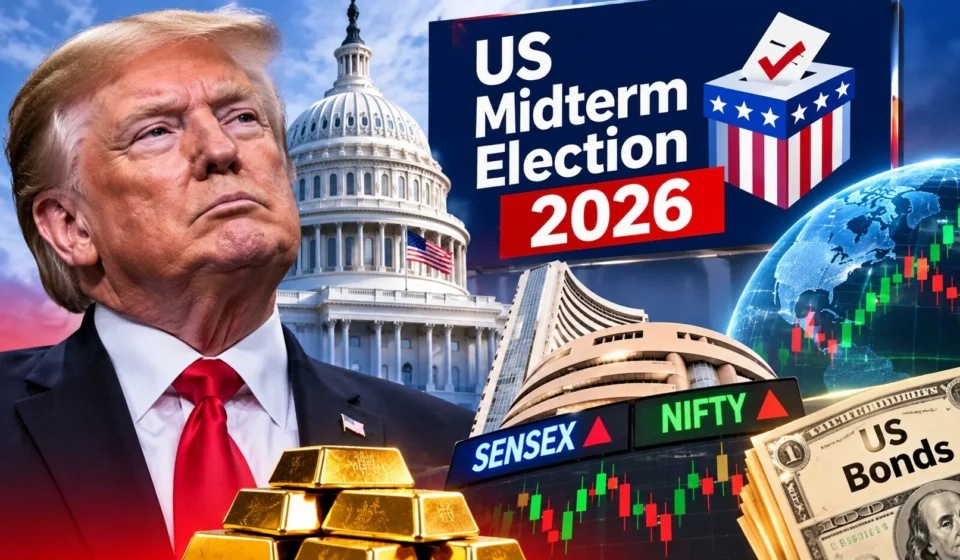
US Midterm Results 2026: Democrats Win Congress, but Tariffs on India May Stay at 10% to 20%. What It Means for the Sensex (75,693) and Indian Business

By Shuchi, FinanceChecks.com | Published 4 November 2026 | Category: Stock Market | Reading time: about 6 minutes
Many people in India are asking whether “Trump lost the election” and whether tariffs on Indian goods will now go away. The first claim is wrong and the second is unlikely in the short term. This article explains what actually happened in the US on 3 November, what it means for tariffs, the Indian stock market and Indian business, and what to watch next.
Quick Answer
Donald Trump did not lose an election. He is still US President, and his term runs to January 2029. The vote on 3 November was the US midterm election for Congress, and Democrats were projected to win both the House of Representatives and the Senate, taking control in January 2027. This changes who controls Congress, not who runs the White House. Most analysts expect little immediate change in US tariffs on India, because the President keeps his veto and wide trade powers. Jefferies expects the average effective US tariff rate to stay between 10% and 20% even under a divided government. For Indian markets, experts mainly expect short-term volatility, with oil, the Fed and foreign investor flows mattering more.
About This Guide
This article is written by the editorial desk of FinanceChecks.com, an independent Indian personal finance publication. It uses results reports from CNN, NBC News and Yahoo News (citing AP), and analysis from UNI, CNBC-TV18, Emkay Research, Jefferies and Kotak Neo published between 1 and 4 November 2026. Some races were still being counted, and trade-deal details are reported differently across sources. This article does not take a political side and is not investment advice.
What Happened in the US Election
| Item | Detail |
|---|---|
| Election | US midterm elections, 3 November 2026 |
| What was on the ballot | All 435 House seats and 33 Senate seats, not the presidency |
| Senate | Democrats flipped seven Republican seats, including Iowa, Kansas, Ohio, Maine, North Carolina, South Carolina and Texas, according to NBC News projections |
| House | Democrats reached at least 218 confirmed seats, enough for a majority, according to NBC News |
| When it takes effect | The new Congress takes office in January 2027 |
| President | Donald Trump remains in office with his veto and executive powers |
Before the vote, Emkay Research had put the odds at about 60 percent for Democrats winning both chambers. Counting continued in some races, so final seat numbers may change slightly.
Can India Still Face Tariff Problems?
Yes, because tariffs depend mostly on the President, not Congress. Four points explain why.
1. The President keeps his powers. He holds his veto and substantial delegated authority over trade policy, so even a Democratic Congress would struggle to dismantle his tariff framework. Overriding a presidential veto needs a two-thirds majority in both chambers, which is a very high bar.
2. Congress can scrutinise but not easily cut. Jefferies expects a Democratic House to hold hearings on how tariffs affect consumer prices, but does not expect Congress to pass laws that materially reduce tariffs.
3. The legal picture is complicated. The US Supreme Court ruled in February 2026 that the emergency law used for many tariffs does not authorise them, and the administration has relied on other trade laws since. One report says a 10 percent duty under a different law, Section 301, applies to India. India faced much higher duties in 2025, when additional tariffs took the overall rate on many Indian goods to 50 percent.
4. There is no signed trade deal, as far as reports say. An India-US framework was announced earlier in 2026, and the Sensex and Nifty rose about 2.5 percent in a day on the news. But a report published on 3 November says India and the US have no signed trade deal, and the 18 percent framework rate was never applied. Commerce Ministry officials quoted by UNI see little immediate reason for Indian exporters to expect relief. Please confirm the current position with official sources.
Is It Good or Bad for India?
Analysts see a mixed picture rather than a clear win or loss.
| Possible positive | Possible negative or uncertainty |
|---|---|
| Democrats may scrutinise tariffs and could seek tweaks or selective rollbacks | The President keeps most trade powers, so the tariff framework is unlikely to disappear soon |
| Democrats may see India as a vital partner against China, which could strengthen India’s hand in talks | Trade and immigration frictions are expected to persist whoever controls Congress, according to Emkay |
| A divided Washington could slow sweeping new tariff moves | Policy uncertainty can continue, and sanctions risk linked to Russian oil has not been ruled out, according to UNI |
The most accurate summary is that the outcome adds uncertainty and some bargaining potential, but it does not change market access overnight.
What It Means for the Indian Stock Market
On 2 November, the Sensex closed at 75,692.78 and the Nifty 50 at 23,440.80, both higher for a third session. Emkay noted that the Sensex and Nifty had fallen by as much as 12 percent in 2026 amid shifting US tariff policy, higher bond yields and foreign investor selling. Antique Stock Broking says foreign investors have pulled out about $34 billion from Indian equities since October 2024, the most among emerging markets, and that a firm trade deal could help reverse that.
I could not find a reliable report of how Indian markets reacted on 4 November, so please check live levels. What the experts say is that midterm elections usually cause short-term swings and not lasting trends. The bigger drivers for Indian shares right now are:
- Oil prices and the Iran conflict, which affect inflation, the rupee and import costs.
- The US Federal Reserve, whose next meeting is on 8 and 9 December, and expectations about rate hikes.
- Foreign investor flows into and out of India.
- Any official news on the India-US trade deal.
What It Means for Indian Businesses
| Sector | What to watch |
|---|---|
| Exporters such as textiles, gems and jewellery, and seafood | These were hit hardest by earlier tariffs. Plan for current rates to continue, and watch for any trade deal announcement |
| IT and services | Immigration and visa policy in the US matters more than the election result itself |
| Oil-sensitive sectors | Airlines, paints, tyres and logistics are more exposed to crude than to US politics right now |
| Small exporters | Review contracts, pricing and payment terms for tariff risk, and consider other markets |
What Should Investors Do?
This is general information, not advice. If you invest through SIPs for the long term, a US midterm result is not a reason to change your plan. Keep your asset allocation in line with your goals, avoid trading on headlines, and be careful with social media claims. Verify any viral message about “tariffs removed” or “Trump lost” before you act on it, because misinformation spreads fast around elections.
Common Mistakes to Avoid
The usual mistakes are treating a midterm as a presidential election, assuming Congress can cancel tariffs, expecting an overnight market rally, and buying export or “tariff beneficiary” stocks based on a forwarded tip. Another is ignoring oil and the Fed, which are moving Indian markets more than US domestic politics right now.
My Take
The honest answer to “is it good or bad for India” is that it depends on timing. In the short run, little changes. Tariffs stay mostly in the President’s hands, and Indian exporters should plan as if current conditions continue. In the medium run, a Democratic Congress could slow the most sweeping tariff moves and give India a little more room to bargain, but nobody can promise a result.
For Indian investors the most useful step is to stay focused on what you can see: oil, the Fed and flows. And for readers sharing news on WhatsApp, please check the facts. The president did not change, and neither did the tariffs.
Frequently Asked Questions
1. Did Trump lose the election? No. The 3 November 2026 vote was a midterm election for Congress. Democrats were projected to win both the House and the Senate, but Donald Trump remains President until January 2029.
2. Will US tariffs on India go away now? Unlikely in the short term. The President keeps his veto and wide trade powers, and Jefferies expects the average US tariff rate to stay between 10% and 20% even under divided government.
3. Can the US Congress remove the tariffs? It can hold hearings and pass bills, but overriding a presidential veto needs a two-thirds majority in both chambers, which is difficult. Analysts do not expect legislation that materially cuts tariffs.
4. Will the Sensex and Nifty rise or fall after the midterms? Experts mostly expect short-term volatility and not a lasting effect. Oil prices, Fed expectations and foreign investor flows are the main drivers right now. The Sensex closed at 75,692.78 and the Nifty at 23,440.80 on 2 November.
5. Is the result good or bad for India? It is mixed. Democrats may scrutinise tariffs and could strengthen India’s bargaining hand, but trade and immigration frictions are expected to persist, and there is no immediate relief for exporters.
Disclaimer
This article is for general information and education only. It is not investment, tax, legal or political advice. Election counts, trade policy and market levels change quickly, and some details are reported differently across sources. Verify the latest position with official sources and consult a SEBI-registered investment adviser for investment decisions.
Sources Consulted
CNN, NBC News and Yahoo News (AP tracker) midterm election live coverage, 4 November 2026. UNI, “US Midterm Results: Little immediate relief for India on trade, tariffs, Iran risks” (4 November 2026). CNBC-TV18 on TradingView, “What control of Congress could mean for India’s trade and markets” (2 November 2026). Analytics Insight on Emkay Research’s midterm outlook. Multibagg and Mint reports on Jefferies, Emkay and Kotak Neo views (1 to 3 November 2026). Business Standard market report on the August 2025 tariff increase.

Shuchi founded Finance Checks after spending 16+ years working in corporate, managing operations and distribution. She managed her own finances, learned and read regularly and helped people make sense of their savings, loans, insurance, and investments.
She started this site to offer the kind of clear, honest financial guidance she wished was more available when she was learning to manage her own money. Every article is researched personally, checked against official sources such as the Reserve Bank of India, SEBI, or the Income Tax Department, and revisited whenever regulations or figures change. She is upfront about how the site earns money through ads and select affiliate partnerships, and she does not let either influence what she actually recommends to readers.