
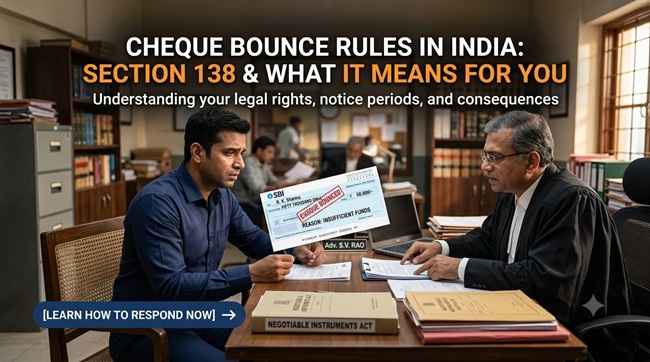
Cheque Bounce Rules in India: Section 138 and What It Means for You

Sanjay runs a small furniture workshop in Faridabad, and eight months ago he delivered a custom dining set worth ₹1.4 lakh to a client who paid with a post-dated cheque, promising it would clear the following week.
It didn’t. The bank returned it marked “insufficient funds,” and Sanjay’s first instinct was to simply call the client and ask for cash instead. The client apologised, promised to sort it out “soon,” and then went quiet for two months.
What Sanjay didn’t realise at the time was that the clock on his legal options had already started ticking the moment his bank stamped that cheque with a return memo, and that the specific way he responded in the following weeks would decide whether he had any real recourse at all.
A bounced cheque in India isn’t just an awkward, embarrassing inconvenience between two parties. It is, under a specific section of a 144-year-old law, potentially a criminal offence, and the process for actually using that law has strict timelines that trip up far more people than the law itself does. Here is exactly how Section 138 works, what counts as a punishable bounce, and the steps that determine whether you have a real case or a missed window.
Quick Answer
Section 138 of the Negotiable Instruments Act, 1881 makes it a criminal offence to issue a cheque that bounces due to insufficient funds, when that cheque was given to discharge a legally enforceable debt. The payee must send a written legal notice within 30 days of the bounce, and the drawer then gets 15 days to pay. If payment still doesn’t happen, a criminal complaint can be filed within 30 days after that 15-day window closes. Punishment can include imprisonment up to 2 years, a fine up to twice the cheque amount, or both, though the offence is compoundable, meaning it can be settled between the parties even after a complaint is filed.
About This Guide
This guide has been researched and written by the FinanceChecks editorial team, based on the Negotiable Instruments Act, 1881, as amended by the Negotiable Instruments (Amendment) Act, 2015 and the Negotiable Instruments (Amendment) Act, 2018, along with relevant Supreme Court rulings that have shaped how courts interpret and apply these provisions.
FinanceChecks is an independent Indian personal finance publication. We are not lawyers, and this guide should not be treated as legal advice for an ongoing dispute. Please read the disclaimer at the end before acting on anything discussed here.
Last reviewed: September 2026
What Exactly Is a Cheque Bounce Under Section 138
Not every bounced cheque is a criminal matter. Section 138 has a fairly specific scope, and understanding it precisely is where most confusion starts.
The provision applies when three conditions are all met. First, a cheque was drawn by a person on their bank account to discharge, wholly or partly, a legally enforceable debt or liability, not a gift, not an informal favour, but an actual debt owed. Second, the cheque was returned unpaid, specifically because of insufficient funds in the account, or because the amount exceeded an arrangement made with the bank. Third, the payee has followed the legal notice and waiting period process correctly, which we cover in detail below.
That second condition matters more than people expect. A cheque bouncing due to a signature mismatch, an account being frozen for unrelated reasons, or the cheque having simply expired, does not automatically fall under Section 138’s plain wording, since these aren’t failures of funds. In practice, though, courts have taken a broader view in specific situations, most notably where a drawer issues a “stop payment” instruction to the bank specifically to avoid honouring a genuine debt. The Supreme Court has held in such cases that this can still attract Section 138, since the intent to dishonour a legitimate obligation is what the law is really targeting, not the literal bank error code on the return memo.
Post-dated cheques and cheques given as security for a loan are also squarely covered. If a cheque was issued as collateral and the underlying loan was still outstanding at the time the cheque was presented, its dishonour attracts the same criminal liability as any other unpaid debt cheque, a point the Supreme Court clarified explicitly in a 2016 ruling.
The Legal Process: Notice, Waiting Period, and Complaint
This is the part that actually decides whether a case holds up, and it runs on strict, unforgiving timelines.
| Step | What happens | Timeline |
|---|---|---|
| 1. Cheque dishonoured | Bank returns the cheque with a memo stating the reason | Immediate |
| 2. Legal notice | Payee sends a written demand notice to the drawer | Within 30 days of receiving the bank’s return memo |
| 3. Waiting period | Drawer gets a window to pay the cheque amount | 15 days from receipt of the notice |
| 4. Cause of action arises | If unpaid after the 15 days, the offence is complete | Day 16 after notice is received |
| 5. Criminal complaint | Payee files a complaint before a Magistrate | Within 30 days of the cause of action arising |
Miss any of these windows without a valid, court-accepted reason for delay, and the case can be dismissed on a technicality alone, regardless of how genuine the underlying debt is. Courts do have limited power under Section 142 to condone delay in filing the complaint if sufficient cause is shown, but relying on that discretion is a poor substitute for simply acting within the deadlines.
A few practical details matter here. The legal notice must be in writing, must clearly state the cheque details and the amount owed, and must demand payment. It is generally sent by registered post or speed post specifically so there is proof of dispatch and delivery, which becomes important evidence later. And the 15-day payment window belongs entirely to the drawer; a payee cannot rush to file a complaint before those 15 days have actually run out, even if they’re confident the drawer has no intention of paying.
What Punishment Does Section 138 Actually Carry
If the complaint proceeds and results in conviction, Section 138 allows for imprisonment of up to 2 years, a fine that can extend to twice the amount of the cheque, or both together. In practice, many cases resolve through compensation rather than jail time, since the offence is compoundable, but the criminal exposure is real and is what gives the provision its teeth compared to a purely civil recovery suit.
Two amendments from 2018 changed how this plays out procedurally, and both are aimed at reducing the years-long delays that used to plague cheque bounce litigation.
Interim compensation under Section 143A. A trial court can now direct the accused to pay interim compensation of up to 20% of the cheque amount, while the case is still being heard, before any conviction has been decided. This gives the payee some relief without waiting for the full trial to conclude.
Deposit pending appeal under Section 148. If the accused is convicted and chooses to appeal, the appellate court can require a deposit of a minimum 20% of the fine or compensation amount as a condition for suspending the sentence during the appeal. This discourages using an appeal purely as a delay tactic.
Is a Cheque Bounce a Criminal Case, a Civil Matter, or Both
Both, and they can run in parallel.
Section 138 creates a criminal offence, but it doesn’t stop the payee from also pursuing a separate civil recovery suit for the underlying debt, including a summary suit procedure meant for quicker recovery on negotiable instruments. Many payees pursue the criminal route specifically because the threat of imprisonment tends to push settlement faster than a purely civil claim would, even though the primary goal in most cases is recovering the money, not punishment for its own sake.
It’s worth noting that cheque bounce under Section 138 is classified as a bailable, compoundable, and non-cognizable offence. Non-cognizable means the police cannot register an FIR or investigate on their own initiative; the payee must file a private criminal complaint directly before a Magistrate. Compoundable means the two parties can settle the matter, at almost any stage, including after conviction, with the court’s permission, and the case then closes without further criminal consequence for the drawer.
If the Drawer Is a Company: Who Actually Gets Prosecuted
Section 141 extends liability to companies specifically, since a company itself cannot go to jail. Where the drawer is a company, every person who was in charge of, and responsible for, the conduct of the company’s business at the time the offence was committed can be held liable alongside the company, typically directors, though this depends heavily on their actual role and involvement, not just their designation on paper. Simply being listed as a director without any real operational role has, in various rulings, been found insufficient grounds for automatic liability, so courts do examine the specifics of who was actually running the relevant part of the business.
Where Do You File the Complaint
Jurisdiction used to be a genuinely contested question, with an earlier Supreme Court ruling holding that a complaint had to be filed where the drawer’s bank was located, which created real hardship for payees dealing with drawers based far away.
The Negotiable Instruments (Amendment) Act, 2015 fixed this by law: the complaint is now filed in the court within whose jurisdiction the cheque was presented for payment, meaning the branch of the payee’s own bank, where the cheque was deposited. This shifted the convenience decisively toward the payee, who no longer has to travel to the drawer’s location just to pursue a claim.
Common Mistakes People Make With Cheque Bounce Cases
- Missing the 30-day window to send the legal notice. This is the single most common way a genuine case gets thrown out. The clock starts from when the bank’s return memo is received, not from whenever the payee gets around to dealing with it.
- Filing the complaint too early, before the 15-day payment window has actually expired. The drawer is legally entitled to that full window. A complaint filed prematurely can be rejected outright.
- Sending the legal notice informally, over WhatsApp or a phone call, instead of in writing with proof of delivery. Without documented proof that a valid notice was sent and received, the entire chain of the case weakens considerably.
- Assuming every type of bounce qualifies. A cheque bounced due to a signature mismatch or account closure is a different situation from one bounced for insufficient funds, and conflating the two can lead to pursuing the wrong remedy.
- Not preserving the original cheque and the bank’s return memo. These are the core pieces of evidence in the entire case, and losing or misplacing them can seriously undermine an otherwise solid claim.
- Treating a cheque bounce complaint as a way to inflict punishment rather than resolve a debt. Since the offence is compoundable, most cases that drag on for years without a settlement offer end up costing both sides more in time and legal fees than a reasonable negotiated resolution would have, and courts increasingly encourage parties toward settlement precisely for this reason.
My Take
I think the most underappreciated part of this law is how much it depends on the payee acting quickly and precisely, rather than on how strong the underlying debt itself is. Sanjay’s dining set money was completely legitimate. What actually determines whether he gets his ₹1.4 lakh back isn’t the strength of his claim, it’s whether he sent a proper written notice within 30 days and followed through within the subsequent deadlines. That is a genuinely counterintuitive feature of the law for most non-lawyers, who tend to assume that having a valid debt is the hard part and the paperwork is a formality. It’s the other way around.
I also think the 2018 amendments, interim compensation and the appeal deposit requirement, were a sensible fix to a real problem. Cheque bounce litigation in India used to be notorious for dragging on for years while the accused simply kept appealing, and a payee with a genuinely valid claim could wait the better part of a decade to see any money. Forcing some meaningful compensation earlier in the process, and making appeals costlier for delay tactics, shifts the incentives in a direction that actually helps the person who was wronged.
My practical advice for anyone in Sanjay’s position: the moment a cheque bounces, treat the return memo like a countdown timer, not a piece of paper to deal with later. Send the written notice immediately, by registered post, and keep every proof of delivery. And go into the process expecting that settlement, not a courtroom victory, is probably the realistic and faster outcome, since the compoundable nature of the offence means most cases end there anyway.
Frequently Asked Questions
1. What is Section 138 of the Negotiable Instruments Act?
It is the provision that makes it a criminal offence to issue a cheque that bounces due to insufficient funds, when the cheque was given to discharge a legally enforceable debt or liability.
2. How long do I have to send a legal notice after a cheque bounces?
Within 30 days from the date you receive the bank’s memo confirming the cheque was dishonoured.
3. How much time does the drawer get to pay after receiving the notice?
15 days from the date the notice is received. Only if payment is still not made after this period does the offence under Section 138 become complete.
4. What is the punishment for a cheque bounce under Section 138?
Imprisonment of up to 2 years, a fine that can extend to twice the cheque amount, or both, though many cases resolve through compensation and settlement rather than imprisonment.
5. Can a cheque bounce case be settled outside court?
Yes. The offence is compoundable, meaning the parties can settle the matter at almost any stage, including after a complaint is filed or even after conviction, with the court’s permission.
6. Where should the complaint be filed?
In the court with jurisdiction over the place where the cheque was presented for payment, generally the branch of the payee’s own bank where the cheque was deposited, following the 2015 amendment to the law.
7. Can the police register an FIR for a bounced cheque?
No. Cheque bounce under Section 138 is a non-cognizable offence, so the payee must file a private criminal complaint directly before a Magistrate rather than relying on the police to investigate.
8. Is a company director personally liable if a company’s cheque bounces?
Potentially, yes, under Section 141, but liability generally attaches to those actually in charge of and responsible for the company’s business at the time, not merely anyone listed as a director on paper.
9. Does filing a criminal complaint stop me from also filing a civil recovery suit?
No. A criminal complaint under Section 138 and a civil suit for recovery of the debt can proceed in parallel, since they address different aspects, criminal liability and monetary recovery, of the same underlying dispute.
10. Does a post-dated cheque or a cheque given as security also fall under Section 138?
Yes. Courts have held that post-dated cheques and cheques issued as security for a loan attract the same liability if they are dishonoured while the underlying debt is still legally enforceable.
Key Takeaways
- Section 138 applies to cheques dishonoured for insufficient funds when issued against a legally enforceable debt, and courts have extended this to certain stop-payment cases made to avoid a genuine obligation.
- The legal process runs on strict deadlines: a written notice within 30 days of the bounce, a 15-day payment window for the drawer, and a complaint within 30 days after that window closes.
- Punishment can include up to 2 years imprisonment, a fine up to twice the cheque amount, or both, but the offence is compoundable and most cases end in settlement.
- Since 2015, complaints are filed where the payee’s bank is located, not the drawer’s, which significantly eased the process for payees.
- The 2018 amendments introduced interim compensation during trial and a mandatory deposit for suspending a sentence during appeal, both aimed at reducing years-long delays.
- A criminal complaint and a civil recovery suit can be pursued simultaneously, since they serve different purposes.
Disclaimer
The information provided in this article is for educational and informational purposes only and should not be construed as legal advice.
FinanceChecks.com is not a law firm, and the authors are not practicing advocates. The application of Section 138 and related provisions of the Negotiable Instruments Act depends heavily on the specific facts of each case, the evidence available, and how a particular court interprets them. Court rulings referenced in this article reflect the legal position as understood as of September 2026 and may be clarified, distinguished, or overruled by future judgments.
Strict limitation periods apply to sending a legal notice and filing a complaint under this law. Please consult a qualified lawyer promptly if you are dealing with a bounced cheque, since delay can materially affect your legal options.
FinanceChecks.com and its authors accept no liability for any loss or legal consequence arising from reliance on the information presented here.

Shuchi founded Finance Checks after spending 16+ years working in corporate, managing operations and distribution. She managed her own finances, learned and read regularly and helped people make sense of their savings, loans, insurance, and investments.
She started this site to offer the kind of clear, honest financial guidance she wished was more available when she was learning to manage her own money. Every article is researched personally, checked against official sources such as the Reserve Bank of India, SEBI, or the Income Tax Department, and revisited whenever regulations or figures change. She is upfront about how the site earns money through ads and select affiliate partnerships, and she does not let either influence what she actually recommends to readers.