
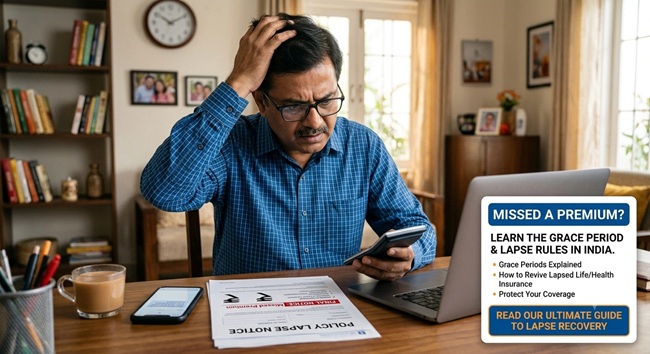
What Happens If You Miss an Insurance Premium Payment? Grace Period, Lapse and Revival Explained

Meenal missed her term insurance renewal by eleven days. Not out of carelessness, her auto-debit had failed silently after her bank reissued her debit card following a fraud alert, and the SMS reminder from her insurer had gone straight into a folder she rarely checked.
She only found out when she logged in to check her policy details for an unrelated reason and saw a small red banner: “Policy Status: Grace Period.” Her stomach dropped for a second, and then she read further and realised she still had a few days left to pay before anything serious happened. She paid that evening.
Not everyone catches it in time, and the honest truth is that what happens next depends heavily on exactly which kind of policy you’re holding, how long you’ve let it slide, and how quickly you act once you notice. A missed life insurance premium behaves very differently from a missed health insurance premium, and both behave differently depending on how many days, months, or years have actually gone by. Here’s exactly how the grace period, lapse, and revival process actually works in India, and what you can still do if you’ve already fallen behind.

Quick Answer
Most Indian insurance policies give you a grace period after a missed premium, 15 days if you pay monthly, 30 days for quarterly, half-yearly or annual payment modes, during which your cover generally continues. If you don’t pay within that window, the policy lapses. For life insurance, IRDAI rules allow revival within 5 years from the date of the first unpaid premium for traditional policies, and 3 years for ULIPs, by paying the outstanding premiums plus interest and submitting a health declaration. For health insurance, there is no equivalent long revival window: missing the grace period generally means starting over with a fresh policy, losing your accumulated waiting-period credits and no-claim bonus in the process.
About This Guide
This guide has been researched and written by the FinanceChecks editorial team, based on IRDAI’s Master Circular on Life Insurance Products (June 2024), issued under the IRDAI (Insurance Products) Regulations, 2024, IRDAI’s Master Circular on Protection of Policyholders’ Interests (2024), and publicly available policy terms from major Indian life and health insurers.
FinanceChecks is an independent Indian personal finance publication. We are not licensed insurance advisers, and this guide should not be treated as a substitute for reading your own policy document, since specific terms can vary by insurer and product. Please read the disclaimer at the end of this guide.
Last reviewed: September 2026
The Grace Period: Your First, Automatic Safety Net
Every regulated insurance policy in India comes with a mandatory grace period, a window after your premium due date during which you can still pay without your policy immediately lapsing.
| Premium payment mode | Grace period |
|---|---|
| Monthly | 15 days |
| Quarterly, half-yearly, or annual | 30 days |
For life insurance, if you die during the grace period, before you’ve actually paid the overdue premium, your policy is still treated as in force, and your nominee receives the death benefit, with the unpaid premium simply deducted from the payout. This is a standard, IRDAI-mandated term across all compliant life insurance contracts, and it’s exactly what saved Meenal from a genuinely serious problem, not just an inconvenient one.
For health insurance, the picture is a little more nuanced. If you pay in instalments, your coverage generally continues through the grace period. If you pay a single annual premium, coverage may pause until you actually pay, meaning a claim arising during those unpaid grace days could be denied, even though the same grace period still protects your continuity benefits, no-claim bonus, and waiting period credits, as long as you pay before it ends. It’s worth checking your specific policy’s Customer Information Sheet for how your insurer handles this distinction.
What Happens If You Miss the Grace Period Too
This is where the two types of insurance genuinely diverge, and it’s the part most people don’t find out until it’s already too late.
Life Insurance: The Policy Lapses, But Revival Is Usually Possible
Once the grace period ends without payment, your life insurance policy lapses. The death benefit and any other cover stop, and the insurer will typically notify you of the lapse within three months of the first unpaid premium.
There’s an important exception for certain traditional, participating policies. If you’ve already paid at least a minimum number of years of premiums, commonly around three years for many endowment and money-back plans, the policy may instead convert to a reduced paid-up status rather than lapsing entirely. In this state, your sum assured reduces proportionately based on how many premiums you’ve actually paid versus the total you were due to pay, and this reduced cover continues without needing further premiums, though no further bonuses accrue. Pure term insurance plans generally don’t have this feature and simply lapse if premiums stop.
Health Insurance: There’s No Long Revival Window
Health insurance works differently, and this is the part that catches people out. If you miss the grace period on a health policy, it lapses, and there generally isn’t an extended, multi-year revival window the way there is for life insurance. Your only real path forward is to buy a new policy, whether from the same insurer or a different one, and that new policy starts fresh: a new waiting period for pre-existing diseases, currently capped at 3 years under IRDAI’s 2024 regulations, new specific-illness waiting periods, and a reset no-claim bonus. Whatever continuity you’d built up simply doesn’t carry over once that grace period closes.
This is arguably the single most expensive consequence of a missed health insurance payment, not the premium itself, but the loss of accumulated waiting-period credit that took years to build.
How Life Insurance Revival Actually Works
If your life insurance policy has lapsed, you’re not necessarily out of options, and reviving it is usually a considerably better financial move than buying a brand-new policy from scratch, since a new policy means a higher premium at your current age and a fresh contestability period.
| Policy type | Revival window | Measured from |
|---|---|---|
| Traditional/non-linked policies (term, endowment, whole life) | 5 years | Date of the first unpaid premium |
| ULIPs (unit-linked policies) | 3 years | Date of the first unpaid premium |
This 5-year window for traditional policies and 3-year window for ULIPs came into effect under IRDAI’s Insurance Products Regulations, 2024, a meaningful extension from the shorter windows that applied to many older policies.
What reviving a lapsed policy typically involves:
- Paying all outstanding premiums, calculated from the date the first premium was missed through to the present, in full.
- Paying interest on the arrears, typically in the range of 8 to 10% per annum, charged by the insurer for the period the policy was lapsed.
- Submitting a Declaration of Good Health, confirming no material change in your health since the policy lapsed. For longer lapses or higher sum assured amounts, insurers may require a fresh medical examination.
- Insurer approval, since the insurer retains discretion to decline revival if your health has changed significantly, or to revive the policy with modified terms.
Once successfully revived, the policy is generally treated as though it had never lapsed. Your original sum assured, your original entry age for premium calculation purposes, and your original policy terms remain intact, you don’t end up paying the higher premium a new policy taken at your current, older age would carry.
For ULIPs specifically, a missed premium moves your policy into “discontinued” status, and your fund value is transferred into a separate discontinued policy fund, which earns a minimum guaranteed return, typically around 4% per annum, while you decide whether to revive. If the revival period ends without you reviving the policy, the fund proceeds are paid out to you and the policy terminates.
What If You Don’t Revive: Surrender vs Letting It Lapse
If reviving isn’t realistic for you, financially or otherwise, letting a lapsed traditional policy simply sit unrevived generally isn’t the best option either, particularly if you’ve already paid premiums for at least two consecutive years, since this typically makes you eligible for a Guaranteed Surrender Value, a contractual minimum payout based on your total premiums paid. Formally surrendering the policy converts whatever value has built up into cash you actually receive, rather than leaving it stranded in limbo until the revival window quietly closes.
Common Mistakes People Make With Missed Premiums
Assuming one missed payment instantly kills the policy. It doesn’t. The grace period exists specifically to prevent this, and for life insurance, cover generally continues right through it.
Confusing health insurance’s short grace period with life insurance’s multi-year revival window. These are genuinely different systems. Missing a health insurance grace period is a much more costly mistake than missing a life insurance one, precisely because there’s no long safety net afterward.
Letting a lapsed life insurance policy sit untouched for years without deciding to revive or surrender it. Doing nothing means the revival window eventually closes entirely, and any accumulated value in a traditional plan may end up delayed or complicated to recover.
Buying a brand-new policy instead of reviving an old one out of impatience. A new policy means underwriting at your current, likely higher, age, a higher premium for the same cover, and a fresh contestability period, generally a worse deal than reviving the original policy within the allowed window.
Not disclosing health changes honestly during revival. Suppressing a material change in health to get a lapsed policy revived can allow the insurer to repudiate a future claim, since revival still involves the same duty of disclosure that applied when you first bought the policy.
Relying solely on auto-debit without checking it periodically. Meenal’s situation, a silently failed auto-debit after a card reissue, is common enough that it’s worth manually confirming your premium actually went through at least once or twice a year, rather than assuming a standing instruction is foolproof.
My Take
I think the most important thing to internalise from all of this is that “missed payment” and “lost coverage” are not the same event, they’re separated by a real, often generous window, but that window’s length depends enormously on which kind of policy you’re holding. A missed life insurance premium gives you months of grace and then years of revival room. A missed health insurance premium gives you a much shorter runway before you’re effectively starting from zero on your waiting periods, which is exactly the kind of asymmetry that trips people up because it isn’t intuitive; both feel like “insurance,” but they behave completely differently once a payment slips.
I’d also push back gently on the common instinct to just let a lapsed policy go and move on, especially for life insurance. The revival math is almost always better than starting fresh, because you keep your original age-based pricing and your original policy terms, and that difference compounds meaningfully over a long-term policy. The paperwork of revival, arrears, interest, a health declaration, feels like a hassle in the moment, but it’s usually a smaller hassle than it looks, and a considerably better deal than a brand-new policy bought years later at a higher premium.
My honest, practical suggestion: treat renewal dates the way you’d treat an EMI due date, not something to remember casually, but something to actually verify went through, especially if you’re relying on auto-debit. And if you do discover a lapsed policy sitting untouched, don’t assume the window has already closed; check the actual dates against your policy’s revival period before writing it off.
Frequently Asked Questions
1. What is a grace period in insurance?
It’s the window after your premium due date, 15 days for monthly payment mode, 30 days for quarterly, half-yearly or annual modes, during which you can still pay your premium without the policy immediately lapsing.
2. If I die during the grace period without having paid, will my life insurance nominee still get the payout?
Yes. If death occurs during the grace period before the overdue premium is paid, the policy is treated as in force, and the claim is payable with the unpaid premium deducted from the payout.
3. How long can I revive a lapsed life insurance policy?
Under current IRDAI rules, 5 years from the date of the first unpaid premium for traditional, non-linked policies, and 3 years for ULIPs.
4. What does reviving a lapsed life insurance policy actually require?
Paying all outstanding premiums in full, paying interest on the arrears, typically around 8 to 10% per annum, and submitting a Declaration of Good Health, with a medical examination sometimes required depending on how long the policy has been lapsed and the sum assured involved.
5. Does a revived life insurance policy cost more than before it lapsed?
No, if successfully revived, your original sum assured, entry age for pricing, and policy terms remain intact. This is exactly why reviving is generally cheaper than buying a new policy at your current, older age.
6. What happens if I miss my health insurance renewal grace period?
The policy lapses, and unlike life insurance, there’s typically no extended revival window. You’ll generally need to buy a fresh policy, losing accumulated benefits like your no-claim bonus and your served pre-existing disease waiting period, which restarts from zero.
7. Can an insurer reject my request to revive a lapsed life insurance policy?
Yes. Insurers retain discretion to decline revival, or revive with modified terms, if your health has changed materially since the policy lapsed.
8. What happens to a lapsed ULIP?
The policy moves to “discontinued” status, and your fund value is transferred to a discontinued policy fund earning a minimum guaranteed return, typically around 4% per annum, while you remain eligible to revive within the 3-year window.
9. Should I revive a lapsed policy or surrender it instead?
If you can afford the arrears and interest, reviving is usually better, since it preserves your original terms and pricing. If revival genuinely isn’t feasible, and you’ve paid at least two years of premiums on a traditional policy, surrendering for the Guaranteed Surrender Value is typically better than letting the policy sit unrevived indefinitely.
10. Does my health insurance waiting period reset if I switch insurers through portability instead of letting the policy lapse?
No. If you port your health policy to a new insurer before it lapses, following IRDAI’s portability process, your already-served waiting periods for disclosed conditions carry forward. This continuity is lost only if the policy actually lapses beyond the grace period.
Key Takeaways
- Every regulated Indian insurance policy carries a mandatory grace period, 15 days for monthly premiums, 30 days for other modes, during which a missed payment doesn’t immediately end your cover.
- Life insurance cover generally continues through the grace period, including in the event of death, with the unpaid premium simply deducted from the payout.
- If a life insurance policy lapses, IRDAI rules allow revival within 5 years for traditional policies and 3 years for ULIPs, by paying arrears with interest and a health declaration.
- Health insurance has no comparable long revival window; missing the grace period generally means starting over with a fresh policy and losing your waiting-period credits and no-claim bonus.
- Reviving a lapsed life insurance policy is usually financially better than buying a new one, since it preserves your original pricing and terms.
- Health insurance portability, done before a policy lapses, protects your accumulated waiting-period credits in a way that letting the policy lapse does not.
Disclaimer
The information provided in this article is for educational and informational purposes only and should not be construed as insurance, financial, or legal advice.
FinanceChecks.com is not a licensed insurance adviser or broker. Grace period durations, revival windows, and specific terms and conditions can vary between insurers and individual products, and this article reflects general regulatory rules and common industry practice as understood in September 2026. Please refer to your own policy document and Customer Information Sheet for the exact terms applicable to your specific policy.
Insurance and financial regulations are subject to change. Please consult your insurer directly, or a licensed insurance adviser, before making decisions about reviving, surrendering, or replacing an insurance policy.
FinanceChecks.com and its authors accept no liability for any loss arising from reliance on the information presented in this article.

Shuchi founded Finance Checks after spending 16+ years working in corporate, managing operations and distribution. She managed her own finances, learned and read regularly and helped people make sense of their savings, loans, insurance, and investments.
She started this site to offer the kind of clear, honest financial guidance she wished was more available when she was learning to manage her own money. Every article is researched personally, checked against official sources such as the Reserve Bank of India, SEBI, or the Income Tax Department, and revisited whenever regulations or figures change. She is upfront about how the site earns money through ads and select affiliate partnerships, and she does not let either influence what she actually recommends to readers.