
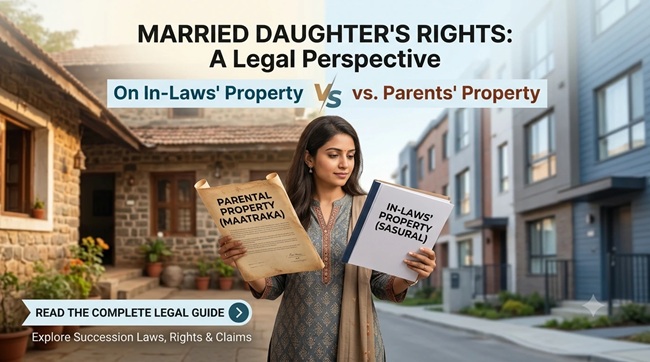

Radhika got married three years ago and moved into her husband’s family home, a house her father-in-law had built decades earlier on land that had been in his family for two generations.
One evening, a cousin visiting from abroad casually asked her, “So this house, is it partly yours now too? Like how you still have a share in your own father’s property?” Radhika didn’t have a confident answer. She knew, vaguely, that she had some legal standing in her father’s property even after marriage, she’d read about it when her own parents were dividing assets. But did the same logic apply here, in the house she now actually lived in?
It doesn’t, and the gap between these two sets of rights is one of the more consequential things a married woman in India can misunderstand about her own financial position. Her rights in her parents’ property and her rights in her in-laws’ property aren’t just different in degree. They come from entirely different legal foundations, one rooted in birth, the other almost entirely in her husband’s status and her in-laws’ discretion.
Here’s exactly how the two compare, and what that actually means in practice.

Quick Answer
A married daughter’s right to her own parents’ property is a birthright: under the Hindu Succession Act, she is a coparcener by birth in ancestral property, equal to a son, and a Class I legal heir to her parents’ self-acquired property if they die without a will. Her rights in her in-laws’ property are fundamentally different and far more limited: she is not a coparcener in her husband’s family by marriage, has no automatic inheritance right in her father-in-law’s property, and any claim she does have generally flows only through her husband, either as his wife during his lifetime or as an heir to his estate after his death. She does, however, have a legal right to reside in the marital home under domestic violence law, regardless of whose name the property is in.
About This Guide
This guide has been researched and written by the FinanceChecks editorial team, based on the Hindu Succession Act, 1956, as amended in 2005, the Hindu Adoptions and Maintenance Act, 1956, the Protection of Women from Domestic Violence Act, 2005, and relevant Supreme Court rulings that have clarified these provisions.
FinanceChecks is an independent Indian personal finance publication. We are not lawyers, and nothing here should be treated as legal advice for a specific family dispute. Please read the disclaimer at the end of this guide.
Last reviewed: September 2026
Her Rights in Her Own Parents’ Property: A Birthright
We’ve covered this in detail elsewhere on FinanceChecks, but the short version matters here as the baseline for comparison.
Since the Hindu Succession (Amendment) Act, 2005, a daughter becomes a coparcener by birth in her father’s ancestral Hindu family property, on exactly equal footing with a son, and that status does not change when she marries. She retains this right whether she lives with her parents, moves cities, or moves in with her husband’s family entirely. If her father dies without a will, she is also a Class I legal heir to his self-acquired property, sharing the estate alongside her siblings, her mother, and other Class I heirs, again regardless of her marital status.
The critical word here is birthright. Nothing about her relationship with her parents needs to be actively maintained, negotiated, or granted for this right to exist. She was born into it.
Her Rights in Her In-Laws’ Property: Almost the Opposite Situation
This is where the legal picture changes entirely, and it’s the part most people, Radhika included, don’t fully grasp until they actually need to.
She is not a coparcener in her husband’s family. Coparcenary rights under the Hindu Succession Act attach by birth into a specific Hindu Undivided Family. Marriage does not create that birthright; it never did, even for sons’ wives before the 2005 amendment, and the amendment changed nothing about this for daughters-in-law either. A woman who marries into a family joins that household, but she does not become a coparcener in her husband’s ancestral property, no matter how many years she has been part of that family.
She has no automatic inheritance right in her father-in-law’s self-acquired property. Whatever her father-in-law owns outright, purchased or earned in his own name, remains entirely his to dispose of as he wishes. He can gift it to her, will it to her, or leave her out entirely, and none of these choices would violate any legal entitlement of hers, because she doesn’t hold one to begin with.
Any claim she does have generally runs through her husband, not independently. This is the structural key to the whole comparison. Her legal position in the family’s property is almost entirely derivative of her relationship to her husband, not a standalone right she holds simply by virtue of being married into the family.
You May Also Like To Read About:
Side-by-Side Comparison
| Aspect | Rights in Parents’ Property | Rights in In-Laws’ Property |
|---|---|---|
| Coparcenary status | Coparcener by birth, equal to sons, since 2005 | Not a coparcener under any circumstance |
| Right in ancestral property | Statutory birthright, exists independently | No independent right; only through husband’s share after his death |
| Right in self-acquired property (intestate) | Class I heir, shares in the estate | Not a legal heir to father-in-law directly |
| Can she be excluded via a will (self-acquired property) | Yes, for self-acquired property only, ancestral share still protected | Entirely at the family’s discretion; no protected share to begin with |
| Does marital status affect the right | No, right exists before, during and after marriage | The right doesn’t exist independently of marriage in the first place |
| Basis of any claim | Her own birth into the family | Her husband’s status and her in-laws’ discretion |
What About the House She Actually Lives In
This is the nuance that often gets missed, and it matters enormously in practice, even though it isn’t an ownership right at all.
Under the Protection of Women from Domestic Violence Act, 2005, a married woman has a legal right of residence in what the law calls the “shared household,” the home she lives in with her husband and his family. This right exists regardless of whose name the property is actually registered in, her husband’s, her father-in-law’s, or another family member’s. The Supreme Court clarified the scope of this right in its 2020 ruling in Satish Chander Ahuja vs Sneha Ahuja, confirming that a shared household can include a property owned by the husband’s relatives, not only property owned by the husband himself.
It’s important to be precise about what this right actually is. It is a right to reside, protecting her from being thrown out of the home, not a right of ownership or inheritance in the property itself. She cannot sell the house, will it, or claim a proportional share of its value based on this provision alone. It protects her ability to live there; it does not make her a co-owner.
What Happens If Her Husband Dies
This is where a daughter-in-law’s position in her in-laws’ property genuinely does strengthen, though it’s worth being precise about the mechanism.
If her husband was a coparcener in an undivided ancestral Hindu family property and he dies, his notional share, calculated as though a partition had taken place immediately before his death, devolves to his Class I heirs. As his wife, she is one of those heirs, alongside his children and his mother, and she inherits a portion of that notional share. She also inherits her share of anything her husband owned as self-acquired property, again as a Class I heir under intestate succession.
The key distinction is that this right comes to her through her husband’s estate, not as an independent entitlement she held in her in-laws’ property all along. Before his death, her position in that ancestral property was essentially nil in her own right; his death is what converts a portion of his notional coparcenary interest into something she can actually inherit.
Maintenance Rights: A Narrower, Conditional Entitlement
Indian law does provide one further, more limited protection specifically for a widowed daughter-in-law. Under the Hindu Adoptions and Maintenance Act, 1956, a widowed daughter-in-law has a right to maintenance from her father-in-law’s estate, but this right is conditional and fairly narrow. It applies only to the extent she is unable to maintain herself from her own earnings, her own property, her deceased husband’s estate, or from her own children or parents, and it is payable only out of coparcenary property in her father-in-law’s possession, out of which her husband would have been entitled to a share had he been alive.
This is a maintenance right, a right to financial support, not a property or inheritance right. It doesn’t give her ownership of anything; it obliges the family to support her under specific, limited circumstances.
What About Gifts From In-Laws: Stridhan
Whatever her in-laws give her directly, jewellery, cash, or property, at the time of her wedding or afterward, qualifies as her stridhan, and she holds absolute personal ownership over it, entirely separate from any inheritance question. This is worth distinguishing clearly from everything discussed above: stridhan is about what has actually been given to her as a gift, while inheritance rights are about what she is legally entitled to claim from an estate regardless of whether anyone chooses to give her anything at all. She has no inheritance right in her in-laws’ property by default, but anything genuinely gifted to her becomes hers outright, with no one, including her husband, having a legal claim over it.
Common Mistakes People Make on This Topic
Assuming marriage automatically creates coparcenary rights in the husband’s family. It doesn’t, and it never has, regardless of the 2005 amendment, which addressed daughters’ rights in their own birth family, not a wife’s status in her marital family.
Confusing the right of residence with a right of ownership. Being legally entitled to live in the house is not the same as owning a share of it, and conflating the two leads to unrealistic expectations about what can actually be claimed.
Assuming a father-in-law is legally obligated to leave property to his daughter-in-law. He isn’t, for his self-acquired property. Anything she receives from him is a matter of his choice, not her entitlement.
Overlooking that her real claim on the marital family’s ancestral property arises only through her husband, and specifically strengthens only after his death. Many women assume they already hold some ongoing share simply by being married into the family, when the legal reality only crystallises around her husband’s own coparcenary interest.
Not distinguishing stridhan from inheritance rights. Gifts received from in-laws are hers absolutely, but that has nothing to do with whether she has any inheritance claim on the broader family estate.
My Take
I think the reason this distinction catches so many women off guard is that, socially, marriage is often framed as fully joining a new family, sharing its home, its routines, its responsibilities, while legally, that “joining” is far more one-sided than it feels day to day. Radhika has lived in her in-laws’ house for three years, contributed to the household, and built a genuine life there. None of that translates into any legal ownership stake, and it was never going to, regardless of how long she stays or how integrated she becomes.
I don’t think this asymmetry is inherently unfair once you understand where it comes from. Coparcenary rights exist because of birth into a specific family lineage, and marriage was never the mechanism the law used to create that kind of birthright, for anyone, historically including sons’ wives long before daughters gained equal standing in 2005. What I do think is worth naming plainly is that this asymmetry is often not explained to women clearly before or during marriage, and the gap between the social expectation of “this is now my family’s home too” and the legal reality of “I have a right to live here, not to own it” can be a genuinely difficult thing to discover only when a real dispute or crisis arises.
My honest suggestion: understand the shape of this before you need it, not during a family conflict. If a father-in-law genuinely wants his daughter-in-law to have a defined stake in the family’s property, that has to happen deliberately, through a gift, a will, or being made a joint owner, none of which happens automatically, however long or however well she has been part of the family.
Frequently Asked Questions
1. Does a married woman have any legal right to her in-laws’ property?
Not automatically, and not simply by virtue of marriage. She is not a coparcener in her husband’s family and has no independent inheritance right in her father-in-law’s self-acquired property. Any claim she has generally arises through her husband, particularly after his death.
2. Is a daughter-in-law a coparcener in her husband’s ancestral property?
No. Coparcenary status arises by birth into a specific Hindu Undivided Family. Marrying into a family does not create coparcenary rights, for daughters-in-law now or historically.
3. Can a father-in-law leave his daughter-in-law out of his will entirely?
Yes, for his self-acquired property, he can dispose of it however he chooses, since she has no legal entitlement to it in the first place, unlike a daughter’s protected coparcenary share in ancestral property.
4. Does a married woman have a right to live in her husband’s family home?
Yes. Under the Protection of Women from Domestic Violence Act, 2005, she has a legal right of residence in the “shared household,” regardless of whose name the property is registered in, as clarified by the Supreme Court in 2020. This is a right to reside, not a right of ownership.
5. What happens to a woman’s rights in her in-laws’ property if her husband dies?
If her husband was a coparcener in undivided ancestral property, his notional share devolves to his Class I heirs, including her, upon his death. She also inherits her share of his self-acquired property as a Class I heir. This right comes through her husband’s estate, not as an independent entitlement.
6. Does a widowed daughter-in-law have any right to maintenance from her in-laws?
Yes, a conditional one. Under the Hindu Adoptions and Maintenance Act, 1956, she has a right to maintenance from her father-in-law’s estate if she cannot support herself through her own means, her husband’s estate, or her children or parents, payable from coparcenary property her husband would have been entitled to had he lived.
7. Are gifts given by in-laws considered the daughter-in-law’s own property?
Yes. Jewellery, cash, or property given to her by her in-laws, around her wedding or afterward, qualifies as her stridhan, over which she holds absolute personal ownership, entirely separate from any inheritance rights.
8. Does a married daughter lose her rights in her own parents’ property?
No. Her coparcenary rights in ancestral property and her status as a Class I heir to her parents’ self-acquired property remain completely unaffected by marriage.
9. If a couple divorces, does the woman retain a right to her former in-laws’ property?
No. She never had an independent inheritance right in her in-laws’ property to begin with, since any claim ran through her husband. On divorce, her legal remedies relate to maintenance and alimony from her husband, and the return of her stridhan, not a claim on her former in-laws’ assets.
10. Can a daughter-in-law be made a co-owner of her in-laws’ property?
Yes, but only if the family deliberately chooses to do so, through a gift deed, a will, or explicitly adding her name as a joint owner. It does not happen automatically through marriage or through living in the household for any length of time.
Key Takeaways
- A married daughter’s rights in her own parents’ property are a statutory birthright, coparcenary status in ancestral property and Class I heir status in self-acquired property, unaffected by marriage.
- Her rights in her in-laws’ property are fundamentally different: she is not a coparcener, has no automatic inheritance right in her father-in-law’s property, and any claim generally flows through her husband.
- She does hold a legal right to reside in the marital home under domestic violence law, regardless of whose name the property is in, though this is a right to reside, not to own.
- Her strongest claim in her husband’s family’s ancestral property arises only after his death, through his notional coparcenary share, inherited as his Class I heir.
- A widowed daughter-in-law has a conditional, limited right to maintenance from her father-in-law’s estate, separate from any ownership right.
- Gifts from in-laws qualify as her stridhan and are hers absolutely, entirely distinct from the separate question of inheritance rights.
Disclaimer
The information provided in this article is for educational and informational purposes only and should not be construed as legal advice.
FinanceChecks.com is not a law firm, and the authors are not practising advocates. Property, succession, and maintenance law outcomes depend heavily on the specific facts of each case, the applicable personal law framework, and relevant state amendments. Court rulings referenced in this article reflect the legal position as understood as of September 2026 and may be clarified or distinguished by future judgments.
Please consult a qualified lawyer with expertise in property and family law before relying on any interpretation in this article for an actual family or legal situation.
FinanceChecks.com and its authors accept no liability for any loss or legal consequence arising from reliance on the information presented here.

Shuchi founded Finance Checks after spending 16+ years working in corporate, managing operations and distribution. She managed her own finances, learned and read regularly and helped people make sense of their savings, loans, insurance, and investments.
She started this site to offer the kind of clear, honest financial guidance she wished was more available when she was learning to manage her own money. Every article is researched personally, checked against official sources such as the Reserve Bank of India, SEBI, or the Income Tax Department, and revisited whenever regulations or figures change. She is upfront about how the site earns money through ads and select affiliate partnerships, and she does not let either influence what she actually recommends to readers.