
Meta vs Google: How AI Is Boosting Meta’s Ad Business While Creating Challenges for Google

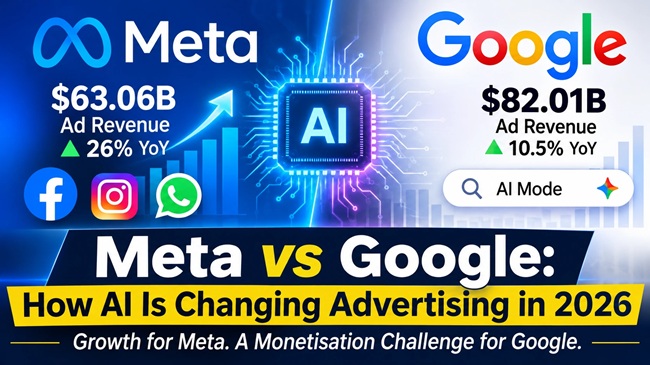
Meta generated $63.06 billion in advertising revenue in Q3 2026, growing 26% year-on-year. Google, meanwhile, reported $82.01 billion in total advertising revenue, but missed market expectations as AI-powered Search experiences affected monetisation.
Artificial intelligence is transforming the digital advertising industry, but its impact on major technology companies is not the same.
Meta Platforms is using AI to improve advertising performance across Facebook, Instagram and WhatsApp. Better ad creation, audience targeting and content recommendations are helping businesses reach potential customers more effectively.
Google, however, is facing a different challenge. Its AI-powered search experiences are changing how people discover information, products and services. While users are asking more questions through AI Mode, Google is still working to monetise these interactions as effectively as traditional search.
The difference became particularly noticeable after Meta and Alphabet announced their third-quarter 2026 financial results.
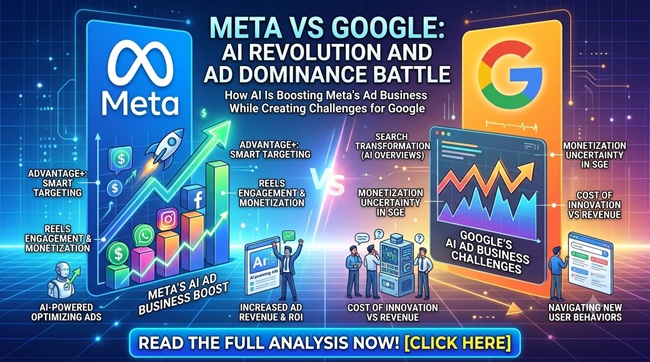
Meta vs Google: Q3 2026 Advertising Revenue Compared
The latest financial results show that Google continues to generate more advertising revenue overall, but Meta is growing faster.
Here is the comparison:
| Financial metric | Meta | |
|---|---|---|
| Q3 2026 advertising revenue | $63.06 billion | $82.01 billion |
| Year-on-year growth | 26% | 10.5% |
| Q3 2025 advertising revenue | $50.08 billion | $74.18 billion |
| Key AI impact | Better ad performance | Search monetisation challenge |
Note: Google’s advertising figure includes Search, YouTube and Google Network advertising. It should not be confused with Google Search & other revenue, which was $63.35 billion.
Meta’s advertising revenue increased from $50.08 billion in Q3 2025 to $63.06 billion in Q3 2026, representing 26% growth.
Google’s total advertising revenue increased from $74.18 billion to $82.01 billion, representing approximately 10.5% growth.
However, Google’s advertising revenue missed analyst expectations of approximately $83.4 billion, a shortfall of around $1.39 billion.
This highlights the difference between the two companies: Meta is seeing stronger advertising growth, while Google is navigating changes to its traditional search advertising model.
Sources: Meta Q3 2026 earnings release; Alphabet Q3 2026 financial results.
For Latest Business Updates, Follow us on Instagram and Youtube.
How AI Is Helping Meta Grow Its Advertising Business
Meta’s advertising model benefits from the enormous amount of engagement generated across Facebook, Instagram and its other platforms.
The company is increasingly using artificial intelligence to improve three important parts of digital advertising.
1. AI-powered ad creation
AI tools can help businesses create advertising content, generate variations of creatives and improve campaign development.
This can reduce the time and effort required to produce multiple advertisements, particularly for businesses with limited marketing resources.
2. Better audience targeting
Meta uses AI-powered recommendation and advertising systems to identify users who are more likely to engage with particular advertisements.
More relevant ad delivery can improve conversion opportunities and encourage advertisers to invest more in campaigns.
3. Improved user engagement
AI also helps Meta personalise content recommendations across its platforms.
When users spend more time engaging with relevant content, the platforms can create additional opportunities to deliver advertisements.
Meta’s Q3 2026 results provide evidence of this advertising momentum:
- Advertising impressions increased 10% year-on-year.
- Average price per advertisement increased 14%.
- Advertising revenue grew 26% year-on-year.
Meta also reported 3.64 billion average daily active people across its family of applications during September 2026, an increase of 3% year-on-year.
These numbers show how advertising volume, pricing and audience engagement are contributing to the company’s growth.
Why Google’s AI Mode Is Creating a Monetisation Challenge
Google’s traditional search business has historically generated revenue through sponsored listings and advertisements displayed alongside search results.
However, AI is changing how people interact with search engines.
With AI Overviews and AI Mode, users can ask detailed questions and receive conversational answers directly within Google Search.
Consider someone searching for the best smartphones under ₹30,000.
Traditional search results may display sponsored listings, shopping advertisements and links to retailers.
An AI-powered search experience can provide a detailed comparison directly on the results page.
Although this improves the user experience, it also changes the opportunities available for advertising.
Google executives acknowledged that increased use of AI Mode contributed to slower Search advertising growth because monetisation in AI Mode remains lower than in traditional search.
The company is still experimenting with advertisements in these AI-powered experiences.
Importantly, Google’s Search & other revenue did not decline.
It reached $63.35 billion in Q3 2026, compared with $56.57 billion in the corresponding quarter last year, representing 12% year-on-year growth.
The challenge is therefore not falling Search revenue, but slower growth and the need to develop effective advertising formats for AI-driven interactions.
Google’s AI Search Opportunity: Longer Queries Could Change Advertising
Despite the monetisation challenge, Google believes AI-powered search could create new commercial opportunities.
According to LiveMint’s report on Google’s Q3 earnings commentary, AI Mode queries are, on average, three times longer than traditional searches.
Longer conversational queries can provide more context about what users need.
For example, a traditional search for running shoes may provide limited information about purchase intent.
A detailed AI query asking for comfortable running shoes for beginners training for a half marathon provides much more context.
This could eventually help Google deliver more relevant commercial recommendations and advertisements.
Google CEO Sundar Pichai described the expansion of AI-powered search activity as an opportunity.
Google Chief Business Officer Philipp Schindler also indicated that most AI Mode queries are incremental, potentially creating additional monetisation opportunities over time.
Google has also indicated that it will expand advertising experiments in AI Mode to international markets.
The challenge will be balancing advertising opportunities with the quality and usefulness of AI-generated answers.
What Does This Mean for the Future of Digital Advertising?
The competition between Meta and Google highlights two different approaches to monetising artificial intelligence.
Meta is using AI to improve an established advertising business. Better targeting, content recommendations and advertising performance can encourage businesses to increase their marketing budgets.
Google is transforming the way people search for information. While this could eventually create new advertising opportunities, the company must adapt its revenue model to changing user behaviour.
For advertisers, the shift could mean greater reliance on automated campaigns, AI-generated creatives and more personalised marketing.
For investors, the important factors to monitor include advertising revenue growth, AI monetisation, user engagement, infrastructure spending and profitability.
Google also has another important growth engine in its cloud business. Alphabet reported Q3 2026 Google Cloud revenue of $30.71 billion, increasing 103% year-on-year, driven by demand for AI infrastructure and enterprise AI solutions.
The Bottom Line
Meta is currently demonstrating how artificial intelligence can strengthen an existing digital advertising business.
Its 26% advertising revenue growth, combined with higher ad impressions and pricing, shows that AI investments are supporting its core business.
Google, meanwhile, faces the challenge of adapting traditional search advertising to an AI-first environment. Its Search business continues to grow, but lower monetisation from AI Mode is creating pressure on advertising growth.
However, longer conversational queries and new advertising formats could create significant opportunities in the future.
The real winner of the AI advertising race will be the company that can turn AI-driven engagement into sustainable advertising revenue without compromising the user experience.
Frequently Asked Questions
1. How much advertising revenue did Meta generate in Q3 2026?
Meta generated $63.06 billion in advertising revenue in the third quarter of 2026, representing 26% year-on-year growth.
2. How much advertising revenue did Google generate in Q3 2026?
Google generated approximately $82.01 billion in total advertising revenue, including Search, YouTube and Google Network advertising.
3. Why is Google’s AI Mode affecting advertising growth?
Google said increased usage of AI Mode contributed to slower Search advertising growth because monetisation in AI Mode remains lower than in traditional search.
4. Is Google’s Search advertising revenue declining?
No. Google Search & other revenue increased 12% year-on-year to $63.35 billion in Q3 2026. The concern is slower growth and the monetisation of AI-powered queries.
5. How is AI helping Meta’s advertising business?
Meta uses AI to improve advertisement creation, audience targeting, content recommendations and advertising delivery. These improvements can increase campaign effectiveness and advertiser spending.
6. Can Google make money from AI-powered search?
Google is experimenting with advertisements in AI Overviews and AI Mode. Longer conversational queries could provide more commercial context and create new advertising opportunities.
7. Which company is benefiting more from AI advertising?
Meta currently has stronger measurable advertising growth. Google has substantial opportunities in AI-powered search and cloud computing, but its ability to monetise AI search remains an important factor to watch.
Sources and References
- Meta Platforms – Q3 2026 Financial Results – Official advertising revenue, impressions, pricing and user figures.
- Alphabet – Q3 2026 Financial Results (SEC Filing) – Official Search, advertising, Cloud and consolidated revenue figures.
- Alphabet Q3 2026 Form 10-Q – Detailed financial disclosures.
- Google – Q3 2026 Earnings Call: CEO Remarks – Management commentary on Search query growth and AI.
Disclaimer: This article is intended for informational and educational purposes. Financial figures are based on publicly available company disclosures. It does not constitute investment advice or a recommendation to buy or sell any securities.

Shuchi founded Finance Checks after spending 16+ years working in corporate, managing operations and distribution. She managed her own finances, learned and read regularly and helped people make sense of their savings, loans, insurance, and investments.
She started this site to offer the kind of clear, honest financial guidance she wished was more available when she was learning to manage her own money. Every article is researched personally, checked against official sources such as the Reserve Bank of India, SEBI, or the Income Tax Department, and revisited whenever regulations or figures change. She is upfront about how the site earns money through ads and select affiliate partnerships, and she does not let either influence what she actually recommends to readers.