

By Shuchi, FinanceChecks.com | Published 2 November 2026 | Category: Personal Finance | Reading time: about 6 minutes
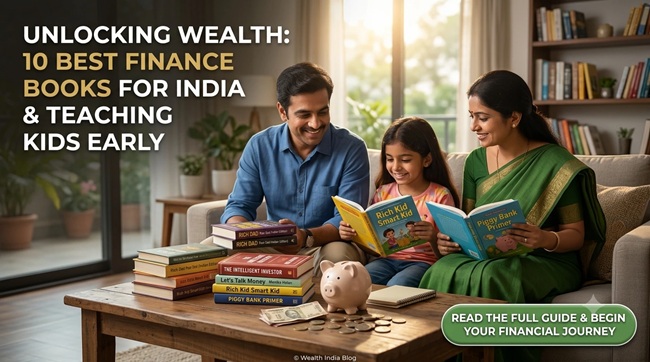
Good money decisions depend less on how much you earn and more on how you think about money. Books are still the cheapest way to build that thinking. This guide lists ten finance books for adults, in the order I would read them, plus age-wise picks for children and a short case for why kids should start early.
Quick Answer
For a financial thought process, start with Morgan Housel’s The Psychology of Money and Monika Halan’s Let’s Talk Money, which covers Indian insurance, loans and retirement. Then read Benjamin Graham’s The Intelligent Investor or John Bogle’s The Little Book of Common Sense Investing for investing basics. For children, start with picture books like Alexander, Who Used to Be Rich Last Sunday and move to The Richest Man in Babylon in the teens. Children should read early because money habits form young, and because time is the biggest lever in compounding.

About This Guide
This article is written by the editorial desk of FinanceChecks.com, an independent Indian personal finance publication. The books chosen are widely read and discussed titles. I have no affiliate links or commercial relationship with any author or publisher. Book descriptions are my summary of each book’s main ideas, and no book replaces personalised advice. Many older books use US examples and tax rules, so check Indian rules before acting on specifics. This is educational content and not investment advice.
Ten Books for Adults, in Reading Order
| Book | Author and year | What you will learn | Best for |
|---|---|---|---|
| The Psychology of Money | Morgan Housel, 2020 | Behaviour matters more than intelligence. Short stories on greed, fear, luck and knowing when you have enough | Everyone, as a first book |
| Let’s Talk Money | Monika Halan, 2018 | Indian personal finance in plain language: budgeting, insurance, loans, investing and avoiding mis-selling | Indian salaried readers and first-time investors |
| The Richest Man in Babylon | George S. Clason, 1926 | Simple parables on saving first, avoiding debt and making money work | Beginners and teenagers |
| Your Money or Your Life | Vicki Robin and Joe Dominguez, 1992 | How much of your life you trade for money, and how to reach financial independence | Anyone rethinking spending |
| The Intelligent Investor | Benjamin Graham, 1949 | Margin of safety, Mr. Market and the difference between investing and speculating | Stock market beginners ready for a classic |
| The Little Book of Common Sense Investing | John C. Bogle, 2007 | Why low-cost index funds beat most active investors over time | SIP and mutual fund investors |
| One Up on Wall Street | Peter Lynch, 1989 | How ordinary investors can spot good companies in everyday life | Direct stock investors |
| Value Investing and Behavioral Finance | Parag Parikh, 2010 | Behavioural biases that hurt investors, with Indian market examples | Indian equity investors |
| Thinking, Fast and Slow | Daniel Kahneman, 2011 | How mental shortcuts and biases lead us to poor decisions | Readers who want depth |
| Rich Dad Poor Dad | Robert Kiyosaki, 1997 | A popular introduction to assets, liabilities and the mindset of building wealth | Motivation, read with a critical eye |
A note on the last one. Rich Dad Poor Dad is widely read and good at starting conversations, but critics point out that its advice is vague and its stories are hard to verify. Treat it as inspiration, not as a manual.
To Get The Regular Finance and Business Updates, Follow us on Instagram and Youtube.
A Simple Reading Path
- First stage: The Psychology of Money and Let’s Talk Money. These build your mindset and your Indian basics.
- Second stage: The Little Book of Common Sense Investing or The Intelligent Investor. Pick the one that suits you: Bogle if you prefer index funds, Graham if you want to understand stocks.
- Third stage: One Up on Wall Street, Value Investing and Behavioral Finance and Thinking, Fast and Slow for deeper investing and behaviour.
Things Books Teach That You Should Take Care Of
Across these books, the same handful of lessons keep returning:
- Spend less than you earn and invest the difference first, not last.
- Avoid high-cost debt, and never borrow to invest.
- Keep an emergency fund and enough insurance before you chase returns.
- Keep costs low, stay diversified and give investments time.
- Be careful about your own behaviour: fear and greed do more damage than bad luck.
- Be suspicious of guaranteed returns and tips from strangers.
Books for Children and Teens
| Age | Book | Lesson |
|---|---|---|
| 4 to 8 | Alexander, Who Used to Be Rich Last Sunday by Judith Viorst (1978) | Money disappears quickly when you spend it without a plan |
| 4 to 8 | A Chair for My Mother by Vera B. Williams (1982) | Saving small amounts towards a goal |
| 4 to 8 | The Berenstain Bears’ Trouble with Money by Stan and Jan Berenstain (1983) | Needs, wants and spending choices |
| 8 to 12 | Lemonade in Winter by Emily Jenkins (2012) | Counting money, prices and small business |
| 8 to 12 | The Lemonade War by Jacqueline Davies (2007) | Profit, competition and customers |
| 13 and above | The Richest Man in Babylon | Pay yourself first, avoid debt |
| 15 and above | The Psychology of Money and Let’s Talk Money | Behaviour, saving, insurance and loans |
For parents, Ron Lieber’s The Opposite of Spoiled (2015) is a useful guide on how to talk to children about money.
Why Kids Should Read These Books at an Early Age
1. Money habits form early. Research cited in Indian financial-education commentary suggests that money habits are largely set by around age seven. Reading about saving and spending shapes them before bad habits settle.
2. Time is the biggest advantage in compounding. As an illustration, ₹5,000 invested every month at an assumed return of 12 percent a year grows to about ₹1.75 crore in 30 years but only about ₹49.5 lakh in 20 years. Ten extra years bring roughly three and a half times more. The return is an assumption and not a promise, but the lesson is real: starting early beats investing more later.
3. Financial literacy in India is low. A survey by the National Centre for Financial Education found that only about 27 percent of Indian adults were financially literate, a widely cited 2019 figure. Children who learn the basics start with an advantage that most adults never had.
4. Kids are online and handling payments sooner. UPI, gaming purchases, loan apps and scams reach teenagers early. A child who understands that guaranteed returns do not exist and that nobody gives free money is harder to trick.
5. It builds patience. Saving for a bicycle teaches delayed gratification, which is a skill that predicts good decisions throughout life.
6. It makes money a normal topic. Many Indian families avoid talking about money. A shared book gives parents and children an easy way to begin.
How to Get Children Started
- Read together. Pick one picture book at a time and ask what the character should have done differently.
- Use three jars or three accounts: spend, save and share.
- Give pocket money at regular intervals and let them make small mistakes.
- Let teenagers help plan one family budget, such as a festival or a trip.
- Teach digital safety: never share OTPs, and ask before paying anyone online.
- Open a savings account for a minor with a guardian, and show them the passbook or statement.
Common Mistakes to Avoid
The usual mistakes are reading many books without acting on any, copying an author’s US advice without checking Indian rules, taking Rich Dad Poor Dad-style claims as a plan, starting with the hardest book, giving children adult books too soon, and skipping the conversation. A book works only when you try one idea from it this month.
My Take
If you can read only two books this year, I would pick The Psychology of Money and Let’s Talk Money. One teaches how to think and the other teaches what to do in India. After that, choose by the kind of investor you want to be, not by what is trending.
For children, a ten-minute talk about a book is worth more than any lecture. Parents who stay curious about money usually raise children who do too.
Frequently Asked Questions
1. What is the best finance book for beginners in India? Let’s Talk Money by Monika Halan is written for Indian readers, and The Psychology of Money by Morgan Housel is a widely recommended first book on behaviour. Reading both gives you mindset and practical basics.
2. Which book is best for learning about investing? The Little Book of Common Sense Investing by John Bogle suits index fund and SIP investors, and The Intelligent Investor by Benjamin Graham is the classic for understanding stocks.
3. Is Rich Dad Poor Dad worth reading? It is popular for introducing ideas about assets and liabilities, but its advice is often vague and critics question its claims. Read it for motivation and not as a financial plan.
4. At what age should children start learning about money? Picture books on saving and spending can start around age four, and money habits are largely set by about seven, so earlier is better. Teenagers can move on to books like The Richest Man in Babylon.
5. Which finance books are good for kids? For ages 4 to 8, try Alexander, Who Used to Be Rich Last Sunday, A Chair for My Mother and The Berenstain Bears’ Trouble with Money. For ages 8 to 12, try Lemonade in Winter and The Lemonade War.
Disclaimer
This article is for general information and education only. It is not investment, tax or legal advice and does not recommend any security. Books reflect their authors’ views and may use rules from other countries. Illustrative returns are assumptions and not guarantees. Consult a SEBI-registered investment adviser for personal decisions.
Sources Consulted
Publisher and author information for the books named. National Centre for Financial Education survey (2019) as cited in policy commentary on financial education in Indian schools, and RBI’s National Strategy for Financial Education 2020-2025.

Shuchi founded Finance Checks after spending 16+ years working in corporate, managing operations and distribution. She managed her own finances, learned and read regularly and helped people make sense of their savings, loans, insurance, and investments.
She started this site to offer the kind of clear, honest financial guidance she wished was more available when she was learning to manage her own money. Every article is researched personally, checked against official sources such as the Reserve Bank of India, SEBI, or the Income Tax Department, and revisited whenever regulations or figures change. She is upfront about how the site earns money through ads and select affiliate partnerships, and she does not let either influence what she actually recommends to readers.