
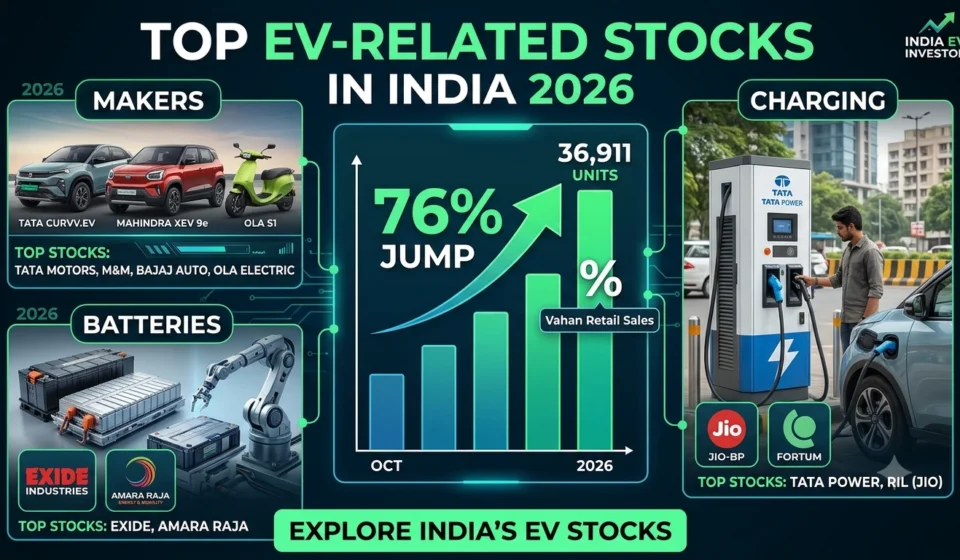
Top EV-Related Stocks in India 2026: Makers, Batteries and Charging, as EV Sales Jump 76% to 36,911 in October

By Shuchi, FinanceChecks.com | Published 5 November 2026 | Category: Stock Market | Reading time: about 7 minutes
India’s electric vehicle market is growing fast, but the listed companies that benefit from it are very different from one another. Some make vehicles, some make batteries and some build charging networks, and their risks differ widely. This guide maps the main listed EV-related companies by segment, shows the latest sales data, and explains what to check before investing. It is a sector explainer, not a recommendation to buy or sell any stock.
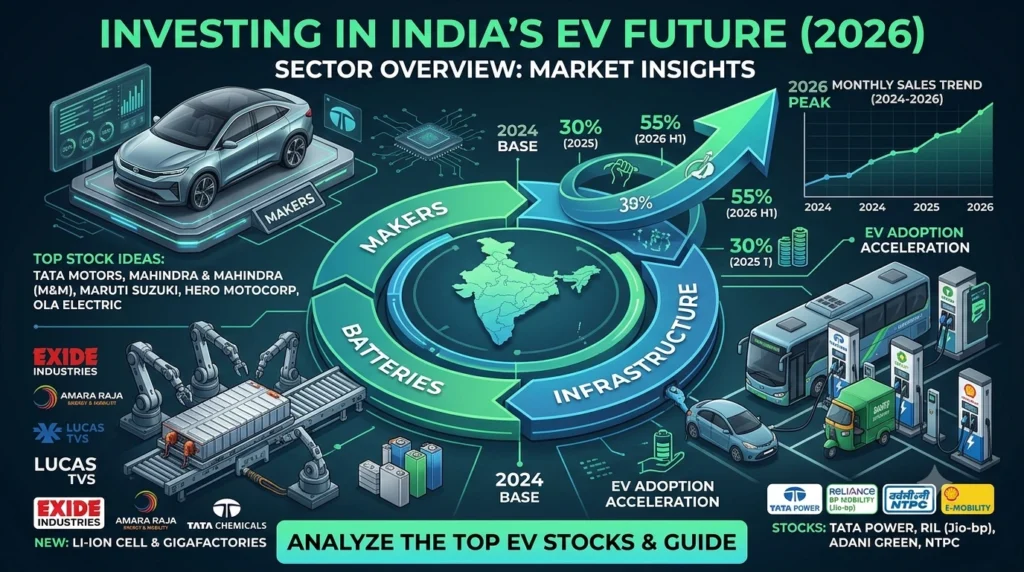
Quick Answer
Electric passenger vehicle sales in India rose about 76% to 36,911 units in October 2026, according to reported data, with Tata Motors leading at about 40% share, followed by Mahindra and JSW MG Motor. The main listed EV-related names fall into four groups: vehicle makers (Tata Motors Passenger Vehicles, Mahindra and Mahindra, Ola Electric, Ather Energy, TVS Motor, Bajaj Auto, Hero MotoCorp), batteries (Exide Industries, Amara Raja Energy and Mobility), charging and power (Tata Power) and electric buses and components (Olectra Greentech and component makers). Established companies with other income streams are generally less volatile than loss-making pure EV makers, but all are exposed to policy, competition and market swings.
About This Guide
This article is written by the editorial desk of FinanceChecks.com, an independent Indian personal finance publication. Sales data comes from reports on October 2026 vehicle registrations by NewsBytes, Autopunditz, EVreporter, Business Today and Auto India Daily, and company prices and market values from market-data pages dated 30 October and 2 November 2026. Data sources differ slightly, and prices change daily. This list is illustrative and not exhaustive. I am not a SEBI-registered research analyst, and nothing here is advice to buy, sell or hold any security.
The EV Market Today: October 2026 Snapshot
| Segment | October 2026 data |
|---|---|
| Electric cars | About 36,000 to 36,900 units, up about 76% from a year earlier. Sales have stayed above 30,000 for five months |
| Leading car makers | Tata Motors about 14,550 to 14,650 units (about 40% share), Mahindra about 8,500 units, JSW MG about 6,000 |
| Tata Motors total EV sales | 16,244 units including exports, up 75% |
| Electric two-wheelers | Record 2.23 lakh retail sales, up 48%. TVS led the market |
| Two-wheeler players | Ather Energy about 31,800 units, Hero Vida about 29,900, Ola Electric 12,096 (down 26% from a year earlier) |
| EV share of sales | About 9.7% in two-wheelers, and about 54.5% of passenger electric three-wheelers |
| EV share in cars | Under 1% for Maruti, about 20% for Tata’s passenger vehicles and about 13% for Mahindra’s |
Reports link the strong October to festive demand and a recent GST cut. Electric cars are still a small share of total car sales, while electric three-wheelers are already the majority in some segments.
EV-Related Listed Companies by Segment
| Segment | Examples of listed companies | EV link | What to check |
|---|---|---|---|
| Car makers | Tata Motors Passenger Vehicles, Mahindra and Mahindra | Largest electric car sellers | EV share of sales, margins, new launches, battery costs |
| Two-wheeler makers | Ola Electric, Ather Energy, TVS Motor, Bajaj Auto, Hero MotoCorp | Electric scooters and motorcycles | Market share, losses, subsidy dependence, service quality |
| Batteries | Exide Industries, Amara Raja Energy and Mobility | Lead-acid and lithium-ion battery plans | Cell technology, plant progress, customers, capex |
| Charging and power | Tata Power | Public charging network and EV power supply | Number of chargers, utilisation, debt |
| Buses and fleets | Olectra Greentech | Electric buses on government contracts | Order book, payment delays, concentration |
| Components | Sona Comstar, Uno Minda and others | EV motors, drivetrains and parts | Share of EV revenue, customer concentration |
A Closer Look at the Main Names
Tata Motors Passenger Vehicles. Tata’s passenger vehicle and EV business sits in this entity after the 2025 demerger, which also created the separately listed commercial vehicle company. It leads electric car sales, but reports note that EV adoption, competition and costs are risks for the business.
Mahindra and Mahindra. A large, diversified company with a growing electric SUV line and a three-wheeler business where almost all sales are electric. EVs are a part of a larger business, which can lower risk but also dilutes the EV theme.
Ola Electric. The most talked-about pure electric two-wheeler stock, but its October sales fell 26% from a year earlier to 12,096 units, and it is loss-making according to market reports. It is a high-risk stock with a volatile price history.
Ather Energy. A premium electric scooter maker with strong October volumes of about 31,800 units, but also reported as loss-making. Pure-play two-wheeler makers depend on continued growth and funding.
TVS Motor, Bajaj Auto and Hero MotoCorp. Established two-wheeler groups with EV lines (iQube, Chetak and Vida). Bajaj’s electric share in passenger three-wheelers was about 33% in October. For these companies, EVs are one segment inside a profitable petrol vehicle business.
Exide Industries and Amara Raja Energy and Mobility. The leading listed battery makers, building lithium-ion capacity. They benefit from both vehicle and energy storage demand but face technology and capital spending risks.
Tata Power. Combines power generation with an EV charging network. Its EV business is a small part of a large, debt-heavy utility.
Olectra Greentech. Makes electric buses, largely for state transport undertakings. Orders can be large, but payments and tender timing can be lumpy.
Prices and Market Value: A Snapshot
These figures are from a market-data page dated 30 October 2026 and will have changed.
| Company | Price | Market value |
|---|---|---|
| Mahindra and Mahindra | ₹2,840.30 | About ₹3.4 to ₹3.5 lakh crore |
| Tata Power | ₹345.05 | About ₹1.10 lakh crore |
| Exide Industries | ₹335.50 | About ₹28,500 crore |
| Amara Raja Energy and Mobility | ₹686.85 | About ₹12,600 crore |
| Olectra Greentech | ₹951.10 | About ₹7,800 crore |
The same page showed Exide, Amara Raja and Olectra down sharply over the previous month. Reported figures for Tata Motors Passenger Vehicles, Ola Electric and Ather Energy were inconsistent across sources, so please check live data on NSE or BSE.
Key Risks for EV Stocks
- Policy risk. Subsidies, GST rates and local-content rules can change, and growth often depends on them.
- Competition. New and global entrants, including VinFast, are targeting the same buyers, and price cuts can squeeze margins.
- Profitability. Several pure EV makers are loss-making and depend on continued funding.
- Battery costs and technology. Battery prices, supply and technology shifts affect margins.
- Volatility. EV-themed stocks often swing sharply on news, and many fell steeply in October.
- Valuation. Popular themes can be priced for growth that may not arrive.
What to Check Before Investing
- Revenue mix. How much of the company’s revenue actually comes from EVs?
- Profitability. Is the company profitable, and are losses narrowing?
- Cash and debt. Can it fund growth without repeated fundraising?
- Market share trend. Is its share rising or falling month after month?
- Customer service and quality, especially for two-wheeler makers.
- Dependence on subsidies or a few customers.
- Valuation against peers, and against what you are paying for growth.
- Your own limit. How much of your portfolio would one volatile theme represent?
Common Mistakes to Avoid
The usual mistakes are buying a stock because it is an “EV theme” without checking how much revenue EVs generate, chasing a stock after a big rally, treating a single month’s sales jump as a trend, ignoring losses and debt, putting too much money in one theme and following tips from social media. Another is confusing a vehicle maker with a battery or charging company, since their risks are completely different.
My Take
The EV story in India is real. Sales are growing, electric three-wheelers have already tipped to majority share in some segments and electric cars are rising from a small base. But a growing industry does not guarantee that every listed company will make money for its shareholders.
If you want exposure to the theme, one way to think about it is to separate established companies, where EVs are a growing part of a profitable business, from pure plays, where the whole bet rests on rapid growth and eventual profits. Whichever you choose, keep the position modest and check the company’s numbers, not just the headline sales figure.
Frequently Asked Questions
1. Which companies are EV-related stocks in India? Listed names include Tata Motors Passenger Vehicles, Mahindra and Mahindra, Ola Electric, Ather Energy, TVS Motor, Bajaj Auto, Hero MotoCorp, Exide Industries, Amara Raja Energy and Mobility, Tata Power and Olectra Greentech. This list is illustrative, not exhaustive.
2. How fast are EV sales growing in India? Electric car sales rose about 76% year on year to roughly 36,900 units in October 2026, and electric two-wheeler sales reached a record 2.23 lakh units, up 48%, according to reports.
3. Who leads electric car sales in India? Tata Motors leads with about 40% of the market, followed by Mahindra and JSW MG Motor, according to October 2026 data.
4. Are EV stocks risky? They can be. Pure EV makers are often loss-making and volatile, and all EV-related stocks are exposed to policy changes, competition and battery costs. Many fell sharply in the month to 30 October.
5. Is this a list of stocks to buy? No. It is an educational overview of the sector and not a recommendation. Consult a SEBI-registered investment adviser before making investment decisions.
Disclaimer
This article is for general information and education only. FinanceChecks.com and its author are not SEBI-registered research analysts or investment advisers, and nothing here is a recommendation to buy, sell or hold any security. Company lists are illustrative, and prices, market values and sales figures come from third-party sources and change quickly. Investments in securities are subject to market risk, and you can lose some or all of your capital.

Shuchi founded Finance Checks after spending 16+ years working in corporate, managing operations and distribution. She managed her own finances, learned and read regularly and helped people make sense of their savings, loans, insurance, and investments.
She started this site to offer the kind of clear, honest financial guidance she wished was more available when she was learning to manage her own money. Every article is researched personally, checked against official sources such as the Reserve Bank of India, SEBI, or the Income Tax Department, and revisited whenever regulations or figures change. She is upfront about how the site earns money through ads and select affiliate partnerships, and she does not let either influence what she actually recommends to readers.