
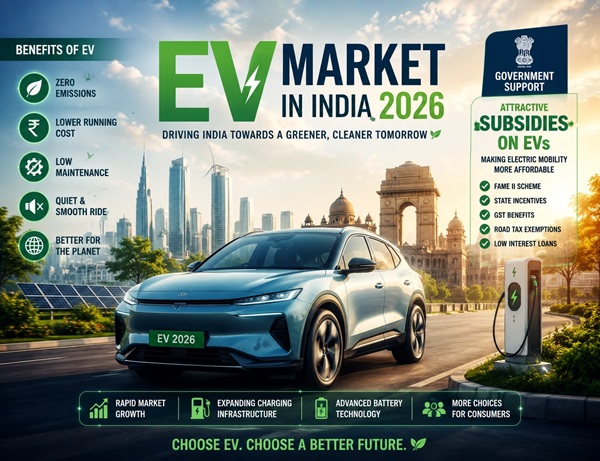
EV Market in India 2026: Is Buying an Electric Vehicle Actually Worth It, and How Much Can You Really Save

Every second person shopping for a new car right now ends up asking the same question at some point during their research. Should this be an EV, or should I just stick with a regular petrol car like everyone in my family always has. It is a fair question, and honestly, most of the answers floating around online are either written by someone trying to sell you an EV or by someone who drove one badly ten years ago and never looked again.
This post is meant to be the version you can actually trust to make a decision from. No hype, no fear mongering, just what is actually happening in the Indian EV market right now, what subsidies the government genuinely gives you, what an EV actually costs to run compared to petrol, and where the real catches are that nobody puts in the headline.
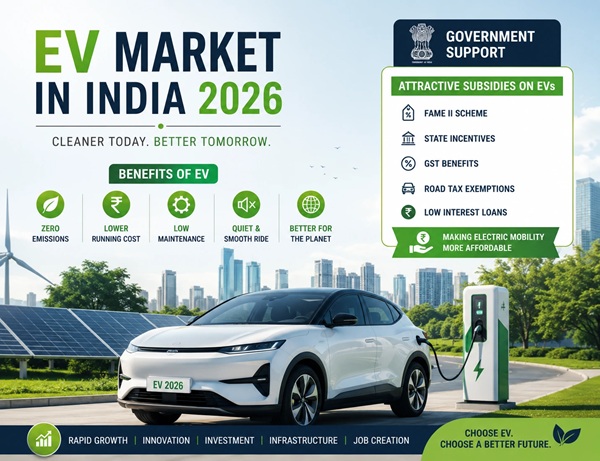
Where EV Market in India Actually Stands Right Now
India is no longer in the experimental phase with electric vehicles. In the financial year 2025-26, the country crossed roughly 24.5 lakh EV units sold, which is close to a 25 percent jump over the previous year. That number includes two-wheelers, three-wheelers, cars, buses and commercial vehicles, and overall EV penetration across all vehicle categories is now sitting around 8.5 percent of total vehicle sales.
Break that down a bit and the picture gets more interesting. Electric two-wheelers are the real volume driver, with penetration touching close to 8 percent of all two-wheeler sales in some months. Electric three-wheelers, the autos you see everywhere in Indian cities, are even further ahead, since they were among the earliest and easiest categories to electrify. Electric passenger cars are the slower moving segment but they are catching up fast, moving from under 3 percent of total car sales just a couple of years ago to somewhere between 4 and 6 percent now, with monthly numbers still climbing.
Tata Motors continues to lead the electric car race in India by a wide margin, followed by Mahindra and JSW MG Motor, and the model lineup has genuinely improved. What used to be two or three compliance-level EVs a few years ago is now a real spread of hatchbacks, SUVs and premium options from Tata, Mahindra, MG, Hyundai and Maruti, with more launches lined up through 2026.
Why This Shift Is Happening Now, Not Just Government Talk
A few things are converging at the same time, and it is worth understanding them because they explain why this is not a passing trend.
Petrol and diesel prices in India have stayed stubbornly high, and every time there is any geopolitical tension anywhere in the world, pump prices are among the first things Indian households feel directly. That volatility has quietly pushed a lot of buyers, especially in cities, toward something with a more predictable running cost.
Charging infrastructure has also genuinely improved. India now has close to 30,000 public charging stations, expanding fast, with states like Karnataka and Maharashtra leading the buildout. Oil marketing companies themselves are now installing EV chargers at fuel stations, which is a fairly telling sign of where things are headed.
On top of that, GST on electric vehicles was cut from 12 percent to 5 percent, and GST on EV chargers and charging equipment was cut from 18 percent to 5 percent as part of the broader GST 2.0 reform. That single change alone made a meaningful dent in EV pricing across the board.
You May Also Like To Read:
Government Subsidies for EVs in India: What You Actually Get
This is where most articles get sloppy, so let us go category by category and be precise about what applies to you.
GST benefit, which applies to everyone. Every electric vehicle sold in India, whether a two-wheeler, three-wheeler or car, attracts only 5 percent GST, compared to 28 to 50 percent on petrol and diesel vehicles depending on engine size and type. This is not a scheme you need to apply for, it is baked into the price you see at the showroom.
PM E-DRIVE, the central government scheme, and an important catch. PM E-DRIVE replaced the older FAME II scheme in October 2024 with a total outlay of around 10,900 crore rupees. Here is the part a lot of people miss. This scheme’s direct cash purchase incentives are mainly built for electric two-wheelers, electric three-wheelers, e-buses, e-trucks and e-ambulances. Private electric cars for personal use are largely left out of PM E-DRIVE’s direct purchase subsidy. If you are buying a two-wheeler, you can currently get up to 2,500 rupees per kWh of battery capacity, capped at 5,000 rupees per vehicle, and this incentive is scheduled to run until July 31, 2026. Three-wheeler incentives run considerably longer, through March 2028. If you are buying a private electric car, do not go in expecting a central government cash discount, because for that segment, your real savings come from GST and state level benefits instead.
State government incentives, which is where most car buyers actually save money. This is genuinely the most impactful part of the subsidy picture for private car buyers, and it varies a lot depending on where you register your vehicle. A few examples as things stand today: Delhi offers electric car buyers benefits worth up to 1.5 lakh rupees along with full road tax and registration fee exemption. Maharashtra offers incentives of up to 2.5 lakh rupees on electric cars along with an additional scrapping incentive if you retire an old petrol vehicle. Telangana currently gives a full 100 percent exemption on road tax and registration fees, valid until the end of 2026. Tamil Nadu also offers a full road tax waiver on EVs. Gujarat offers strong per-kWh incentives on two-wheelers along with partial road tax relief on cars. Karnataka, which used to offer a full road tax exemption, revised its policy in April 2026 and now applies a tiered road tax of 5 to 10 percent instead of a complete waiver, so the benefit there has actually gotten smaller recently.
The bigger point here is that these state policies change fairly often, sometimes with very little notice, and they usually come with price caps, quotas or expiry dates. Before you assume a subsidy applies to you, it is worth checking your specific state transport department’s current EV policy rather than relying on a number you read somewhere online six months ago.
Section 80EEB, the income tax deduction, and a myth that needs correcting. You will see a lot of blogs and even some bank websites casually mention that you can claim up to 1.5 lakh rupees a year in income tax deduction on interest paid for an EV loan under Section 80EEB. This was true, but it comes with a critical catch that most of these articles conveniently leave out. This deduction is only available if your EV loan was sanctioned between April 1, 2019 and March 31, 2023. That window has closed. If you are taking a fresh EV loan today, in 2026, you cannot claim this deduction, full stop. The only people still legitimately claiming Section 80EEB are those who took an eligible loan within that original window and are still repaying it. If a salesperson or a blog tells you that buying an EV today gets you this tax benefit, that information is outdated, and it is worth knowing that before it factors into your decision.
The Real Cost Comparison: What an EV Actually Saves You
Here is the number everyone actually wants. Forget the marketing lines, here is the arithmetic.
A typical petrol car in India, driven in real city conditions with the AC running, gives somewhere between 12 and 18 kilometres per litre depending on the vehicle. With petrol prices hovering around 100 to 107 rupees a litre in most Indian cities right now, that works out to a running cost of roughly 5.5 to 8 rupees per kilometre.
A typical mid-size electric car consumes about 15 to 18 kWh to travel 100 kilometres. If you charge it at home, where domestic electricity in most Indian cities costs somewhere between 6 and 9 rupees per unit, your running cost comes down to roughly 1 to 1.5 rupees per kilometre. That is genuinely 5 to 8 times cheaper than petrol, and it is not an exaggerated marketing number, it holds up in real usage.
The catch is charging location. If you rely entirely on public fast chargers instead of home charging, the rate jumps to somewhere between 18 and 25 rupees per kWh, which pushes your running cost up to roughly 2.5 to 4 rupees per kilometre. Still noticeably cheaper than petrol, but the gap narrows a lot. Most EV owners in India end up doing 70 to 80 percent of their charging at home overnight and only use public fast charging occasionally, which keeps the blended cost low.
Maintenance is the other big saving that people underestimate. Petrol cars need regular engine oil changes, spark plug replacements, filter changes and exhaust system upkeep. EVs have none of this. No engine oil, no spark plugs, no clutch, no exhaust. Annual maintenance on an EV typically runs somewhere between 3,000 and 5,000 rupees, compared to significantly more for an equivalent petrol car once you add up regular servicing.
Put together, for someone driving around 1,000 to 1,200 kilometres a month, the combined fuel and maintenance savings from switching to an EV usually land somewhere between 60,000 and 90,000 rupees a year. Over five years, that adds up to anywhere between 3 and 5 lakh rupees in pure running cost savings, depending on your driving pattern and local electricity rates.
Now for the honest part. Electric cars still cost more upfront than an equivalent petrol variant, typically by 2 to 4 lakh rupees before any state subsidy is applied. This is often called the green premium. So the real question is not whether an EV saves money in the long run, because for most regular drivers it clearly does, but how long it takes to recover that upfront premium through running cost savings. For someone driving 1,000 kilometres a month or more with reliable home charging, that break-even point usually arrives somewhere between three and five years. For someone driving significantly less, say under 500 to 600 kilometres a month, the break-even stretches out much longer, and a petrol car might genuinely make more financial sense for them.
What Nobody Tells You Upfront: The Real Catches
An honest advisory post has to cover this properly, because a lot of EV coverage online conveniently skips it.
Home charging access is the single biggest factor in whether an EV works for you financially and practically. If you own an independent house or have a dedicated parking spot with an electricity connection, setting up a home charger is straightforward and usually costs somewhere between 15,000 and 50,000 rupees depending on the charger type, and some of that cost is offset by manufacturer or state incentives. If you live in an apartment and depend on your housing society’s permission to install a charger in a shared parking area, this can genuinely be a hurdle, though courts and regulators have increasingly ruled in favour of residents’ rights to install home chargers.
Battery life and degradation is the other thing worth understanding honestly. Most EV manufacturers in India now offer battery warranties of 8 years or 1.6 lakh kilometres, whichever comes first. Within that period, you are largely protected. After the warranty period, batteries typically retain somewhere around 70 to 80 percent of their original capacity, which means reduced range but a vehicle that is still fully usable, not a dead car. If a battery does need full replacement outside the warranty window, the cost can run anywhere from 3 to 6 lakh rupees depending on the vehicle, which is a real number worth factoring into your long-term ownership math, even if it is unlikely to hit most owners within a typical 8 to 10 year ownership period.
Resale value is still a genuinely evolving space in India. The second-hand EV market is younger and thinner than the second-hand petrol car market, and buyers are understandably cautious about battery health in a used EV. This is improving as adoption grows and as certified battery health reports become more standard, but if you plan to sell your car in three or four years, it is worth going in with realistic expectations rather than assuming EV resale works exactly like petrol car resale.
Insurance on EVs also tends to run somewhat higher than an equivalent petrol car, typically 8 to 15 percent more, mainly because insurers price in the cost and risk of battery replacement. It is a real cost, though a smaller one compared to the fuel and maintenance savings.
And finally, long distance and highway travel is still where petrol cars have a practical edge. Charging infrastructure on highways is expanding but is still uneven outside major routes, and a public fast charge takes considerably longer than a two-minute petrol refill. If your driving pattern regularly involves long intercity trips through areas with limited charging infrastructure, this is a genuine consideration, not something to dismiss.
Who Should Actually Buy an EV Right Now
If you drive mostly within a city, cover more than 800 to 1,000 kilometres a month, and have reliable access to home charging, an EV makes strong financial and practical sense today, and the math genuinely works in your favour over a normal ownership period.
If your driving is occasional, mostly short trips under 500 to 600 kilometres a month, or if you frequently travel long distances through regions with thin charging infrastructure, a petrol car, or possibly a strong hybrid where available, may still serve you better for now, even though the environmental case for EVs remains strong regardless of mileage.
If you live in an apartment without a clear path to installing a home charger, it is worth solving that question first before committing to an EV, because your running cost savings shrink significantly if you are forced to rely mostly on public charging.
My Take on EV Market in India
I think the EV conversation in India has moved past the “is this even real” stage and landed squarely in the “does this work for my specific situation” stage, and that is actually a healthier place for it to be. The running cost math is not marketing spin anymore, it holds up under real scrutiny, and for a genuinely large chunk of Indian car buyers, particularly city dwellers with home charging access, an EV is now the more rational financial choice, not just the environmentally conscious one.
What frustrates me is how much outdated or half-true information is still floating around, especially about tax benefits like Section 80EEB that quietly stopped applying to new buyers years ago, or blanket claims about subsidies that vary wildly by state and change without much warning. If you are seriously considering an EV, treat every subsidy number you read, including the ones in this post, as a starting point to verify against your own state’s current notification, not as a guaranteed number to bank on.
My honest advice is this. Do not buy an EV because it feels like the trendy thing to do, and do not avoid one because of stories from five years ago about range anxiety and unreliable charging. Sit down with your actual monthly driving distance, your access to home charging, and how long you typically keep a car, run the real numbers the way this post has laid them out, and let that decide it for you rather than either hype or old fear.
EV Market in India : Disclaimer
This article is written for general informational and educational purposes only and reflects government schemes, subsidy figures, tax provisions and market data as understood at the time of writing. It is not financial, legal or tax advice, and it should not be treated as a substitute for checking the latest official notifications from your state transport department, the Ministry of Heavy Industries, or consulting a qualified financial advisor or chartered accountant for your specific situation. Subsidy amounts, eligibility criteria, scheme deadlines and tax provisions change frequently and can vary significantly by state, vehicle category and individual circumstances, so please verify current details through official government sources before making any purchase or financial decision based on this content.
EV Market in India: Frequently Asked Questions
Is buying an electric vehicle actually worth it in India in 2026? For most city drivers covering more than 800 to 1,000 kilometres a month with access to home charging, yes, the running cost and maintenance savings typically outweigh the higher upfront price within three to five years. For occasional drivers or those without home charging access, the financial case is weaker, though not necessarily absent.
How much can I actually save by switching from petrol to an EV? Running cost alone can save you roughly 60,000 to 90,000 rupees a year if you drive around 1,000 to 1,200 kilometres a month and charge mostly at home, which adds up to 3 to 5 lakh rupees over five years. This is before accounting for the higher upfront purchase price, which typically takes a few years of these savings to fully offset.
What subsidies does the Indian government currently give for buying an EV? Every EV buyer benefits from the reduced 5 percent GST rate. Central government cash incentives under PM E-DRIVE mainly apply to electric two-wheelers, three-wheelers, buses, trucks and ambulances, not private cars. Private car buyers mainly benefit from state-level incentives such as road tax exemption, registration fee waivers, and in some states, direct purchase incentives, which vary significantly depending on where you register the vehicle.
Can I still claim tax benefits under Section 80EEB if I buy an EV now? No. Section 80EEB only applies to EV loans sanctioned between April 1, 2019 and March 31, 2023. If you take a new EV loan today, you are not eligible for this deduction. Only buyers who took an eligible loan within that original window and are still repaying it can continue claiming it.
Which Indian states offer the best subsidies for electric cars? As of now, Delhi and Maharashtra offer some of the strongest state-level incentives for electric cars, including sizeable purchase incentives along with road tax and registration exemptions. Telangana and Tamil Nadu currently offer full road tax waivers. These policies change periodically, so it is worth checking your specific state’s current notification before assuming a benefit applies.
Does an EV really cost less to maintain than a petrol car? Yes, meaningfully so. EVs have no engine oil to change, no spark plugs, no clutch and far fewer moving parts overall, which typically brings annual maintenance costs down to around 3,000 to 5,000 rupees compared to a noticeably higher figure for an equivalent petrol car serviced regularly.
How long do EV batteries actually last, and what happens after the warranty ends? Most EVs sold in India today come with battery warranties of 8 years or 1.6 lakh kilometres. After the warranty period, batteries typically retain around 70 to 80 percent of their original capacity, meaning reduced range but a vehicle that remains usable. Full battery replacement outside warranty can cost 3 to 6 lakh rupees depending on the vehicle, though this is uncommon within a normal ownership period.
Is it a problem to own an EV if I live in an apartment? It can be, mainly around getting permission to install a home charger in a shared parking area, though this has been improving as more societies adapt and as residents’ rights to install chargers get clearer regulatory backing. If home charging genuinely is not possible for you, your running cost savings shrink because you will rely more on public charging, which is more expensive.
Are EVs practical for long distance highway travel in India? This is improving steadily as public charging networks expand, but it is still less convenient than a petrol car for frequent long intercity trips, mainly because charging takes considerably longer than refuelling and coverage on some highway routes is still thin. For predominantly city driving, this is a non-issue.
Is EV insurance more expensive than petrol car insurance? Yes, typically by around 8 to 15 percent, mainly because insurers factor in the cost and risk associated with battery replacement. It is a real additional cost, but usually small compared to the overall running cost savings an EV offers.
Will my EV lose value faster than a petrol car when I try to sell it? The second-hand EV market in India is still developing and buyers tend to be cautious about battery health, so resale confidence is not yet on par with petrol cars. This is expected to improve as adoption grows and certified battery health checks become more standard, but it is worth going in with realistic expectations if resale value in three to four years is an important factor for you.
Should I wait for better EV technology or buy now? This depends on your current vehicle situation and driving needs more than on the technology itself. EV technology, range and charging infrastructure are all improving steadily, but they have already reached a point where they genuinely work for a large share of Indian city drivers today. If your monthly driving distance and charging access already fit the profile that benefits most from an EV, waiting mainly means paying petrol running costs a bit longer without materially better terms guaranteed on the other end.

Shuchi founded Finance Checks after spending 16+ years working in corporate, managing operations and distribution. She managed her own finances, learned and read regularly and helped people make sense of their savings, loans, insurance, and investments.
She started this site to offer the kind of clear, honest financial guidance she wished was more available when she was learning to manage her own money. Every article is researched personally, checked against official sources such as the Reserve Bank of India, SEBI, or the Income Tax Department, and revisited whenever regulations or figures change. She is upfront about how the site earns money through ads and select affiliate partnerships, and she does not let either influence what she actually recommends to readers.



[…] EV Market in India 2026 […]
[…] EV Market in India 2026 […]