

The 50-30-20 Rule for Indian Salaries: Does It Actually Work in 2026?

I still remember the first time someone told me about the 50-30-20 rule. I was three years into my job, my salary had gone up twice, and yet I had no idea where the money went every month. A colleague casually mentioned this rule over chai, said something like “just split your salary into three parts and you’re sorted,” and walked off looking very pleased with himself. I went home that night, opened my bank statement, and tried to fit my life into those three neat percentages.
It did not fit. Not even close.
That gap between what the rule promises and what actually happens on an Indian salary slip is exactly what this post is about. We will go through what the 50-30-20 rule really means, why it suddenly feels like everyone from your bank’s app to your cousin’s finance reels is talking about it, where it genuinely helps, and where it quietly falls apart for people earning and spending in rupees. By the end, you will know whether to use it as it is, tweak it, or throw it out the window for something that actually matches your life.
What Exactly Is the 50-30-20 Rule
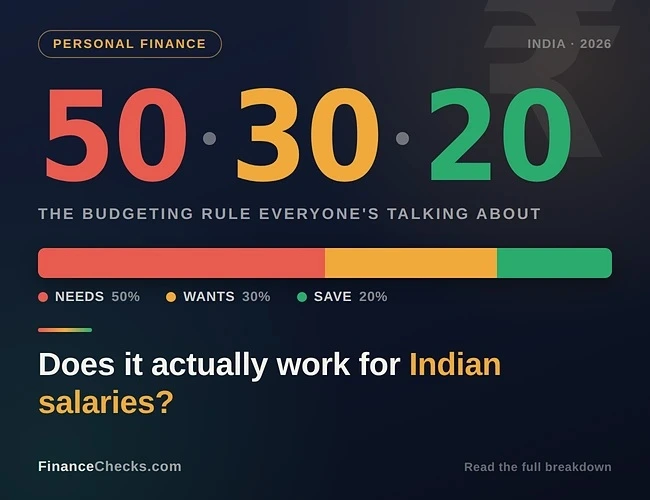
The 50-30-20 rule is a simple way to divide your monthly take-home salary into three buckets.
Fifty percent goes to your needs, the things you cannot avoid paying for. Thirty percent goes to your wants, the things that make life enjoyable but you could technically live without. Twenty percent goes to savings and investments, the part that takes care of future you.
This idea was popularised by Elizabeth Warren, a US senator and bankruptcy law expert, along with her daughter Amelia Warren Tyagi, in their book on lifetime money planning. It was never built with Indian metro rents, joint family expenses, or wedding season in mind, but the core logic behind it travels well anywhere: stop tracking every fifty rupees you spend on something tiny, and instead check whether your three big buckets are roughly in balance.
The reason this rule has stayed popular for almost two decades is that it does not ask you to maintain forty categories in a spreadsheet. It asks one honest question every month. Are my needs, wants, and savings roughly where they should be, or has one bucket quietly swallowed the other two.
Why 50-30-20 Rule Is Suddenly Everywhere in India
If it feels like every finance page, bank newsletter, and YouTube video is suddenly talking about the 50-30-20 rule, there is a real reason behind it, and the numbers are a bit sobering.
According to the Reserve Bank of India’s latest annual report, net household financial savings rose to 7.0 percent of gross national disposable income in 2024-25, a genuine improvement from 5.1 percent the year before. That is good news, and worth acknowledging. But read the number again next to what this rule actually asks for. The rule recommends putting away 20 percent of your income. Even after a real and welcome jump, the average Indian household is saving roughly a third of that target, once loans and EMIs are factored in.
That is not a small gap. It tells you that most of us are not failing this rule because we are bad with money. We are failing it because spending has quietly outpaced saving across the country, and almost nobody noticed until they sat down and did the math.
This is exactly why a simple three-bucket system has found new fans here. It does not require financial literacy you do not have. It requires you to look at your own salary slip honestly, once a month, and ask where the money actually goes.
50-30-20 Rule : Breaking Down the Three Buckets on an Actual Indian Salary
Let’s stop talking in percentages and put real rupees on the table. Say your monthly take-home salary, the amount that actually lands in your bank account after tax, provident fund, and other deductions, is fifty thousand rupees.
Your needs bucket would be twenty-five thousand rupees. This covers rent, electricity, groceries, your phone and internet bill, commuting costs, health insurance premiums, school fees if you have kids, and EMIs on a home or anything you genuinely need to function. If missing a payment here would cause real disruption to your life, it belongs in this bucket.
Your wants bucket would be fifteen thousand rupees. This is your guilt-free zone. Eating out, OTT subscriptions, weekend trips, that new pair of shoes, gifting, salon visits, gadgets you wanted but did not strictly need. Nothing wrong with spending here, that is exactly what this bucket exists for, as long as it stays inside its limit.
Your savings and investment bucket would be ten thousand rupees. This is the one that builds your future, whether that is an emergency fund sitting safely in a liquid fund, a SIP running quietly every month, a recurring deposit, or extra principal paid towards a loan to close it faster. This money is not optional and it is not what is “left over” at the end of the month. It gets paid first, the same way rent or your phone bill gets paid first.
One important point that trips up almost everyone in India: always apply these percentages to your take-home salary, not your CTC. Your offer letter might say nine lakh a year, but if your actual monthly credit is fifty thousand after deductions, that fifty thousand is your real number. Budgeting against your CTC is one of the fastest ways to feel like you are failing a rule you never actually applied correctly in the first place.
50-30-20 Rule: Where the Rule Genuinely Struggles in India
Here is the part most articles gloss over, and it is the part that actually answers the question in this post’s title.
Rent in Indian metros is brutal. In cities like Mumbai, Bengaluru, or Gurgaon, it is common for a fresh graduate’s rent alone to eat thirty-five to fifty percent of their take-home salary, before a single rupee goes towards food, transport, or utilities. The rule assumes your needs can be contained within half your income. For a huge number of young earners in expensive cities, that assumption breaks on day one.
Then there is the part of Indian life this American framework was never built to handle: family. Many of us are not just managing our own needs, we are sending money home, contributing to a parent’s medical expenses, or saving for a sibling’s education. None of that fits neatly into “needs” or “wants,” yet it is very real and very non-negotiable for a large share of Indian households.
Festivals and weddings add another wrinkle. A typical monthly budget might survive nicely until Diwali, a cousin’s wedding, or back-to-back festival season arrives, and suddenly months of careful percentages get thrown off by genuinely unavoidable, culturally important spending.
And then there is debt. If you are paying EMIs on a personal loan, a car, and a credit card all at once, your needs bucket can balloon well past fifty percent before you even get to groceries. Most lenders in India actually use a similar but separate concept when deciding how much loan to give you, called the fixed obligation to income ratio. Most banks treat EMIs up to roughly forty to fifty-five percent of income as a manageable range, and approvals get noticeably harder above that. If your EMIs alone are already pushing toward that range, no budgeting rule in the world is going to make the math work until that debt comes down.
50-30-20 Rule: So Does It Actually Work for Indian Salaries
Here is my honest answer after using a version of this rule for years and watching dozens of friends try and abandon it: the percentages are not gospel, but the structure underneath them absolutely works.
Think of needs, wants, and savings the way many of us already think in everyday language, even without realising it. Zaroorat, shauk, and bachat. Necessity, indulgence, and savings. Indians have been mentally sorting expenses into these three buckets for generations, often without ever calling it a “budgeting framework.” The 50-30-20 rule simply puts numbers on instincts we already have.
What does not work is treating fifty, thirty, and twenty as sacred numbers carved in stone, especially if you live in an expensive city or are early in your career. What works brilliantly is the underlying habit: decide where your money is going before you spend it, rather than wondering where it went after it is gone.
50-30-20 Rule: How to Adapt the Rule So It Actually Fits Your Life
If your rent and basic expenses are eating closer to sixty or even seventy percent of your salary, you are not failing at budgeting, your city is simply more expensive than the original rule accounted for. In that case, a more realistic split for many Indian metro earners looks closer to sixty percent needs, twenty percent wants, and twenty percent savings. The non-negotiable part stays the same: never let the savings bucket drop below that twenty percent floor, because that is the one habit that actually builds long-term wealth. If something has to bend, let it be the wants bucket, not the savings bucket.
If you are dealing with high-interest debt right now, a temporary seventy-twenty-ten split, where seventy percent covers combined needs and wants, twenty percent goes to savings, and ten percent goes specifically towards aggressively clearing that debt, can get you back to a healthier position faster than trying to force the standard ratio while interest quietly compounds against you.
If you live in a tier two or tier three city where rent and living costs are genuinely lower, you might find the classic fifty-thirty-twenty fits with room to spare, and honestly, you might even be able to push savings to twenty-five or thirty percent and get a serious head start on building wealth early.
The percentages are a starting point for a conversation with your own numbers, not a final exam you either pass or fail.
50-30-20 Rule: A Simple Way to Actually Start This Month
Open your bank statement from the last two months before you do anything else. Do not guess where your money went, look at the actual numbers.
Write down your real take-home salary, the amount that hits your account, not the number on your offer letter. Go through your statement and sort every expense into needs, wants, or savings. You will be surprised how many things you assumed were needs are actually wants wearing a disguise, and that streaming subscription you forgot about will definitely show up.
Once you see where you actually stand, pick the split that matches your real life, whether that is the classic fifty-thirty-twenty, the metro-friendly sixty-twenty-twenty, or a temporary debt-clearing seventy-twenty-ten. Then do the one thing that makes any version of this rule actually stick: set up an automatic transfer for your savings bucket on the very day your salary is credited. Pay your future self first, then let the rest of your money sort itself into needs and wants. Willpower is unreliable. Automation is not.
Give it two to three months before judging whether it is working. The first month is almost always messy because old habits do not disappear overnight. By month three, you will know exactly which bucket needs adjusting, and that is when this rule stops being theory and starts becoming the way you naturally handle money.
50-30-20 Rule: Frequently Asked Questions
Does the 50-30-20 rule actually apply to Indian salaries? Yes, but rarely in its exact original form. The three-bucket structure works well for Indian earners, but the percentages often need adjusting for metro rent, family financial support, and existing debt, especially in expensive cities.
Should I calculate the 50-30-20 rule on my gross salary or my in-hand salary? Always use your take-home or in-hand salary, the amount actually credited to your bank account after tax and provident fund deductions. Calculating it on your CTC will give you numbers that do not match your real bank balance.
What if my rent alone is more than 50 percent of my salary? This is common in cities like Mumbai, Bengaluru, and Delhi NCR. Rather than forcing your needs into 50 percent, try a 60-20-20 split instead, where needs take 60 percent, wants take 20 percent, and savings still hold firm at 20 percent.
Is saving only 20 percent of my salary actually enough in India? Twenty percent is a solid minimum, not a ceiling. If you are starting your career, 20 percent builds a strong habit. As your income grows and big expenses like rent or EMIs reduce as a share of your salary, pushing savings up to 25 or 30 percent will get you to your financial goals noticeably faster.
Do EMIs count as needs or wants under this rule? A home loan EMI generally counts as a need since it builds an asset. A car loan for a vehicle you genuinely need for work falls under needs too. EMIs for purely discretionary purchases, like a loan taken for a vacation or gadgets you did not need, are better classified as wants, even though the payment itself is fixed.
How much should I actually be saving every month from my salary in India? There is no single number that fits everyone, but 20 percent of your take-home salary is the widely used baseline that most financial planners suggest as a starting point. If your fixed expenses allow it, pushing that to 25 or 30 percent as your salary grows will get you to your financial goals noticeably faster.
Can the 50-30-20 rule work if I have an irregular or freelance income? Yes, with one adjustment. Instead of applying the percentages to last month’s income, which can swing wildly for freelancers, calculate your buckets based on your average income over the last six months. This smooths out the feast-and-famine cycle and stops your savings bucket from disappearing entirely during a slow month.
The Bottom Line
The 50-30-20 rule does not fail Indian salaries. What fails is using someone else’s percentages without checking whether they match your city, your stage of life, and your family’s reality. Use it as a mirror that shows you exactly where your money is going, adjust the numbers until they reflect your actual life, and keep that savings bucket sacred no matter what else moves. That, far more than the exact ratio, is what actually changes your financial future.
Disclaimer
This article is written for general informational and educational purposes only and should not be treated as personalised financial, investment, tax, or legal advice. The figures, percentages, and salary examples used here are illustrative, meant to explain the concept, and will not match every reader’s exact situation. Data points referencing the Reserve Bank of India have been taken from RBI’s publicly released annual reports at the time of writing and are subject to revision in future reports. Budgeting splits like 50-30-20, 60-20-20, and 70-20-10 are commonly used heuristics in personal finance, not regulatory mandates, and what works for one household may not work for another. Before making any financial decision, including changes to your savings, investments, or debt repayment, please consult a SEBI-registered investment advisor, a chartered accountant, or another qualified financial professional who can assess your specific circumstances. Finance Checks does not accept responsibility for any financial loss or decision made solely on the basis of this article.

Shuchi founded Finance Checks after spending 16+ years working in corporate, managing operations and distribution. She managed her own finances, learned and read regularly and helped people make sense of their savings, loans, insurance, and investments.
She started this site to offer the kind of clear, honest financial guidance she wished was more available when she was learning to manage her own money. Every article is researched personally, checked against official sources such as the Reserve Bank of India, SEBI, or the Income Tax Department, and revisited whenever regulations or figures change. She is upfront about how the site earns money through ads and select affiliate partnerships, and she does not let either influence what she actually recommends to readers.



[…] The 50-30-20 Rule for Indian Salaries […]
[…] The 50-30-20 Rule for Indian Salaries: Does It Actually Work in 2026? […]
[…] The 50-30-20 Rule for Indian Salaries: Does It Actually Work in 2026? […]