
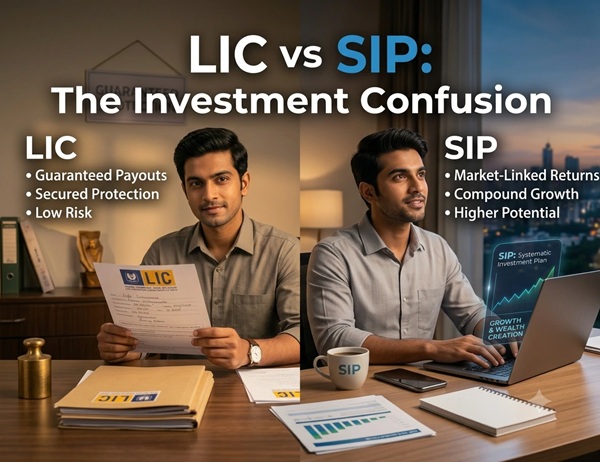
LIC vs SIP: Which Is the Better Investment Option in 2026?

A practical, no-nonsense comparison for Indian investors trying to decide between LIC policies and SIP mutual funds.
If you’ve spent any time talking to a relative, a bank RM, or an insurance agent about “safe investments,” you’ve probably heard two names come up again and again: LIC (Life Insurance Corporation of India) and SIP (Systematic Investment Plan). Both are hugely popular in India. Both get pitched as ways to “grow your money.” And both are, honestly, completely different financial products that get compared far more often than they should be.
This post breaks down LIC vs SIP in plain language — what each one actually is, how returns compare, who each one is genuinely suited for, and where people usually go wrong when choosing between them. By the end, you should be able to answer the question everyone’s really asking: “Should I put my money in LIC or SIP?”

Quick Answer: LIC vs SIP in One Line
LIC policies are primarily insurance products with a savings component, while SIPs are a method of investing regularly in mutual funds, mostly equity or debt. If your goal is wealth creation, SIPs in mutual funds have historically delivered far higher returns. If your goal is life cover with guaranteed (if modest) returns, LIC has its place — but even then, most financial planners recommend keeping insurance and investment separate rather than buying a combined product.
That’s the short version. Now let’s get into the details, because the right answer genuinely depends on your goals, your age, your risk appetite, and your family’s financial situation.
What Is LIC, Exactly?
LIC, or Life Insurance Corporation of India, is a government-owned insurance company and one of the oldest, most trusted financial institutions in the country. When people say “I invested in LIC,” they usually mean they bought one of LIC’s endowment plans, money-back policies, or ULIPs (Unit Linked Insurance Plans) — not a term insurance policy.
These plans work like this: you pay a premium (monthly, quarterly, or yearly) for a fixed term. In return, you get:
- A life insurance cover (a payout to your nominee if you pass away during the policy term)
- A maturity benefit if you survive the term — this is your “investment” coming back, usually with a bonus
The catch is that LIC’s traditional plans (endowment and money-back policies) typically deliver returns in the range of 4-6% annually over the long term. That’s barely ahead of inflation, and in some years, it doesn’t even keep up.
What Is a SIP?
A SIP, or Systematic Investment Plan, isn’t a product by itself — it’s a method of investing a fixed amount at regular intervals (usually monthly) into a mutual fund. You could SIP into an equity fund, a debt fund, a hybrid fund, or an index fund. The mutual fund is the product; SIP is just how you feed money into it.
SIPs became popular because they let ordinary salaried people invest small, consistent amounts (₹500, ₹1,000, ₹5,000 a month) without needing a lump sum, and they benefit from rupee cost averaging — buying more units when markets are down and fewer when markets are up, which smooths out volatility over time.
Equity mutual fund SIPs, held over 10+ years, have historically delivered average annual returns in the 10-14% range, though this varies by fund, market cycle, and time horizon, and — this is important — past performance never guarantees future returns.
Check Your SIP Maturity Amount Using SIP Calculator
LIC vs SIP: Side-by-Side Comparison
| Factor | LIC (Endowment/Money-Back) | SIP (Equity Mutual Fund) |
|---|---|---|
| Primary purpose | Life insurance + savings | Wealth creation |
| Typical returns | 4-6% per annum | 10-14% per annum (historical, market-linked) |
| Risk level | Low, guaranteed | Market-linked, moderate to high |
| Liquidity | Low; surrendering early means heavy losses | High; can redeem (with exit load in some cases) |
| Life cover | Yes, built in | No, unless you separately buy term insurance |
| Lock-in period | Long (often 15-20 years for full benefit) | Flexible; ELSS SIPs have a 3-year lock-in, others none |
| Tax benefit | Section 80C, maturity often tax-free under conditions | Section 80C only for ELSS funds |
| Transparency on charges | Historically low, improving with newer plans | High, expense ratio clearly disclosed |
| Ideal for | Risk-averse individuals, guaranteed-return seekers | Long-term wealth builders, goal-based investors |
Where Does LIC Actually Make Sense?
It’s easy to write LIC off completely after seeing return numbers next to equity SIPs, but that’s not entirely fair. LIC — and traditional insurance-cum-savings plans generally — make sense in specific situations:
- You want zero-risk, guaranteed maturity value and you’re not comfortable with market ups and downs, even over the long term.
- You need forced financial discipline. Some people simply won’t save consistently unless there’s a policy premium due date pressuring them.
- You want a combined life cover and savings instrument and don’t want to manage two separate products (even though, as we’ll get to, this usually isn’t the most efficient approach).
- You’re closer to retirement and prioritizing capital protection over growth.
Where SIPs Clearly Win
- Long-term wealth creation. If your goal is 15-20 years away — retirement, a child’s education, buying a house — equity SIPs have historically built far more wealth than LIC endowment plans over similar periods.
- Flexibility. You can increase, decrease, pause, or stop a SIP anytime. LIC premiums, if missed for long, can lapse your policy and forfeit past payments.
- Beating inflation. At 4-6% annual returns, LIC’s traditional plans barely outpace inflation. Equity SIPs, over a decade or more, have a much better historical track record of real (inflation-adjusted) wealth growth.
- Transparency. Mutual funds disclose expense ratios, portfolio holdings, and NAV daily. Traditional insurance plans are historically harder to evaluate in terms of where your premium actually goes.
The Insurance vs Investment Mistake
Here’s the thing almost every financial advisor will tell you, and it’s the single most important point in this entire comparison: insurance and investment are two different needs, and mixing them usually shortchanges both.
A pure term insurance plan gives you a large life cover (say, ₹1 crore) for a very small premium, because it has no savings component — it’s just protection. A LIC endowment plan bundles a much smaller life cover with a savings component, and the returns on that savings portion end up mediocre because the insurer has to account for mortality costs, administrative charges, and agent commissions within the same premium.
The commonly recommended approach among financial planners is:
- Buy a term insurance plan separately for life cover (cheap and high coverage)
- Invest the rest of your money in SIPs, PPF, or other investment instruments based on your goals and risk appetite
This “buy term, invest the rest” strategy generally results in both better life cover and better returns than a combined LIC endowment plan, though the right mix always depends on individual circumstances.
LIC vs SIP: Which One Should You Choose?
There’s no single correct answer for everyone, but here’s a practical way to think about it:
- If you’re young (20s-30s) with a stable income and a long investment horizon, equity SIPs are generally better suited for wealth creation, paired with a separate term insurance policy for protection.
- If you’re extremely risk-averse and cannot tolerate any market volatility, LIC’s guaranteed-return plans (or newer instruments like PPF, which also offer guaranteed, tax-free returns) may suit your comfort level better.
- If you already hold an LIC policy, it’s often not worth surrendering it mid-way, since early surrender usually results in a loss. It may be more sensible to let it run its course while directing new savings toward SIPs going forward.
- A hybrid approach — some allocation to guaranteed instruments (LIC, PPF, FD) for stability, and the rest to SIPs for growth — is what many financial planners actually recommend, rather than an all-or-nothing choice.
My Personal Take
Having looked closely at both categories of products, my own view is this: LIC and similar endowment plans were far more relevant a couple of decades ago, when mutual funds weren’t as accessible, digital SIP platforms didn’t exist, and financial literacy around equity markets was low. Today, with SIPs available through apps in minutes, with SEBI-regulated transparency, and with decades of return data to study, the case for combining insurance and investment into one LIC product is much weaker than it used to be.
That said, I don’t think LIC is a “bad” product — it’s a mismatched one for people whose primary goal is wealth creation. For guaranteed, low-risk savings, it still has a place in a conservative portfolio, especially for someone who values certainty over higher expected returns. But for most working professionals building long-term wealth, separating term insurance from mutual fund SIPs tends to be the more efficient path. This is a personal opinion based on general product characteristics — your own decision should factor in your specific goals, dependents, and risk comfort, ideally with the help of a qualified advisor.
Frequently Asked Questions (FAQs)
1. Is SIP better than LIC for returns? Historically, equity mutual fund SIPs have delivered higher average annual returns (around 10-14% over long periods) compared to LIC’s traditional plans (around 4-6%). However, SIP returns are market-linked and not guaranteed, while LIC’s returns are largely guaranteed. Higher potential return comes with higher risk.
2. Should I surrender my LIC policy and invest in SIP instead? Generally, surrendering an LIC policy mid-term results in a financial loss because surrender values are usually much lower than the premiums paid, especially in the early years. Most advisors suggest letting an existing policy continue (or converting it to a paid-up policy if premiums become unaffordable) rather than surrendering, and directing fresh savings toward SIPs instead.
3. Can I do both LIC and SIP together? Yes, and many people do. A common approach is to keep an existing LIC policy for its guaranteed component while starting SIPs for wealth creation, alongside a separate term insurance plan for adequate life cover.
4. Which is safer, LIC or SIP? LIC’s traditional plans are generally considered safer because returns are largely guaranteed and backed by a government-owned insurer. SIPs, especially in equity funds, carry market risk and the value can go up or down, though this risk tends to reduce over longer holding periods.
5. Is LIC maturity amount tax-free? Under Section 10(10D) of the Income Tax Act, LIC maturity proceeds are tax-free if certain conditions are met, primarily relating to the premium-to-sum-assured ratio. Recent tax rule changes have also introduced taxability for high-premium policies in some cases, so it’s worth checking current rules or consulting a tax advisor for your specific policy.
6. What is the minimum amount needed to start a SIP? Many mutual funds allow SIPs starting from as low as ₹500 per month, making it accessible even for small, regular investors.
7. Does SIP guarantee returns like LIC? No. SIP is a method of investing in mutual funds, and mutual fund returns are market-linked, meaning they are not guaranteed and can fluctuate with market performance. LIC’s traditional plans, on the other hand, typically offer guaranteed or near-guaranteed returns as part of the policy terms.
8. Which is better for a beginner investor: LIC or SIP? For a beginner with a long time horizon (10+ years) and some risk tolerance, SIPs in diversified equity or index funds are often recommended for wealth creation, alongside a separate, affordable term insurance plan. For someone who wants zero market exposure, LIC or other guaranteed-return instruments may feel more comfortable, even if the growth potential is lower.
Disclaimer
This article is written for general informational and educational purposes only and does not constitute financial, investment, insurance, or tax advice. LIC policies, mutual funds, and SIPs are subject to market risks, policy terms, and regulatory guidelines that can change over time. Historical returns mentioned here are indicative, based on long-term averages, and are not a guarantee of future performance. Mutual fund investments are subject to market risk; please read all scheme-related documents carefully before investing. Insurance is a subject matter of solicitation; please read the policy document carefully before concluding a sale. Readers are strongly advised to consult a certified financial advisor, tax consultant, or insurance professional who understands their personal financial situation before making any investment or insurance decisions. The author and publisher are not liable for any financial decisions made based solely on this article.
Last updated: July 2026

Shuchi founded Finance Checks after spending 16+ years working in corporate, managing operations and distribution. She managed her own finances, learned and read regularly and helped people make sense of their savings, loans, insurance, and investments.
She started this site to offer the kind of clear, honest financial guidance she wished was more available when she was learning to manage her own money. Every article is researched personally, checked against official sources such as the Reserve Bank of India, SEBI, or the Income Tax Department, and revisited whenever regulations or figures change. She is upfront about how the site earns money through ads and select affiliate partnerships, and she does not let either influence what she actually recommends to readers.



[…] LIC vs SIP […]
[…] LIC vs SIP […]
[…] LIC vs SIP: Which Is the Better Investment Option in 2026? […]
[…] LIC vs SIP: Which Is the Better Investment Option in 2026? […]