
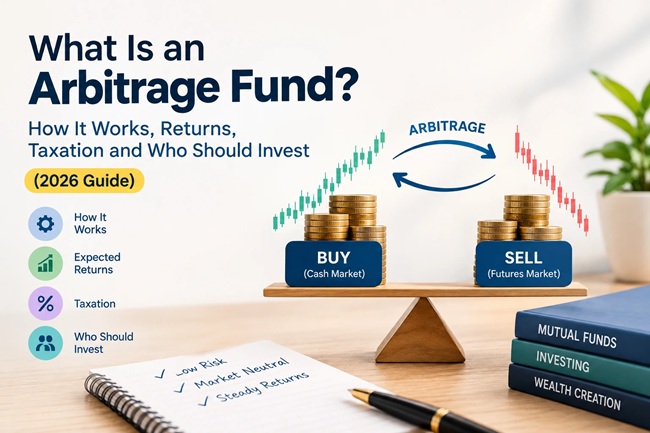
What Is an Arbitrage Fund? How It Works, Returns, Taxation and Who Should Invest (2026 Guide)

Meera Krishnan had ₹8 lakh sitting in her savings account and a problem she could not solve.
The money was earmarked for her daughter’s college admission, roughly fourteen months away. She could not risk it in equity. A fixed deposit felt like the obvious answer until her chartered accountant pointed at her Form 16 and did the arithmetic out loud. At a 7 percent FD rate and a 30 percent tax slab, she would keep about 4.9 percent after tax. Inflation would eat most of what was left.
“There is a category you have probably never looked at,” he said. “Arbitrage funds. Same risk profile as your FD, roughly the same gross return, but taxed like an equity fund.”
Meera’s first reaction was suspicion. An equity fund for money she could not afford to lose? That sounded like exactly the kind of advice that ends badly.
What her CA explained next is what this guide is about. Arbitrage funds hold equity, but they hold it in a way that cancels out the risk almost entirely. The fund is not betting on whether a stock goes up or down. It is harvesting a small, mechanical price difference that exists between two markets at the same moment. And because of how Indian tax law defines an equity mutual fund, that mechanical income gets the equity tax treatment.
For somebody in the 30 percent bracket parking money for a year or more, that distinction is worth real money. Let us go through exactly how it works.

Quick Answer
An arbitrage fund is a type of equity mutual fund that earns returns by simultaneously buying a stock in the cash market and selling the same stock in the futures market, locking in the small price difference between the two. Because both positions cancel each other out, the fund carries almost no directional equity risk. Returns typically range between 6 and 7.5 percent annually, similar to a liquid fund or short-term FD, but arbitrage funds are taxed as equity funds, which means 12.5 percent long-term capital gains tax after 12 months instead of your income tax slab rate. This makes them especially attractive for investors in the 30 percent tax bracket parking money for six months to two years.
About This Guide
This guide has been researched and written by the FinanceChecks editorial team, drawing on SEBI’s Categorisation and Rationalisation of Mutual Fund Schemes framework, the Income Tax Act provisions governing equity-oriented fund taxation as amended by the Finance (No. 2) Act 2024, AMFI category data, and scheme information documents published by Indian asset management companies.
Every figure in this article reflects rules and rates applicable as of September 2026. Tax rates, exit load structures and SEBI category definitions do change, and we update this guide whenever they do.
We hold no commercial relationship with any asset management company. No fund house has paid for placement, mention or omission in this article. Where we name schemes, it is illustrative of category behaviour and not a recommendation to buy.
FinanceChecks is an independent Indian personal finance publication. We are not SEBI-registered investment advisers, and nothing here constitutes personalised investment advice. Please read the disclaimer at the end of this guide.
Last reviewed: September 2026
What Is an Arbitrage Fund, in Plain Language
Arbitrage, in its oldest sense, means profiting from the same thing being priced differently in two places at the same time.
Imagine gold selling for ₹95,000 per 10 grams in Mumbai and ₹95,400 in Chennai on the same morning. If you could buy in Mumbai and sell in Chennai instantly, with no transport cost and no delay, you would pocket ₹400 without taking any view on whether gold is headed up or down. You do not care about gold. You care about the gap.
Arbitrage funds do exactly this, except the two markets are not two cities. They are the cash market and the futures market of the same Indian stock exchange.
A stock like Infosys trades in the cash segment, where you buy the actual share and it lands in your demat account. The same Infosys also trades in the futures segment, where you enter a contract to buy or sell the share at a fixed price on a fixed future date, the last Thursday of the expiry month.
These two prices are related but almost never identical. The futures price usually sits a little above the cash price. That gap is where arbitrage funds live.
A SEBI-defined arbitrage fund must invest a minimum of 65 percent of its total assets in equity and equity-related instruments, following an arbitrage strategy. That 65 percent threshold is not arbitrary. It is the exact line that qualifies a scheme as an equity-oriented fund under Indian tax law, which is the whole reason this category exists in the form it does.
How an Arbitrage Fund Actually Works: A Worked Example
Let us walk through a single trade, start to finish.
It is the first week of a monthly expiry cycle. The fund manager looks at the screen and sees this:
| Market | Instrument | Price |
|---|---|---|
| Cash | Infosys share | ₹1,500 |
| Futures | Infosys current-month futures | ₹1,512 |
The gap is ₹12, or 0.8 percent, over roughly one month.
The fund manager executes two trades at the same instant:
- Buys Infosys shares in the cash market at ₹1,500
- Sells an identical quantity of Infosys futures at ₹1,512
The position is now fully hedged. The fund owns the shares and has simultaneously promised to sell the same number of shares at ₹1,512 on expiry day.
Here is the part that makes the whole thing work. On expiry day, the futures price and the cash price must converge. They have to. A futures contract expiring today is a promise to transact today, so it settles at the spot price by definition. The exchange enforces this mechanically.
So consider what happens at expiry under three scenarios:
| Scenario at expiry | Cash leg result | Futures leg result | Net gain |
|---|---|---|---|
| Infosys falls to ₹1,300 | Loss of ₹200 | Gain of ₹212 | ₹12 |
| Infosys stays at ₹1,500 | No change | Gain of ₹12 | ₹12 |
| Infosys rises to ₹1,700 | Gain of ₹200 | Loss of ₹188 | ₹12 |
The stock can do anything at all. The fund still earns ₹12 per share. That is the entire concept.
The fund does not care which direction Infosys moves. It never took a view. It locked in a spread and waited for the calendar to do the rest.
Multiply this across dozens of stocks, roll the positions into the next expiry month, and repeat month after month. That is an arbitrage fund’s day job.
Why the Price Gap Exists at All
A reasonable question at this point is why anybody would sell Infosys futures at ₹1,512 when the share itself is available at ₹1,500. Why does free money sit on the table?
It is not free money, and the gap is not a mistake. Three forces create it.
Cost of carry. Futures pricing has a theoretical basis. If you buy a share today and hold it until the futures expiry date, you have tied up capital for that period. The futures price builds in the interest cost of that capital. This is why arbitrage spreads broadly track short-term money market rates. When repo rates are higher, spreads tend to be wider. When rates fall, spreads compress.
Leverage demand. Futures let a trader take a large position with a fraction of the capital, since only margin is required rather than the full contract value. Retail and proprietary traders who want bullish exposure to a stock often prefer futures for this reason. That persistent buying pressure in the futures segment pushes futures prices above cash prices. The more bullish and excited the market, the wider the gap.
Structural segmentation. Many large institutional investors face mandate restrictions on derivatives, or cannot short, or cannot hold physical delivery. These frictions prevent the gap from closing to zero.
The practical implication for you as an investor is straightforward. Arbitrage fund returns are not constant. They are high in volatile, bullish, high-interest-rate environments and thin in dull, sideways, falling-rate markets. A category that delivered 7.5 percent in an exciting year might deliver 4.5 percent in a quiet one.
What Sits in the Other 35 Percent
An arbitrage fund does not keep 100 percent of its money in arbitrage positions, and it could not even if it wanted to. The number of attractive spreads available on any given day is limited by market conditions.
The typical portfolio looks like this:
| Component | Typical allocation | Purpose |
|---|---|---|
| Hedged equity arbitrage positions | 65 to 75 percent | Core return engine, no directional risk |
| Debt and money market instruments | 15 to 30 percent | Parking ground when spreads are thin |
| Cash, TREPS, margin requirements | 5 to 15 percent | Liquidity for redemptions and derivative margins |
The debt portion matters more than most investors realise. When arbitrage opportunities dry up, a larger share of the fund sits in treasury bills, commercial paper and similar instruments, and the fund starts behaving more like a liquid fund. This is also where a small amount of credit risk can creep in, depending on what the manager buys. Most arbitrage funds stay conservative here, sticking to the highest-rated short-duration paper, but it is worth glancing at the portfolio holdings before investing.
Note also that fund houses will sometimes keep the hedged equity portion at exactly 65 to 70 percent even when opportunities exist beyond that, because dropping below 65 percent would strip the fund of its equity tax status. That threshold is defended carefully.
Arbitrage Fund vs Liquid Fund vs Fixed Deposit vs Debt Fund
This is the comparison that matters most, because arbitrage funds are almost never competing with equity funds for your money. They compete with the boring parking options.
Assume a 30 percent tax slab, a 7 percent gross return across all four options, ₹10 lakh invested, and a 14-month holding period.
| Feature | Arbitrage Fund | Liquid Fund | Bank FD | Short-Duration Debt Fund |
|---|---|---|---|---|
| Typical gross return | 6 to 7.5% | 6 to 7% | 6.5 to 7.25% | 6.5 to 7.5% |
| Tax treatment | Equity | Slab rate | Slab rate | Slab rate |
| LTCG rate (after 12 months) | 12.5% above ₹1.25 lakh exemption | Slab rate | Slab rate | Slab rate |
| STCG rate (under 12 months) | 20% | Slab rate | Slab rate | Slab rate |
| Post-tax return at 30% slab | Approximately 6.1% | Approximately 4.9% | Approximately 4.9% | Approximately 4.9% |
| Risk level | Very low | Very low | Nil, insured to ₹5 lakh | Low to moderate |
| Liquidity | T+1, exit load 15 to 30 days | T+1, minimal load | Penalty on premature closure | T+1, some have load |
| Return predictability | Moderate, varies with market | High | Fixed and guaranteed | Moderate |
| Premature exit penalty | Exit load, typically 0.25% | Usually nil after 7 days | 0.5 to 1% rate reduction | Varies |
The post-tax gap of roughly 1.2 percentage points does not sound dramatic. On ₹10 lakh over 14 months, it is about ₹14,000 of extra money in your pocket for taking on a risk profile that is not meaningfully different. On ₹50 lakh, it is ₹70,000.
Two caveats deserve emphasis before you get too excited.
First, the FD return is guaranteed and the arbitrage return is not. Your bank has contractually promised you 7 percent. The arbitrage fund has promised you nothing. If spreads collapse for a stretch, you might earn 4 percent. The category has had such stretches.
Second, this comparison only favours arbitrage funds decisively at the higher tax slabs. If you are in the 5 percent or 10 percent bracket, an FD or liquid fund is simpler and the tax advantage largely evaporates.
Taxation of Arbitrage Funds in 2026: The Detail That Drives Everything
This is the single most important section of this guide, because taxation is the entire reason arbitrage funds exist as a category rather than as a niche institutional strategy.
Under the Income Tax Act, a mutual fund scheme qualifies as an equity-oriented fund if it invests a minimum of 65 percent of its total proceeds in equity shares of domestic companies. An arbitrage fund, by SEBI mandate, does exactly this. The fact that the equity is fully hedged and carries no market risk is irrelevant to the tax definition. The law looks at the asset class, not the risk exposure.
The result is a genuine and entirely legal anomaly. An investment with the risk profile of a money market instrument receives the tax treatment of an equity investment.
Current rates as of September 2026
Following the Finance (No. 2) Act 2024, which reset capital gains taxation across asset classes with effect from 23 July 2024:
| Holding period | Classification | Tax rate | Exemption |
|---|---|---|---|
| 12 months or less | Short-term capital gain | 20% | None |
| More than 12 months | Long-term capital gain | 12.5% | First ₹1.25 lakh of equity LTCG per financial year is exempt |
The ₹1.25 lakh exemption is a combined annual limit across all your equity LTCG, including gains from direct stocks, equity mutual funds, ELSS and arbitrage funds. It is not a separate allowance for each.
Surcharge and the 4 percent health and education cess apply on top of these rates as per your total income.
A worked tax comparison
Priya invests ₹15 lakh for 15 months. Her marginal rate is 30 percent plus cess. Assume both options return 7 percent gross.
Option A, Bank FD:
- Interest earned over 15 months: approximately ₹1,31,000
- Tax at 30% plus 4% cess: approximately ₹40,900
- TDS deducted by bank at 10% along the way, balance paid at filing
- Net gain: approximately ₹90,100
Option B, Arbitrage Fund held 15 months:
- Gain on redemption: approximately ₹1,31,000
- Classified as long-term, since holding exceeds 12 months
- First ₹1.25 lakh exempt, taxable LTCG: ₹6,000
- Tax at 12.5% plus cess: approximately ₹780
- Net gain: approximately ₹1,30,220
The difference is roughly ₹40,000 on a ₹15 lakh investment. That is the arbitrage fund case in one table.
A further structural advantage is that FD interest is taxed on an accrual basis in most cases, meaning you owe tax each financial year even if you have not received the money. Mutual fund gains are taxed only on redemption, which gives you control over the timing of your tax event.
Who Should Consider Arbitrage Funds
The category fits a specific set of situations well and is wrong for everything else.
It suits you if you are parking money for six months to two years. Wedding expenses, a property down payment, school fees, a planned car purchase, an emergency fund beyond the portion you keep truly liquid.
It suits you if you are in the 20 or 30 percent tax bracket. The entire advantage is a tax arbitrage. At lower slabs, the maths thins out considerably.
It suits you as a staging post for a large lump sum entering equity. If you receive a bonus, a property sale proceeds or a retirement corpus and want to deploy into equity funds over 12 months rather than all at once, an arbitrage fund is a common holding ground. Many fund houses allow a Systematic Transfer Plan from an arbitrage fund into their equity schemes, which moves money across on a schedule while the balance earns an arbitrage return in the meantime.
It suits you if you want to reduce equity exposure temporarily without a taxable exit. Some investors switch from an equity fund into an arbitrage fund within the same fund house when they want to de-risk. Note that this switch is itself a redemption and a taxable event, so this is not a tax dodge, just a risk adjustment.
Who should stay away
Anyone with a horizon under three months. Exit loads and the variability of short-term spreads make this a poor fit. Use a liquid fund or an overnight fund.
Anyone in the 5 percent slab or below the taxable threshold. You are adding complexity for a benefit you do not receive. An FD is simpler and guaranteed.
Anyone seeking growth. An arbitrage fund will never build wealth. It preserves purchasing power with mild tax efficiency. Expecting more from it is a category error.
Anyone who needs certainty. If a shortfall of even half a percent would derail your plan, take the guaranteed FD.
Common Mistakes Investors Make With Arbitrage Funds
Treating them as equity funds because of the name. The word equity in the category description causes real confusion. People either avoid arbitrage funds out of misplaced fear, or worse, invest expecting equity-like returns and are disappointed when they get 6.5 percent. The equity label here is a tax classification, not a risk description.
Ignoring the exit load window. Most arbitrage funds carry an exit load of around 0.25 percent for redemptions within 15 to 30 days, and the window varies by scheme. On a return of roughly 0.5 percent per month, a 0.25 percent load can wipe out half of your first month’s gain. Read the scheme document and check the specific window before you invest.
Redeeming at day 360 instead of day 366. This is the most expensive avoidable mistake in the category. Redeem at 11 months and you pay 20 percent short-term tax. Wait a few more weeks and you pay 12.5 percent, with the first ₹1.25 lakh exempt. Investors lose meaningful sums to impatience here. Note the purchase date and let the 12-month clock complete.
Choosing the regular plan when direct is available. When gross returns are 6.5 percent, an expense ratio difference of 0.6 percentage points between regular and direct plans is consuming close to a tenth of your return. Expense ratios matter far more in low-return categories than in equity funds. Direct plans, bought through the AMC website or a direct platform, cost meaningfully less.
Assuming past returns will repeat. A fund showing 7.8 percent over the trailing year benefited from a volatile market with wide spreads. That is a market condition, not a manager skill, and it will not persist. Look at three-year and five-year returns to see the category through a full cycle.
Investing the true emergency fund here. Redemption is T plus one business day, and there is an exit load window. Genuine emergency money, the amount you might need this week, belongs in a savings account or an overnight fund. Arbitrage funds hold the second layer.
Not checking the debt portion. Some funds stretch for yield in the non-arbitrage 30 percent by buying lower-rated paper. This introduces credit risk into a category you chose precisely because it had none. Open the monthly portfolio disclosure and confirm the debt holdings are short-duration and highly rated.
How to Choose an Arbitrage Fund
Since the strategy is largely mechanical and every fund is doing essentially the same trade, differentiation is narrower than in most categories. Focus on four things.
Assets under management. A larger fund has better access to arbitrage opportunities and can spread fixed costs across a bigger base. Very small funds may struggle to deploy efficiently. Somewhere above ₹1,000 crore is a reasonable comfort threshold.
Expense ratio. This is the most controllable variable. In a category where the gross opportunity is roughly 6.5 to 7 percent, every basis point of cost comes straight out of your pocket. Compare direct plan expense ratios specifically.
Consistency, not peak return. Look at rolling returns across three years rather than the trailing one-year number. A fund that stayed within a tight band through both wide-spread and thin-spread periods is being run well.
Exit load structure. Compare the load window across schemes. Some are 15 days, some 30, and a few structure it in tiers. If your horizon is flexible, pick the shorter window.
Do not chase the top performer in a category like this. The dispersion between a good arbitrage fund and an average one is typically a few tenths of a percentage point, and much of that comes from cost rather than skill.
My Take
I find arbitrage funds to be one of the few genuinely underused products in the Indian mutual fund landscape, and I think the reason is a naming problem more than anything else.
Tell a conservative investor that there is an equity mutual fund suitable for their child’s tuition money and you will lose them in the first sentence. The word equity carries too much weight. Yet the mechanics here are closer to a treasury operation than to stock picking, and the risk sits much nearer a liquid fund than an equity fund.
That said, I want to be careful not to oversell the category, because a lot of the content written about arbitrage funds does exactly that.
The tax advantage is real but it is not enormous, and it only exists at the higher slabs. If you are in the 30 percent bracket parking a substantial sum for over a year, you are looking at roughly 1 to 1.2 percentage points of additional post-tax return. That is worth having. It is not life-changing, and it does not justify contorting your financial plan around it.
The variability deserves more honest attention than it usually receives. Arbitrage returns depend on market conditions that nobody controls. Most of the time the category behaves like a slightly better liquid fund. In a dull, low-volatility stretch with falling rates, it can behave like a distinctly worse one. If your plan has zero tolerance for that, you should take the FD and accept the tax.
One more thought. The tax treatment of this category is a quirk of how the law defines an equity-oriented fund by allocation rather than by risk exposure. Tax quirks are not permanent. Indian capital gains rules were rewritten substantially in 2024, and there is no guarantee the definition survives untouched forever. I would not build a ten-year strategy around it, but for the one-to-two-year horizon this category is designed to serve, that risk is manageable.
My practical position is this. Use arbitrage funds for what they are, which is a tax-efficient parking spot for medium-term money at higher tax slabs. Choose a direct plan, keep an eye on the expense ratio, cross the 12-month line before redeeming, and hold no expectation that this is an investment rather than a place to wait.
Frequently Asked Questions
1. Are arbitrage funds safe? Can I lose money in them?
Arbitrage funds are among the lowest-risk equity-categorised funds available, but they are not risk-free. Because every equity position is fully hedged with an offsetting futures position, directional market risk is almost entirely eliminated. Negative returns over meaningful periods are rare but not impossible. Losses can arise from execution slippage, unusual expiry-day settlement behaviour, or credit issues in the debt portion of the portfolio. Over any period beyond a few months, historical instances of negative returns in this category have been very uncommon. There is no capital guarantee and no deposit insurance, unlike a bank FD.
2. What return can I realistically expect from an arbitrage fund?
Historically the category has delivered somewhere in the range of 5 to 7.5 percent annually, tracking broadly with short-term money market rates and market volatility. In volatile, bullish periods with wide spreads, returns at the upper end are achievable. In quiet, range-bound markets they can fall towards 4.5 to 5 percent. Treat the mid-6 percent range as a reasonable central expectation and do not plan around the best trailing year you can find.
3. How are arbitrage funds taxed in India in 2026?
They are taxed as equity-oriented funds. Gains on units held for 12 months or less are short-term capital gains taxed at 20 percent. Gains on units held for more than 12 months are long-term capital gains taxed at 12.5 percent, with the first ₹1.25 lakh of combined equity LTCG in a financial year exempt. Surcharge and 4 percent cess apply as per your income. There is no TDS on redemption for resident investors, unlike FD interest.
4. Is an arbitrage fund better than a fixed deposit?
For an investor in the 30 percent tax bracket holding for more than 12 months, the post-tax return from an arbitrage fund is typically about 1 to 1.2 percentage points higher, because 12.5 percent LTCG beats 30 percent slab taxation on FD interest. For an investor in the 5 percent bracket, the FD is usually the better and simpler choice. An FD also offers a guaranteed return and DICGC insurance up to ₹5 lakh, neither of which an arbitrage fund provides. The comparison turns almost entirely on your tax slab and your need for certainty.
5. Is an arbitrage fund better than a liquid fund?
For holding periods over 12 months and at higher tax slabs, arbitrage funds generally win on post-tax return because liquid fund gains are taxed at your slab rate regardless of holding period. For holding periods under three months, liquid funds are better, since they usually carry no exit load beyond seven days and their returns are steadier over very short windows. The crossover point is roughly the three to six month mark, depending on the exit load window of the specific arbitrage scheme.
6. What is the minimum holding period for an arbitrage fund?
There is no regulatory minimum, but there are two practical ones. First, check the exit load window, typically 15 to 30 days at around 0.25 percent, and stay past it. Second, if you want the favourable 12.5 percent tax rate rather than 20 percent, you must hold for more than 12 months from the date of purchase. As a rule of thumb, three months is the practical minimum and just over 12 months is the tax-optimal minimum.
7. Can I run a SIP in an arbitrage fund?
Yes, SIPs are permitted, but they are usually not the right approach. Rupee cost averaging exists to smooth out volatility, and arbitrage funds have very little volatility to smooth. The category is designed for lump sum parking. The one exception worth noting is the reverse arrangement, a Systematic Transfer Plan out of an arbitrage fund into an equity fund, which is a widely used and sensible technique for deploying a large sum into equity gradually. Also keep in mind that each SIP instalment carries its own 12-month clock for tax purposes, which complicates redemption planning considerably.
8. Do arbitrage funds perform better in bull markets or bear markets?
They generally perform better in bullish and volatile markets. Strong sentiment drives demand for leveraged long positions in the futures segment, which widens the gap between futures and cash prices, which is precisely what the fund harvests. In flat, low-volatility markets, spreads compress and returns fall. Sharp bear markets are mixed, since volatility can widen spreads in some stocks while overall futures demand weakens. The key point is that the fund is not harmed by falling markets in the way an equity fund is, because its positions are hedged.
9. What is the difference between an arbitrage fund and an equity savings fund?
An arbitrage fund keeps essentially all of its equity exposure hedged, so it takes no directional market risk. An equity savings fund deliberately keeps a portion, commonly 15 to 40 percent, of its equity unhedged, which means it does carry real market risk and can lose value when markets fall. In exchange, equity savings funds offer higher return potential. Both receive equity tax treatment. If you want stability, choose arbitrage. If you want a moderate risk-return profile with some equity participation, equity savings is the more aggressive cousin.
10. Should I choose the growth option or the IDCW option in an arbitrage fund?
For almost all investors, growth. Under current rules, IDCW payouts, formerly called dividends, are added to your total income and taxed at your slab rate. For someone in the 30 percent bracket, this defeats the entire purpose of choosing an arbitrage fund in the first place. The growth option lets gains compound within the fund and get taxed at the favourable 12.5 percent LTCG rate on redemption, with control over when that tax event occurs.
Key Takeaways
- An arbitrage fund buys a stock in the cash market and simultaneously sells it in the futures market, locking in the price gap and eliminating directional risk.
- Returns typically land between 6 and 7.5 percent, comparable to a liquid fund or short-term FD, and they vary with market volatility and interest rates.
- SEBI requires a minimum 65 percent in hedged equity, which qualifies the scheme for equity tax treatment.
- Tax is 20 percent for holdings up to 12 months and 12.5 percent beyond that, with the first ₹1.25 lakh of annual equity LTCG exempt.
- The category makes the most sense for investors in the 20 or 30 percent tax slab parking money for six months to two years.
- Watch the exit load window, cross the 12-month mark before redeeming, and always choose the direct plan.
- This is a parking product, not a growth product. Expecting wealth creation from it is the most common misunderstanding.
Disclaimer
The information provided in this article is for educational and informational purposes only and should not be construed as investment advice, tax advice, or a recommendation to buy, sell or hold any security or financial product.
FinanceChecks.com is not a SEBI-registered investment adviser or research analyst. The content reflects general information about a category of mutual fund schemes and does not take into account the specific financial situation, investment objectives, risk tolerance or tax circumstances of any individual reader.
Mutual fund investments are subject to market risks. Please read all scheme-related documents carefully before investing. Past performance of any scheme or category is not indicative of future returns. Arbitrage funds do not offer guaranteed returns, and returns can vary significantly with market conditions. Units of mutual funds are not insured by DICGC or any other body, unlike bank deposits.
Tax rates, exemption limits, exit load structures and SEBI scheme categorisation norms stated in this article are as applicable in September 2026 and are subject to change through legislative amendment or regulatory notification. Tax outcomes depend on your individual residential status, income level and filing position. Please consult a qualified chartered accountant or tax professional before making decisions with tax consequences.
Any scheme names, figures or illustrations used in this article are for explanatory purposes only and do not constitute an endorsement. FinanceChecks.com has no commercial arrangement with any asset management company mentioned or implied.
Readers are strongly advised to consult a SEBI-registered investment adviser before making any investment decision. FinanceChecks.com and its authors accept no liability for any loss or damage arising from reliance on the information presented here.

Shuchi founded Finance Checks after spending 16+ years working in corporate, managing operations and distribution. She managed her own finances, learned and read regularly and helped people make sense of their savings, loans, insurance, and investments.
She started this site to offer the kind of clear, honest financial guidance she wished was more available when she was learning to manage her own money. Every article is researched personally, checked against official sources such as the Reserve Bank of India, SEBI, or the Income Tax Department, and revisited whenever regulations or figures change. She is upfront about how the site earns money through ads and select affiliate partnerships, and she does not let either influence what she actually recommends to readers.