
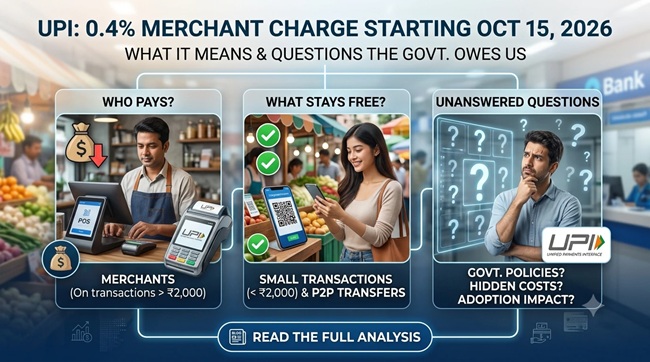
UPI Will Charge Merchants 0.4% From October 15, 2026: What It Means and the Questions the Government Still Owes Us

Ramesh Oberoi has run an electronics store in Gurugram for eleven years, and for the last five of them, UPI has been the backbone of his business.
A customer walks in, picks out a soundbar for ₹9,500, scans the QR code taped to his billing counter, and the payment lands in his account in under two seconds. No change to count, no card machine to fumble with, no bounced cheques. Ramesh has watched UPI turn his shop from a cash-counting operation into something closer to instant settlement.
So when a supplier’s WhatsApp group started buzzing about a “new UPI charge” this week, Ramesh’s first reaction was mild panic. Was UPI about to start costing him money on every sale? Would his customers start asking why the soundbar suddenly cost ₹40 more?
The honest answer, once you cut through the noise, is more nuanced than the forwarded messages suggest. From October 15, 2026, the National Payments Corporation of India will apply a Merchant Discount Rate of 0.4 percent on certain UPI payments merchants receive above ₹2,000. It is real, it is happening, and Ramesh will likely pay something on his bigger tickets. But it is also nothing like the blanket “UPI is now chargeable” story spreading on social media.
Here is what is actually changing, who really pays for it, and the questions that genuinely deserve straight answers from the government before this rolls out.
Quick Answer
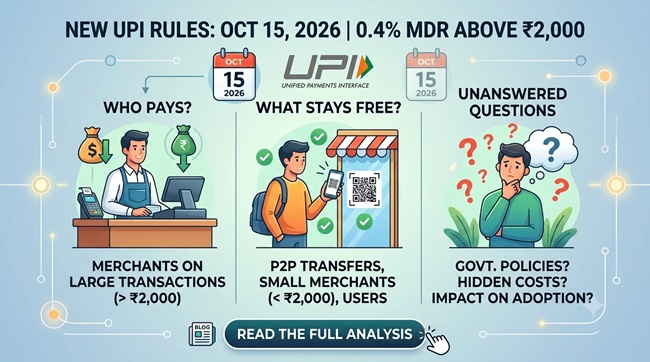
From October 15, 2026, NPCI will apply a 0.4% Merchant Discount Rate on person-to-merchant UPI transactions above ₹2,000, capped at ₹300 for transactions of ₹75,000 and above. This is a merchant-side charge, not a consumer fee and not a government tax. Person-to-person UPI transfers stay free, merchant payments up to ₹2,000 stay free, and small merchants processing up to ₹1 lakh a month through UPI QR codes remain exempt. NPCI estimates roughly 96% of merchant transactions by count will be unaffected. The bigger open question is what happens to the remaining 4%, and whether higher-value payments start quietly drifting back toward cash.
About This Guide
This article has been researched and written by the FinanceChecks editorial team, drawing on the official NPCI circular on the new Merchant Discount Rate framework, statements from the Payments Council of India, and reporting from Business Standard, Entrackr and other financial news outlets covering the announcement.
FinanceChecks holds no commercial relationship with NPCI, any bank, payment aggregator, or UPI application provider. This article does not take a political position on the policy. It lays out what is changing, what stays the same, and the questions we think deserve public, data-backed answers once the framework goes live.
This guide reflects the framework as announced in mid-September 2026, ahead of its October 15, 2026 implementation date. Rules, exemptions and merchant categorisation may be refined by NPCI or partner banks before or after rollout, and we will update this guide as clearer detail emerges.
Last reviewed: September 2026
What Is Actually Changing
Starting October 15, 2026, NPCI will levy a 0.4 percent MDR on person-to-merchant, or P2M, UPI transactions above ₹2,000. The fee is capped at ₹300 for any single transaction of ₹75,000 or more, so the charge stops climbing well before it becomes meaningful even on very large payments.
This is the first time a charge of any kind has touched UPI since the government made P2M transactions free in January 2020. For nearly six years, merchants have paid nothing to accept a UPI payment, no matter the size. That changes now, though only for a slice of transactions.
Here is what a 0.4 percent MDR actually looks like in rupee terms.
| UPI payment amount | MDR at 0.4% |
|---|---|
| ₹2,000 | ₹0 (below threshold) |
| ₹3,000 | ₹12 |
| ₹5,000 | ₹20 |
| ₹10,000 | ₹40 |
| ₹25,000 | ₹100 |
| ₹50,000 | ₹200 |
| ₹75,000 and above | ₹300 (capped) |
Crucially, this fee is charged to the merchant receiving the payment, not the customer sending it. NPCI has explicitly barred merchants from passing the MDR on to customers as a separate line item, and UPI app providers cannot add their own platform fees on top of it either. Whatever the shop’s billboard price says is what the customer pays.
What Stays Completely Free
The panic spreading through WhatsApp forwards this week mostly comes from missing four exemptions that NPCI has built into the framework.
Person-to-person transfers, the kind you send a friend splitting a dinner bill or a family member for rent, remain free no matter how large the amount. Merchant payments up to ₹2,000 also stay free under the standard framework, which NPCI says covers the vast majority of everyday UPI use, your chai, your auto fare, your grocery top-up. Small merchants enrolled under the P2PM zero-MDR framework, generally those receiving up to ₹1 lakh a month through UPI QR codes, continue paying nothing regardless of individual transaction size. And several thin-margin, high-volume sectors get their own, gentler structure rather than the standard 0.4 percent.
| Sector | MDR structure |
|---|---|
| Standard merchant payments above ₹2,000 | 0.4%, capped at ₹300 |
| Railways, telecom, insurance, fuel, agricultural inputs | Flat ₹5 per transaction above ₹2,000 |
| Capital market transactions | 0.02%, capped at ₹300 |
| Small merchants (up to ₹1 lakh/month via QR) | Zero MDR |
| Person-to-person transfers | Zero MDR, any amount |
NPCI’s own figures suggest around 96 percent of P2M transactions by count will fall entirely outside the standard MDR. That is the number the government has led with in its messaging, and it is accurate as far as it goes. It just is not the whole picture, which is where the real questions start.
Why the 96% Figure Doesn’t Settle the Debate
Ninety-six percent of transactions by count sounds reassuring until you separate transaction count from transaction value.
Think about Ramesh’s shop again. On any given day, he might process forty small UPI payments under ₹2,000 for accessories, cables and cases, and just two or three larger payments for televisions and soundbars that cross ₹10,000. By count, the small payments dominate his day heavily. By rupee value, the handful of large-ticket sales likely account for most of his actual revenue.
That asymmetry matters because if a small share of transactions carries a disproportionate share of total UPI merchant value, the real economic bite of this MDR on the merchant side could be considerably larger than “only 4 percent of transactions” suggests. The government has not yet published the second number, the percentage of total UPI merchant value that falls above the ₹2,000 threshold, and that figure would tell a much more complete story than transaction count alone.
Why NPCI Says This Charge Is Needed at All
The core argument is sustainability. UPI processes billions of transactions every month, and running that infrastructure, servers, fraud detection systems, technical support, continuous upgrades, costs real money. Industry estimates put the annual cost of operating UPI at around ₹20,000 crore.
Since 2021, the government has covered a chunk of this cost through a direct incentive scheme aimed at supporting low-value UPI transactions for small merchants, paying out ₹3,631 crore in 2023-24 alone. NPCI’s position is that this incentive was designed as short-term support, not a permanent subsidy, and that a self-sustaining revenue model is the more durable path forward for an infrastructure this critical to India’s digital economy.
Vishwas Patel, chairman of the Payments Council of India, has framed the MDR similarly, saying it exists to sustain UPI’s growth and fund cybersecurity and infrastructure investment rather than to create profit pools for private players. NPCI has also proposed routing an amount equal to 5 percent of total MDR collections into a fund specifically meant to support UPI adoption among small merchants.
Industry estimates reported by Reuters put the potential annual revenue from this MDR framework at roughly ₹16,000 to ₹17,000 crore, though the final number will depend heavily on actual transaction volumes and how strictly the exemptions are enforced.
The Real Risk: Could This Push Merchants Back Toward Cash?
This is the question that matters most, and it is genuinely too early to answer with certainty.
A merchant facing a ₹40 MDR on a ₹10,000 UPI sale has a few realistic options. Absorb the cost quietly, since it is small relative to the sale. Nudge the customer toward a payment method with a lower cost to the merchant. Or, in some cases, simply prefer cash for that transaction, since cash carries no MDR at all.
Nobody can currently say with any precision how many merchants will choose which path. But the direction of the incentive is unmistakable: for the first time in six years, cash has become relatively cheaper than UPI for a subset of merchant transactions, whereas for the entire life of UPI so far, digital payment has been the cheaper and easier option by every measure. That reversal, even a small one, is worth watching closely.
Could This Actually Bring Cash, and Black Money, Back Into the Market?
This is the question generating the most heated forwards on WhatsApp, and it deserves a careful answer rather than a viral one.
Start with the historical backdrop, because it matters. India spent 2016 onward on an aggressive, sometimes painful push to shrink the cash economy, starting with demonetisation and continuing through UPI’s explosive growth, which took the platform from ₹21.3 lakh crore in annual transaction value in FY2019-20 to over ₹260 lakh crore by March 2025. That is not a small shift. It is arguably the single biggest change in how ordinary Indians pay for things in a generation, and a large part of what made it possible was that digital payment was, in every practical sense, free and frictionless for the merchant accepting it.
The 0.4% MDR is the first time since January 2020 that this frictionlessness has a small crack in it, for a specific slice of transactions. That is genuinely new territory, and it is fair to ask whether it reopens a door the country spent nine years trying to close.
Here is the honest, unglamorous answer: it might nudge things at the margin, but there is no credible basis today for any specific claim about how much cash, black money or unaccounted wealth this could pull back into circulation.
Why the fear is not baseless. Economic incentives do move behaviour, even small ones. If cash becomes relatively cheaper than UPI for a merchant on a ₹15,000 or ₹40,000 sale, some merchants, particularly those already running on thin margins, will rationally lean toward cash for exactly those transactions. This is not a hypothetical concern invented by social media. It is a predictable response to a straightforward change in relative pricing, and it is the kind of thing economists would expect to see at least in isolated pockets, especially in categories like jewellery, electronics, furniture and other high-ticket retail where UPI payments above ₹2,000 are common and margins can be tight.
Why the fear gets wildly overstated. Two things get conflated the moment “cash coming back” enters the conversation. The first is cash itself, which is a payment instrument. The second is black money, which is income or wealth concealed from tax authorities. These are not the same thing, and treating them as identical is where most viral claims go wrong.
A customer paying ₹8,000 in cash for a washing machine, with a proper GST invoice issued and the sale entered in the shop’s books, has done nothing different from paying by UPI except choosing a different instrument. No income is concealed. No tax is evaded. The transaction is just as legitimate, just less traceable in real time to an outside observer.
The genuine risk sits one layer deeper: a merchant who receives that same ₹8,000 in cash and simply does not record the sale at all, understating turnover and consequently paying less GST and income tax than they should. That is where cash substitution actually threatens the tax base, and it depends entirely on whether the merchant chooses to under-report, not on the payment instrument itself. UPI’s real contribution to formalisation was never that digital payments are moral and cash is not. It was that UPI made under-reporting significantly harder by creating a default, automatic transaction trail that a merchant would have to actively work around. A modest MDR on a slice of transactions does not erase that structural advantage. It just makes cash marginally more attractive for merchants willing to under-report anyway, on the specific transactions that cross ₹2,000.
What it would actually take for this to show up as a real number. For any meaningful volume of “black money returning” to occur, you would need several things to align: a large enough share of merchants deciding the MDR is worth dodging, those merchants successfully persuading customers to switch to cash without losing the sale, those merchants then choosing to under-report the resulting cash sales rather than simply banking them normally, and this pattern repeating at a scale large enough to move national tax collection or currency-in-circulation figures. That is a long chain of ifs. Possible in pockets, particularly in sectors already known for cash preference, but a far cry from headline claims of lakhs of crores of black money flooding back into the system within weeks of October 15.
What would actually prove or disprove this. Three data series would settle the debate far better than any forwarded message. Currency-in-circulation and cash withdrawal trends from RBI over the next two to three quarters. GST filing patterns in high-ticket retail categories like electronics, jewellery and furniture, watching for any unusual dip in reported turnover post-October. And NPCI’s own UPI transaction value data broken down by ticket size, to see whether growth in the above-₹2,000 bracket specifically slows relative to the sub-₹2,000 bracket. None of these numbers exist yet in a form that answers the question. They will, in a few months, and that is when this debate should actually be settled, not now.
Until then, the responsible position is a narrow one: the incentive to shift toward cash on specific higher-ticket transactions is real and worth watching, the equation of that shift with “black money coming back” is mostly speculation, and anyone citing a precise rupee figure for either right now is guessing.
Common Mistakes People Are Making About This News
Assuming UPI itself now costs money. It does not. Person-to-person transfers and the overwhelming majority of merchant payments remain completely free. The charge applies to a specific slice of larger merchant transactions.
Believing the government is taxing UPI. MDR is explicitly not a tax and is not collected by the government or NPCI directly. It is a payment-processing fee distributed among banks, payment service providers and UPI app providers, the same category of cost that has always existed for card payments.
Expecting to be charged extra at checkout. NPCI has been explicit that merchants cannot pass this fee on to customers as a separate charge, and UPI apps cannot add their own fees either. If a shop tries to add a “UPI charge” line item to your bill, that is not sanctioned by the framework.
Treating the 96% figure as the full story. It measures transaction count, not transaction value. The rupee impact on merchants could be meaningfully larger than that headline number implies, since larger transactions naturally cluster above the ₹2,000 threshold.
Forwarding or believing viral claims about lakh-crore sums of black money returning to cash. There is currently no reliable data to support any specific figure here. Claims like this are speculation dressed up as fact, and responsible reporting should say so plainly rather than repeating a number nobody can verify.
Assuming your neighbourhood kirana shop is suddenly affected. Small merchants processing up to ₹1 lakh a month through UPI QR codes remain under the zero-MDR framework. The policy targets specified higher-value transactions, not everyday small-ticket local commerce.
My Take
I think the government’s underlying argument, that a payments system processing this much national volume needs a durable funding model rather than an indefinite subsidy, is reasonable on its face. UPI has been free for merchants for nearly six years, and infrastructure this large does not run itself for free forever. Somebody pays for the servers and the fraud detection eventually, whether through a subsidy, a fee, or a compromise between the two.
What I find genuinely underwhelming is the transparency around where the money actually goes. NPCI has said MDR revenue supports cybersecurity, infrastructure and small merchant incentives, and that is a fine sentence, but a sentence is not a number. If this framework is expected to generate somewhere around ₹16,000 to ₹17,000 crore a year, taxpayers and merchants funding that indirectly deserve a real breakdown, published regularly, not just at the announcement stage. How much goes to banks. How much to payment apps. How much genuinely reaches the small merchant fund. Sustainability arguments only hold up if the sustainability itself is visible.
The cash substitution risk is the part I would watch most carefully over the next two quarters. I do not think UPI is going anywhere. The convenience gap between UPI and cash is enormous, and ₹40 on a ₹10,000 purchase is not going to undo six years of habit formation for most merchants or customers. But at the margins, particularly for businesses already running thin, the incentive to nudge a big-ticket sale toward cash has just gotten slightly stronger for the first time since UPI launched. Whether that shows up meaningfully in GST filings and cash withdrawal data six months from now is an empirical question, and it is one the government should be measuring publicly rather than leaving to speculation on social media.
My honest advice to a small business owner like Ramesh: don’t panic, don’t add a surprise fee to your billing, and don’t believe every forwarded message about UPI dying. Just keep an eye on your own numbers, and if the MDR on your bigger tickets starts to genuinely bite, that is worth flagging to your payment aggregator and your bank rather than absorbing quietly or improvising a workaround.
Frequently Asked Questions
1. Is UPI becoming chargeable for everyone from October 15, 2026?
No. Person-to-person transfers stay free at any amount, and merchant payments up to ₹2,000 stay free under the standard framework. Only person-to-merchant transactions above ₹2,000 attract the new 0.4% MDR, and even then it is the merchant, not the customer, who pays it.
2. Who actually pays the new 0.4% MDR?
The merchant receiving the payment. NPCI’s framework explicitly prohibits merchants from passing this charge on to customers as a separate fee, and UPI apps cannot add platform charges of their own on top of it.
3. Is this 0.4% charge a government tax?
No. NPCI has stated clearly that the MDR is not a tax and is not collected by the government. It is distributed among ecosystem participants such as banks, payment service providers and UPI application providers.
4. How much MDR would a merchant pay on a ₹10,000 UPI sale?
Under the standard 0.4% rate, ₹40. On a ₹50,000 sale, it would be ₹200, and on anything ₹75,000 or above, the charge is capped at ₹300 regardless of how large the transaction gets.
5. Will small kirana shops and street vendors have to pay this?
Generally, no. Small merchants receiving up to ₹1 lakh a month through UPI QR codes remain under the existing zero-MDR framework, unaffected by this change.
6. Are there different rules for sectors like fuel, telecom or insurance?
Yes. Railways, telecom, insurance, fuel and agricultural input payments above ₹2,000 attract a flat ₹5 MDR rather than the standard 0.4% rate, reflecting the thinner margins typical in those sectors.
7. Could this push merchants back toward preferring cash?
It is a real possibility for merchants sensitive to payment costs, since cash now carries no MDR while a subset of UPI transactions does. The incentive is genuine, especially on higher-ticket sales in categories like electronics, jewellery and furniture. There is currently no reliable data on how widespread this shift might be, and it will likely take a few months of transaction, GST and RBI cash-in-circulation data after October 15 to know for sure.
8. Will this bring black money back into the economy?
There is no credible basis today for any specific claim about this, and any figure being circulated is speculation. Cash and black money are different things: a cash sale with a proper bill is entirely legitimate. The real risk is narrower and depends on merchants choosing to under-report cash sales they receive, not on cash use itself. That would require a long chain of behaviour changes to happen at scale, and it is something GST filings and RBI currency data over the next few quarters will reveal far better than any forwarded message can.
9. How much revenue will this MDR generate for the payments ecosystem?
Industry estimates reported by Reuters put potential annual revenue in the range of ₹16,000 to ₹17,000 crore, though the actual figure will depend on transaction volumes and how the exemptions play out in practice.
10. Will UPI stop being popular because of this change?
Unlikely in any near-term sense. UPI’s convenience advantage over cash and cards remains enormous, and the vast majority of everyday transactions stay completely free. The more useful question to track is whether growth in higher-value merchant UPI payments slows or shifts after October 15, which will only be clear once post-implementation data becomes available.
Key Takeaways
- From October 15, 2026, a 0.4% MDR applies to UPI merchant payments above ₹2,000, capped at ₹300 for transactions of ₹75,000 and above.
- The merchant pays this fee, not the customer, and it cannot legally be passed on as a separate charge.
- Person-to-person transfers, small-ticket merchant payments under ₹2,000, and small merchants under the zero-MDR framework remain unaffected.
- NPCI says roughly 96% of transactions by count stay outside this MDR, but that figure doesn’t capture the share of total transaction value affected, which could be meaningfully higher.
- The bigger unresolved questions are whether some merchants shift higher-value sales toward cash, and whether the government will publish transparent data on where the MDR revenue actually goes.
- Cash and black money are not the same thing. A cash sale with a proper bill is legitimate; the real risk is merchants under-reporting cash sales, which is a separate behavioural choice, not an automatic consequence of using cash.
- There is no reliable estimate for how much cash or unaccounted money this change could bring back into circulation. RBI cash-in-circulation data, GST filings in high-ticket categories, and NPCI’s own ticket-size breakdown over the next two to three quarters will settle this far better than any forwarded message can. Treat any specific rupee figure circulating online with scepticism until that data exists.
Disclaimer
This article is intended for general financial and informational awareness and should not be treated as legal, tax, investment or financial advice.
The UPI MDR framework discussed here reflects information available as of September 2026, ahead of its stated October 15, 2026 implementation date. Exemptions, merchant categorisation and operational details may be refined by NPCI, banks, or other authorities before or after rollout, and figures such as projected revenue are industry estimates rather than confirmed government data.
This article does not claim that the new MDR will definitely increase cash usage, reduce tax compliance, or bring unaccounted money back into circulation. These are open questions that require data collected after implementation, not settled conclusions.
FinanceChecks does not endorse or oppose the policy discussed here. Readers should verify current details through official NPCI, RBI, and government communications before making business or payment decisions based on this information.

Shuchi founded Finance Checks after spending 16+ years working in corporate, managing operations and distribution. She managed her own finances, learned and read regularly and helped people make sense of their savings, loans, insurance, and investments.
She started this site to offer the kind of clear, honest financial guidance she wished was more available when she was learning to manage her own money. Every article is researched personally, checked against official sources such as the Reserve Bank of India, SEBI, or the Income Tax Department, and revisited whenever regulations or figures change. She is upfront about how the site earns money through ads and select affiliate partnerships, and she does not let either influence what she actually recommends to readers.