
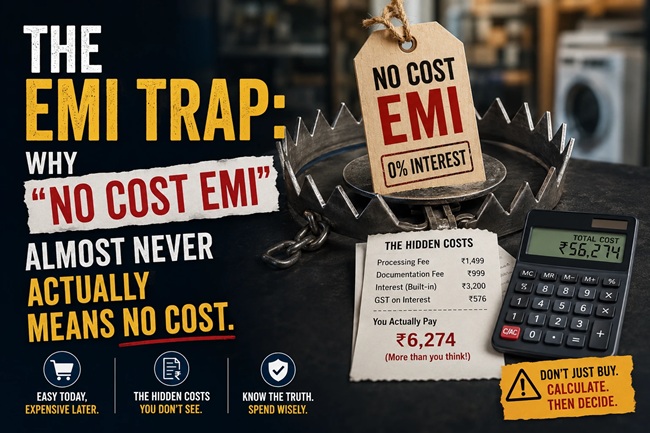
The EMI Trap: Why “No Cost EMI” Almost Never Actually Means No Cost

Last updated: July 2026
About This Guide: Written by the Financechecks.com Editorial Team, Personal Finance Researchers. This article has been researched using RBI guidelines on interest subvention and loan disclosure, GST regulations, and publicly disclosed bank and e-commerce EMI fee structures, and is reviewed for accuracy as regulations and offers change.
Ravi bought a television during a big sale last year — ₹50,000, marked down with a ₹7,000 discount, and a tempting “No Cost EMI, 6 months” option sitting right there at checkout. Zero interest, easy monthly payments, no stress. He felt genuinely smart about the decision. What he didn’t notice, in that moment, was that the ₹7,000 discount quietly vanished the second he selected the EMI option instead of paying the full amount upfront.
He didn’t lose money to a scam. He didn’t get charged anything illegal. He simply didn’t understand what “no cost” actually meant — and neither do most people who click that button every single day across Amazon, Flipkart, and pretty much every major retailer in India. This guide breaks down exactly where that hidden cost lives, with real numbers, so you can actually tell a genuinely good no cost EMI offer from one that’s quietly costing you money.
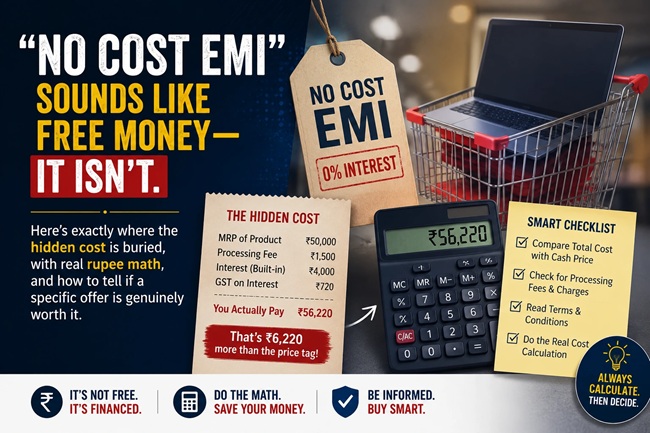
What “No Cost EMI” Actually Means, Mechanically
Here’s the part almost no checkout page explains clearly: when you select “No Cost EMI,” you are still taking out a real, interest-bearing loan. The bank isn’t lending you money for free — banks don’t do that. What’s actually happening is called interest subvention.
The bank calculates a normal EMI, complete with its usual annual interest rate (commonly somewhere in the 13-16% range). Then, instead of charging that interest to you, the retailer or manufacturer pays it to the bank on your behalf, usually by giving up the discount they would otherwise have offered you for paying in full. From your side, the monthly instalment shown looks interest-free — but internally, the bank still books it as a normal loan, split into principal and interest, exactly like any other EMI. The interest simply gets paid by someone else, not waived entirely.
This single mechanism is the root of every “hidden cost” covered below — because once you understand that a real loan with real interest still exists underneath the marketing, it becomes obvious why several genuine costs can still land on you.
Cost 1: The Discount You Quietly Give Up
This is exactly what happened to Ravi, and it’s the single biggest hidden cost in most no-cost EMI offers. If the same product would have come with a cash discount for paying upfront, choosing EMI instead usually means forfeiting that discount — and that forgone discount is, functionally, your interest payment, even though it never shows up on your statement labelled as “interest.”
The simple test: compare the full upfront price (after any full-payment discount) against the total of all your EMI instalments. If the EMI total is higher, even by a small amount, that gap is the real cost of choosing “no cost” EMI — regardless of what the checkout page called it.
Cost 2: GST on the “Waived” Interest
This is the cost that catches even careful shoppers off guard, because it’s genuinely not visible until you check your card statement afterward. Since the bank is still charging real interest internally (just billed to the retailer instead of you), that interest amount attracts 18% GST — and under current rules, this GST is passed on to you, the customer, not absorbed by the bank or the retailer.
On a ₹50,000 product financed over 12 months at a typical 15% bank interest rate, the underlying interest works out to roughly ₹4,200 — meaning the GST on that interest comes to somewhere around ₹750. It’s a smaller number individually, but it’s real money you’re paying on interest you were told didn’t apply to you.
Cost 3: Processing Fees
Most banks charge a processing fee for setting up an EMI conversion, typically ranging from around ₹100 to ₹500 or more, depending on the bank and the product value — and this fee, too, attracts GST on top of itself. On a 12-month EMI with a ₹499 monthly processing charge, for instance, the total processing cost alone can add up to nearly ₹6,000 on a ₹50,000 purchase — a genuinely significant number that rarely gets mentioned in checkout marketing.
Cost 4: Your Credit Limit Gets Blocked for the Full Amount
This one isn’t a rupee cost, but it’s a real, practical one worth knowing. The moment you convert a purchase into EMI on your credit card, the entire product value is blocked against your credit limit immediately — not just the instalment due that month. If you have a ₹2 lakh credit limit and convert a ₹50,000 purchase to EMI, your available limit drops to ₹1.5 lakh for the entire tenure of the loan, even though you’re only actually paying a small portion each month. This can catch you off guard if you need that credit headroom for something else during the EMI period.
Cost 5: Foreclosure and Early Closure Penalties
If you decide to pay off a no-cost EMI early — say, you get a bonus and want to clear the balance — many banks charge a foreclosure fee for doing so. In some structures, closing early can also void the very discount or cashback that made the deal attractive in the first place, since that benefit was often tied to completing the full tenure. What looked like a flexible, low-pressure payment plan can quietly penalise you for trying to be financially responsible and pay it off sooner.
Cost 6: What Happens If You Return the Product
This is a genuinely underexplained scenario. If you return a product bought on no-cost EMI, the loan doesn’t just disappear instantly — the EMI schedule was already generated and processing fees already charged at the time of purchase. Refund processing for the loan entry itself can take days, and processing charges are frequently non-refundable even when the product itself is returned in full.
A Real Worked Example: Is It Actually Free?
Let’s put real numbers against Ravi’s situation from the start of this guide, using a similar structure:
| Paying Upfront | “No Cost” EMI (6 months) | |
|---|---|---|
| Sticker price | ₹50,000 | ₹50,000 |
| Full-payment discount | -₹7,000 | ₹0 (discount forfeited) |
| GST on waived interest | ₹0 | ~₹400-750 (varies by tenure/rate) |
| Processing fee (+GST) | ₹0 | ~₹200-500 |
| Effective total cost | ~₹43,000 | ~₹50,600-51,250 |
The gap here isn’t small — it’s a genuine ₹7,000-plus difference, dressed up as a “free” payment plan. This is precisely why the honest, one-line test matters more than the marketing label: compare your actual total outflow under EMI against what you’d pay upfront, including every fee, and see if they truly match. If they do, the offer is genuinely close to free. If they don’t, you’ve found the hidden cost.
When No-Cost EMI Genuinely Makes Sense
It’s worth being fair here — this isn’t a guide telling you to never use EMI. There are situations where it’s a genuinely sound choice:
- When no upfront discount exists at all, meaning you’re not actually forfeiting anything by choosing EMI over paying in full
- When you have a genuine short-term cash flow need — a large, necessary purchase where spreading payments protects your emergency fund or liquidity, rather than being a discretionary “why not” decision
- When you’ve actually calculated the total cost, including processing fees and GST, and confirmed it’s genuinely close to, or the same as, the upfront price
- When the tenure is short (3 months tends to minimise processing fee accumulation better than 12 months, since many fees are charged per instalment or per month)
When It’s a Poor Choice
- When a meaningful upfront discount is on the table and you’re giving it up purely for the psychological comfort of smaller monthly payments
- When you could realistically save up and pay in full within a few months anyway — in which case, the “convenience” of EMI is costing you money for very little actual benefit
- When you’re already juggling multiple other EMIs, since stacking fixed monthly obligations reduces your financial flexibility even when each individual EMI seems small and manageable on its own
- When it’s a genuinely discretionary purchase rather than a necessity — the ease of no-cost EMI can quietly encourage spending on things you’d think twice about if paying the full amount upfront, all at once
Does No-Cost EMI Affect Your Credit Score?
Yes, in both directions, and this is worth knowing regardless of which way you lean on the purchase itself. Making your EMI payments on time can genuinely help build a positive credit history, the same way any other timely loan repayment does. But missing a payment, even once, hits your credit report — and it’s worth knowing that from July 2026, RBI has mandated weekly credit bureau updates, meaning a missed EMI payment becomes visible to every lender checking your credit report within about a week, not the roughly month-long lag that used to apply. That’s a meaningfully faster consequence than many borrowers are used to expecting.
Common Mistakes People Make With No-Cost EMI
- Assuming “no cost” means literally zero additional charges, without checking for GST on the underlying interest or a processing fee, both of which are extremely common
- Not checking whether an upfront discount was available and quietly forfeited by selecting EMI instead — this is usually the single biggest hidden cost, and it’s the easiest one to miss since it’s an absence, not a visible charge
- Forgetting that the full purchase amount blocks your credit limit immediately, which can create an unexpected cash-flow squeeze if you need that credit room for something else during the tenure
- Paying off an EMI early without checking for a foreclosure charge first, assuming early repayment is always a purely positive move
- Using no-cost EMI as a reason to buy something that wasn’t actually necessary, simply because the monthly number feels small and manageable in isolation
- Not comparing the EMI’s total outflow against the upfront price before deciding, relying instead on the checkout page’s “no cost” label at face value
Frequently Asked Questions
1. Is no-cost EMI really interest-free? Not entirely. The bank still charges real interest internally, but it’s paid by the retailer rather than you directly, often by giving up a discount you would have otherwise received. On top of that, GST on that underlying interest and processing fees are frequently charged to you, making the true cost rarely a perfect zero.
2. Why was I charged GST on a “no cost” EMI? Because the bank is still charging real interest to the merchant behind the scenes, even though you don’t see it as a separate line item. Under current rules, the 18% GST applicable on that interest amount is passed on to the customer, not absorbed by the bank or retailer.
3. Does no-cost EMI affect my credit score? Yes, in both directions. Timely EMI payments can help build a positive credit history, while a missed payment negatively affects your score. Since RBI’s 2026 rule requiring weekly credit bureau updates, missed payments now become visible to lenders significantly faster than before.
4. How can I tell if a specific no-cost EMI offer is actually a good deal? Compare your total outflow under the EMI plan (every instalment, plus any processing fees and GST) against the upfront cash price, including any discount available for full payment. If the two numbers are genuinely close, the offer is fair; if EMI costs meaningfully more, the “no cost” label is misleading.
5. Does choosing EMI block my full credit limit? Yes. The entire purchase value is typically blocked against your credit card limit for the full tenure of the EMI, not just the monthly instalment amount, which reduces your available credit for other spending during that period.
6. Are there penalties for paying off a no-cost EMI early? Often, yes. Many banks charge a foreclosure fee for early repayment, and closing the EMI ahead of schedule can sometimes void the original discount or cashback that was tied to completing the full tenure.
7. What happens to my no-cost EMI loan if I return the product? The loan doesn’t cancel instantly, since the EMI schedule and processing fees were already generated at the time of purchase. Refund processing for the loan entry can take several days, and processing charges are often non-refundable even if the product itself is fully returned.
8. Is it better to pay full price or use no-cost EMI? It depends on whether a full-payment discount exists and whether you can comfortably manage without spreading the cost. If a meaningful discount is on offer, paying upfront is usually cheaper overall. If no discount exists and you have a genuine cash-flow reason to spread payments, no-cost EMI can be a reasonable choice, provided you’ve checked the total cost including fees.
9. Why do banks and retailers offer no-cost EMI at all if it’s not truly free? Retailers use it as a sales tool to make higher-value purchases feel more accessible, often absorbing the bank’s interest cost as a form of promotional spending. Banks benefit by growing their loan book and, in many cases, still collecting processing fees and GST from the customer, making it a workable arrangement for both parties, even when it isn’t a pure “free” benefit for the buyer.
10. Is there a way to avoid the hidden costs of no-cost EMI entirely? The most reliable way is to save up and pay the full amount upfront when a genuine discount is available, since that avoids forfeiting the discount, the GST on interest, and processing fees altogether. If EMI is genuinely necessary for cash-flow reasons, choosing a shorter tenure and confirming all fees upfront helps minimise the gap.
Final Thoughts
“No cost” is one of the most effective pieces of financial marketing in Indian retail today, precisely because it sounds like a factual claim rather than a sales pitch. In reality, it’s neither a lie nor a perfect truth — it’s a structure where the cost simply moves from an obvious interest line item into less visible places: a forfeited discount, GST on interest you were told didn’t apply to you, and processing fees tucked into the fine print.
None of this means EMI is inherently bad — spreading out a genuinely necessary, large purchase can be a completely sensible financial decision. The only real requirement is doing the one-line test before you click “confirm”: add up everything you’ll actually pay under the EMI plan, and compare it honestly against what you’d pay by simply paying in full. That single habit is the difference between using EMI as a smart cash-flow tool and quietly paying more for the privilege of thinking you didn’t.
Disclaimer: This article is for general informational and educational purposes only and should not be treated as financial advice. Interest rates, fees, GST calculations, and figures mentioned above are illustrative and based on publicly available data current as of the stated dates; actual charges vary by bank, retailer, and specific offer. Please review the complete terms, including all fees and GST, provided by your bank or retailer before opting for any EMI plan, and consult a qualified financial advisor if needed.

Shuchi founded Finance Checks after spending 16+ years working in corporate, managing operations and distribution. She managed her own finances, learned and read regularly and helped people make sense of their savings, loans, insurance, and investments.
She started this site to offer the kind of clear, honest financial guidance she wished was more available when she was learning to manage her own money. Every article is researched personally, checked against official sources such as the Reserve Bank of India, SEBI, or the Income Tax Department, and revisited whenever regulations or figures change. She is upfront about how the site earns money through ads and select affiliate partnerships, and she does not let either influence what she actually recommends to readers.



[…] The EMI Trap: Why “No Cost EMI” Almost Never Actually Means No Cost […]
[…] is the single most important thing to understand before financing a phone this expensive. “No-cost EMI” offers, commonly advertised by retailers and banks during a major phone launch, work by […]