
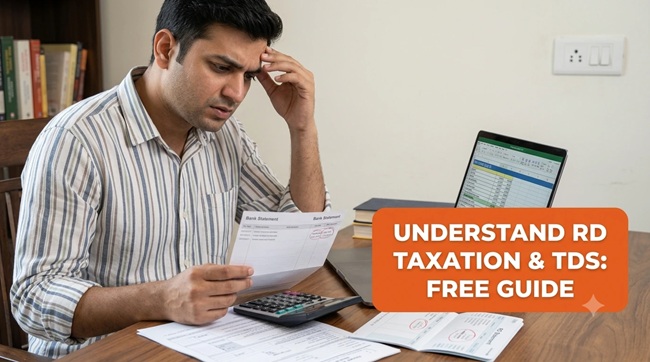
Recurring Deposit Interest Is Taxed Every Year, Not Just at Maturity, Here’s the Surprise Waiting at Tax Time

Priya opened a five year RD three years ago, ₹8,000 a month, specifically because she liked the idea of not touching the money or thinking about it until it matured. That was the whole appeal, set it, forget it, deal with it later. This year, going through her Form 26AS while filing her return, she found TDS entries against her PAN for RD interest she’d never actually received a rupee of, money still sitting locked in the deposit, two years away from maturity. Her first reaction was that something had gone wrong. Nothing had. The tax department had simply been treating her RD interest as taxable income every single year since she opened it, whether she’d touched the money or not.

Quick answer
Interest earned on a recurring deposit is fully taxable in India as “Income from Other Sources,” at your applicable income tax slab rate, and it’s taxed on an accrual basis, meaning the interest that builds up each financial year must be declared in that year’s return, not only in the year the RD finally matures. This catches a lot of people off guard, since an RD is a cumulative product, you don’t see or touch the interest until maturity, which makes it easy to assume the tax liability works the same way. It doesn’t. Banks are also required to deduct TDS under Section 194A once your total interest income from all deposits at that bank crosses a threshold in a financial year, currently ₹50,000 for individuals below 60 and ₹1,00,000 for senior citizens, following a revision under the Finance Act 2025 effective from April 1, 2025. A meaningful number of articles online still quote the older, pre-2025 thresholds of ₹40,000 and ₹50,000, so it’s worth double-checking which figure you’re actually working with. If your total income is below the taxable limit, you can submit Form 15G, or Form 15H if you’re a senior citizen, to stop the TDS deduction altogether, rather than paying it and claiming it back later.
About this guide
This guide is based on the taxation of interest income under the Income Tax Act, Section 194A TDS provisions as revised under the Finance Act 2025 effective April 1, 2025, and standard bank practice for recurring deposit interest reporting, current as of September 2026. FinanceChecks.com is not a tax consultancy, and this article does not constitute tax advice specific to your situation. TDS thresholds and tax slab rates are subject to periodic revision, so please verify current figures with a qualified chartered accountant or directly with your bank before filing.
Why accrual basis catches people off guard
The confusion here comes from a fairly reasonable place. An RD is designed around a simple mental model, you deposit a fixed amount every month, the bank compounds the interest quietly in the background, and you get the whole lump sum, principal plus interest, when it matures. Nothing about that experience feels like income arriving year by year. It feels like one single payout, years from now.
Tax law doesn’t see it that way. Interest on a recurring deposit accrues, meaning it’s earned and added to the deposit’s value, continuously through each financial year, even though you don’t physically receive it until maturity. The Income Tax Act taxes this interest as it accrues, not as it’s eventually paid out, which means the interest that builds up in year one of your RD is taxable income for year one, the interest from year two is taxable income for year two, and so on, each year layering onto your total income and taxed at whatever slab rate applies to you that year. By the time your RD actually matures, most or all of the tax on the interest it generated may have already been paid, or at least ought to have been declared, across the years leading up to that point.
What actually happens with TDS
Banks don’t wait for you to self-report this at tax filing time. Under Section 194A of the Income Tax Act, once the total interest you’ve earned from all your fixed and recurring deposits at a particular bank crosses a set threshold within a financial year, the bank is required to deduct tax at source before crediting or reporting the interest.
Following the Finance Act 2025, effective from April 1, 2025, this threshold sits at ₹50,000 for individuals below 60, and ₹1,00,000 for senior citizens, aggregated across all your fixed and recurring deposits at that specific bank, not calculated separately for each individual RD account you hold there. It’s genuinely worth being careful here, since a fair amount of content published even in 2026 still quotes the older, pre-revision thresholds of ₹40,000 and ₹50,000, figures that were accurate before the Finance Act 2025 change but no longer reflect the current rule. If you’re checking whether TDS should apply to your situation, it’s worth confirming you’re working with the current, post-revision numbers rather than an outdated article.
The TDS rate itself is 10 percent if your PAN is on file with the bank, and 20 percent if it isn’t, a meaningful difference that makes sure your PAN is properly linked to every deposit account worth double-checking on its own.
TDS is not your final tax bill
This is worth stating clearly, since it’s a common point of confusion. TDS deducted on your RD interest is an advance collection toward your overall tax liability for the year, not a final settlement. When you file your income tax return, you declare your total income, including the RD interest that accrued that year, calculate your actual tax liability based on your slab rate, and then claim the TDS already deducted as a credit against that liability. If your actual tax liability on that income is lower than the TDS deducted, perhaps because your total income for the year falls in a lower bracket than the flat 10 percent TDS rate would suggest, you’re entitled to claim a refund for the difference when you file.
How to avoid the TDS deduction entirely, if you’re eligible
If your total income for the year is below the basic taxable exemption limit, you don’t need to go through the TDS-then-refund cycle at all. You can submit Form 15G, if you’re below 60, or Form 15H, if you’re a senior citizen, to your bank at the start of the financial year, declaring that your income doesn’t exceed the taxable threshold. This instructs the bank not to deduct TDS on your interest income in the first place, provided the declaration is accurate. It’s worth submitting this form fresh at every bank where you hold an RD or FD, and at the start of each financial year, since a declaration made once doesn’t automatically carry forward.
A detail worth knowing if you’re a senior citizen
Non-senior individuals get no specific exemption on RD or FD interest under Section 80TTA, which only covers savings account interest, up to ₹10,000, and doesn’t extend to fixed or recurring deposit interest at all. Senior citizens, however, can claim a deduction of up to ₹50,000 on interest income from deposits, including RD and FD interest, under Section 80TTB, though this benefit is available only under the old tax regime. This is a meaningful difference worth knowing if you’re helping a parent or older relative plan their RD investments, since the same interest income can be taxed quite differently depending on age and which tax regime is being used.
You May Also Like To Read About:
- You Agreed to Be a Loan Guarantor for a Friend or Family Member. Here’s What Happens If They Default or Die
- Nominee vs Will: Who Has the Legal Right to Your Money and Property in India?
- Lost Your Job With EMIs Still Due? Here Is Exactly What Happens Next and What You Can Legally Do
- RBI’s UDGAM Portal: How to Check If You Have Forgotten Money Sitting in an Old Bank Account
- Bank Lost Your Property Documents? Here’s the Legal Process to Get Justice
What to actually do about this
Report your RD interest accurately each year, rather than waiting until maturity to declare the full amount at once. Most banks provide an interest certificate or make this figure visible through net banking or your passbook, and it also shows up in your Annual Information Statement and Form 26AS, which your bank reports directly to the tax department, so the accrued interest is generally already visible to the tax authorities whether or not you actively report it yourself.
Check your Form 26AS or AIS before filing your return each year specifically for TDS entries against RD and FD interest, the way Priya did, rather than assuming no money changed hands means nothing needs to be checked. This is exactly the kind of entry that surprises people precisely because it doesn’t correspond to any cash actually landing in their account that year.
If your income is genuinely below the taxable threshold, submit Form 15G or 15H at the start of the financial year at every bank where you hold a deposit, rather than letting TDS get deducted and going through the refund process afterward, which ties up your money for longer than necessary.
My take
What strikes me about Priya’s situation is that nothing about it was actually a mistake, hers or the bank’s. The system worked exactly as designed, it’s just that the design assumes a level of awareness about accrual taxation that most people opening a straightforward, set it and forget it RD never really have reason to think about. An RD is marketed, and experienced, as one single financial event, years from now. The tax code treats it as a series of smaller events happening quietly every year in between. That gap between how a product feels and how it’s actually taxed is exactly the kind of thing worth checking before you open one, not after you’re staring at an unfamiliar TDS entry on your Form 26AS wondering where the money went, when the honest answer is that it was never about money moving, it was about interest accruing, silently, the whole time.
Frequently asked questions
Is recurring deposit interest taxable in India? Yes. RD interest is taxed as “Income from Other Sources” at your applicable income tax slab rate, the same treatment as fixed deposit interest.
Is RD interest taxed only when the deposit matures, or every year? It’s taxed every year, on an accrual basis. The interest that builds up during each financial year must be declared in that year’s income tax return, even though you don’t actually receive the money until the RD matures.
What is the current TDS threshold for RD interest? Following the Finance Act 2025, effective from April 1, 2025, the threshold is ₹50,000 for individuals below 60 and ₹1,00,000 for senior citizens, aggregated across all fixed and recurring deposits held at that specific bank. Some older articles still show the earlier ₹40,000 and ₹50,000 thresholds, which are no longer current.
What TDS rate applies to RD interest once the threshold is crossed? 10 percent if your PAN is linked to the account, and 20 percent if it isn’t.
Can I avoid TDS being deducted on my RD interest? Yes, if your total income for the year is below the basic taxable exemption limit. Submit Form 15G, or Form 15H if you’re a senior citizen, to your bank at the start of the financial year.
Is TDS deducted on RD interest my final tax liability? No. TDS is an advance collection toward your overall tax liability. You calculate your actual tax due when filing your return and claim the TDS already deducted as a credit, with any excess refunded to you.
Is there any tax exemption on RD interest like there is for savings accounts? Not for individuals below 60; Section 80TTA covers only savings account interest, not RD or FD interest. Senior citizens can claim up to ₹50,000 in deductions on deposit interest, including RD, under Section 80TTB, but only under the old tax regime.
How do I know how much RD interest has accrued each year if I haven’t received any money? Your bank typically provides an interest certificate or shows the accrued interest through net banking, and this figure also appears in your Annual Information Statement and Form 26AS, which the bank reports directly to the tax department.
Does the TDS threshold apply per RD account or per bank? Per bank. The threshold is calculated on your total interest from all fixed and recurring deposits held at that specific bank combined, not separately for each individual RD account.
What should I check before filing my tax return if I hold an RD? Check your Form 26AS or Annual Information Statement for any TDS entries against your RD interest, and make sure you’ve declared the interest that accrued during the year, even if the RD hasn’t matured yet.
Disclaimer
This article is intended for general informational and educational purposes only and does not constitute tax advice specific to your situation. FinanceChecks.com is not a tax consultancy. TDS thresholds, tax slab rates, and deduction provisions referenced here reflect publicly available rules as of September 2026, including the Finance Act 2025 revision to Section 194A thresholds effective April 1, 2025, and are subject to change. Please consult a qualified chartered accountant to confirm current figures and how they apply to your specific income and deposits.

Shuchi founded Finance Checks after spending 16+ years working in corporate, managing operations and distribution. She managed her own finances, learned and read regularly and helped people make sense of their savings, loans, insurance, and investments.
She started this site to offer the kind of clear, honest financial guidance she wished was more available when she was learning to manage her own money. Every article is researched personally, checked against official sources such as the Reserve Bank of India, SEBI, or the Income Tax Department, and revisited whenever regulations or figures change. She is upfront about how the site earns money through ads and select affiliate partnerships, and she does not let either influence what she actually recommends to readers.