
Why You’re Paying ₹35,000 When Ads Show ₹499/Month: The Real Math Behind Term Insurance Pricing

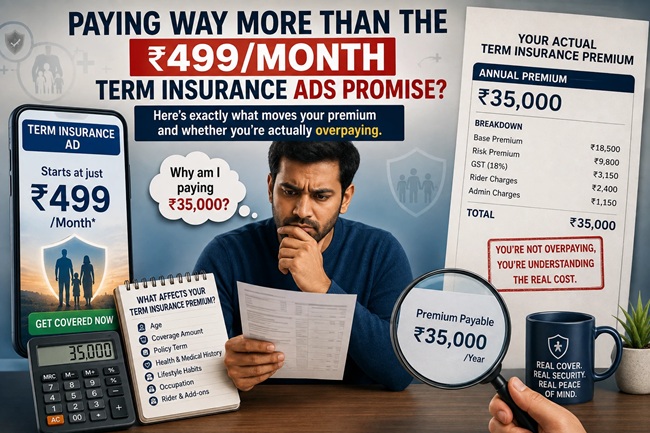
A reader wrote in recently, genuinely confused and a little annoyed. She pays 35,000 rupees a year for her 1 crore term insurance policy, and every other website she visits seems to be advertising the exact same 1 crore cover for 499 or 599 rupees a month. That’s a gap of nearly five times. Her question was simple and completely fair: is she being overcharged, or is that 500 rupee figure simply not real?
The honest answer is that both things are true at once. The 499 rupee plans are genuinely real, verified directly on insurer and comparison platform calculators. And her 35,000 rupees could also be entirely fair, once you understand what actually moves this number. Term insurance pricing looks like a single, comparable figure from the outside, but it’s really the sum of half a dozen variables stacked on top of each other, and most people only ever see the lowest possible version of that number in an ad.

What the ₹499-599 a Month Plans Actually Are
These figures aren’t marketing exaggeration. Running the numbers directly through insurer calculators confirms it: a healthy, non-smoking 18-year-old male can genuinely get 1 crore rupees of term cover for around 410 to 525 rupees a month, with cover running until roughly age 68. By 25, that same profile is looking at somewhere between 587 and 668 rupees a month. Women, across the same age brackets, generally pay noticeably less than men.
What all of these lowest-published figures have in common is the profile behind them: young, healthy, non-smoking, buying online directly rather than through an agent, with a basic policy carrying no additional riders. That’s the exact combination insurers use to advertise their most attractive headline rate, because it’s the lowest number they can honestly show, not because it’s what most buyers will actually end up paying.
The Six Things That Actually Move Your Premium
- Your age at purchase. This is, by a wide margin, the single biggest lever in this entire pricing puzzle. Premiums are locked in at your entry age and stay fixed for the life of the policy, but the starting point rises steeply the later you buy. Roughly speaking, premiums increase 8 to 10 percent for every year you delay, and can nearly double every 8 to 10 years of entry age. A 25-year-old buying today locks in a rate that a 35-year-old simply can’t access anymore, even for an identical policy from the same insurer.
- Riders bundled into the base policy. Critical illness cover, accidental death benefit, and premium waiver riders are all optional add-ons that stack on top of your base premium, typically adding somewhere in the range of 1,000 to 3,000 rupees a year depending on the rider and sum assured. A return-of-premium variant, which pays back your total premiums if you survive the policy term, costs considerably more than a standard term plan, sometimes several times more, since the insurer is essentially building an investment component into what was originally a pure protection product.
- How long your cover actually runs. A policy running until age 60 costs meaningfully less than one running until 70 or 75, simply because the insurer is underwriting a longer window of risk. If your policy covers you well past the standard age-60 benchmark most advertised rates are built around, that alone can explain a large chunk of a premium gap.
- Whether you bought online or through an agent. Online, direct-to-insurer plans typically carry a discount of up to 18.5 percent compared to the same plan sold through an agent or offline channel, since the agent’s commission gets built into the premium you pay instead.
- When you actually bought the policy. This one surprises a lot of existing policyholders. Individual life insurance premiums in India have been exempt from GST since September 22, 2025. If your policy was purchased before that date, your premium included an 18 percent GST charge that simply doesn’t exist for someone buying the identical plan today. A policy bought even a year or two ago can look meaningfully more expensive than the current advertised rate purely because of this one change, with nothing else about your risk profile having shifted at all.
- Health and lifestyle factors. Smoking or tobacco use, including gutkha and paan, not just cigarettes, typically pushes premiums up 40 to 60 percent above non-smoker rates. Even conditions like blood pressure or diabetes, disclosed honestly at the time of purchase, as they should be, can load your premium above the standard healthy-applicant rate. Insurer-specific pricing also varies, some companies are simply priced higher across the board than others for an identical risk profile.
What This Actually Looks Like With Real Numbers
| Age at Purchase | Monthly Premium (₹1 Crore, till age 60) | Annual Equivalent |
|---|---|---|
| 18-25 years | ₹410 – ₹668 | ~₹5,000 – ₹8,000 |
| 30 years | ₹587 – ₹900 | ~₹7,000 – ₹12,000 |
| 35 years | ₹1,200 – ₹2,000 | ~₹14,400 – ₹24,000 |
| 40-45 years | ₹1,692 – ₹3,003+ | ~₹20,000 – ₹36,000+ |
These figures assume a healthy, non-smoking applicant buying a basic online plan. Add even one rider, a longer cover term, agent commission, or pre-September 2025 GST, and the same age bracket can land considerably higher, which is exactly the territory a 35,000 rupee annual premium likely falls into.
How to Actually Check If You’re Overpaying
Before assuming you’ve been overcharged, pull out your actual policy document and check three specific things. First, what age is your cover running to, 60, 70, or later. Second, what riders are actually attached to your base policy, critical illness, accidental death, waiver of premium, or a return-of-premium structure. Third, when exactly you purchased it, specifically whether it was before or after September 22, 2025, since the GST removal alone can explain a meaningful chunk of any gap you’re seeing against today’s advertised rates.
If, after checking all three, your policy still looks priced well above what your current age and profile should command, it’s worth getting fresh quotes from two or three insurers directly. But there’s an important caution here: never cancel or lapse an existing policy before a new one is fully issued and confirmed. Your insurability today depends on your current health, and a gap in coverage while switching, even a short one, is a real risk not worth taking to save a few thousand rupees a year.
You May Also Like To Read About:
About This Guide
This article uses term insurance premium figures published by insurer and comparison platform calculators as of 2026, including PolicyBazaar, Axis Max Life, and Bajaj Finserv, for healthy, non-smoking applicants purchasing basic online plans. Actual premiums vary by insurer, individual health profile, occupation, and policy structure, so please get personalised quotes before making any decision about your existing or a new policy.
Common Mistakes People Make Comparing Term Insurance Prices
Comparing your own premium against the lowest advertised rate without accounting for age is probably the most common source of confusion. An 18-year-old’s starting rate was never meant to be a like-for-like comparison for someone buying in their mid-30s or 40s, even for an identical sum assured.
Forgetting to check what riders are already bundled into an existing policy is another frequent gap. A critical illness or accidental death rider genuinely adds value, but it also genuinely adds cost, and it’s easy to forget these were ever added years after actually purchasing the policy.
Assuming a higher premium always signals a bad deal is a mistake worth avoiding too. Sometimes a higher premium reflects a longer cover term or meaningful additional protection, not simply being overcharged for the same thing someone else is paying less for.
Finally, cancelling an older, seemingly expensive policy before securing a new one is a genuinely risky move. Health conditions can develop unexpectedly, and losing your insurability, even temporarily, is a far bigger risk than a premium gap that a few thousand rupees a year represents.
My Take
The gap between a 500 rupee ad and a 35,000 rupee real-world premium isn’t really a mystery once you break it down, it’s five or six ordinary variables quietly stacking on top of each other, each one reasonable on its own. What bothers me about how these plans get marketed isn’t that the low figure is fake, it’s that it’s presented as if it’s the number everyone should expect, when it’s really the floor, reserved for the youngest, healthiest, most basic-coverage buyer in the entire market. If you’re checking your own premium against an ad like this, the right comparison isn’t “why am I not paying that,” it’s checking your own age, riders, and purchase date against a quote built for your actual profile, not someone else’s.
Frequently Asked Questions
1. Is ₹499 a month for ₹1 crore term insurance actually real? Yes, but only for a specific profile, typically an 18 to 25-year-old, healthy, non-smoking applicant buying a basic online plan with no additional riders. Older applicants or those with riders attached will see a meaningfully higher premium for the same cover amount.
2. Why does my term insurance premium seem so much higher than advertised rates? Common reasons include being older at the time of purchase, having riders like critical illness or accidental death cover attached, a longer cover term extending past age 60, buying through an agent rather than online, or having purchased before the September 2025 GST exemption on life insurance.
3. Does age really make that much difference to term insurance premiums? Yes, it’s typically the single biggest factor. Premiums rise roughly 8 to 10 percent for each year you delay buying, and can nearly double every 8 to 10 years of entry age, since your rate is locked in at the age you purchase the policy.
4. Has GST on term insurance actually been removed in India? Yes, individual life insurance premiums, including term insurance, have been exempt from GST since September 22, 2025. Policies purchased before that date included an 18 percent GST charge that no longer applies to new purchases.
5. Do riders really add that much to a term insurance premium? It depends on the specific rider, but critical illness or accidental death riders typically add 1,000 to 3,000 rupees a year, while a return-of-premium variant can cost considerably more, sometimes multiple times the base premium, since it includes a savings component.
6. Should I cancel my expensive term insurance policy and buy a cheaper one? Not without a new policy already confirmed and issued first. Your insurability depends on your current health, and any gap in coverage while switching carries real risk, so compare quotes carefully before cancelling anything existing.
7. Do women really pay less for term insurance than men? Yes, women generally receive lower term insurance premiums than men across most age brackets and insurers, reflecting statistically different risk assessments used in underwriting.
8. Does buying term insurance online actually save money compared to an agent? Yes, online direct plans typically carry a discount of up to 18.5 percent compared to the same plan purchased through an agent, since agent commission is built into the offline premium instead.
9. How much does smoking increase term insurance premiums? Smoking or tobacco use, including non-cigarette forms like gutkha or paan, typically increases premiums by 40 to 60 percent compared to non-smoker rates for the same cover.
10. What’s the best age to buy term insurance to get the lowest premium? The lowest premiums are generally available in your early to mid-20s. Every year of delay adds to the cost permanently, since the rate you lock in at purchase stays fixed for the policy’s duration.
Disclaimer
This article is for informational and educational purposes only and does not constitute financial or insurance advice. Premium figures cited are illustrative, based on publicly available insurer and comparison platform data as of 2026, and actual premiums depend on individual health, lifestyle, occupation, and the specific insurer and policy chosen. Please compare personalised quotes from multiple insurers and consult a financial advisor before making decisions about existing or new life insurance coverage.

Shuchi founded Finance Checks after spending 16+ years working in corporate, managing operations and distribution. She managed her own finances, learned and read regularly and helped people make sense of their savings, loans, insurance, and investments.
She started this site to offer the kind of clear, honest financial guidance she wished was more available when she was learning to manage her own money. Every article is researched personally, checked against official sources such as the Reserve Bank of India, SEBI, or the Income Tax Department, and revisited whenever regulations or figures change. She is upfront about how the site earns money through ads and select affiliate partnerships, and she does not let either influence what she actually recommends to readers.



Want to know more about term life insurance.
Your last information is very useful.
I’ll be revisiting this article whenever I need a refresher.
This post was concise and very helpful.
[…] Why You’re Paying ₹35,000 When Ads Show ₹499/Month: The Real Math Behind Term Insurance Pricin… […]