
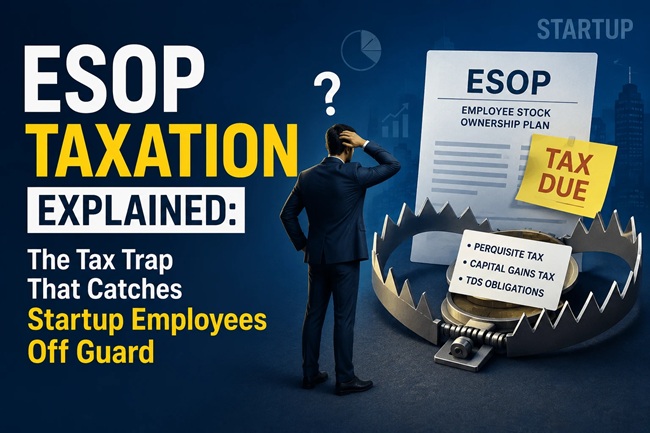
ESOP Taxation Explained: The Tax Trap That Catches Startup Employees Off Guard

Priya joined a fast-growing startup as an early engineering hire, and four years later, her options had vested in full. She exercised all 10,000 of them, excited to finally hold real equity in a company she’d helped build. A few weeks later, her employer’s payroll team flagged a tax deduction that made her stomach drop, a perquisite tax bill running into lakhs, calculated on shares she hadn’t sold, couldn’t easily sell, and had received no actual cash for. She hadn’t done anything wrong. She’d simply never been told that in India, exercising an ESOP is a taxable event all on its own, completely separate from whatever happens when she eventually sells those shares.
This exact scenario plays out constantly across India’s startup ecosystem, and it’s arguably the single most misunderstood part of equity compensation. Here’s exactly how ESOP taxation actually works, where the real trap sits, and what startup employees need to plan for well before they hit exercise.
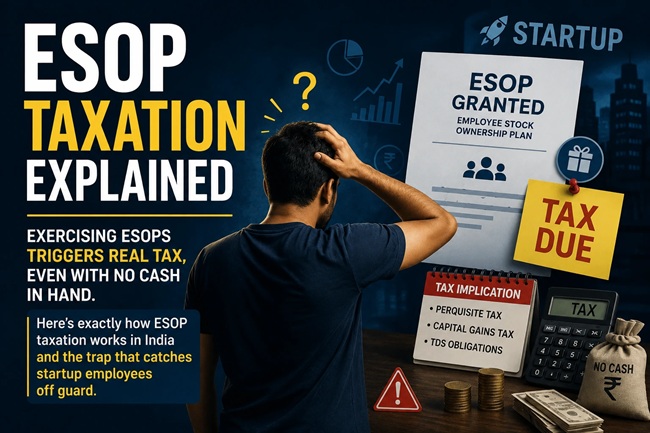
The Core Rule: Two Separate, Independent Tax Events
Indian ESOP taxation happens at exactly two points, and understanding that these are two completely separate, independent events is the single most important thing to internalize. Grant and vesting themselves trigger no tax at all. The clock only starts when you actually exercise your options, and it starts again, separately, when you eventually sell the resulting shares.
At exercise, the difference between the Fair Market Value of the shares on your exercise date and the exercise price you actually paid is treated as a perquisite, taxed as salary income under Section 17(2)(vi) of the Income Tax Act, at your regular income tax slab rate.
At sale, whenever that eventually happens, the difference between your sale price and the FMV on your original exercise date is taxed separately, as a capital gain.
The critical detail that catches people off guard is this: the perquisite tax at exercise is owed regardless of whether you’ve sold a single share or received any actual cash. “I haven’t sold anything, so I haven’t made any money yet” feels intuitively true, but it simply isn’t how the law treats it. The moment you exercise, you owe tax on the paper gain between FMV and your exercise price, in real cash, out of your own pocket, even while holding illiquid, pre-IPO shares you may not be able to sell for years.
How the Perquisite Value Actually Gets Calculated
Perquisite Value = (FMV on the date of exercise − Exercise price you paid) × Number of shares exercised
For shares of a company listed on a recognised stock exchange, FMV is calculated as the average of the opening and closing price on your specific exercise date. This is fairly straightforward to verify yourself.
For unlisted shares, which describes the overwhelming majority of Indian startup ESOPs, since most employees exercise well before any IPO, FMV has to be determined by a Category I merchant banker, using the Discounted Cash Flow method or another accepted valuation approach. In practice, most startups commission these merchant banker valuations once or twice a year and try to time employee exercise windows around when a fresh valuation report is available, since this valuation directly determines your tax bill.
This perquisite amount gets added to your gross salary for that financial year, and your employer is legally required to deduct TDS on it under Section 192, the same mechanism used for your regular salary TDS, and reflect it in your Form 16.
What Happens Later, When You Actually Sell
When you eventually sell your shares, a second, entirely separate tax event kicks in: capital gains tax. The gain here is calculated as your sale price minus the FMV on your original exercise date, not your original exercise price. This distinction matters enormously and is worth getting right, since your exercise price was already accounted for in the perquisite calculation at exercise. Using the FMV at exercise as your cost of acquisition for capital gains purposes avoids taxing the same appreciation twice.
Your holding period for determining whether this is a short-term or long-term capital gain begins from your date of exercise, when shares were actually allotted to you, not from your original grant date. For listed shares, gains on holdings under 12 months are taxed at a flat 20 percent, while gains on holdings over 12 months are taxed at 12.5 percent above the 1.25 lakh rupee annual exemption. Unlisted shares, again the more common scenario for startup employees exercising pre-IPO, generally require a longer holding period, 24 months, to qualify for long-term treatment, with short-term gains on unlisted shares taxed at your regular slab rate instead.
Why This Creates a Genuine Liquidity Trap
Here’s a realistic illustration of how severe this can get. If an employee’s vested options carry a meaningful gap between FMV and exercise price, exercising a moderately sized batch, say 5,000 options, at a startup that’s grown substantially in value since the original grant, can add well over a crore rupees to that year’s taxable income in one shot, pushing the employee into the highest tax slab and surcharge bracket for that year, on shares that are almost certainly illiquid and unsellable at that exact moment.
This is precisely the trap the title of this article refers to. Employees join startups partly for the promise of meaningful equity upside, then discover that claiming that equity, simply exercising the options they’ve earned, can trigger a tax bill large enough to require dipping into savings, taking a loan, or delaying exercise entirely, well before any actual liquidity event like an IPO or acquisition ever arrives.
The Startup Deferral That Can Help, If You Qualify
Recognising this exact problem, the government introduced a relief mechanism under Section 80-IAC for employees of eligible, DPIIT-recognised startups. Rather than paying the perquisite tax immediately at exercise, qualifying employees can defer this tax liability for up to 48 months from the end of the assessment year in which they exercised, or until they sell the shares, or until they leave the company, whichever comes first.
This is a genuinely useful cash-flow relief, but it isn’t automatic or universal. It applies specifically to employees of startups that hold current, valid DPIIT recognition, and industry bodies have pushed to broaden this eligibility further, though as of mid-2026 this expansion hasn’t been enacted. If you’re at a startup and unsure whether your employer qualifies, this is worth confirming directly with your company’s finance or HR team well before you plan to exercise, not after.
A Mistake Worth Avoiding: Playing Games With the Valuation
Some employees, on hearing about the exercise-time tax bill, wonder whether a lower FMV at exercise might reduce their immediate tax pain. It’s worth understanding why this thinking backfires. An understated FMV at exercise does lower your perquisite tax in the short term, but since that same FMV becomes your cost of acquisition for capital gains purposes, an artificially low FMV at exercise means an artificially inflated capital gain, and a bigger tax bill, when you eventually sell. Beyond the tax math, deliberately understating FMV also creates real regulatory and compliance exposure. The valuation needs to reflect reality on both ends of this two-stage system, not be gamed to defer pain from one stage into a worse outcome at the other.
ESOP Taxation at a Glance
| Stage | What Happens | Tax Treatment |
|---|---|---|
| Grant | Options granted with exercise price and vesting schedule | No tax |
| Vesting | Options become exercisable | No tax |
| Exercise | Employee pays exercise price, receives shares | Perquisite tax = (FMV − Exercise Price) × Shares, taxed as salary at slab rate |
| Sale | Shares sold for cash | Capital gains = Sale Price − FMV at exercise, taxed as STCG/LTCG depending on holding period |
About This Guide
This article reflects ESOP taxation rules under Section 17(2)(vi) of the Income Tax Act, 1961, Rule 3 of the Income Tax Rules for FMV determination, and the Section 80-IAC startup deferral provision, as they stand for AY 2026-27. Specific valuation requirements, deferral eligibility, and capital gains rates depend on your company’s DPIIT status, listing status, and your individual holding period. Please consult a qualified chartered accountant to plan your specific exercise timing and tax liability, particularly before exercising a large batch of options.
Common Mistakes Startup Employees Make With ESOP Taxes
Assuming no cash received means no tax owed is, by a wide margin, the most common and costly misunderstanding, and it’s exactly what caught Priya off guard. The perquisite tax at exercise is owed in real cash regardless of whether you’ve sold anything or hold genuinely illiquid shares.
Exercising a large batch of options in a single financial year without planning for the resulting tax spike is another frequent mistake. Since the perquisite gets added to that year’s salary income, a large exercise can push you into a meaningfully higher tax bracket for that year alone, something that can sometimes be managed better by spreading exercises across multiple financial years if your vesting and company policy allow it.
Not checking whether your employer holds current DPIIT recognition, and therefore whether the Section 80-IAC deferral is even available to you, is a missed opportunity that could otherwise ease a genuine liquidity crunch at exercise time.
Using the exercise price instead of the FMV at exercise as your cost of acquisition when calculating capital gains at sale is a calculation error that results in overpaying capital gains tax, effectively taxing the same appreciation twice.
My Take
The uncomfortable truth about ESOP taxation in India is that it’s structured in a way that can genuinely penalize employees for the very success they helped create, a company’s valuation climbing sharply between your grant and your exercise date directly inflates your tax bill at a moment when you likely have zero liquidity from the shares themselves. If you’re holding vested options at a startup, the single most valuable thing you can do is model out your potential tax liability before you exercise, not after, ideally with a chartered accountant who’s actually worked with ESOP cases, and check your company’s DPIIT status for deferral eligibility while you’re at it. This is exactly the kind of tax bill that surprises people specifically because nobody explained the mechanics in advance, not because the rules themselves are impossible to plan around.
Frequently Asked Questions
1. Are ESOPs taxed when they vest? No. Vesting itself creates no tax event in India. Tax liability arises only at two later points: when you exercise the options, and again when you eventually sell the resulting shares.
2. Do I owe tax on ESOPs even if I haven’t sold the shares? Yes. The perquisite tax at exercise is owed based on the difference between FMV and your exercise price, regardless of whether you’ve sold any shares or received actual cash from them.
3. How is the FMV of unlisted startup shares determined for tax purposes? For unlisted shares, FMV must be determined by a Category I merchant banker using the Discounted Cash Flow method or another accepted valuation technique, as of the specific exercise date.
4. What is the cost of acquisition when I sell my ESOP shares later? The FMV on your exercise date, not your original exercise price. Using the exercise price instead would result in being taxed twice on the same appreciation.
5. Can startup employees defer their ESOP tax liability? Yes, under Section 80-IAC, employees of DPIIT-recognised eligible startups can defer their perquisite tax for up to 48 months from the end of the assessment year of exercise, or until they sell the shares or leave the company, whichever comes first.
6. Does my holding period for capital gains start from the grant date or exercise date? From the exercise date, when shares are actually allotted to you, not from the original grant date when your options were first awarded.
7. What tax rate applies to gains when I sell unlisted startup shares? Unlisted shares generally require a holding period of 24 months to qualify for long-term capital gains treatment. Short-term gains on unlisted shares are taxed at your regular income tax slab rate.
8. Does my employer deduct TDS on ESOP perquisite tax? Yes, employers are required to deduct TDS on the perquisite value under Section 192, the same mechanism used for regular salary TDS, and reflect it in your Form 16.
9. Which ITR form should I use if I have ESOP income? ITR-1 doesn’t support capital gains and generally isn’t suitable if you have ESOP-related capital gains. Most employees with ESOP perquisite and capital gains income need to file ITR-2, or ITR-3 if they also have business income.
10. Can I reduce my tax by exercising fewer options at a time? Spreading option exercises across multiple financial years, rather than exercising a large batch at once, can help manage the tax bracket impact of the perquisite tax, since it’s added to that year’s salary income. This should be planned carefully alongside your vesting schedule and company policy.
Disclaimer
This article is for informational and educational purposes only and does not constitute tax or legal advice. ESOP taxation depends on your company’s listing status, DPIIT recognition, valuation methodology, and individual circumstances, and rules are subject to change through future Finance Acts. Please consult a qualified chartered accountant before exercising options or planning your ESOP-related tax liability.

Shuchi founded Finance Checks after spending 16+ years working in corporate, managing operations and distribution. She managed her own finances, learned and read regularly and helped people make sense of their savings, loans, insurance, and investments.
She started this site to offer the kind of clear, honest financial guidance she wished was more available when she was learning to manage her own money. Every article is researched personally, checked against official sources such as the Reserve Bank of India, SEBI, or the Income Tax Department, and revisited whenever regulations or figures change. She is upfront about how the site earns money through ads and select affiliate partnerships, and she does not let either influence what she actually recommends to readers.



Very thorough and well-researched. Impressive work.
Great content. Looking forward to reading more from this site.