

What Is an IPO? How a Company Goes Public, and How Allotment and Pricing Actually Work

Last updated: July 2026
About This Guide: Written by the Financechecks.com Editorial Team, Personal Finance Researchers. This article has been researched using SEBI’s ICDR Regulations, stock exchange disclosures, and publicly available IPO process documentation, and is reviewed for accuracy as regulations are updated.
A few years back, a friend of mine applied for his very first IPO. He’d heard a stock was “listing with huge demand,” blocked ₹15,000 in his bank account through his broker’s app, and then spent the next week refreshing his phone every few hours, genuinely unsure what he was even waiting for. When the shares weren’t allotted to him, his money came back automatically, but he had no idea why some people got shares and he didn’t, what had actually happened to his money in the meantime, or what “listing gain” even meant.
If any part of that sounds familiar, this post is for you. An IPO is one of those terms everyone in India has heard constantly, especially with 2025 having been a record year for IPOs and 2026 shaping up to be even bigger, but very few people actually understand what happens behind the scenes — both from the company’s side and the investor’s side. This guide walks through the entire journey, in plain language, from the moment a company decides to go public to the moment shares hit your demat account.
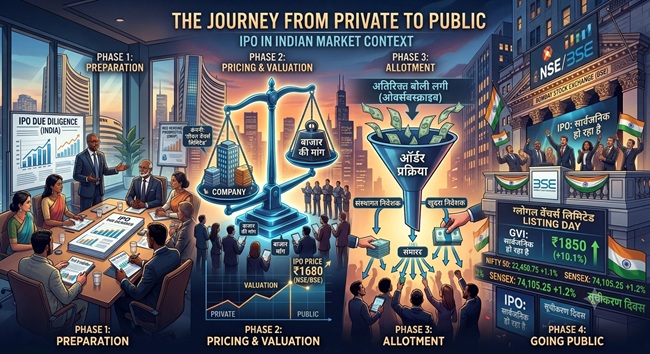
What Is an IPO, in the Simplest Possible Terms
IPO stands for Initial Public Offering. It’s the process through which a private company — one owned by its founders, family members, or early investors like venture capitalists — sells a portion of its shares to the general public for the very first time, and becomes a publicly listed company on a stock exchange like the NSE or BSE.
Before an IPO, if you wanted to own a piece of a company like, say, a fast-growing startup, you simply couldn’t — ownership was restricted to founders, employees, and a small circle of private investors. After an IPO, anyone — you, me, large institutions, foreign funds — can buy and sell that company’s shares on the open market, every single trading day.
Think of it as the company opening its doors to public ownership for the first time. In exchange for giving up a slice of ownership, the company typically raises a substantial amount of money, which it can use to expand operations, repay debt, fund new projects, or let its early investors and founders cash out some of their stake.
Why Does a Company Choose to Go Public?
Understanding the company’s motivation actually helps you understand the rest of the process better, since almost every step exists to protect either the company’s interests or the investing public’s interests. Companies generally go public to:
- Raise capital for expansion, new projects, or repaying existing debt, without having to take on more loans
- Provide an exit for early investors — venture capital and private equity investors who backed the company years earlier often use the IPO as their opportunity to sell some or all of their holding
- Increase visibility and credibility, since being a listed company comes with a certain public trust and brand recognition that private companies don’t get
- Create liquidity for employees, particularly where stock options (ESOPs) form part of compensation, since those shares become tradeable only after listing
Who Actually Manages an IPO? Meet the Key Players
A company doesn’t run its own IPO process — it’s far too regulated and complex for that. Here’s who’s actually involved:
- The Company (Issuer): The business going public, along with its promoters and existing shareholders
- Merchant Bankers / Book Running Lead Managers (BRLMs): Investment banks appointed by the company to manage the entire process — studying the company’s financials, helping decide the price band, handling every regulatory filing, and marketing the issue to investors. For large IPOs, several BRLMs work together
- SEBI (Securities and Exchange Board of India): The market regulator that reviews every disclosure the company makes, to ensure nothing is hidden or misleading before the public is allowed to invest
- Stock Exchanges (NSE/BSE): Which grant “in-principle approval” for the shares to eventually be listed and traded
- Registrar to the Issue: The entity responsible for processing applications and finalising the share allotment
- Depositories (NSDL and CDSL): Where your allotted shares are actually credited, since all IPO shares are allotted only in dematerialised (demat) form
How and When Can a Company Apply for an IPO?
This is the part most people never see, because it happens long before the IPO is ever announced publicly. Here’s the sequence:
Step 1: Appointing merchant bankers. The company first appoints one or more BRLMs, who study its financials, business model, and growth story to assess whether it’s genuinely ready to go public, and to help structure the offer.
Step 2: Preparing the DRHP (Draft Red Herring Prospectus). This is the single most important document in the entire process. It’s a detailed disclosure covering the company’s business model, promoters and management, complete financial statements, risk factors, pending litigation, and exactly what the raised money will be used for. Nothing material can legally be left out.
Step 3: Filing with SEBI and the stock exchanges. The DRHP is filed with SEBI and simultaneously submitted to the stock exchanges where the company intends to list. This document is also made public — genuinely worth skimming yourself if you’re seriously considering applying for a specific IPO, since it contains the honest risk factors most news coverage glosses over.
Step 4: SEBI’s review. SEBI examines the DRHP closely and typically issues an “observation letter” within 30 days of receiving a complete filing and satisfactory responses to its queries — effectively a green light to proceed, sometimes with conditions. This stage alone can take several weeks to a few months, and it’s the reason a company can’t simply announce an IPO overnight; the entire process, from initial preparation to actual listing, typically takes anywhere from 7 to 12 months.
Step 5: Filing the RHP (Red Herring Prospectus). Once SEBI is satisfied, the company files an updated, final version of the prospectus — the RHP — which now includes the price band and issue timeline. This is the document investors actually see when the IPO opens.
Step 6: Roadshows. In the days leading up to the IPO opening, company executives and the BRLMs meet institutional investors to build interest and confidence in the issue — essentially a structured pitch tour to the big money before the public gets a chance to apply.
You May Also Like To Read:
- Best Stocks Under ₹50 in India: How to Actually Evaluate Them (Not Just a Tip List) — 2026 Guide
- Stock Market Technical Analysis Basics for Beginners: How to Read Trends, Not Just Prices
- Understanding Sensex and Nifty: What Stock Market Indices Actually Mean
- How to Read a Stock Quote and Stock Chart: A Complete Beginner’s Guide
- Understanding Stock Market Indices: The Complete Guide to How They Work, What They Measure, and Why They Matter to Every Investor
What Happens When a Company Actually Announces Its IPO Launch
Once SEBI’s observations are in hand and the RHP is filed, the company announces the IPO to the public, and this is the part most retail investors actually experience:
- Anchor investor bidding. One working day before the IPO opens to the general public, large institutional investors — called anchor investors — place their bids. Strong anchor investor participation is often read by the market as a vote of confidence in the issue
- The IPO opens for public subscription. This is your window to apply, and it typically stays open for three to four working days
- Bidding across investor categories. Applications are grouped into three main categories — Retail Individual Investors (RIIs, meaning people like you and me applying up to ₹2 lakh), Non-Institutional Investors (NIIs, typically high-net-worth individuals applying larger amounts), and Qualified Institutional Buyers (QIBs, meaning mutual funds, insurance companies, and foreign institutional investors)
- The issue closes, and demand across each category is tallied
- Allotment is finalised, typically within a day or two of the issue closing
- Listing happens. Since a 2023 SEBI reform, shares must be listed and begin trading within 3 working days (T+3) of the issue closing — a much faster turnaround than the T+6 timeline that applied previously
How Is the IPO Price Actually Decided?
This is where a lot of confusion sets in, because IPO pricing isn’t decided the same way a stock’s daily price moves on the exchange afterward. There are two distinct methods:
Fixed Price Issue: The company and its merchant bankers decide a single, specific price in advance, and this price is disclosed to investors before the issue opens. What you see is exactly what you’ll pay if allotted.
Book Building Issue: This is far more common for larger IPOs today. Instead of one fixed number, the company announces a price band — a range, such as ₹80 to ₹90 — within which investors bid. SEBI regulations require this band to have a minimum spread of at least 5% between the floor price and the cap price, and the cap cannot exceed the floor by more than 20%, specifically to prevent companies from setting an artificially narrow band that gives investors no real room to bid.
During the bidding process, investors specify both the quantity of shares they want and the price within the band they’re willing to pay. Once bidding closes, the company and BRLMs analyse the pattern of demand across the price band and settle on a single cut-off price — the final price at which shares are actually allotted to everyone, regardless of whether an individual investor bid at the cut-off price or slightly higher within the band. This final price is set based on where genuine demand clustered, factoring in comparisons with similar listed companies and the company’s own financial multiples.
How Does Allotment Actually Work? Why Didn’t I Get Shares?
This is the question that frustrates the most first-time applicants, so let’s walk through it properly.
If an IPO is undersubscribed (meaning there’s less demand than the number of shares on offer in a category), every valid applicant in that category typically gets full allotment of what they applied for.
If an IPO is oversubscribed (meaning demand exceeds the shares available — which is extremely common for popular IPOs, sometimes running into dozens or even hundreds of times oversubscribed), allotment works differently depending on the category:
- For retail investors, if the category is oversubscribed, allotment is typically done through a computerised lottery system, ensuring a fair, random chance of allotment among all applicants, generally in minimum lot sizes rather than partial fills
- For NIIs and QIBs, allotment in an oversubscribed scenario is generally done on a proportionate basis relative to the size of their bids
This lottery-based system for retail investors is exactly why two people applying for the same amount, on the same day, can get completely different outcomes — one might receive an allotment, and the other, despite an equally valid application, might not. It isn’t a reflection of anything you did wrong; it’s simply how a heavily oversubscribed, fairness-oriented allotment system works.
What happens to your money if you’re not allotted shares? Nothing is ever actually debited from your account unless shares are allotted to you. When you apply for an IPO, the amount is only blocked in your bank account (through a system called ASBA — Applications Supported by Blocked Amount — usually authorised via UPI), not withdrawn. If you don’t receive an allotment, the blocked amount is simply released back to your free balance automatically, with no action needed from you.
What Happens on Listing Day
Once allotment is finalised, allotted shares are credited directly to the successful applicants’ demat accounts, and on the listing day, the stock begins trading on the exchange for the very first time. The price at which it opens for trading — the listing price — is discovered by the market itself, based on real buy and sell orders, and can be higher, lower, or roughly the same as the IPO price you paid.
A stock listing meaningfully above its IPO price is often described as having delivered “listing gains,” and this is the outcome many retail investors specifically hope for when applying. It’s worth being clear, though, that this isn’t guaranteed — a stock can just as easily list below its issue price, and both outcomes are genuinely determined by market demand on listing day, not by anything fixed in advance.
Shares allotted to certain categories — such as anchor investors and, in many cases, company promoters — are typically subject to a lock-in period, during which they cannot be sold, even though the stock is trading. This is designed to prevent large holders from immediately dumping shares on listing day and destabilising the price for everyone else.
Common Terms You’ll See and What They Actually Mean
- DRHP (Draft Red Herring Prospectus): The preliminary disclosure document filed with SEBI before the price is finalised
- RHP (Red Herring Prospectus): The final version of the prospectus, filed once the price band and issue details are confirmed
- Price Band: The price range within which investors bid, in a book-built issue
- Cut-off Price: The final price at which shares are actually allotted to all successful applicants
- Lot Size: The minimum number of shares you must apply for, as fixed by the company — you can’t apply for a single random number of shares, only in multiples of the lot size
- Oversubscription: When investor demand for shares exceeds what’s actually on offer, often expressed as “subscribed X times”
- Anchor Investor: A large institutional investor who commits to the IPO before it opens to the public
- ASBA: The mechanism that blocks (rather than debits) your application amount until allotment is finalised
Common Mistakes First-Time IPO Applicants Make
- Applying without reading any part of the DRHP or RHP. These documents contain the company’s own disclosed risk factors — skimming even the risk factors and financial summary sections takes a few minutes and tells you far more than a headline about “huge demand”
- Assuming oversubscription always means a good investment. High subscription numbers reflect demand and sentiment, not a guarantee of the company’s actual long-term business quality
- Expecting guaranteed listing gains. As covered above, listing price is genuinely determined by market demand on the day, and IPOs can and do list below their issue price
- Not understanding why an application got rejected. Applications can be rejected for technical reasons — bidding below the price band, incorrect PAN or demat details, or insufficient funds blocked for the applied quantity — worth double-checking before submission, not after
- Forgetting the lock-in period applies to specific categories, not retail investors. Retail investors who receive an allotment can typically sell on listing day itself; it’s specific categories like anchor investors and promoters that face lock-in restrictions
How to Actually Apply for an IPO
For most retail investors today, the process is straightforward:
- Have an active demat and trading account with a SEBI-registered broker
- Check the IPO opening and closing dates, along with the price band and lot size, once the RHP is announced
- Apply through your broker’s app or your bank’s net banking IPO section, specifying the number of lots and your bid price (or simply selecting “cut-off price” to bid at whatever the final price turns out to be, which is the most common choice for retail investors)
- Authorise the UPI mandate that blocks the required amount in your bank account — no money leaves your account at this stage
- Wait for the allotment date, and check your allotment status either through the registrar’s website or your broker’s app
- If allotted, shares are credited to your demat account before listing day; if not allotted, the blocked amount is released automatically
Should You Actually Apply for an IPO?
This isn’t a question this guide can answer for you, since it depends entirely on the specific company, your own research, and your risk appetite — but it’s worth remembering that an IPO is, in the end, still an equity investment in a single company, carrying the same fundamental risks as buying any individual stock. The hype, the oversubscription numbers, and the possibility of listing gains shouldn’t replace actually understanding what the company does, how it makes money, and whether its financials justify the price band it’s asking for. If you’ve read our post on fundamental analysis basics, the same evaluation principles apply here — an IPO doesn’t get a free pass from that scrutiny just because it’s new and exciting.
Frequently Asked Questions
1. What is an IPO in simple terms? An IPO, or Initial Public Offering, is the process by which a private company sells its shares to the public for the first time and becomes listed on a stock exchange, allowing anyone to buy and sell its shares afterward.
2. How long does it take for a company to complete an IPO? From initial preparation to actual stock exchange listing, the process typically takes anywhere from 7 to 12 months, depending on the company’s size and how quickly regulatory due diligence is completed.
3. What is the difference between a DRHP and an RHP? The DRHP (Draft Red Herring Prospectus) is the preliminary disclosure document filed with SEBI before the price is decided. The RHP (Red Herring Prospectus) is the final version, filed once the price band or price has been confirmed, and is the document used when the IPO actually opens to investors.
4. How is the IPO price decided? In a fixed price issue, the company sets a single price in advance. In a book-built issue, which is more common, the company sets a price band, investors bid within that range, and a final cut-off price is determined based on where demand clusters during the bidding process.
5. Why didn’t I get an allotment even though I applied on time? If a retail category is oversubscribed, allotment is done through a computerised lottery system to ensure fairness, since there aren’t enough shares for every applicant. Not receiving an allotment isn’t a reflection of an error in your application — it’s simply the outcome of a random allotment process under high demand.
6. Does IPO application money get deducted immediately? No. The amount is only blocked in your bank account through ASBA (Applications Supported by Blocked Amount) until allotment is finalised. If you’re not allotted shares, the blocked amount is released back to you automatically, with nothing actually debited.
7. What happens on IPO listing day? Allotted shares are credited to your demat account, and the stock begins trading on the exchange for the first time. The opening trading price, called the listing price, is determined by real market demand and can be higher, lower, or similar to the IPO price.
8. Is it guaranteed that an IPO will list at a profit? No. While many IPOs have historically listed above their issue price, this isn’t guaranteed, and stocks can list below their issue price depending on market conditions and investor sentiment on listing day.
9. What is a lock-in period in an IPO? It’s a restriction that prevents certain categories of shareholders, typically anchor investors and company promoters, from selling their shares for a specified period after listing, even though the stock is actively trading. Retail investors who receive an allotment are generally not subject to this lock-in and can sell from listing day itself.
10. Can anyone apply for any IPO? Yes, any eligible investor with a demat and trading account can apply for any open IPO, subject to the minimum lot size and investment category rules. However, being eligible to apply doesn’t mean an application will result in allotment, particularly for heavily oversubscribed issues.
Final Thoughts
An IPO can feel like a mysterious, fast-moving event from the outside — a company suddenly “goes public,” headlines talk about record subscription numbers, and everyone seems to know something you don’t. In reality, it’s a long, heavily regulated process built specifically to protect the very investors reading those headlines, with disclosure requirements, pricing transparency, and a fair allotment system all built in by design.
The next time an IPO you’re interested in opens, you’ll know exactly what’s happening at each stage — from the DRHP sitting quietly on SEBI’s website months earlier, to the anchor investors bidding a day before you get your turn, to why your allotment outcome might come down to a lottery rather than anything you did right or wrong. That understanding alone puts you ahead of most first-time applicants.
Disclaimer: This article is for general informational and educational purposes only and should not be treated as investment advice. IPO processes, regulations, and timelines mentioned above reflect SEBI’s ICDR Regulations and related circulars current as of the stated dates, and are subject to change through future regulatory amendments. IPO investments are subject to market risk, including the risk of listing below the issue price. Please read the specific company’s RHP carefully and consult a qualified financial advisor before applying for any IPO.

Shuchi founded Finance Checks after spending 16+ years working in corporate, managing operations and distribution. She managed her own finances, learned and read regularly and helped people make sense of their savings, loans, insurance, and investments.
She started this site to offer the kind of clear, honest financial guidance she wished was more available when she was learning to manage her own money. Every article is researched personally, checked against official sources such as the Reserve Bank of India, SEBI, or the Income Tax Department, and revisited whenever regulations or figures change. She is upfront about how the site earns money through ads and select affiliate partnerships, and she does not let either influence what she actually recommends to readers.



[…] What Is an IPO? How a Company Goes Public, and How Allotment and Pricing Actually Work […]