
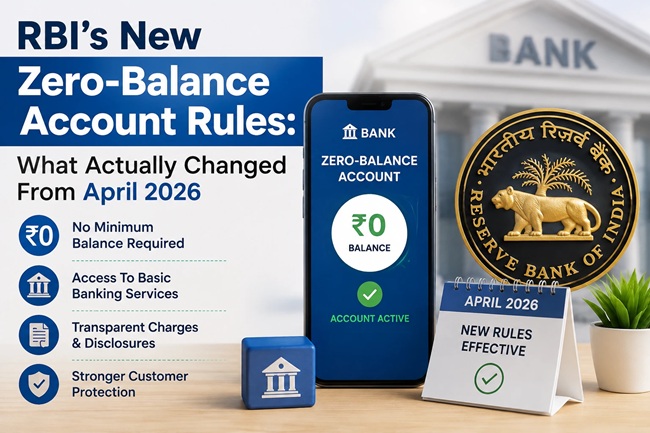
RBI’s New Zero-Balance Account Rules: What Actually Changed From April 2026

Ganesh has held a zero-balance account at his local bank for years, mainly to receive his salary and pay a few bills. He’d always assumed “zero balance” meant just that, no minimum balance requirement, and not much else. What he didn’t know, until his bank sent a notice earlier this year, was that his account type had just been quietly upgraded with a whole set of free features he’d never had access to before, a free chequebook, free debit card, and monthly cash withdrawals that no longer counted digital payments against the limit.
This wasn’t a promotional offer from his bank. It was the result of a sweeping regulatory overhaul the RBI issued in December 2025, which took effect on April 1, 2026, and fundamentally reshaped what a Basic Savings Bank Deposit account, the official name for what most people just call a “zero-balance account,” is legally required to offer. Here’s exactly what changed, and what it means if you hold one of these accounts.
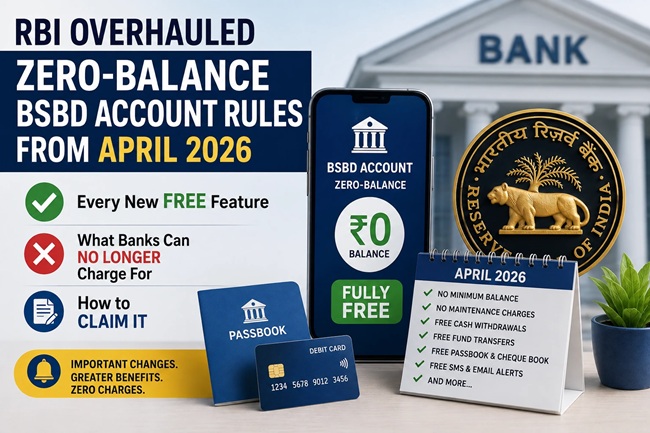
What a Basic Savings Bank Deposit account (BSBD Account) Actually Is
A Basic Savings Bank Deposit account, or BSBD account, is a specific, officially defined account category every bank in India is required to offer, designed to give anyone access to basic banking without needing to maintain a minimum balance or pay routine account charges. If you’ve ever opened an account through a Jan Dhan Yojana enrollment or asked your bank for a “zero-balance account,” there’s a strong chance that’s exactly the account type you’re already holding.
In December 2025, the RBI issued seven amendment directions specifically targeting this account category, covering commercial banks, small finance banks, payments banks, co-operative banks, regional rural banks, and local area banks, essentially every kind of bank operating in India. These changes came into force on April 1, 2026, following a public consultation on draft rules released the previous October.
The Full List of What’s Now Mandatory and Free
Under the revised framework, every BSBD account must offer a specific, expanded set of features at no cost, and banks aren’t permitted to make these conditional on maintaining any balance.
- Zero minimum balance, permanently. There’s no average monthly balance requirement at all, and no penalty if your balance drops to zero at any point.
- Unlimited free cash deposits, through any channel, regardless of the amount.
- A free ATM or debit card, with no issuance fee and no annual renewal charge.
- A free chequebook, with banks required to provide at least 25 leaves a year.
- Free internet and mobile banking access.
- A free passbook or monthly e-statement, so you can track your account activity without a separate charge.
- A minimum of four free cash withdrawals a month, and this now includes withdrawals made at other banks’ ATMs, not just your own bank’s network.
Here’s the detail that genuinely changes daily usability for a lot of account holders: digital payment transactions, UPI, NEFT, RTGS, IMPS, and card payments, no longer count toward that four-withdrawal limit at all. Under the older framework, heavy digital users could still bump into withdrawal caps depending on how their bank counted transactions. Under the new rules, you can transact digitally as often as you like without touching your free cash withdrawal allowance.
What Banks Can’t Do Anymore
Just as important as what’s now free is what banks are explicitly barred from doing. Banks cannot insist that a customer take a chequebook, an ATM card, or enroll in digital banking as a condition of opening or operating a BSBD account, these remain entirely optional, available on request rather than bundled by default. Banks are also required to offer any additional services beyond this baseline in a non-discretionary, non-discriminatory way, with transparent disclosure, and specifically cannot require a minimum balance as a backdoor way of gatekeeping access to the mandatory free features.
There’s also a new limit worth knowing about: you’re not permitted to hold more than one BSBD account across all banks combined, and banks are now required to obtain a declaration from you confirming this before opening a new one.
If You Already Have a BSBD Account
This is the part that catches a lot of existing account holders off guard, the way it did Ganesh. These newly expanded free features aren’t applied automatically to existing accounts. You need to actively request them from your bank, either through a physical branch visit or, in most cases, through your bank’s digital channels. Banks are required to honour these requests, but they’re not required to proactively upgrade every existing BSBD account without you asking.
If you’re currently holding a regular savings account and would prefer the BSBD structure instead, banks must process a conversion request within seven days, and this can typically be initiated digitally rather than requiring an in-person visit.
BSBD Account Changes at a Glance
| Feature | Old Standard | New Standard (from April 1, 2026) |
|---|---|---|
| Minimum balance | Often required or came with restrictions | Zero, permanently, no penalty |
| ATM/debit card | Sometimes chargeable | Free, no issuance or renewal fee |
| Chequebook | Often not included or limited | Free, minimum 25 leaves/year |
| Free cash withdrawals | Varied by bank, often 4/month at own bank only | Minimum 4/month, including other banks’ ATMs |
| Digital transactions (UPI/NEFT/IMPS) | Sometimes counted against withdrawal limits | Unlimited, don’t count toward the free withdrawal cap |
| Chequebook/card/digital banking | Sometimes bundled by default | Optional, available only on request |
| Number of BSBD accounts allowed | Not explicitly restricted | One per person, across all banks |
About This Guide
This article reflects the RBI’s seven Amendment Directions on Responsible Business Conduct, issued December 4, 2025, and effective from April 1, 2026, covering Basic Savings Bank Deposit account rules across all categories of Indian banks. Specific implementation timelines and processes can vary slightly by bank, so please check directly with your bank to confirm whether your existing account has been updated or requires an active request to access these newly mandated features.
Common Mistakes People Are Making With This Change
Assuming these new features apply automatically to an existing account is probably the most common gap right now, given how recently this took effect. If you opened your BSBD account before April 2026 and haven’t specifically requested the expanded free features, there’s a real chance you’re still operating under the older, more limited version of your own account.
Confusing a BSBD account with a regular zero-balance savings product offered by a bank as a promotional variant is another common mix-up. Commercial zero-balance accounts, the kind banks sometimes market directly, aren’t necessarily the same regulatory category as a BSBD account, and may come with different interest rate structures or slab-based terms. It’s worth confirming with your bank specifically which category your account falls under.
Not checking whether you already hold a BSBD account elsewhere before opening a new one is a mistake that can create compliance issues, given the new one-account-per-person restriction across all banks.
My Take
What I find genuinely useful about this particular update is how directly it closes gaps that used to quietly work against exactly the customers this account category was designed to serve, people who don’t carry large balances and rely on straightforward, low-cost banking. The unlimited digital transaction provision alone is a meaningful shift for anyone who does most of their banking through UPI rather than physical cash withdrawals. If you hold a zero-balance account and haven’t checked in with your bank since April 2026, this is genuinely worth a five-minute conversation, or a quick request through your banking app, to make sure you’re actually getting what you’re now entitled to.
Frequently Asked Questions
1. What is a BSBD account? A Basic Savings Bank Deposit account is a specific, officially defined zero-balance account category every Indian bank is required to offer, designed to provide basic banking access without minimum balance requirements or routine charges.
2. When did the new BSBD account rules take effect? The RBI’s revised rules came into force on April 1, 2026, following seven amendment directions issued in December 2025.
3. Do I automatically get the new free features on my existing zero-balance account? Not automatically. Existing BSBD account holders need to actively request the newly expanded free features from their bank, either at a branch or through digital channels.
4. Do UPI and other digital transactions count toward my free withdrawal limit now? No. Under the new rules, digital payment transactions like UPI, NEFT, RTGS, IMPS, and card payments no longer count toward the minimum four free cash withdrawals a month.
5. Can a bank force me to take a chequebook or ATM card with my BSBD account? No, under the new rules these remain entirely optional and must be provided only on request, not bundled by default.
6. Can I have more than one BSBD account? No, the new rules restrict individuals to holding only one BSBD account across all banks combined, and banks are required to obtain a declaration confirming this before account opening.
7. How do I convert my regular savings account into a BSBD account? You can request a conversion from your bank, and they’re required to process it within seven days, typically through either a branch visit or a digital request channel.
8. Is a Jan Dhan (PMJDY) account the same as a BSBD account? Yes, PMJDY accounts are built on the BSBD account structure, so these updated rules generally apply to Jan Dhan account holders as well.
9. Do these new rules apply to all banks in India? Yes, the rules apply across commercial banks, small finance banks, payments banks, co-operative banks, regional rural banks, and local area banks.
10. Are there any charges at all on a BSBD account under the new rules? The core mandatory features, cash deposits, a minimum of four free withdrawals, ATM/debit card, chequebook, and digital banking, must be provided free. Banks may offer additional services beyond this baseline, which can carry charges, but these must be optional, transparent, and non-discriminatory.
Disclaimer
This article is for informational and educational purposes only and does not constitute financial advice. RBI’s BSBD account rules are subject to further clarification or amendment, and specific bank implementation may vary. Please confirm current account features and any request process directly with your bank.

Shuchi founded Finance Checks after spending 16+ years working in corporate, managing operations and distribution. She managed her own finances, learned and read regularly and helped people make sense of their savings, loans, insurance, and investments.
She started this site to offer the kind of clear, honest financial guidance she wished was more available when she was learning to manage her own money. Every article is researched personally, checked against official sources such as the Reserve Bank of India, SEBI, or the Income Tax Department, and revisited whenever regulations or figures change. She is upfront about how the site earns money through ads and select affiliate partnerships, and she does not let either influence what she actually recommends to readers.



I appreciate the balanced perspective you offered.