

Income Tax Filing for Freelancers and F&O Traders: The Complete Guide, Do’s and Don’ts

Rahul freelances as a UI designer and trades F&O on the side to supplement his income. Come tax season, he genuinely didn’t know where to start. His freelance income didn’t feel like a “business” the way a shop or company would be, and his F&O losses felt like something he could just quietly not mention since he hadn’t actually made money. Both assumptions were wrong, and both are extremely common. Freelance income and F&O trading are two of the most misunderstood categories in Indian income tax, precisely because neither fits the salaried-employee template most people grow up filing under.
Here’s a complete, practical breakdown of how each is actually taxed, which forms you need, and the specific mistakes that get people into trouble with the tax department.
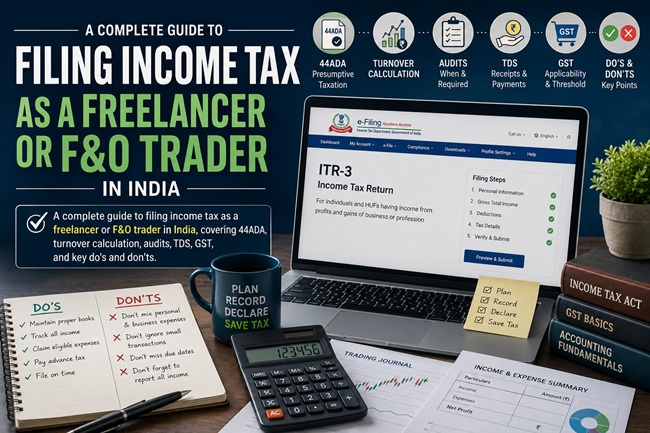
Part 1: Freelancers and Independent Professionals
Which Income Head Your Earnings Fall Under
The Income Tax Act doesn’t have a category called “freelancer.” Your earnings fall under “Profits and Gains of Business or Profession,” a fundamentally different head from salary, which means you’re taxed on net profit, what you earn minus legitimate business expenses, not on your gross receipts the way TDS on your invoices might make it feel.
Section 44ADA: The Simplified Route for Specified Professionals
If you fall under a “specified profession” as defined under Section 44AA, IT professionals, designers, writers, consultants, lawyers, doctors, architects, chartered accountants, engineers, and interior decorators are the commonly cited categories, you can opt for presumptive taxation under Section 44ADA. This lets you declare 50 percent of your gross receipts as taxable income, regardless of your actual expenses, with no requirement to maintain detailed books of accounts.
This scheme is available if your gross receipts don’t exceed 75 lakh rupees a year, raised from the earlier 50 lakh rupee limit, provided at least 95 percent of your receipts come through banking or digital channels. If your cash receipts exceed that 5 percent threshold, the lower 50 lakh rupee cap applies instead.
Here’s a genuinely common misconception worth clearing up directly: simply holding a professional degree or calling yourself a consultant doesn’t automatically qualify you for 44ADA. The scheme applies specifically to the professions listed under Section 44AA, and it’s worth actually checking whether your specific type of work fits that list rather than assuming it does.
When 44ADA Isn’t Actually Your Best Option
The 50 percent presumptive rate is a convenience, not automatically a tax-saving move. If your actual business expenses genuinely exceed 50 percent of your revenue, laptop and software costs, coworking space rent, travel, subscriptions, a significant chunk of your income, filing under the regular method with ITR-3 and proper books can result in a meaningfully lower tax bill, since you’d be claiming your real expenses rather than an assumed 50 percent.
TDS: What That 10 Percent Deduction on Your Invoices Actually Means
When an Indian client pays you more than 30,000 rupees in professional fees in a financial year, they’re required to deduct 10 percent TDS under Section 194J before paying you, and deposit it with the government on your behalf. This isn’t an extra tax, it’s a prepayment credited against your eventual tax liability. The deducted amount shows up in your Form 26AS and the Annual Information Statement, and you claim it as credit when filing your return. If your actual tax liability turns out lower than the TDS already deducted, you get the difference refunded. Foreign clients generally aren’t required to deduct Indian TDS at all, which is worth knowing if a meaningful share of your income comes from overseas.
GST: A Separate System From Income Tax Entirely
GST registration becomes mandatory once your aggregate turnover crosses 20 lakh rupees in a financial year, or 10 lakh rupees in certain special category states. Below that threshold, registration is generally optional. Once registered, domestic services typically attract 18 percent GST. If you serve foreign clients, exports of services qualify as zero-rated supply, meaning you can either file a Letter of Undertaking to export without charging GST at all, or charge IGST and claim it back as a refund.
Advance Tax: The Part Freelancers Most Often Forget
Because freelance income doesn’t have automatic monthly TDS the way a salary does, if your estimated tax liability for the year exceeds 10,000 rupees, you’re required to pay advance tax in quarterly instalments, 15 percent by June 15, 45 percent by September 15, 75 percent by December 15, and the full 100 percent by March 15. Missing these deadlines triggers interest under Section 234C. There’s a specific relief for those using Section 44ADA, though: you’re permitted to pay your entire advance tax in a single instalment by March 15 without the usual interest penalty for earlier quarters, a genuinely useful accommodation for freelancers whose income tends to be lumpy and unpredictable earlier in the year.
Freelancer Do’s and Don’ts
What To Do
- Do reconcile your Form 26AS and AIS against your actual invoices every quarter, not just at filing time, to make sure every TDS credit you’re owed is actually captured.
- Do check whether you genuinely qualify as a “specified profession” under Section 44AA before assuming 44ADA applies to you.
- Do run the numbers both ways, presumptive versus actual expenses, before defaulting to 44ADA, especially if your work involves significant equipment, software, or workspace costs.
- Do register for GST proactively once you’re approaching the 20 lakh rupee threshold, rather than scrambling after you’ve already crossed it.
What Not To Do
- Don’t assume foreign client income is tax-free just because no Indian TDS was deducted, it’s still taxable income in India for a resident.
- Don’t ignore advance tax simply because you don’t receive a salary slip reminding you, the interest penalties under Section 234C accumulate regardless of whether anyone reminds you.
- Don’t mix personal and business bank transactions carelessly if you’re maintaining actual books, since this makes both your own tracking and any future scrutiny considerably messier.
Part 2: F&O Traders
The First Thing to Understand: F&O Is Business Income, Not Capital Gains
This is the single most common and costly misunderstanding among F&O traders. Futures and Options trading is classified as non-speculative business income under Section 43(5)(d) of the Income Tax Act, taxed at your regular income tax slab rate, not at the capital gains rates that apply to stock investments. If you’ve been mentally applying the 20 percent STCG or 12.5 percent LTCG rates to your F&O profits, that’s simply the wrong framework, and it can lead to significant underreporting.
How F&O “Turnover” Actually Gets Calculated, and Why It’s Not What You Think
This confuses almost every trader at some point. Your F&O turnover is not your total contract value, and it’s not your net profit or loss either. Under the ICAI’s Guidance Note on Tax Audit, 8th edition, turnover is calculated as the absolute sum of profits and losses across every squared-off trade during the year.
Here’s a concrete example: if Trade 1 made a profit of 50,000 rupees and Trade 2 resulted in a loss of 30,000 rupees, your turnover is 80,000 rupees, the sum of both absolute values, not the 20,000 rupee net profit. This absolute-sum method is exactly why a trader with a fairly modest net profit or loss can still end up with a surprisingly large turnover figure once every individual trade gets added up this way, which matters enormously because this turnover number is what determines your audit and presumptive taxation eligibility.
When a Tax Audit Actually Becomes Mandatory
A tax audit under Section 44AB is generally required if your F&O turnover exceeds 10 crore rupees, provided at least 95 percent of your transactions are digital, or exceeds just 1 crore rupees if your digital transaction share falls below that 95 percent threshold.
There’s a second, separate audit trigger that catches smaller traders off guard, and it’s worth understanding specifically. If you previously opted into presumptive taxation under Section 44AD, and in a later year you declare profit below the prescribed 6 percent threshold, or report a loss, while your total income still exceeds the basic exemption limit, an audit can become mandatory regardless of how small your actual turnover is that year. This is genuinely how a trader with turnover of just 12 lakh rupees and a loss can still get pushed into audit territory, purely because of a choice made in an earlier filing year.
Presumptive Taxation for F&O: Section 44AD
If your F&O turnover doesn’t exceed 2 crore rupees, or 3 crore rupees where cash receipts and payments stay under 5 percent of the total, you can opt for presumptive taxation under Section 44AD, declaring at least 6 percent of digital turnover, or 8 percent for any cash component, as your taxable profit, without maintaining detailed books.
The catch worth understanding clearly: if your actual losses are larger than this presumed profit, or if your real profit margin is thinner than 6 percent, the presumptive scheme forces you to pay tax on an inflated, assumed profit rather than your genuine result. Many active traders, once their trading activity becomes substantial, find that computing actual profit and filing ITR-3 with proper books serves them better than defaulting to the presumptive route.
Setting Off and Carrying Forward F&O Losses
F&O losses, since they’re classified as non-speculative business income, can be set off against almost any other income you have in the same year, except salary income specifically. Any loss that remains unabsorbed can be carried forward for up to 8 assessment years, but only if you file your return by the original due date, not a belated one. This filing deadline discipline matters enormously here, missing it doesn’t just delay your paperwork, it can permanently forfeit your right to carry that loss forward at all.
It’s worth clearly distinguishing this from intraday equity trading, which is classified differently, as speculative business income. Speculative losses can only be set off against other speculative income, not your broader income, and can only be carried forward for 4 assessment years rather than 8. Mixing these two categories up on your return is a common and consequential error.
Which ITR Form You Actually Need
Almost every F&O trader, regardless of whether they made a profit or a loss, needs to file ITR-3. This includes salaried employees who made even a single F&O trade during the year, a genuinely common misconception is that salary income alone means ITR-1 or ITR-2 suffices, but F&O activity specifically requires ITR-3, with your salary reported under its own separate head within the same form. The exception is if you’re opting into presumptive taxation under Section 44AD, in which case ITR-4 becomes usable instead.
F&O Trader Do’s and Don’ts
What To Do
- Do calculate your turnover using the absolute-sum method described above, not your broker’s notional contract value figure, which typically overstates things dramatically.
- Do keep your trade-wise profit and loss statements organized throughout the year, not scrambled together at filing time, since this is exactly what substantiates your turnover calculation if questioned.
- Do file by the original due date, even if you’re reporting a loss, specifically to preserve your right to carry that loss forward for future years.
- Do separate your F&O results from any intraday equity trading you also do, since they fall under different tax treatment entirely.
- Don’t assume reporting a loss means no filing is required, or that a tax audit automatically applies just because you had a loss year, neither assumption is correct on its own.
What Not To Do
- Don’t apply capital gains tax rates to your F&O profits, this is business income taxed at your slab rate, a different calculation entirely.
- Don’t ignore the Section 44AD(4) trap if you’ve used presumptive taxation in a prior year, check this specifically before assuming your current year’s small turnover keeps you safely outside audit territory.
- Don’t forget that carried-forward F&O losses cannot later be set off against speculative income, keep these two loss categories tracked separately in your own records.
Key Numbers at a Glance
| Category | Freelancers (44ADA) | F&O Traders |
|---|---|---|
| Income head | Profits and Gains of Business/Profession | Non-speculative business income |
| Presumptive rate | 50% of gross receipts | 6% (digital) / 8% (cash) of turnover under 44AD |
| Presumptive turnover limit | ₹75 lakh (95%+ digital receipts) | ₹2 crore (₹3 crore if cash ≤5%) |
| Tax audit trigger | N/A directly, but relevant if opting out of 44ADA | Turnover > ₹10 crore (95%+ digital) or > ₹1 crore otherwise |
| TDS on income | 10% under Section 194J (payments > ₹30,000/client) | Not typically applicable the same way |
| Applicable ITR form | ITR-4 (presumptive) or ITR-3 (actual books) | ITR-3 (or ITR-4 if using Section 44AD) |
| Loss carry-forward | N/A under presumptive scheme | 8 years (F&O), 4 years (speculative/intraday) |
About This Guide
This article reflects Section 44ADA, 44AD, and 44AB provisions, the ICAI’s 8th edition Guidance Note on Tax Audit (August 2022), and TDS, GST, and advance tax rules as they stand for AY 2026-27. Specific thresholds, rates, and applicability depend on your individual profession, turnover, and prior filing history. Please consult a qualified chartered accountant to confirm your specific filing category, especially if you’re near an audit threshold or have used presumptive taxation in a previous year.
My Take
What freelancers and F&O traders actually have in common, beyond both falling outside the neat salaried-employee tax template, is that the biggest risks in both categories come from assumption, not deliberate wrongdoing. Rahul’s instinct to stay quiet about his F&O losses because “he hadn’t made money” is exactly the kind of assumption that costs people their loss carry-forward rights, a benefit that exists specifically to help traders in exactly his situation, if only the return gets filed correctly and on time. Similarly, defaulting to 44ADA without checking whether it’s actually the better math, or without confirming genuine eligibility, is a habit worth breaking. Neither of these tax categories is inherently complicated once you understand the specific mechanics. They’re just different enough from salaried filing that assuming the old rules still apply is where most of the real mistakes happen.
Frequently Asked Questions
1. Do freelancers need to pay GST? Only once your aggregate annual turnover crosses 20 lakh rupees, or 10 lakh rupees in certain special category states. Below that, registration is generally optional.
2. Is F&O income taxed like stock market capital gains? No. F&O trading is classified as non-speculative business income and taxed at your regular income tax slab rate, not at capital gains rates.
3. Can I carry forward F&O losses if I file a belated return? No, F&O losses can only be carried forward if you file your return by the original due date, not a belated one.
4. What is the difference between F&O and intraday equity trading for tax purposes? F&O is non-speculative business income, offsettable against most income and carried forward up to 8 years. Intraday equity trading is speculative business income, offsettable only against speculative income and carried forward up to 4 years.
5. Do all freelancers qualify for Section 44ADA? No, only those in specified professions listed under Section 44AA, such as IT professionals, doctors, lawyers, architects, and similar categories. Holding a degree or working as a general consultant doesn’t automatically qualify you.
6. What happens if my F&O turnover is small but I show a loss after previously using presumptive taxation? You may still be required to undergo a tax audit under Section 44AD(4), even with a small turnover, if you had opted into presumptive taxation in an earlier year and are now declaring profit below the threshold or a loss, while your total income exceeds the basic exemption limit.
7. How is F&O turnover actually calculated? As the absolute sum of profits and losses from every squared-off trade during the year, not your net profit or the notional contract value shown on your broker’s dashboard.
8. Do I need to file ITR-3 if I’m salaried but also trade F&O? Yes, even a single F&O trade during the year generally requires filing ITR-3 instead of ITR-1 or ITR-2, with your salary income reported separately within the same form.
9. Is the TDS deducted by my clients an additional tax I owe? No, it’s a prepayment of your eventual tax liability, credited against what you owe when you file your return. If it exceeds your actual liability, you receive a refund.
10. Should I always choose presumptive taxation for simplicity? Not necessarily. If your actual expenses or losses are significant, the regular method with proper books, filed via ITR-3, can result in meaningfully lower tax than a presumptive scheme that assumes a fixed profit percentage regardless of your real numbers.
Disclaimer
This article is for informational and educational purposes only and does not constitute tax or legal advice. Provisions under Sections 44ADA, 44AD, 44AB, TDS, GST, and advance tax rules are subject to change through future Finance Acts, and applicability depends on individual circumstances, profession, and turnover. Please consult a qualified chartered accountant before choosing a taxation method or filing your return, particularly if you are near an audit threshold or have previously used presumptive taxation.

Shuchi founded Finance Checks after spending 16+ years working in corporate, managing operations and distribution. She managed her own finances, learned and read regularly and helped people make sense of their savings, loans, insurance, and investments.
She started this site to offer the kind of clear, honest financial guidance she wished was more available when she was learning to manage her own money. Every article is researched personally, checked against official sources such as the Reserve Bank of India, SEBI, or the Income Tax Department, and revisited whenever regulations or figures change. She is upfront about how the site earns money through ads and select affiliate partnerships, and she does not let either influence what she actually recommends to readers.