
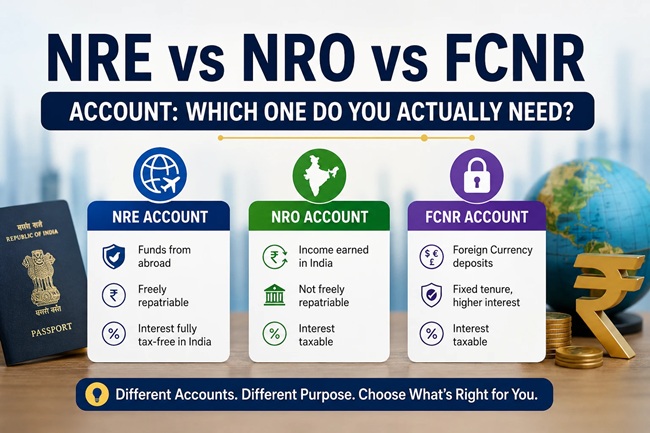
NRE vs NRO vs FCNR Account: Which One Do You Actually Need

When Kavya moved to Toronto for work, her bank back home asked her a question that genuinely stumped her: did she want to open an NRE account, an NRO account, or both? She’d never heard either term before, picked NRE because it sounded more relevant to her foreign salary, and moved on. Eighteen months later, she inherited a small rental property from her grandmother in Pune, and her CA had to explain, somewhat urgently, that depositing that rental income into her NRE account was actually a compliance violation, not just a minor technicality.
This mix-up is extremely common, and it happens because these three account types aren’t interchangeable versions of the same thing. Each one is built for a specific kind of money, and using the wrong one creates real tax and regulatory problems, not just inconvenience. Here’s exactly what each account is for, and how to figure out which one, or combination, you actually need.

NRE: For Money You Earn Outside India
A Non-Resident External account is designed to hold your foreign earnings, your salary, savings, or other income earned abroad, once you bring it into India. The money gets converted into Indian Rupees when deposited, and from that point on, it sits in INR.
The appeal here is twofold. First, interest earned on an NRE account is completely tax-free in India, provided you meet the standard conditions. Second, both your principal and the interest are fully and freely repatriable, meaning you can move the entire amount back abroad whenever you want, with no cap and minimal paperwork. Indian banks currently offer NRE fixed deposit rates in the range of roughly 6.5 to 7.25 percent per annum at major banks, though this varies by bank and changes over time, so it’s worth checking current rates rather than treating this as fixed.
The important restriction to understand is what can go into an NRE account in the first place. It can only be funded through foreign remittances or transfers from another NRE or FCNR account, not through income earned within India. This is exactly the mistake Kavya nearly made with her rental income, and depositing India-sourced money into an NRE account is treated as a genuine FEMA violation, not just an accounting inconvenience.
NRO: For Money You Earn Inside India
A Non-Resident Ordinary account is the counterpart, built specifically to hold income you earn within India while living abroad, rental income, dividends from Indian investments, a pension, or proceeds from selling property or shares in India.
Two features distinguish it clearly from an NRE account. First, interest earned on an NRO account is taxable in India, with TDS deducted at source, commonly around 30 percent plus applicable surcharge and cess, which can push the effective rate to roughly 31.2 percent in many cases. Second, repatriation out of an NRO account is capped at USD 1 million per financial year, and every outward transfer requires documentation, specifically a self-declaration Form 15CA and a CA-certified Form 15CB, along with proof of the source of funds. It’s worth noting that under India’s new Income Tax Act, effective from April 2026, some of these forms are being renumbered as part of a broader compliance overhaul, so the underlying requirement remains, even if the exact form numbers your CA references may shift.
One practical advantage of an NRO account is that it can be held jointly with a resident Indian, which makes it genuinely useful for situations like rental income, where a local family member can help manage transactions on your behalf while you’re abroad.
If a meaningful share of your NRO interest is getting eaten by that 30 percent TDS and you’re eligible for a lower rate under a Double Taxation Avoidance Agreement with your country of residence, you can apply to Indian tax authorities for a lower withholding certificate, which reduces the amount withheld upfront rather than requiring you to claim it all back at tax filing time.
FCNR: For Parking Foreign Currency Without Exchange Rate Risk
A Foreign Currency Non-Resident account is structurally different from the other two in an important way, it’s a term deposit held in the foreign currency itself, not converted into rupees at all. You can hold FCNR deposits in USD, GBP, EUR, JPY, CAD, AUD, and several other permitted currencies, with tenures typically ranging from 1 to 5 years.
Because your money stays in its original currency throughout the deposit term, there’s no rupee-conversion risk on your principal, a genuine concern for NRE deposits, where currency fluctuations between deposit and withdrawal can meaningfully affect what you actually receive back in your home currency. Like an NRE account, FCNR interest is tax-free in India, and both principal and interest are fully repatriable. FCNR deposits also typically carry deposit insurance coverage up to 5 lakh rupees under DICGC, the same protection that applies to regular Indian bank deposits.
It’s worth knowing that FCNR interest rates, particularly for USD deposits, have generally declined in line with global interest rate trends, so it’s worth comparing current FCNR rates against what you might earn on similar term deposits in your country of residence before committing funds here purely for the tax-free structure.
The one thing FCNR can’t do is replace an NRO account for everyday needs. It’s a fixed-term deposit, not a transactional account, so it isn’t suited to managing ongoing Indian income or regular local expenses the way an NRO account is.
The Three Accounts at a Glance
| Feature | NRE | NRO | FCNR |
|---|---|---|---|
| Purpose | Foreign earnings brought into India | Income earned within India | Foreign currency term deposit |
| Currency held | INR (converted from foreign currency) | INR | Original foreign currency (USD, GBP, EUR, etc.) |
| Interest taxability | Tax-free in India | Taxable, ~30%+ TDS | Tax-free in India |
| Repatriation | Fully and freely repatriable | Capped at USD 1 million/year, with documentation | Fully and freely repatriable |
| Account type | Savings or fixed deposit | Savings or fixed deposit | Term deposit only, 1-5 years |
| Can hold Indian income? | No | Yes | No |
| Joint holding with resident Indian | Generally not permitted (limited exceptions) | Permitted | Generally not permitted |
| Exchange rate risk | Yes, on conversion to and from INR | Yes, on conversion to and from INR | No, held in original currency |
Which One Do You Actually Need?
For most NRIs, the realistic answer isn’t choosing just one, it’s understanding that these accounts serve different jobs and using the right combination based on where your money actually comes from.
If your only financial connection to India is periodically sending savings home and keeping them accessible for future use, an NRE account alone may be sufficient. If you have any income source within India at all, rental property, dividends from Indian stocks, a pension, or proceeds from a property sale, you need an NRO account to legally receive and manage that money, regardless of whether you also hold an NRE account.
FCNR becomes relevant specifically if you want to hold foreign currency savings in India for an extended period without exposing yourself to rupee fluctuation risk, often because you’re planning to eventually move that money back abroad and don’t want currency movements eating into the tax-free interest you’ve earned in the meantime.
Most NRIs with any meaningful financial footprint in both countries end up maintaining both an NRE and an NRO account at minimum, using the NRE account for foreign savings and mobility, and the NRO account specifically for Indian-sourced income and local obligations, adding FCNR into the mix if currency-risk-free deposits become a priority.
About This Guide
This article reflects NRE, NRO, and FCNR account rules under RBI’s FEMA framework as they stand in 2026, including compliance requirements referencing India’s new Income Tax Act effective from April 2026. Interest rates, specific form numbers, and repatriation documentation requirements are subject to change and vary by bank, so please confirm current rates and requirements directly with your bank or a chartered accountant experienced in NRI taxation before opening an account or planning a large transfer.
Common Mistakes NRIs Make With These Accounts
Depositing Indian-sourced income, rent, dividends, or sale proceeds, into an NRE account instead of an NRO account is one of the most common and consequential mistakes, since it’s a genuine FEMA compliance violation, not simply a matter of picking the “wrong” tax-free option.
Ignoring the TDS impact on NRO interest until tax filing time is another frequent gap. Many NRIs are surprised to discover a significant chunk of their NRO interest has already been withheld, and don’t realize they could have applied for a lower withholding certificate under a DTAA if eligible, reducing that upfront deduction rather than waiting to claim it back later.
Assuming FCNR can replace an NRO account for managing everyday Indian income or expenses is a structural misunderstanding, since FCNR is strictly a fixed-term deposit vehicle, not a transactional account suited to ongoing local financial management.
Not comparing current FCNR rates against equivalent options in your country of residence before committing funds is another overlooked step, since global rate movements have shifted the relative appeal of FCNR deposits over time, and the tax-free structure alone doesn’t automatically make it the best place for your money.
My Take
The confusion between these three accounts almost always comes down to one thing: treating “NRI account” as a single category rather than three genuinely different tools built for different kinds of money. Once you separate the question into “where is this money actually coming from,” foreign earnings, Indian income, or foreign currency I want to park safely, the right account, or combination, becomes fairly obvious. The real risk isn’t picking a suboptimal account for tax efficiency, it’s mixing up which type of money belongs in which account entirely, which is exactly the kind of mistake that turns into a compliance problem rather than just a missed opportunity.
Frequently Asked Questions
1. Can I deposit my Indian rental income into my NRE account? No, this is a FEMA compliance violation. NRE accounts can only be funded through foreign remittances or transfers from other NRE or FCNR accounts. Indian-sourced income like rent must go into an NRO account.
2. Is interest on an NRO account really taxed at 30 percent? Yes, generally, TDS is deducted at approximately 30 percent plus applicable surcharge and cess on NRO interest, though this rate may be reduced if you’re eligible for benefits under a Double Taxation Avoidance Agreement with your country of residence.
3. How much money can I repatriate from an NRO account each year? Up to USD 1 million per financial year, subject to submitting the required documentation, including a self-declaration form and a CA-certified form confirming tax compliance.
4. Is there a limit on repatriating money from an NRE or FCNR account? No, both NRE and FCNR account balances, including principal and interest, are fully and freely repatriable without the annual cap that applies to NRO accounts.
5. What currencies can I hold in an FCNR account? Common permitted currencies include USD, GBP, EUR, JPY, CAD, and AUD, among others, depending on what your specific bank offers.
6. Can I open a joint NRE account with my resident Indian parent? Generally, NRE accounts don’t permit joint holding with resident Indians, though limited exceptions exist for close relatives under a “former or survivor” holding structure. NRO accounts are more commonly held jointly with resident Indians.
7. Do I need all three accounts, NRE, NRO, and FCNR? Not necessarily. Most NRIs with income in both countries maintain at least an NRE and an NRO account. FCNR becomes relevant specifically if you want to hold foreign currency deposits without rupee exchange rate risk.
8. Is FCNR interest really tax-free in India? Yes, similar to NRE accounts, FCNR interest is tax-free in India, and both principal and interest are fully repatriable, provided standard conditions are met.
9. What happens if I mistakenly deposit foreign income into an NRO account instead of NRE? While not as serious a violation as the reverse, it means you’d be needlessly subjecting tax-free-eligible foreign income to NRO’s taxation and repatriation restrictions, so it’s worth correcting with your bank rather than leaving it as is.
10. Can NRIs use FCNR deposits for everyday transactions in India? No, FCNR accounts are fixed-term deposits, typically 1 to 5 years, and aren’t designed for regular transactional use. An NRO account is the appropriate choice for managing ongoing Indian income and expenses.
Disclaimer
This article is for informational and educational purposes only and does not constitute financial, tax, or legal advice. NRE, NRO, and FCNR account rules are governed by RBI’s FEMA framework and are subject to change, including recent updates tied to India’s new Income Tax Act effective April 2026. Please consult your bank and a chartered accountant experienced in NRI taxation before opening an account or planning fund transfers between India and abroad.

Shuchi founded Finance Checks after spending 16+ years working in corporate, managing operations and distribution. She managed her own finances, learned and read regularly and helped people make sense of their savings, loans, insurance, and investments.
She started this site to offer the kind of clear, honest financial guidance she wished was more available when she was learning to manage her own money. Every article is researched personally, checked against official sources such as the Reserve Bank of India, SEBI, or the Income Tax Department, and revisited whenever regulations or figures change. She is upfront about how the site earns money through ads and select affiliate partnerships, and she does not let either influence what she actually recommends to readers.



[…] NRE vs NRO vs FCNR Account: Which One Do You Actually Need […]