
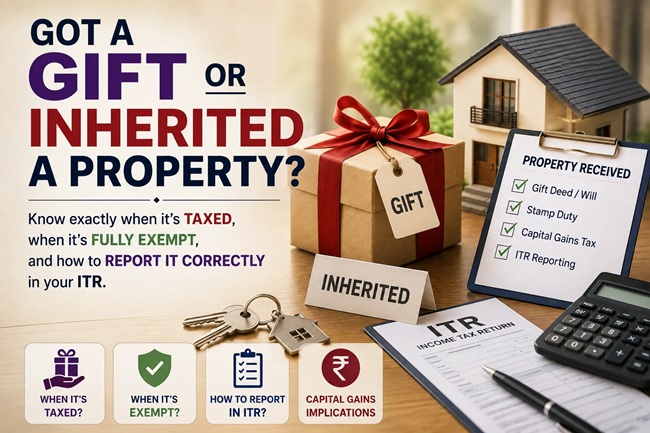
Received a Gift or Inherited a Property? Here’s What the Taxman Actually Wants From You

Suppose your father decides to gift you the family house this year. Or maybe your grandmother’s jewellery has come to you after her passing. Or a close friend transferred you two lakh rupees to help you through a rough patch. The first question that pops into most people’s heads, right after the emotional part settles down, is a very practical one — do I have to pay tax on this?
It’s a fair question, and honestly, a confusing one, because gifts and inheritance get treated very differently under Indian tax law, and even within “gifts,” the rules change completely depending on who gave it to you. This post breaks the whole thing down in plain language, with real examples, so you know exactly where you stand.
Quick answer: Inheritance is never taxed in India, no matter how big it is. Gifts, on the other hand, are tax-free only if they come from a close relative, on your wedding, or by way of a will — everything else gets taxed once it crosses ₹50,000 in a year. And here’s the part almost nobody remembers — even a tax-free gift or inheritance can trigger tax later, when you actually sell it.

Inheritance Is Completely Tax-Free in India
Let’s start with the simpler of the two. India used to have an Estate Duty, which was essentially an inheritance tax, but it was scrapped way back in 1985. Since then, there is no tax on inheritance in India, full stop. It doesn’t matter whether you inherit a small flat in a tier-2 city or a business worth crores, whether it comes through a will or without one, or how many people are inheriting alongside you — none of it attracts income tax at the time you receive it.
So if your parents pass on their house to you, or you inherit gold, mutual funds, a bank balance, or shares from a relative’s estate, you don’t owe the government a single rupee on that inheritance itself. The confusion usually starts later, and we’ll get to that.
One thing worth knowing though — while inheritance itself isn’t taxable, it still needs to be disclosed properly. The newer ITR forms have a dedicated section for reporting receipts that aren’t taxable income, including inherited assets, so that the tax department doesn’t flag it as unexplained money landing in your account. Skipping this step is one of the most common and easily avoidable mistakes people make.
Gifts Are a Different Story Altogether
Unlike inheritance, gifts are taxed — but only in certain situations. Here’s the rule in its simplest form: if you receive money, property, or anything of value without paying for it, and the total value from non-relatives crosses ₹50,000 in a financial year, the entire amount becomes taxable as “Income from Other Sources” and gets added to your regular income, taxed at your slab rate.
Notice that word “entire” — this trips people up all the time. If you receive ₹60,000 in gifts from a friend in a year, you don’t just pay tax on the ₹10,000 above the limit. The whole ₹60,000 becomes taxable income. It’s an all-or-nothing threshold, not a slab-based one.
This rule comes from Section 56(2)(x) of the Income Tax Act. Starting from the financial year 2026-27, this same rule has simply been renumbered as Section 92 under the new Income Tax Act, 2025 — the substance of the rule hasn’t changed at all, just the section number, so don’t panic if you see a different citation floating around.
Who Counts as a “Relative” for Tax-Free Gifts
This is the single most important part of the whole gift tax rule, because gifts from relatives are fully exempt, no matter how large the amount is. Gift your child ten lakh rupees, and it’s completely tax-free for them. Same with gifts between spouses, from parents to children, between siblings, and a defined list of in-laws and extended family that the law specifically names.
What catches people off guard is who doesn’t make the cut. Cousins, for instance, are not treated as “relatives” for this exemption, no matter how close you are to them. Friends obviously don’t count either. So a generous gift from a cousin or a close friend is fully taxable once it crosses ₹50,000, even though it might feel every bit as personal as a gift from a sibling.
The Two Other Situations Where Gifts Are Always Tax-Free
Besides gifts from relatives, there are exactly two more situations where a gift escapes tax entirely, regardless of the amount involved.
The first is a wedding gift. Anything you receive around your own marriage — cash, jewellery, property, appliances — is fully exempt, and this applies no matter who gives it, relative or not. It’s the only life event in the entire Income Tax Act that gets this kind of blanket exemption.
The second is anything received through a will or by way of inheritance, which we’ve already covered above — this stays tax-free even if it technically counts as a “gift” in a loose sense.
What Happens When the Gift Is a House, Not Cash
Property gifts work a little differently from cash gifts, because instead of the actual amount you received, the tax department looks at the property’s stamp duty value — essentially what the local government considers the property to be worth for registration purposes.
If a relative gifts you a house, it stays completely tax-free, no matter what the stamp duty value says. But if a non-relative gifts you a property and its stamp duty value is more than ₹50,000, that entire stamp duty value becomes taxable in your hands as income. There’s a related situation too — if someone sells you a property for much less than its stamp duty value, and the gap between what you paid and the stamp duty value is more than ₹50,000, that difference itself is treated as a gift and taxed accordingly.
Here’s the Part Everyone Forgets: Selling It Later
This is honestly where most of the real tax planning happens, and where people get caught off guard years down the line. Just because receiving a gift or inheritance was tax-free doesn’t mean selling it later is tax-free too. The moment you sell an inherited or gifted property, shares, or any capital asset, capital gains tax kicks in, and two carry-over rules decide how much you owe.
The first is your cost of acquisition. You don’t get to treat your “cost” as zero just because you didn’t pay for it, and you also don’t use the property’s value on the day you received it. Instead, the cost is whatever the original owner paid when they first bought or built it. So if your father bought a house in 1995 for ten lakh rupees and gifted it to you in 2020, your cost of acquisition for tax purposes is still that original ten lakh rupees from 1995, not the market value in 2020.
The second is your holding period, and this one works in your favour. The time the previous owner held the asset gets added to your own holding period. Using the same example, if you sell that house in 2026, your holding period is counted all the way back to 1995, not from 2020 when you actually received it. In almost every practical case, this means the asset qualifies as a long-term capital asset, which usually comes with a lower tax rate and indexation benefits compared to short-term gains.
This combination — old cost, long holding period — is actually quite favourable once you understand it, but plenty of people assume their cost is either zero or the current market value, and end up either overpaying tax out of confusion or underreporting it by mistake.
A Quick Example to Tie It All Together
Say your uncle (your father’s brother, who counts as a relative) gifts you a plot of land this year. Since it’s from a relative, there’s no tax at all when you receive it, regardless of the plot’s value. Your uncle originally bought that plot in 2010 for eight lakh rupees. If you sell it in 2027 for twenty-five lakh rupees, your capital gains will be calculated using the 2010 purchase price of eight lakh rupees as your cost, and your holding period will be counted from 2010, not from the year your uncle gifted it to you — making it a long-term capital gain with indexation benefits applied.
Now compare that to a friend gifting you the same plot. If its value is above ₹50,000, the entire value becomes taxable as income in the year you receive it, taxed at your regular slab rate. And when you eventually sell it, your cost of acquisition this time would be the value that was already taxed as a gift, not your friend’s original purchase price.
How to Report Gifts and Inheritance in Your ITR
Even when a gift or inheritance is fully tax-free, it still needs to show up somewhere in your income tax return, or it risks looking like unexplained money if the tax department ever cross-checks your bank statements. The current ITR forms include a specific section for reporting receipts that aren’t taxable income, which covers exempt gifts, inherited property, and a few other similar categories. Along with this, it helps to keep supporting documents ready — a gift deed for property gifts, a copy of the will or a legal heir certificate for inheritance, and bank statements showing the source of any money transferred, in case you’re ever asked to explain the entry.
The Bottom Line
Inheritance in India is tax-free, period. Gifts are tax-free only when they come from a defined list of relatives, on your wedding, or through inheritance — everything else is taxed the moment it crosses ₹50,000 in a year, and the entire amount gets taxed, not just the excess. And the piece that catches most people off guard years later is that selling an inherited or gifted asset isn’t tax-free just because receiving it was — the original owner’s cost and holding period carry forward to you, which usually works out in your favour if you know how to use it.
Frequently Asked Questions
Is money received from parents taxable in India? No. Parents are classified as relatives under the Income Tax Act, so any amount of money or property they give you is completely tax-free, with no upper limit.
Do I have to pay tax if my grandmother leaves me her house in her will? No. Property received through a will or inheritance is fully exempt from tax in India, regardless of its value, since India has no inheritance tax.
Is a gift from a friend taxable in India? Yes, if the total value of gifts you receive from a friend (or any non-relative) in a financial year exceeds ₹50,000, the entire amount becomes taxable as income from other sources, added to your regular income and taxed at your slab rate.
Are wedding gifts taxed in India? No. Any gift received around your own wedding is fully tax-free, regardless of the amount or who gives it, whether relative or non-relative.
Who is considered a “relative” for tax-free gifts? The Income Tax Act defines relatives to include your spouse, parents, children, siblings, and certain in-laws and extended family members specifically named in the law. Cousins and friends are not included in this list.
If I inherit property, do I pay tax when I later sell it? Yes. While inheriting the property itself is tax-free, selling it later attracts capital gains tax. Your cost of acquisition is treated as the original owner’s purchase price, and your holding period includes the time the original owner held it.
Is jewellery received as a gift taxable? The same rules apply as any other gift. Jewellery from a relative, at your wedding, or by inheritance is tax-free. From a non-relative, it’s taxable once its value crosses ₹50,000 in a year.
Do I need to report a tax-free gift or inheritance in my ITR? Yes. Even though it isn’t taxable income, current ITR forms have a separate section for reporting such receipts, and it’s important to disclose them there with supporting documents to avoid any scrutiny later.
What documents should I keep for a gifted or inherited property? For gifts, keep the gift deed. For inheritance, keep the will or a legal heir certificate. In both cases, also keep proof of the original owner’s purchase cost, since you’ll need it when you eventually sell the asset.
Has the gift tax rule changed under the new Income Tax Act, 2025? The rule itself hasn’t changed. From the financial year 2026-27, the earlier Section 56(2)(x) has simply been renumbered as Section 92 under the new Act, with all the same exemptions and thresholds carried forward as they were.
Disclaimer: This article is for general informational and educational purposes only and does not constitute tax, legal, or financial advice. Tax laws and thresholds are subject to change, and individual circumstances can significantly affect how these rules apply to you. Please consult a qualified chartered accountant or tax professional before making any decisions regarding gifts, inheritance, or capital gains on such assets.

Shuchi founded Finance Checks after spending 16+ years working in corporate, managing operations and distribution. She managed her own finances, learned and read regularly and helped people make sense of their savings, loans, insurance, and investments.
She started this site to offer the kind of clear, honest financial guidance she wished was more available when she was learning to manage her own money. Every article is researched personally, checked against official sources such as the Reserve Bank of India, SEBI, or the Income Tax Department, and revisited whenever regulations or figures change. She is upfront about how the site earns money through ads and select affiliate partnerships, and she does not let either influence what she actually recommends to readers.



I appreciate the balanced perspective you offered.
[…] answer: The legal heir who sells the inherited property pays the capital gains tax, not the estate and not the original owner’s other heirs who didn’t sell. The cost of […]