
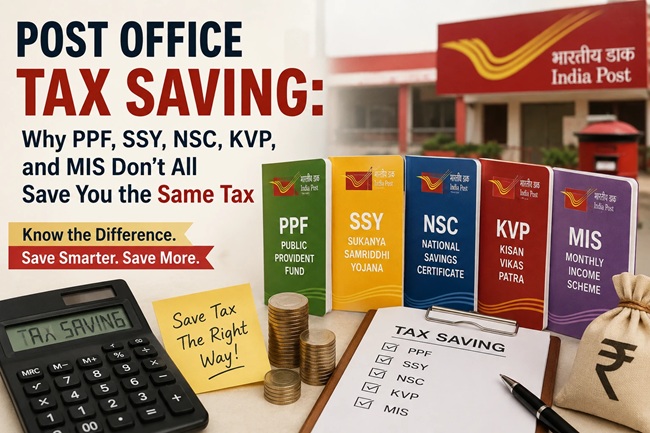
Post Office Tax Saving: Why PPF, SSY, NSC, KVP, and MIS Don’t All Save You the Same Tax

A neighbour of mine, a retired schoolteacher, once proudly told me she’d invested her Diwali bonus in Kisan Vikas Patra because “post office schemes save tax, don’t they?” She wasn’t wrong to trust the post office as a safe place for her money, government-backed instruments genuinely are among the safest options available to Indian savers. But she was wrong about the tax part, and she isn’t alone in that assumption. Ask most people what post office schemes have in common, and “government-backed” and “tax-saving” tend to get mentioned in the same breath, as if every scheme on the counter automatically qualifies for both.
They don’t. Of the six schemes people compare most often, PPF, Sukanya Samriddhi Yojana, NSC, KVP, MIS, and the Time Deposit, only some genuinely reduce your tax bill, and even among those, the actual level of tax efficiency differs quite a bit once you look past the headline interest rate. This piece walks through each one on its own tax merits, not just its return.
Quick answer: PPF and Sukanya Samriddhi Yojana are the most tax-efficient post office schemes, both carrying EEE status, meaning your contribution, the interest you earn, and your final payout are all completely tax-free. NSC and the 5-year Time Deposit give you a Section 80C deduction on the amount invested, but tax the interest, though NSC softens this considerably through a reinvestment-linked deduction for most of its tenure. KVP and MIS, despite often having competitive interest rates, offer no tax deduction whatsoever and tax their entire interest income, making them the weakest performers on tax efficiency specifically, even when their raw returns look reasonably attractive.
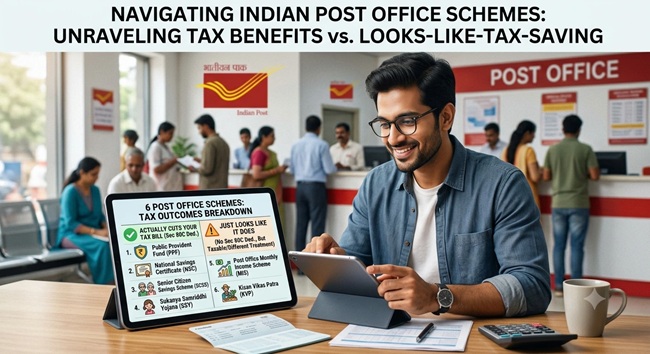
Not Every Post Office Scheme Plays by the Same Tax Rules
It helps to start by separating two things people often merge into one: safety and tax benefit. Every scheme discussed here carries a sovereign guarantee from the Government of India, meaning your principal is about as safe as an investment can get in this country. That part is genuinely consistent across all six. What isn’t consistent at all is how each scheme is treated by the Income Tax Department, both at the time you invest and again when the interest starts accumulating.
Two separate tax questions decide how efficient a scheme actually is. First, does the amount you invest qualify for a deduction under Section 80C, reducing your taxable income for that year? Second, is the interest you earn along the way taxed at your regular income slab rate, or is it exempt? A scheme can answer yes to the first question and no to the second, or vice versa, or in the best cases, get a favourable answer on both. Understanding where each scheme falls on these two questions is really the entire game here.
PPF: Ticks Both Boxes, Completely
The Public Provident Fund answers yes to both questions in the fullest possible way. Your annual contribution, up to ₹1.5 lakh, earns you a Section 80C deduction. The interest that builds up year after year, currently at 7.1%, is entirely tax-free. And when you eventually withdraw at maturity after 15 years, that amount is tax-free too. This three-layer exemption is what tax professionals call EEE status, and PPF sits comfortably at the top of that classification.
The cost of this efficiency is time. Fifteen years is a genuinely long commitment, with only limited partial withdrawals permitted from year seven onward. If your primary goal is minimizing tax while you’re comfortable locking money away for the long haul, PPF does that job about as cleanly as any investment product in India, inside or outside the post office system.
Sukanya Samriddhi Yojana: The Same Tax Treatment, A Better Rate, A Narrower Door
SSY mirrors PPF’s tax treatment exactly, deduction on contribution, tax-free interest, tax-free maturity, and currently pays a meaningfully higher rate at 8.2%. On pure numbers, it’s arguably the strongest tax-saving instrument on this entire list.
The restriction isn’t a tax rule, it’s an eligibility rule. Only a parent or legal guardian of a girl child under 10 can open this account. If you don’t have an eligible daughter, this scheme simply isn’t available to you, no matter how attractive its combination of rate and tax treatment might be. For families who do qualify, though, this is generally the scheme worth prioritizing over PPF for that specific child’s future goals.
National Saving Certificate (NSC): Taxable on Paper, Considerably Less Taxable in Practice
This is where things get genuinely interesting, and where a lot of comparison content oversimplifies. NSC gives you the Section 80C deduction on your invested amount, same as PPF and SSY. But its interest, unlike theirs, is technically taxable, added to your income each year and taxed at your slab rate.
Here’s the part that changes the picture considerably. NSC interest isn’t paid out to you annually, it’s deemed to be automatically reinvested back into the certificate. Because of this reinvestment structure, you’re allowed to claim that reinvested interest as a fresh Section 80C deduction in years one through four of the certificate’s five-year tenure. In effect, the tax on most of your NSC interest gets cancelled out by an equal deduction, year after year, for four of its five years. Only the final year’s interest, since it actually gets paid out at maturity rather than reinvested again, escapes this offsetting deduction and adds to your taxable income in full.
Practically speaking, this makes NSC behave far closer to a tax-free instrument than its “taxable interest” label suggests, right up until that last year. It’s a notch below PPF and SSY’s completely clean treatment, but considerably ahead of where most people assume it sits.
The 5-Year Time Deposit: 80C Benefit, No Reinvestment Cushion
Among the post office’s various Time Deposit tenures, only the 5-year option qualifies for the Section 80C deduction. In that respect, it matches NSC at the entry stage. But it lacks NSC’s deemed-reinvestment mechanism entirely. Each year’s interest is simply taxed as it accrues, at your slab rate, with no offsetting deduction along the way.
The result is a scheme that looks similar to NSC on the surface, both offer 80C deduction, both run five years, both carry comparable interest rates, but delivers a meaningfully less tax-efficient outcome over the full tenure once you account for how differently their interest gets taxed.
KVP: A Doubling Promise With Nothing Behind It on Tax
Kisan Vikas Patra is usually sold on a single, simple pitch: your money doubles in a fixed period, currently around 115 months. It’s an easy number to remember and a genuinely appealing one. What that pitch conveniently leaves out is that KVP offers no Section 80C deduction at all, and every rupee of interest it generates is fully taxable at your slab rate, year after year.
This is exactly the scheme my neighbour chose, and it’s exactly the trap worth avoiding if tax saving is actually your goal. KVP remains a perfectly legitimate, safe place to park money if doubling your investment over a defined horizon is what you’re after. It simply does nothing whatsoever for your tax bill, regardless of how its interest rate compares to the other schemes on this list.
MIS: Built for Monthly Cash Flow, Not for Cutting Tax
The Post Office Monthly Income Scheme exists to solve a different problem entirely, generating a predictable monthly payout, which is precisely why it’s popular among retirees and homemakers who need steady income rather than a lump sum at the end of a tenure. Like KVP, though, it offers zero 80C deduction, and its interest is fully taxable.
If regular monthly income is genuinely what you need, MIS does that job well. If you’re specifically trying to reduce this year’s taxable income, it simply isn’t the right tool, and no amount of comparing its rate to PPF or NSC changes that basic fact.
Ranking All Six Purely on Tax Efficiency
Set aside interest rates for a moment and rank these six purely by how much they actually help your tax situation. SSY and PPF share the top spot, both fully EEE, with SSY only pulling slightly ahead for those who actually qualify, thanks to its higher rate on an otherwise identical tax structure. NSC comes next, genuinely tax-efficient for four of its five years because of the reinvestment deduction, losing ground only in its final year. The 5-year Time Deposit follows behind NSC, offering the initial 80C deduction but none of the ongoing interest-tax relief. KVP and MIS bring up the rear, offering no deduction at all and taxing their entire interest income throughout, regardless of how their headline rates compare to the schemes above them.
Seeing the Gap in Real Numbers
Imagine two people, each investing ₹1.5 lakh for five years, one in NSC, one in KVP, both sitting in the 30% tax bracket. The NSC investor claims the full ₹1.5 lakh as an 80C deduction in year one, and for the next three years, the interest that accrues gets claimed again as a fresh deduction each year, meaning almost none of it touches their taxable income until the fifth and final year. The KVP investor gets no deduction at the outset, and every year’s interest, without exception, gets added straight to their taxable income and taxed at the full 30% rate.
By the time both investments mature, the NSC investor has paid meaningfully less tax on an almost identical amount of money earning a broadly comparable rate, purely because of how differently the two schemes are treated by the tax code, not because one scheme performed better than the other in raw terms.
Matching the Scheme to What You’re Actually Trying to Do
If cutting your taxable income is the primary goal and you’re comfortable with a long horizon, PPF is hard to beat, and SSY beats even PPF if you have an eligible daughter. If you want strong tax efficiency but can’t commit for fifteen years, NSC’s five-year tenure with its reinvestment cushion is the better middle ground. If you’d rather keep things simple and don’t need NSC’s reinvestment mechanics factored in, the 5-year Time Deposit still gives you the 80C deduction, just with a somewhat weaker after-tax outcome than NSC over the same period.
If your actual need is a defined doubling instrument with no particular concern for tax, KVP remains a fine, safe choice on its own terms. And if predictable monthly income matters more to you than either, MIS fits that specific need well. Neither KVP nor MIS should be chosen while expecting a tax benefit that simply isn’t part of how they’re structured.
Where People Usually Go Wrong
The most common misstep, my neighbour’s included, is picking a scheme based on its interest rate alone, without first checking whether it even offers a Section 80C deduction or tax-free interest, and ending up with a less tax-efficient outcome purely because the rate looked appealing on the counter sheet.
A second misstep is treating NSC as tax-equivalent to KVP or MIS simply because all three get labelled “taxable interest,” without understanding that NSC’s reinvestment-linked deduction makes it considerably more efficient than that label alone implies for most of its tenure.
A third misstep is chasing maximum tax efficiency without weighing eligibility and liquidity at all, locking away a large sum in a fifteen-year PPF account, or an SSY account meant for a specific child’s milestone, when a shorter, still reasonably tax-efficient option like NSC would have matched the actual timeline of the goal far better.
My Take
If someone asks me which post office scheme to pick purely for tax saving, and they can genuinely go the distance, PPF, or SSY where it applies, is the answer, and it isn’t particularly close. What I think gets undersold in most comparisons is NSC, it gets filed away as “just another taxable option” right alongside KVP and MIS, when its actual tax behaviour over four of its five years looks a lot closer to PPF than to either of those two. And there’s nothing wrong with choosing KVP or MIS either, as long as you’re choosing them for what they’re genuinely good at, safety and simplicity for KVP, steady income for MIS, rather than expecting a tax break neither one is designed to give you.
Frequently Asked Questions
Which post office scheme offers complete tax exemption? PPF and Sukanya Samriddhi Yojana both carry EEE status, meaning the amount invested, the interest earned, and the final maturity payout are all fully exempt from tax.
Does Kisan Vikas Patra offer any tax benefit? No. KVP does not qualify for a Section 80C deduction, and its interest is fully taxable at your income tax slab rate every year it accrues, despite its popular “money doubles” appeal.
Is interest from NSC really taxable? Yes, technically, but with an important exception. Since NSC interest is deemed to be automatically reinvested, it can be claimed as a fresh Section 80C deduction in years one through four of its five-year term, which offsets most of the tax. Only the interest paid out in the final year is taxed without a matching deduction.
Is the Post Office Monthly Income Scheme tax-free? No. MIS offers no Section 80C deduction, and the interest income it generates is fully taxable at your regular slab rate. It’s designed to provide steady monthly income, not to reduce your tax liability.
Which post office scheme currently offers the highest interest rate? SCSS and SSY both currently lead at 8.2% per annum, though SCSS is available only to those aged 60 and above, and SSY only for a girl child below the age of 10.
Do all Post Office Time Deposits qualify for the Section 80C deduction? No. Among the 1, 2, 3, and 5-year Time Deposit options, only the 5-year Time Deposit qualifies for the Section 80C deduction.
Is PPF or NSC better for saving tax? PPF is generally more tax-efficient overall, since its interest remains fully tax-free throughout its tenure, while NSC’s final year of interest is taxed without an offsetting deduction. However, PPF requires a much longer 15-year commitment compared to NSC’s 5 years, so the right choice also depends on how long you can stay invested.
Who can open a Sukanya Samriddhi Yojana account? Only a parent or legal guardian of a girl child under the age of 10 is eligible to open an SSY account, which makes it unavailable to anyone without a qualifying daughter, regardless of its favourable tax treatment.
If a scheme has a high interest rate, does that mean it also saves tax? Not necessarily. KVP and MIS both carry reasonably competitive interest rates but offer no tax deduction and tax their full interest income, showing that a high headline rate says nothing on its own about a scheme’s actual tax efficiency.
Can I claim Section 80C benefits on multiple post office schemes in the same year? Yes, but the total deduction across all Section 80C-eligible investments combined, including PPF, SSY, NSC, the 5-year Time Deposit, and any other 80C instruments like life insurance premiums, is capped at ₹1.5 lakh per year overall, not per individual scheme.
Disclaimer: This article is for general informational and educational purposes only and does not constitute investment or tax advice. Interest rates for post office schemes are reviewed quarterly by the Ministry of Finance and are subject to change. Please verify current rates on India Post’s official website and consult a qualified financial advisor before making investment decisions.

Shuchi founded Finance Checks after spending 16+ years working in corporate, managing operations and distribution. She managed her own finances, learned and read regularly and helped people make sense of their savings, loans, insurance, and investments.
She started this site to offer the kind of clear, honest financial guidance she wished was more available when she was learning to manage her own money. Every article is researched personally, checked against official sources such as the Reserve Bank of India, SEBI, or the Income Tax Department, and revisited whenever regulations or figures change. She is upfront about how the site earns money through ads and select affiliate partnerships, and she does not let either influence what she actually recommends to readers.