
Salaried and Running a Side Business? Here’s Exactly How to Report Both in Your ITR

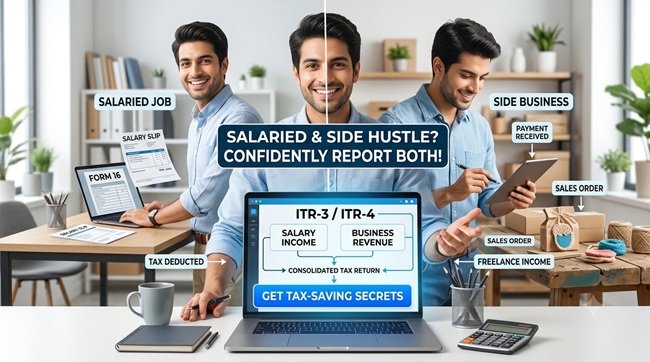
Nikhil has a stable 9-to-5 as a software engineer, and for the last two years, he’s also been building a small side business reselling curated home decor products on Instagram, doing everything from sourcing to packing orders himself on weekends. His salary gets taxed neatly through TDS every month, Form 16 handles most of the paperwork, and he never gave his taxes a second thought. His side business, though, is a different story. He’s never quite known which ITR form covers both incomes together, whether he needs to maintain formal books for a business that started as a weekend hobby, or whether the ₹40,000 he made last quarter needs to be reported any differently from his salary at all.
Nikhil’s situation describes a genuinely large and growing number of salaried Indians today, freelancers moonlighting outside office hours, people running small e-commerce or reselling operations, content creators earning brand income alongside a day job, tuition teachers, consultants taking on projects after work. If any of this sounds like you, here’s exactly how the reporting works.
Quick answer: If you’re salaried and also earn income from a side business or profession, you generally cannot use the simple ITR-1 form anymore. Depending on your side income’s nature and size, you’ll typically file either ITR-4, if you opt for presumptive taxation under Sections 44AD or 44ADA and your total income stays within ₹50 lakh, or ITR-3, if your side income doesn’t qualify for or you don’t wish to use the presumptive scheme. Both your salary and business income get reported within the same return, and separately from your salary’s TDS, you may also need to pay advance tax on your side income directly through the year.
About This Guide: Written by the Finance Checks Editorial Team, Personal Finance Researchers. This article reflects ITR filing provisions applicable for AY 2026-27, including presumptive taxation thresholds under Sections 44AD and 44ADA and current ITR form eligibility rules. Last updated: August 2026.
Why ITR-1 No Longer Works Once You Have a Side Business
Most salaried employees are used to filing ITR-1, the simplest form, designed specifically for salary income, one house property, and limited other income like bank interest. The moment you start earning from a side business or profession, even a modest one, ITR-1 stops being the right form for you. This isn’t a minor technicality, filing the wrong ITR form is one of the most common reasons returns get flagged, rejected, or trigger a defective return notice from the department, precisely because the form itself doesn’t have the schedules needed to capture business income at all.
So the real question for someone like Nikhil isn’t whether to keep using ITR-1, it’s choosing correctly between the two forms that actually accommodate combined salary and business income.
Understanding Presumptive Taxation First
Before deciding which form applies to you, it helps to understand a scheme that shapes this entire decision: presumptive taxation. Under Sections 44AD and 44ADA of the Income Tax Act, small business owners and professionals are allowed to declare their income at a fixed, “presumed” percentage of their total turnover or receipts, instead of calculating actual profit by maintaining detailed books of accounts and getting them audited.
Section 44AD applies to small businesses, think trading, reselling, small manufacturing, or similar ventures, with turnover up to ₹2 crore, extended to ₹3 crore if at least 95% of your receipts come through digital, traceable modes rather than cash. Under this scheme, your taxable income is presumed to be 8% of your turnover, or a lower 6% specifically for the portion of turnover received digitally, whichever combination applies to your actual receipt pattern.
Section 44ADA applies specifically to professionals, consultants, doctors, lawyers, designers, architects, and similar specified professions, where 50% of your gross receipts gets treated as your taxable income, again without needing to maintain detailed books or undergo an audit, as long as your gross receipts stay within the prescribed limit for this scheme.
The appeal here is obvious: considerably less compliance burden, no requirement to track every expense meticulously, and no mandatory audit as long as you stay within the scheme’s limits. The trade-off is that you’re taxed on this presumed income regardless of your actual profit margin, so if your real expenses are unusually high relative to your turnover, this scheme could work against you compared to declaring your genuine, lower profit.
Which ITR Form You’ll Actually Use
ITR-4 (Sugam) is the form built for exactly this combination, salary income together with presumptive business or professional income under Sections 44AD, 44ADA, or 44AE. You’re eligible for ITR-4 if your total income across all sources stays within ₹50 lakh for the year, you’ve opted for the presumptive scheme for your side income, and your other income is limited to salary or pension, one house property, agricultural income up to ₹5,000, and limited other sources, along with long-term capital gains under Section 112A not exceeding ₹1.25 lakh if applicable. For most salaried individuals with a genuinely small side business or freelance income, this is the form that applies, and it’s considerably simpler to file than the alternative.
ITR-3 becomes necessary if your side business or professional income doesn’t qualify for the presumptive scheme, if you choose not to opt for presumptive taxation even though you’re eligible, if you maintain regular books of accounts and want to declare your actual profit rather than a presumed figure, or if your total income or business turnover exceeds the limits that would keep you eligible for ITR-4. ITR-3 requires considerably more detailed reporting, including a full profit and loss statement and balance sheet for your business or professional activity, and is the correct form for anyone running a more substantial or complex side venture alongside their salary.
A Worked Example
Take Nikhil’s situation directly. His annual salary is ₹14 lakh, fully reflected in his Form 16 with TDS already deducted by his employer. His reselling business had a turnover of ₹9 lakh for the year, with roughly 97% of his sales coming through UPI and card payments rather than cash.
Since his turnover falls well within the ₹3 crore digital-receipts threshold under Section 44AD, and his overwhelming majority of receipts are digital, he can opt for presumptive taxation and declare 6% of his turnover as taxable business income, which comes to ₹54,000. His total income for the year becomes ₹14 lakh (salary) plus ₹54,000 (presumed business income), a combined figure comfortably within the ₹50 lakh ceiling for ITR-4, which is exactly the form he should be filing.
If Nikhil’s actual profit margin were considerably lower than 6%, say his real profit after costs was closer to 3% of turnover, he could still choose to opt out of the presumptive scheme and file ITR-3 instead, declaring his genuine, lower profit backed by actual books and records, which would result in a lower taxable business income than the presumed 6% figure.
The Five-Year Commitment Trap With Presumptive Taxation
This is a detail that catches people off guard, and it’s genuinely important if you’re considering the presumptive route under Section 44AD specifically. Once you opt into presumptive taxation under this section, you’re expected to continue declaring income under the same scheme for at least five consecutive assessment years. If you switch away from presumptive taxation to declaring actual profits before completing those five years, you lose eligibility to use the presumptive scheme again for the next five assessment years following that switch, and in that scenario, you’d also be required to maintain full books of accounts and, depending on your income level, potentially get them audited.
This makes the initial decision to opt in worth thinking through carefully rather than treating it as a year-by-year toggle, since switching back and forth isn’t really available as a flexible option the way it might seem at first glance.
Advance Tax: The Part Salaried Employees Often Miss Entirely
Here’s the piece of this puzzle that trips up salaried employees more than almost anything else, because it works completely differently from how their salary tax has always been handled. Your employer deducts TDS from your salary every month, which means your salary-related tax obligation is largely settled through the year automatically. Your side business income has no such automatic deduction happening on your behalf.
If your total tax liability for the year, after accounting for any TDS already deducted, exceeds ₹10,000, you’re required to pay advance tax on your own, in instalments through the financial year, rather than waiting to settle everything at the time of filing your return. Missing these instalments, or underpaying them, attracts interest charges under Sections 234B and 234C, calculated on the shortfall. For someone like Nikhil, whose side business income is modest but genuine, this is a step that’s easy to overlook entirely since nothing about his salaried experience has ever required him to think about instalment-based tax payments before.
A Related Compliance Layer Worth Knowing: GST
This sits outside income tax specifically, but it’s closely related enough to flag here, since side business owners frequently overlook it entirely. If your side business’s turnover crosses ₹40 lakh annually for goods, or ₹20 lakh for services, you may be required to register for GST, regardless of how the same turnover gets treated for income tax purposes under the presumptive scheme. GST registration and income tax filing are separate compliance obligations that both get triggered by your business activity, so crossing one threshold doesn’t automatically mean the other doesn’t apply.
Choosing Between the Old and New Tax Regime With Business Income
If you want to opt for the old tax regime specifically because of deductions or exemptions relevant to your situation, and you have business or professional income being reported, you’re required to file Form 10-IEA before your ITR’s due date to formally opt for the old regime. This is a separate, additional step that doesn’t apply to salaried individuals filing purely on salary income, where the regime choice can simply be indicated within the ITR form itself, so it’s worth building this into your filing checklist if business income is part of your return.
Documents You’ll Need
Beyond your usual Form 16, you’ll need a clear record of your side business’s total turnover or gross receipts for the year, ideally with a split showing how much came through digital modes versus cash, since this directly affects your presumptive tax rate under Section 44AD. If you’re opting out of presumptive taxation and filing ITR-3 with actual profit figures, you’ll additionally need proper books of accounts, expense records, and receipts supporting your declared profit, since these become the basis for your reported income rather than a simple turnover percentage.
Common Mistakes People Make With This Filing
The most frequent mistake is continuing to file ITR-1 out of habit even after starting a side business, simply because that’s the form used in previous years, which almost guarantees a defective return notice once the department’s systems detect income sources ITR-1 isn’t designed to capture.
Another common mistake is not tracking the digital versus cash split of business receipts carefully, which directly affects whether the 8% or 6% presumptive rate applies under Section 44AD, sometimes resulting in an unnecessarily higher declared income simply due to poor record-keeping around payment modes.
A third mistake, and one of the costliest, is ignoring advance tax obligations entirely because salaried tax deduction has always happened automatically, leading to interest charges that could have been easily avoided by estimating and paying quarterly instalments on the side income.
A fourth mistake is opting into the five-year presumptive commitment under Section 44AD without fully understanding the lock-in, then wanting to switch to actual profit reporting a year or two later during a leaner year, only to discover that switching early forfeits presumptive eligibility for the next five years altogether.
My Take
If your side business is genuinely small, has healthy margins, and most of your money moves digitally, the presumptive scheme under 44AD or 44ADA is usually the more sensible, lower-hassle choice, and ITR-4 will serve you well. Where I’d urge more caution is treating this decision casually. Understand the five-year commitment before opting in, and build advance tax into your calendar the moment your side income becomes meaningful, rather than discovering both of these details for the first time when a notice or an interest charge shows up. A side business succeeding is genuinely exciting, don’t let the tax side of it become an afterthought that costs you more than it should.
Frequently Asked Questions
Can a salaried employee file ITR-1 if they also have a side business? No. Once you have business or professional income, ITR-1 is no longer the correct form, regardless of how small that side income is. You’ll typically need to file either ITR-4 or ITR-3, depending on whether you opt for presumptive taxation and whether your income falls within the relevant limits.
Which ITR form should I use for salary plus freelance or side business income? If you opt for presumptive taxation under Section 44AD or 44ADA and your total income stays within ₹50 lakh, ITR-4 is generally the correct form. If your side income doesn’t qualify for presumptive taxation, or you choose to declare actual profits with full books of accounts, ITR-3 is the appropriate form instead.
What is presumptive taxation under Section 44AD? It’s a simplified taxation scheme for small businesses with turnover up to ₹2 crore (or ₹3 crore if at least 95% of receipts are digital), where taxable income is presumed to be 8% of turnover, or 6% for the portion received digitally, without requiring detailed books of accounts or an audit.
Do I need to pay advance tax on my side business income if I’m salaried? Yes, if your total tax liability after accounting for salary TDS exceeds ₹10,000 for the year. Since your employer’s TDS only covers your salary, side business income typically requires separate advance tax payments through the year to avoid interest charges under Sections 234B and 234C.
What happens if I stop using the presumptive taxation scheme before five years? If you switch from presumptive taxation under Section 44AD to declaring actual profits before completing five consecutive assessment years under the scheme, you become ineligible to use presumptive taxation again for the following five assessment years, and would need to maintain full books of accounts, potentially with an audit requirement, during that period.
Do I need to register for GST for my side business? It depends on your turnover, separately from your income tax obligations. GST registration is generally required once turnover crosses ₹40 lakh for goods or ₹20 lakh for services, regardless of how that same turnover is taxed for income tax purposes under the presumptive scheme.
Can I claim old tax regime benefits if I have both salary and business income? Yes, but you’ll need to file Form 10-IEA before your ITR’s due date to formally opt for the old tax regime when business or professional income is involved, which is an additional step not required for salaried individuals filing on salary income alone.
Is Section 44ADA the same as Section 44AD? No. Section 44AD applies to small businesses, presuming 8% (or 6% for digital receipts) of turnover as taxable income. Section 44ADA applies specifically to specified professionals like consultants, doctors, and designers, presuming 50% of gross receipts as taxable income, and has its own separate eligibility limits.
What documents do I need to report side business income in my ITR? Beyond your Form 16 for salary, you’ll need your business’s total turnover or gross receipts for the year, ideally split between digital and cash receipts if opting for presumptive taxation, or full books of accounts and expense records if declaring actual profits under ITR-3.
Will filing ITR-4 or ITR-3 for side income increase my chances of a tax notice? Not inherently, as long as your reported income is accurate and consistent with your AIS and Form 26AS. The far more common trigger for a notice is filing the wrong form altogether, such as continuing to use ITR-1 despite having business income, rather than the mere presence of side income itself.
Disclaimer: This article is for general informational and educational purposes only and does not constitute tax or legal advice. Eligibility for presumptive taxation, applicable ITR forms, and advance tax requirements depend on individual circumstances and are subject to change. Please consult a qualified chartered accountant or tax professional before filing your income tax return.

Shuchi founded Finance Checks after spending 16+ years working in corporate, managing operations and distribution. She managed her own finances, learned and read regularly and helped people make sense of their savings, loans, insurance, and investments.
She started this site to offer the kind of clear, honest financial guidance she wished was more available when she was learning to manage her own money. Every article is researched personally, checked against official sources such as the Reserve Bank of India, SEBI, or the Income Tax Department, and revisited whenever regulations or figures change. She is upfront about how the site earns money through ads and select affiliate partnerships, and she does not let either influence what she actually recommends to readers.