
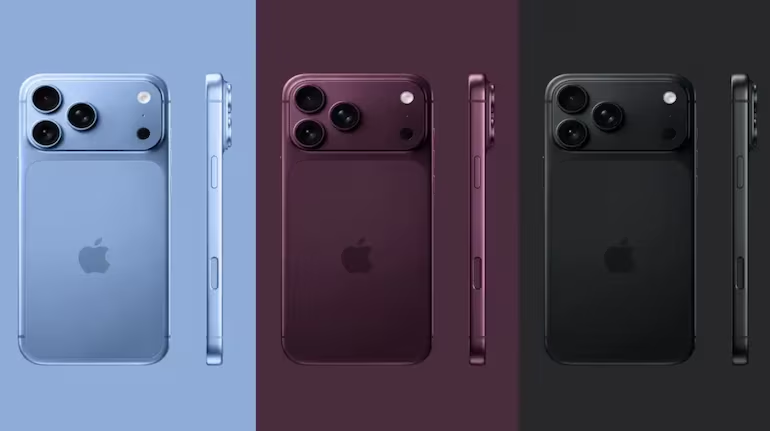

Aditi has upgraded her iPhone every single cycle for the last three years, always on a “no-cost EMI” through her credit card, always trading in the previous phone, and always telling herself it “basically pays for itself.” This week, the moment Apple confirmed its September 9 event, she started mentally budgeting for the iPhone 18 Pro Max before a single official price had even been announced. When a colleague asked her what the actual total cost of her last three iPhones had been, EMI interest, exchange value lost, and all, she genuinely didn’t know. She had never once sat down and added it up.
If you’re someone who upgrades your phone on a predictable cycle, or if the iPhone 18 Pro Max buzz has you eyeing an upgrade this September, this is worth five minutes before you tap “buy,” because the real cost of a premium phone purchase is almost never just the sticker price.
Quick Answer
Apple has confirmed a launch event for September 9, 2026, widely expected to unveil the iPhone 18 series, though as of this writing, Apple has not officially confirmed India pricing, specifications, or exact availability dates for the iPhone 18 Pro Max. Multiple industry reports and leaks estimate a starting India price somewhere between ₹1,59,900 and ₹1,69,990 depending on storage variant, with pre-orders potentially opening around September 12 and sales starting around September 18 or 19, based on Apple’s usual India launch pattern. Before committing to any premium smartphone purchase at this price point, the numbers worth actually running are the true cost of a “no-cost EMI” offer, what your current phone’s exchange value really is versus selling it independently, and what that same money could be worth if invested instead of spent on an annual upgrade cycle.
About This Guide
This guide is based on publicly reported leaks and industry estimates about the iPhone 18 Pro Max as of August 29, 2026, cross-checked across multiple technology outlets, alongside general EMI and credit terms as commonly offered by Indian banks and retailers. FinanceChecks.com is not affiliated with Apple, and none of the specifications, pricing, or launch details in this article are officially confirmed by Apple; they should be treated as expectations until the company’s own announcement on September 9. This article focuses specifically on the financial decision-making around a premium smartphone purchase, not on providing a product review or specification comparison.
What’s Actually Been Confirmed So Far
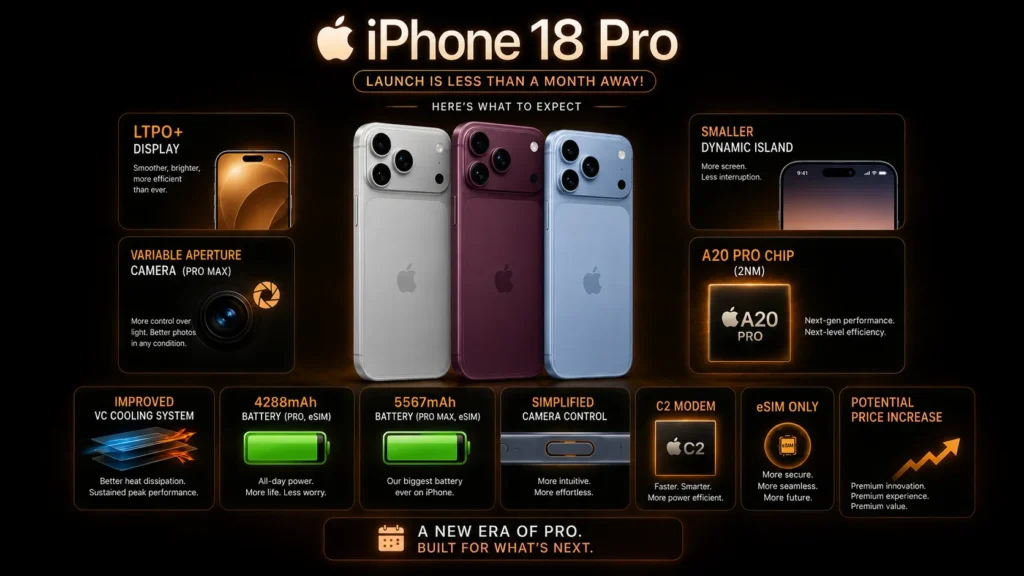
Apple has officially confirmed only one thing: a launch event scheduled for September 9, 2026. Everything else, the iPhone 18 Pro Max’s price, its exact specifications, its India availability date, comes from leaks and analyst estimates rather than Apple itself. Reports point to features like an A20 Pro chip built on a more advanced manufacturing process, a roughly 6.9-inch display, an upgraded camera system, and a larger battery, but none of this is verified. On pricing specifically, estimates for the India launch price range fairly widely, from around ₹1,59,900 to ₹1,69,990 for entry variants, depending on the source and the storage configuration assumed. Given that the previous generation, the iPhone 17 Pro Max, launched with a starting India price in a similar range, it’s reasonable to expect the 18 Pro Max to land somewhere in that neighbourhood or slightly higher, but treat every number in circulation right now as a leak, not a fact, until Apple’s own event.
The “No-Cost EMI” That Isn’t Actually Free
This is the single most important thing to understand before financing a phone this expensive. “No-cost EMI” offers, commonly advertised by retailers and banks during a major phone launch, work by having the retailer discount the product’s listed price by an amount roughly equal to what the interest would have cost, and then charging you that interest-free EMI on the discounted price. In practice, this often means you are paying close to what the interest would have cost anyway, just restructured so it doesn’t appear as a separate interest line item, and it is baked into the price you’re quoted rather than being genuinely free financing.
The more important number to check is the processing fee, which many no-cost EMI offers still charge upfront and which is non-refundable even if you pay off the EMI early. On a ₹1.6 lakh purchase, a processing fee of even 1 to 2 percent adds ₹1,600 to ₹3,200 to your real cost, on top of a phone price that may already have limited room for further negotiation given how tightly Apple controls its retail pricing.
Before you commit to any EMI offer on launch day, ask the retailer or your bank directly for the full cash price without any EMI conversion, and compare it against the EMI total including any processing fee. If the numbers don’t match closely, you’ve found where the “no-cost” claim is quietly not true.
What Your Old Phone Is Actually Worth
Exchange offers during a major launch window are designed to feel generous, but they are almost never the best price you could get for your current phone. Retailers offering exchange bonuses build the cost of that bonus into their overall margin, and the “exchange value” quoted often assumes your phone is in near-perfect condition, a standard that gets reassessed, and typically reduced, once the device is physically inspected at the store.
It is worth spending fifteen minutes checking what your current phone would sell for independently, through a reputable resale platform or a local buyer, before accepting an in-store exchange offer. In many cases, particularly for well-maintained recent-generation iPhones, an independent sale nets a meaningfully higher amount than the in-store exchange bonus, even after accounting for the convenience the exchange offer provides.
The Opportunity Cost Nobody Talks About At Launch
Here is the calculation that upgrade cycles like Aditi’s tend to skip entirely. If a ₹1.6 lakh phone purchase is financed through savings rather than EMI, that same ₹1.6 lakh, had it instead gone into a mutual fund SIP or even a fixed deposit, would have been earning returns over the year you’d otherwise have spent waiting to upgrade again. At a conservative 8 percent annual return, ₹1.6 lakh left invested for just one additional year is worth roughly ₹12,800 more than if it had been spent immediately. That is not a reason to never buy a premium phone, but it is a real number worth having in your head as you decide between buying now, waiting for post-launch price stabilisation, or stretching your current phone’s upgrade cycle by even six months.
This calculation matters more, not less, if you are someone who upgrades every single cycle. The compounding effect of consistently spending on the newest device rather than letting that money sit invested, even partially, adds up substantially over a five or six-year horizon, in a way that rarely feels significant in any single year’s decision.
A Practical Framework Before You Buy
Decide your actual budget independent of the EMI offer being advertised, based on what you could pay in cash today, not based on what monthly instalment feels comfortable, since EMI framing is specifically designed to make a large purchase feel smaller than it is.
Get an independent resale quote for your current phone before accepting any in-store exchange offer, so you have a real number to compare against rather than accepting the first offer presented.
Ask explicitly for the full cash price versus the EMI total, including any processing fee, rather than assuming “no-cost” means genuinely free.
If you’re using a credit card for the EMI, check whether it affects your available credit limit for the full loan amount immediately, since most cards block your entire credit limit against an EMI conversion even though you’re paying it off gradually, which can affect your ability to make other purchases on the same card during that period.
Consider whether waiting even four to six weeks past the launch date makes sense, since initial launch pricing and stock constraints sometimes ease slightly once the first wave of demand is met, particularly for base storage variants.
My Take
I don’t think the right takeaway here is that buying a premium phone is a bad financial decision, since for many people it’s a considered, deliberate purchase that genuinely fits their budget and priorities. What I’d push back on is the framing that launch-season retailers and banks lean on heavily, no-cost EMI, generous exchange bonuses, limited-time launch offers, all of which are specifically designed to make a large purchase decision feel smaller and more urgent than it actually is. The actual math, run properly, usually isn’t dramatically different from what the marketing suggests, but running it yourself, rather than accepting the framing you’re handed at the counter, is what turns a big-ticket purchase from an impulsive upgrade into a genuinely informed decision.
Frequently Asked Questions
1. Has Apple confirmed the iPhone 18 Pro Max price in India? No. As of this writing, Apple has only confirmed a September 9, 2026 launch event. All pricing figures currently in circulation, including estimates between ₹1,59,900 and ₹1,69,990, are based on leaks and industry analysis, not official Apple pricing.
2. Is “no-cost EMI” actually interest-free? Not entirely. Retailers typically discount the listed price by an amount roughly equal to the interest that would otherwise be charged, meaning the cost is often built into the price you’re quoted rather than being genuinely free. Processing fees, where applicable, are also usually non-refundable regardless of how quickly you repay.
3. Is an in-store exchange offer usually the best deal for my old phone? Not always. Independent resale platforms or private buyers sometimes offer meaningfully more for a well-maintained phone than an in-store exchange bonus, which is often designed to look generous while being built into the retailer’s overall margin.
4. Does converting a purchase to EMI on my credit card affect my available credit limit? Yes, typically. Most banks block your entire credit limit against the full EMI amount at the time of conversion, even though you’re repaying gradually, which can reduce what’s available for other spending on that card during the EMI tenure.
5. Should I wait to buy the iPhone 18 Pro Max after launch instead of buying immediately? It can be worth considering. Initial launch-week pricing, stock availability, and exchange offers sometimes shift slightly once the first wave of demand eases, particularly for base storage variants, though this isn’t guaranteed and depends on demand each cycle.
6. What’s the real opportunity cost of spending ₹1.6 lakh on a phone versus investing it? At a conservative 8 percent annual return, ₹1.6 lakh left invested for one additional year would be worth roughly ₹12,800 more than if spent immediately. This isn’t a reason to avoid the purchase, but it’s worth factoring into the decision, especially for frequent upgraders.
7. What specifications are expected on the iPhone 18 Pro Max? Leaks suggest a roughly 6.9-inch display, a new A20 Pro chip, an upgraded camera system, and a larger battery, though none of these details are officially confirmed by Apple as of this writing.
8. When might pre-orders and sales start in India? Based on Apple’s typical launch pattern and current reports, pre-orders could open around September 12, 2026, with sales beginning around September 18 or 19, though these dates are estimates pending Apple’s official announcement.
9. What should I check before accepting a bank’s EMI offer at the point of sale? Ask for the full cash price without EMI conversion, check for any processing fee and whether it’s refundable, and compare the total EMI cost against that cash price to see whether “no-cost” genuinely holds up.
10. Is it worth upgrading my phone every single year? That depends entirely on your personal budget and priorities, but it’s worth being aware that consistent annual upgrading, compared to stretching the same phone across two or more cycles, has a real, compounding opportunity cost over a five to six-year horizon that’s easy to underestimate when looking at any single year’s decision in isolation.
Disclaimer
This article is intended for general informational and educational purposes only and does not constitute financial or investment advice. FinanceChecks.com is not affiliated with Apple Inc., and all specifications, pricing, and launch date details regarding the iPhone 18 Pro Max mentioned here are based on unofficial leaks and industry estimates as of August 29, 2026, subject to change upon Apple’s official announcement. EMI terms, processing fees, and exchange offer values vary by bank, retailer, and individual circumstances; please verify current terms directly with your bank or retailer before making a purchase decision. Investment return figures used for illustrative comparison are hypothetical and not guaranteed.

Shuchi founded Finance Checks after spending 16+ years working in corporate, managing operations and distribution. She managed her own finances, learned and read regularly and helped people make sense of their savings, loans, insurance, and investments.
She started this site to offer the kind of clear, honest financial guidance she wished was more available when she was learning to manage her own money. Every article is researched personally, checked against official sources such as the Reserve Bank of India, SEBI, or the Income Tax Department, and revisited whenever regulations or figures change. She is upfront about how the site earns money through ads and select affiliate partnerships, and she does not let either influence what she actually recommends to readers.