

Markets Fall on Fresh US-Iran Escalation: Should You Invest, Wait, or Hold? The Right Strategy for Every Investor

Ritika opened her trading app on Wednesday morning to place a lump sum order she had been planning for weeks, ₹2 lakh she had saved specifically to deploy into equity mutual funds once she found “the right time.” Instead, she found red across every index, a news alert about fresh US-Iran military strikes, and crude oil climbing past $90 a barrel again. Her thumb hovered over the buy button for a full minute. Then she closed the app entirely, telling herself she would “wait for things to settle down,” the same sentence she had told herself during the March 2026 Strait of Hormuz scare, and the one before that. Six months later, looking back, she still hadn’t found a day that felt calm enough.
Ritika’s hesitation is one of the most common, and most costly, patterns in investing, and today’s fresh escalation between the US and Iran is a genuinely good moment to examine it honestly, because the market’s reaction to this exact kind of headline has now played out in India multiple times within a single calendar year.
Quick Answer
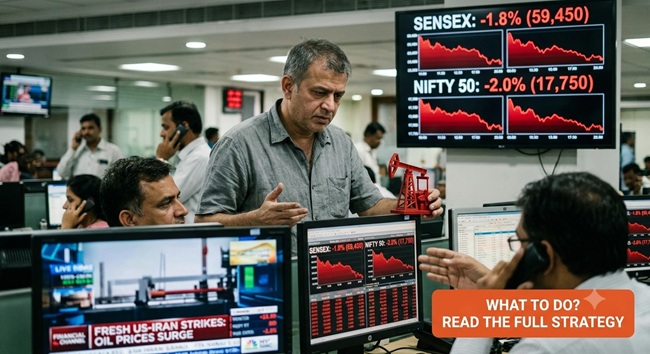
Indian benchmark indices opened sharply lower on September 2, 2026, after a fresh exchange of military strikes between the US and Iran pushed crude oil prices higher and triggered a broad, global risk-off move. As of this writing, during the trading session, the Sensex had fallen as much as 809 points intraday to a low near 76,135, while the Nifty 50 slipped as much as 269 points to around 23,786, with all major sectoral indices trading in the red. This is a developing, live market situation, and readers should check the day’s official closing figures separately, since intraday moves can partially or fully reverse by market close. For most retail investors with a long-term time horizon, the right response to a geopolitically-driven selloff like this one is not to pause SIPs, panic-sell, or try to time a “safer” entry point later, since history through 2026 alone has already shown that these Iran-related selloffs have consistently been followed by stabilization and often sharp recoveries within days to weeks. The right strategy genuinely differs by investor type, and this article breaks down exactly how, for SIP investors, lump sum investors, existing equity holders, and short-term traders.
About This Guide
This guide is based on live market reporting on the September 2, 2026 trading session, cross-referenced against multiple financial news sources, along with a review of how Indian markets responded to at least four separate US-Iran or Israel-Iran escalation episodes earlier in 2026 and in prior years. FinanceChecks.com is not a SEBI-registered investment advisor, and this article does not constitute investment advice or a recommendation regarding any specific stock, fund, or transaction. Given that this is a live, developing situation, figures in this article reflect the information available at the time of writing and may change as the trading day and the underlying geopolitical situation evolve.
What’s Actually Happening Today
Indian equity benchmarks opened sharply lower on Wednesday, September 2, 2026, after the US carried out fresh strikes against Iran, which Iran answered with a retaliatory strike of its own, reviving fears of a broader supply disruption in the Strait of Hormuz, the narrow waterway through which a large share of the world’s crude oil shipments pass. The Sensex opened 472.96 points, or 0.61 percent, lower at 76,471.32, while the Nifty 50 started 197.80 points, or 0.82 percent, down at 23,858. Selling pressure intensified through the morning session, with the Sensex falling as much as 809 points intraday to a low of 76,135 and the Nifty dropping as much as 269 points to 23,786, slipping below the closely watched 23,800 support level. Market breadth was weak, with more than 2,100 stocks declining against roughly 800 gainers at one point in the session, and midcap and smallcap indices were also down around 1 percent. All major sectoral indices were trading lower, according to Reuters data cited in market reports.
Crude oil is the central transmission mechanism behind this selloff. Brent and WTI crude prices climbed on the fresh exchange of strikes, with some reports placing crude above $95 a barrel intraday, reviving the same inflation, import-cost, and rupee-pressure concerns that have accompanied every prior escalation this year. Global bond yields have also risen alongside the equity selloff, adding a second layer of pressure on emerging market assets like Indian equities. It’s worth noting, as one silver lining in an otherwise difficult session, that the rupee had shown some resilience heading into today, closing at a two-month high of approximately ₹94.95 against the dollar on September 1, aided by RBI intervention and dollar inflows, and India’s own economic backdrop remains genuinely strong, with GDP growth for the April-June quarter coming in at 7.8 percent, comfortably beating the RBI’s own 7 percent projection, a data point that continues to reinforce the underlying strength of domestic demand even as global headlines create short-term turbulence.
This Isn’t India’s First US-Iran Selloff of 2026, and That History Is Genuinely Useful
What makes today’s situation particularly instructive is that this is not a one-off event; it is at least the fourth or fifth distinct instance in 2026 alone of Indian markets reacting to escalating US-Iran tensions, and each prior instance has left a track record worth examining honestly rather than assuming this time is fundamentally different.
In late March 2026, following a 48-hour ultimatum from the US over the Strait of Hormuz, the Sensex fell sharply to a near two-year low around 72,696, a decline of roughly 2.5 percent in a single session, with sectors like consumer durables, realty, and oil and gas falling between 3 and 6 percent. Barely two weeks later, in early April 2026, following a US-Iran ceasefire announcement, the Sensex rallied sharply, up as much as 3.6 percent in early trade to reclaim 77,296, with financials, technology, and consumer durables leading the recovery. In late August, ahead of today’s fresh escalation, the Sensex had already absorbed a more modest 307-point, 0.40 percent decline on August 31 amid fading hopes of a diplomatic breakthrough, a decline that market commentators at the time noted was relatively well-contained, with buyers repeatedly stepping in around the 24,000 Nifty support level despite the uncertainty.
This pattern, sharp fall on escalation, followed by stabilisation or a sharp recovery once tensions ease or markets simply absorb the new information, has repeated itself often enough within 2026 that it’s reasonable to treat it as the base case, not the exception, for how this specific type of geopolitical shock tends to resolve in Indian markets. This is not a guarantee that today’s episode resolves the same way, since every escalation carries genuine, real uncertainty about how far it goes, but it is a meaningful data point against the instinct to assume that today’s fall marks the start of a sustained, deep downturn.
What You Should Actually Do, By Investor Type
- If you invest through a SIP, continue it without changes. This is worth stating plainly because it is the single most common mistake investors make during exactly this kind of session. A SIP is mathematically designed to buy more units when prices are lower, which means a day like today, uncomfortable as it feels, is the mechanism working as intended, not a signal to intervene. Pausing a SIP during a dip does not protect you from volatility; it simply removes you from the one moment the strategy is specifically built to take advantage of.
- If you’re sitting on lump sum money waiting to invest, like Ritika, consider a staggered approach rather than waiting for an all-clear signal that may never arrive. The honest truth is that nobody, including professional fund managers, can reliably identify the exact bottom of a geopolitically-driven dip in advance. Rather than trying to time a single “right moment,” which the March-to-April 2026 episode shows can reverse within just two weeks, splitting a lump sum into three or four tranches deployed over the coming weeks captures some of the benefit of buying at lower prices without requiring you to correctly predict the market’s exact turning point.
- If you already hold equity investments for a long-term goal, resist the urge to check your portfolio repeatedly through a volatile session. There is reasonably good behavioural finance research suggesting that investors who check their portfolios less frequently during volatile periods make fewer reactive, poorly-timed decisions, simply because they have fewer opportunities to act on short-term noise that has little bearing on their multi-year financial goals.
- If you hold stocks in oil-sensitive sectors specifically, this is worth a genuine look, not just sentiment-driven concern. Sectors like aviation, paints, chemicals, tyres, and logistics face real, fundamental cost pressure when crude oil prices rise meaningfully and stay elevated, and it’s worth reviewing your specific holdings in these sectors on their own merits rather than reacting to the broad index movement alone. Conversely, upstream oil and gas producers can sometimes see relative benefit from higher crude realisations, which is worth understanding if your portfolio includes exposure on that side too.
- If you’re a short-term trader rather than a long-term investor, this article isn’t really speaking to your situation, and that’s worth being honest about. Trading around geopolitical volatility requires a different skill set, risk tolerance, and time commitment than long-term investing, and the “stay the course” guidance above is specifically calibrated for investors with a multi-year horizon, not for anyone trying to actively trade the day’s swings.
Why Panic-Selling Is Usually the More Expensive Mistake
The mathematics here are worth spelling out plainly. Selling equity holdings during a sharp intraday fall locks in that day’s temporary paper loss and converts it into a permanent, realised one. If the market then recovers, the way it did within roughly two weeks between the late-March low and the early-April rally this year, an investor who sold during the fall has to make two correct decisions in sequence to come out ahead: correctly timing the exit, and then correctly timing the re-entry before the recovery happens. Making one of these calls correctly is difficult even for professionals; making both correctly, in sequence, consistently, is rare enough that it isn’t a reasonable strategy to build a financial plan around.
This is precisely why the standard, research-backed guidance for long-term investors during a geopolitically-driven selloff is to change nothing, rather than to make a confident, active decision in either direction. Staying invested through a volatile session is itself a decision, and for most long-term goals, it also happens to be the one best supported by how these specific episodes have actually played out in India this year.
What Would Actually Change This Analysis
It’s worth being fair about the genuine uncertainty here rather than presenting today’s outcome as predetermined. If the current US-Iran exchange of strikes escalates meaningfully further, particularly if it results in a sustained disruption to shipping through the Strait of Hormuz, crude oil prices could remain elevated for a longer period than in prior 2026 episodes, which would represent a more serious and lasting economic headwind for India specifically, given how heavily the country relies on imported crude. A sustained crude price well above $100 a barrel, rather than a spike that eases within days, would meaningfully change the inflation and interest rate calculus in a way that’s worth monitoring closely over the coming days, even if it doesn’t change the fundamental guidance for long-term SIP investors.
My Take
What I find genuinely useful about today’s episode is that it doesn’t require speculation about how markets typically respond to this kind of news, since India’s own market has already run this exact experiment multiple times within the past six months. Sharp fall on escalation, stabilisation or recovery within days to a few weeks, has been the consistent pattern from March through August 2026, and today’s session, however uncomfortable it feels in the moment, fits the same template rather than representing something genuinely new. My honest suggestion, particularly for investors like Ritika sitting on money they’ve been waiting to deploy, is to stop searching for a day that feels calm enough to invest, because based on this year’s own evidence, that day may simply not arrive before the next headline creates the same hesitation all over again. A staggered entry, or simply continuing an existing SIP without interruption, has consistently been the better mathematical choice than waiting for certainty that markets, by their nature, rarely provide.
Frequently Asked Questions
1. Why did the Sensex and Nifty fall on September 2, 2026? The fall was driven by fresh military strikes between the US and Iran, which pushed crude oil prices higher and triggered a broader global risk-off move, reviving concerns about inflation, India’s import costs, and interest rate pressure given India’s heavy reliance on imported crude oil.
2. How much did the market fall today? As of this writing, during the trading session, the Sensex had fallen as much as 809 points intraday to a low near 76,135, and the Nifty 50 had dropped as much as 269 points to around 23,786. Since this is a live, developing session, readers should check the official closing figures separately for the final numbers.
3. Should I stop my SIP because the market is falling due to the Iran conflict? Generally, no. A SIP is designed to buy more units when prices are lower, which is exactly what a session like this represents. Pausing a SIP during a dip works against the core mechanism the strategy relies on to average your purchase cost over time.
4. Is this the first time Indian markets have fallen due to US-Iran tensions in 2026? No. Indian markets have reacted to US-Iran or Israel-Iran escalation at least three or four separate times in 2026 alone, including a sharp fall to a near two-year low in late March followed by a sharp recovery in early April after a ceasefire announcement, and a more modest decline in late August.
5. How have Indian markets historically recovered from similar Iran-related selloffs? In most instances through 2026, sharp single-day or short-term falls tied to US-Iran tensions have been followed by stabilisation or a meaningful recovery within days to a few weeks, once the initial shock was absorbed or tensions showed signs of easing, though this pattern is not guaranteed to repeat in every case.
6. I have a lump sum ready to invest. Should I wait for the market to stabilise first? Trying to time an exact “safe” entry point is genuinely difficult, since nobody can reliably predict the bottom of a geopolitically-driven dip in advance. A staggered approach, deploying the lump sum in tranches over several weeks rather than waiting for full certainty, is generally a more practical strategy than waiting indefinitely.
7. Which sectors are most affected by rising crude oil prices during this kind of escalation? Sectors like aviation, paints, chemicals, tyres, and logistics tend to face real cost pressure from sustained higher crude prices, while upstream oil and gas producers can sometimes see relative benefit from higher crude realisations.
8. What would make this situation genuinely more serious than prior 2026 episodes? A sustained disruption to shipping through the Strait of Hormuz, or crude oil prices remaining well above $100 a barrel for an extended period rather than spiking briefly, would represent a more serious and lasting economic headwind for India, given the country’s heavy reliance on imported crude.
9. Is India’s broader economic position strong enough to absorb this kind of shock? India’s underlying economic data remains genuinely strong going into this episode, with GDP growth for the April-June FY27 quarter coming in at 7.8 percent, ahead of the RBI’s own 7 percent projection, and the rupee showing resilience in the days leading up to today’s escalation.
10. Should short-term traders follow the same “stay invested” approach as long-term investors? Not necessarily. The guidance to avoid reactive changes during volatility is specifically calibrated for investors with a multi-year time horizon and diversified holdings. Short-term trading around geopolitical volatility involves a different risk tolerance, strategy, and skill set, and isn’t the focus of this article’s guidance.
Disclaimer
This article is intended for general informational and educational purposes only and does not constitute investment advice. FinanceChecks.com is not a SEBI-registered investment advisor. This article discusses a live, developing market and geopolitical situation as of September 2, 2026; figures cited reflect intraday data available at the time of writing and may not represent the day’s final closing numbers, and the underlying geopolitical situation may evolve further. Past market recovery patterns discussed in this article are historical observations, not guarantees of future performance. Equity investments carry market risk, including potential loss of principal. Please verify current market data independently and consult a qualified financial advisor before making investment decisions.

Shuchi founded Finance Checks after spending 16+ years working in corporate, managing operations and distribution. She managed her own finances, learned and read regularly and helped people make sense of their savings, loans, insurance, and investments.
She started this site to offer the kind of clear, honest financial guidance she wished was more available when she was learning to manage her own money. Every article is researched personally, checked against official sources such as the Reserve Bank of India, SEBI, or the Income Tax Department, and revisited whenever regulations or figures change. She is upfront about how the site earns money through ads and select affiliate partnerships, and she does not let either influence what she actually recommends to readers.