
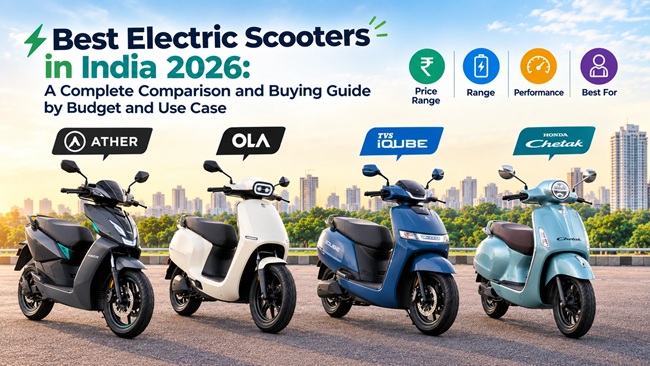
Best Electric Scooters in India 2026: A Complete Comparison and Buying Guide by Budget and Use Case

Rajesh spent three weekends visiting showrooms before buying his petrol scooter replacement, and by the end of it, he had five brochures, four different opinions from friends, and a persistent nagging feeling that he still didn’t actually know which electric scooter made sense for his specific situation: a 22 km daily commute on Bengaluru’s genuinely patchy roads, a budget capped around ₹1.1 lakh, and a wife who occasionally needed to carry their child to school on the same scooter. Every salesperson told him their brand was the best. None of them actually asked him what he needed it for.
This guide is built the other way around: starting from your budget, your roads, and what you’ll actually use the scooter for, rather than starting from which brand has the flashiest showroom display.
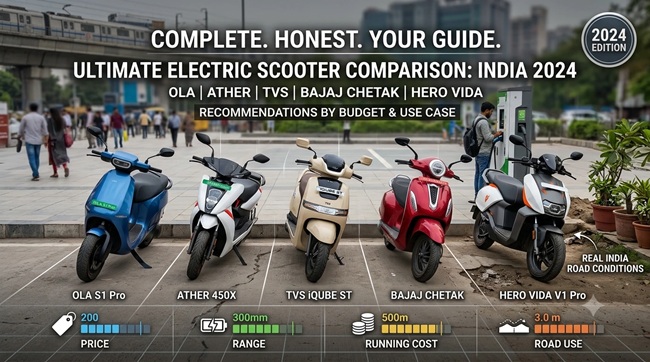
Quick Answer
There is no single “best” electric scooter in India in 2026, since the right choice depends heavily on your budget, commute distance, road quality, and whether you need family-carrying capacity. For most urban commuters prioritizing value and low running cost, the Hero Vida VX2 (₹79,000 to ₹1.10 lakh) or TVS iQube (₹1.01 to ₹1.23 lakh) are strong starting points. For families needing storage and comfort, the Ather Rizta (around ₹1.21 lakh) is widely considered the segment’s best all-rounder. For buyers who want solid build quality and a metal body that copes better with rough roads, the Bajaj Chetak (₹91,000 to ₹1.57 lakh across its C25/C30/C35 range) is a strong pick, and it has climbed to become India’s second-largest electric two-wheeler brand by sales. For performance and outright range, the Ather 450X and Ola S1 range top out with the strongest specs, though both carry service network concerns worth checking in your specific city first. On the financial side, the central government’s PM E-DRIVE purchase subsidy for electric two-wheelers ended on July 31, 2026, so it’s no longer available on any new purchase; what still matters financially is the running cost advantage, roughly ₹0.15 to ₹0.25 per km for electricity versus ₹2.5 to ₹3 per km for petrol, which typically saves a daily commuter somewhere between ₹25,000 and ₹34,000 a year and can recover the higher upfront price within 12 to 18 months of regular use.
About This Guide
This guide is based on publicly available specifications, ex-showroom pricing, and owner-reported real-world performance for major electric scooter models sold in India, along with government subsidy scheme status, current as of September 2026. FinanceChecks.com is not affiliated with any two-wheeler manufacturer, and this article does not constitute a product endorsement. Prices, range figures, and subsidy availability vary by variant, city, and battery configuration, and change frequently in this fast-moving segment; please verify current pricing, real-world range, and service network availability directly with dealers in your city before purchasing.
At a Glance: Star Rating Comparison
The table below is an editorial synthesis based on the comparative research in this guide, owner-reported service experiences, build quality, and feature sets across models, not an official lab-tested score from a single review body, since no single source rates all these models consistently on the same scale. Use it as a quick-reference starting point, then read the detailed comparison below before deciding.
| Model | Price (Ex-showroom) | Real-World Range | Build Quality | Service Network | Family Suitability | Value for Money | Overall |
|---|---|---|---|---|---|---|---|
| Hero Vida VX2 | ₹79,000–1.10L | ⭐⭐⭐ (3/5) | ⭐⭐⭐ (3/5) | ⭐⭐⭐ (3/5) | ⭐⭐⭐ (3/5) | ⭐⭐⭐⭐ (4/5) | ⭐⭐⭐½ (3.5/5) |
| TVS iQube | ₹1.01L–1.23L | ⭐⭐⭐ (3/5) | ⭐⭐⭐⭐ (4/5) | ⭐⭐⭐⭐⭐ (5/5) | ⭐⭐⭐⭐ (4/5) | ⭐⭐⭐⭐ (4/5) | ⭐⭐⭐⭐ (4/5) |
| Ola S1 range | ₹85,000–1.75L | ⭐⭐⭐⭐ (4/5) | ⭐⭐⭐ (3/5) | ⭐⭐ (2/5) | ⭐⭐⭐ (3/5) | ⭐⭐⭐⭐ (4/5) | ⭐⭐⭐½ (3.5/5) |
| Ather Rizta | ~₹1.21L | ⭐⭐⭐⭐ (4/5) | ⭐⭐⭐⭐ (4/5) | ⭐⭐⭐ (3/5) | ⭐⭐⭐⭐⭐ (5/5) | ⭐⭐⭐⭐ (4/5) | ⭐⭐⭐⭐½ (4.5/5) |
| Ather 450X | ₹1.51L–1.54L | ⭐⭐⭐⭐⭐ (5/5) | ⭐⭐⭐⭐ (4/5) | ⭐⭐⭐ (3/5) | ⭐⭐ (2/5) | ⭐⭐⭐ (3/5) | ⭐⭐⭐⭐ (4/5) |
| Bajaj Chetak | ₹91,000–1.57L | ⭐⭐⭐⭐ (4/5) | ⭐⭐⭐⭐⭐ (5/5) | ⭐⭐⭐⭐⭐ (5/5) | ⭐⭐⭐⭐ (4/5) | ⭐⭐⭐⭐ (4/5) | ⭐⭐⭐⭐ (4/5) |
Quick takeaways: The Ather Rizta edges out as the best all-rounder, largely on family suitability and range balance. The TVS iQube and Bajaj Chetak tie for the strongest service network, both a genuine 5/5, which matters more day-to-day than most spec-sheet differences. The Ather 450X leads outright on range if performance is your priority, but trails on family practicality. The Ola S1 range remains competitive on specs and value but carries the clearest weak point on this list, service network reliability, worth checking carefully in your own city before buying.
The Full Comparison, Model by Model
Hero Vida VX2 — Priced roughly between ₹79,000 and ₹1.10 lakh depending on variant, with a claimed range of 93 to 128 km, the VX2 is generally positioned as the most budget-accessible option from an established Hero brand. One important caveat worth knowing before you buy: Vida’s pricing model has historically included a separate battery rental or subscription fee structure on some variants, which can mean the true long-term cost of ownership is higher than the upfront sticker price alone suggests. It’s worth asking your dealer explicitly whether the specific variant you’re considering includes the battery outright or requires an ongoing rental fee.
TVS iQube — Priced between roughly ₹1.01 lakh and ₹1.23 lakh, with the higher-range iQube ST variant offering around 113 km on a claimed basis. The iQube is widely regarded as one of the safest choices for buyers who prioritise an established, deep service network over cutting-edge features, since TVS’s decades of two-wheeler servicing experience translate directly into wider, more reliable after-sales support across both large cities and smaller towns. Its main drawbacks are pricing that runs slightly higher than some rivals at comparable range, and its base variant skipping ABS, which safety-conscious buyers may want to specifically check for before purchase.
Bajaj Chetak — Now spanning three sub-families, C25, C30, and C35, with the entry-level C2501 starting around ₹91,000 to ₹99,900 and higher C35 variants reaching up to ₹1.57 lakh. Claimed range spans roughly 113 km on the entry variant up to 153 km on top variants. The Chetak’s defining characteristic is its metal-body construction, echoing the design language of the original petrol Chetak many Indian riders grew up with, which gives it a reassuringly solid, planted ride feel that tends to cope well with rougher road surfaces. The trade-off is extra weight, which some smaller riders find makes tight parking manoeuvres and low-speed handling somewhat harder. Bajaj has climbed to become India’s second-largest electric two-wheeler brand by sales volume, a meaningful vote of confidence from the broader market.
Ather Rizta — Priced around ₹1.21 lakh, the Rizta is Ather’s family-first scooter, trading the sportier character of Ather’s other models for a flat floorboard, a wide, comfortable seat, and genuinely large underseat storage. Features like AutoHold and a reverse mode add practical convenience for family use, riding two-up with a child, carrying shopping, or simply making low-speed manoeuvring easier. It’s widely cited as the segment’s best all-round pick for exactly this reason, family practicality combined with Ather’s generally well-regarded software and build quality.
Ather 450X — Priced from around ₹1.51 to ₹1.54 lakh, with claimed range between 126 and 161 km, the 450X sits at the sportier, more performance-oriented end of Ather’s lineup. It benefits from the Ather Grid fast-charging network in cities where it’s available, a genuine practical advantage for riders without reliable home charging access. Ather’s pricing tends to place it out of reach for more budget-conscious buyers, and its service network historically concentrates more heavily in southern India, which is worth checking carefully if you’re located elsewhere.
Ola S1 range — Spanning roughly ₹85,000 to ₹1.75 lakh across variants, with claimed range up to around 181 km on higher trims, the Ola S1 lineup remains competitive on pure performance and technology specifications. It’s worth being direct about the most consistent concern raised across owner reports and industry coverage: Ola has drawn frequent after-sales service complaints, particularly regarding battery health after roughly two years of use, and the brand has lost its earlier sales leadership position to both TVS and Bajaj. If you’re considering an Ola model, checking the specific service centre situation and typical wait times in your own city before purchasing is a genuinely important step, more so than with most other brands on this list.
The Honest Range Reality Check
Every manufacturer publishes a claimed or ARAI-certified range figure, and it’s worth understanding upfront that real-world range in actual Indian city riding conditions, traffic, frequent stops, air conditioning load on hot days, is consistently and meaningfully lower than these published figures, commonly by 20 to 40 percent. A scooter claiming 150 km on paper will more realistically deliver something in the range of 90 to 120 km in genuine day-to-day city use. This isn’t a flaw specific to any one brand, it’s a consistent pattern across the entire segment, and it’s worth planning your purchase decision around this more conservative, realistic range rather than the headline number on the brochure.
The Financial Picture: What Actually Saves You Money
The central subsidy has ended, and this matters for your budget planning. The PM E-DRIVE scheme, which offered ₹2,500 per kWh of battery capacity, capped at ₹5,000 per vehicle, for electric two-wheelers, officially closed to new registrations after July 31, 2026. If you’re buying today, this specific central incentive is no longer available on your purchase, and new electric scooter registrations will not benefit from it, regardless of what older articles or dealer promotional material might still reference. Some state governments continue to run their own, separate purchase incentives, Delhi, for instance, has offered incentives in the range of up to ₹30,000 for electric two-wheelers, while other states like Maharashtra offer purchase incentives calculated as a percentage of the vehicle’s base cost, subject to specific caps. It’s worth checking your specific state transport department’s current policy directly, since these state-level schemes vary considerably and are also subject to change or fund exhaustion.
The real, ongoing financial case for an electric scooter is running cost, not the purchase subsidy. Electricity costs for charging typically work out to roughly ₹0.15 to ₹0.25 per kilometre, compared to roughly ₹2.5 to ₹3 per kilometre for an equivalent petrol scooter at current fuel prices. For a typical daily commute in the 25 to 35 km range, this translates to a fuel cost saving of approximately ₹1,450 to ₹1,650 a month, or somewhere between ₹25,000 and ₹34,000 a year, entirely independent of any government subsidy. Maintenance costs also tend to run considerably lower for electric scooters, since they have far fewer moving parts than a petrol engine, commonly cited in the range of ₹1,500 to ₹3,000 a year for electric versus ₹8,000 to ₹12,000 a year for a comparable petrol scooter. Taken together, most owners recover the higher upfront price of an electric scooter compared to a similar petrol model within 12 to 18 months of regular daily use.
On financing, there’s no special income tax deduction available for a personal electric two-wheeler loan. It’s worth being direct about this, since Section 80EEB of the Income Tax Act, which allows a deduction on electric vehicle loan interest, applies only to loans sanctioned between April 1, 2019 and March 31, 2023, a window that closed years ago. A fresh electric scooter loan taken today does not qualify for this deduction, regardless of the lender or your income bracket. What financing does often benefit from is the segment’s fierce competition among two-wheeler-focused NBFCs and banks, so it’s worth comparing at least three lenders’ interest rates and processing fees rather than accepting the first EMI plan offered at the dealership.
Choosing by Your Actual Road Conditions
If you’re riding on genuinely rough, pothole-heavy roads regularly, common in many tier-2 and tier-3 Indian cities and semi-urban areas, prioritise models with sturdier build quality and better ground clearance over the sportiest performance specs. The Bajaj Chetak’s metal-body construction and generally planted ride feel tend to hold up well here, and TVS’s decades of engineering two-wheelers specifically for Indian road conditions gives the iQube a similar practical edge.
If you’re riding predominantly on smoother, well-maintained urban roads, the kind more common in planned areas of larger metros, the ride quality difference between brands matters less, and you have more freedom to prioritise other factors like range, software features, or service network reach based on your other needs.
If monsoon flooding or waterlogging is a regular concern in your area, it’s worth specifically asking dealers about each model’s IP-rating for water and dust resistance, since this varies by model and matters considerably more in regions with severe monsoon seasons.
Choosing by Your Actual Use Case
Solo daily commuter, budget-focused: The Hero Vida VX2 or TVS iQube’s base variants offer the most accessible entry points while still delivering the core running-cost benefit that makes electric scooters worthwhile in the first place.
Family use, carrying a child or occasional pillion with shopping: The Ather Rizta’s storage capacity, flat floorboard, and stability-focused design make it the most purpose-built option for this specific need, though the Bajaj Chetak’s solid build is a reasonable alternative if the Rizta’s price or Ather’s service network in your city is a concern.
Performance and longer daily distances: The Ather 450X and higher Ola S1 variants offer the strongest range and acceleration figures in the segment, but weigh this against the service network concerns specifically noted for both brands in your own city before committing.
Buyers prioritising established service network above all else: TVS iQube and Bajaj Chetak both benefit from their parent companies’ decades of two-wheeler servicing infrastructure across India, which for many owners ultimately matters more day-to-day than a marginal range or feature advantage on a spec sheet.
My Take
What struck me most while putting this comparison together is how consistently “which service network exists in your city” comes up as a deciding factor, more than range, more than price, more than any single feature. An electric scooter that’s slightly less impressive on paper but backed by a service centre ten minutes from your home is, in practical daily terms, a better purchase than one with a longer claimed range and the nearest authorised service centre two hours away. My honest suggestion, echoing what Rajesh eventually did after his three weekends of showroom visits, is to reverse the usual buying process: before comparing spec sheets, find out which two or three brands actually have reliable service presence in your specific city and neighbourhood, and only then compare range, price, and features among that shortlist, rather than falling for the scooter with the most impressive brochure and discovering the service gap only after you’ve already bought it.
Frequently Asked Questions
1. Which is the best electric scooter in India in 2026? There’s no single best option; it depends on your budget, commute, and use case. The Ather Rizta is widely considered the best all-rounder for families, the TVS iQube and Bajaj Chetak are strongest for service network reliability, and the Hero Vida VX2 offers the most accessible budget entry point.
2. Is the government subsidy for electric scooters still available? No. The central PM E-DRIVE purchase subsidy for electric two-wheelers ended for new registrations after July 31, 2026. Some states continue to offer their own separate incentives, which vary by location and are worth checking directly with your state transport department.
3. How much does an electric scooter actually save on running costs compared to petrol? Electricity costs roughly ₹0.15 to ₹0.25 per km compared to ₹2.5 to ₹3 per km for petrol. For a typical 25 to 35 km daily commute, this works out to an annual saving of approximately ₹25,000 to ₹34,000, independent of any subsidy.
4. Is the claimed range on an electric scooter’s brochure accurate? Generally not in real-world conditions. Claimed or ARAI-certified range figures are typically 20 to 40 percent higher than what riders actually experience in genuine city traffic, so it’s worth planning your purchase around a more conservative, real-world range estimate.
5. Which electric scooter is best for rough or pothole-heavy roads? The Bajaj Chetak’s metal-body construction and solid build tend to handle rough roads well, and the TVS iQube also benefits from engineering tailored to Indian road conditions. Both are reasonable choices if your daily commute involves poor road quality.
6. Can I still claim a tax deduction on an electric scooter loan? No, not for a loan taken today. Section 80EEB, which allowed a deduction on electric vehicle loan interest, only applied to loans sanctioned between April 1, 2019 and March 31, 2023, a window that has closed.
7. Which electric scooter has the best after-sales service network? TVS iQube and Bajaj Chetak generally benefit from their parent companies’ long-established two-wheeler service infrastructure across India, while Ola has drawn more frequent service-related complaints and Ather’s network is more concentrated in southern India.
8. Is an electric scooter a good choice for carrying a child or family use? Yes, particularly models designed with this in mind. The Ather Rizta is specifically built for family use, with a flat floorboard, wide seat, and large storage, while the Bajaj Chetak’s stability also suits this need.
9. How long does it take to recover the higher upfront cost of an electric scooter compared to petrol? Most regular daily users recover the price difference within 12 to 18 months, once fuel and maintenance savings are accounted for, assuming a typical daily commute distance.
10. What should I check before choosing between Hero Vida’s variants specifically? Ask the dealer explicitly whether the variant you’re considering includes the battery outright in the purchase price or requires an ongoing battery rental fee, since this can meaningfully change the true long-term cost of ownership beyond the upfront sticker price.
Disclaimer
This article is intended for general informational purposes only and does not constitute a product endorsement or financial advice. FinanceChecks.com is not affiliated with Hero Vida, TVS, Bajaj, Ather, Ola Electric, or any other manufacturer mentioned. Prices, specifications, range figures, and subsidy scheme details referenced here are based on publicly available information as of September 2026 and are subject to change; these vary by variant, battery configuration, city, and dealer, and government subsidy schemes are subject to policy changes and fund availability. Please verify current pricing, real-world range, service network presence, and subsidy eligibility directly with dealers and your state transport department before making a purchase decision.

Shuchi founded Finance Checks after spending 16+ years working in corporate, managing operations and distribution. She managed her own finances, learned and read regularly and helped people make sense of their savings, loans, insurance, and investments.
She started this site to offer the kind of clear, honest financial guidance she wished was more available when she was learning to manage her own money. Every article is researched personally, checked against official sources such as the Reserve Bank of India, SEBI, or the Income Tax Department, and revisited whenever regulations or figures change. She is upfront about how the site earns money through ads and select affiliate partnerships, and she does not let either influence what she actually recommends to readers.



[…] is where electric scooters wins decisively, and it’s not […]
[…] Best Electric Scooters in India 2026: A Complete Comparison and Buying Guide by Budget and Use Case […]