
Petrol vs Electric Two-Wheeler: The Real Money Comparison (2026)

Vikram was 8 months into his EMI on a new petrol scooter when his colleague pulled up next to him on an electric one, charged it overnight for about ₹20, and rode 40 km to work without visiting a fuel station once that week. Vikram did the math on his own commute — roughly ₹150 a week on petrol — and started wondering if he’d made the wrong call.
It’s a question a lot of Indian two-wheeler buyers are asking right now, and most online comparisons answer it with a single, misleading number: “EVs are 90% cheaper to run!” That’s technically true, and also not the full picture. The real answer depends on your daily distance, how long you keep the vehicle, and one cost almost nobody budgets for upfront — the battery replacement. Here’s the comparison with real numbers, including the parts most articles leave out.
The Headline Number: Running Cost Per Km
This is where electric scooters wins decisively, and it’s not close.
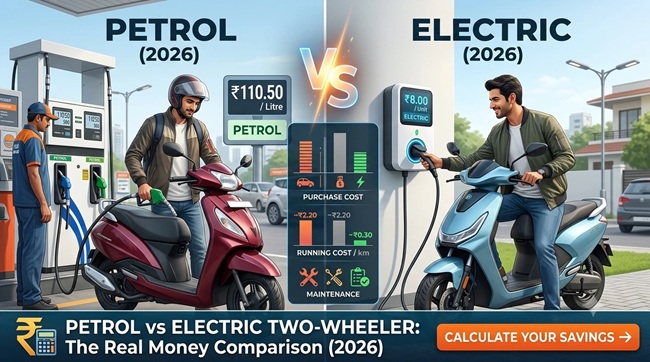
- Petrol scooter: at current petrol prices (~₹100–110/litre) and typical mileage of 45–55 km/litre, running cost works out to roughly ₹2.00–₹2.50 per km.
- Electric scooter (home charging): at typical home electricity rates and efficiency, running cost works out to roughly ₹0.20–₹0.30 per km — sometimes lower for entry-level/low-speed models.
That’s an 8x to 10x difference per kilometre. On a daily 30 km commute, that’s the difference between spending roughly ₹600–750 a month on petrol versus ₹60–90 a month on electricity.
But Running Cost Alone Doesn’t Tell the Whole Story
This is where most comparisons stop — and where they mislead buyers. To actually know which is cheaper for you, you need to look at total cost of ownership (TCO) over the years you’ll actually keep the vehicle, including the one line item that changes the entire calculation: battery replacement.
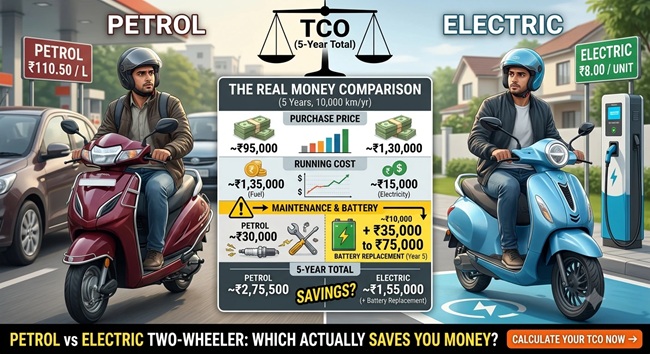
The Realistic 5-Year Cost Comparison Table
Assumptions: 30 km/day average commute (≈10,950 km/year, ≈54,750 km over 5 years), mid-range models on both sides, home charging for the EV.
| Cost Component | Petrol Scooter | Electric Scooter |
|---|---|---|
| On-road price | ₹85,000 – ₹1,00,000 | ₹90,000 – ₹1,40,000 (before subsidy) |
| Government subsidy | None | Up to ₹5,000 (PM E-DRIVE, central) + state subsidy where applicable |
| Annual fuel/electricity cost | ₹22,000 – ₹27,000 | ₹2,200 – ₹3,300 |
| 5-year fuel/electricity cost | ₹1,10,000 – ₹1,35,000 | ₹11,000 – ₹16,500 |
| Annual maintenance/servicing | ₹5,000 – ₹10,000 (oil changes, filters, spark plugs, clutch wear) | ₹1,500 – ₹3,000 (no engine oil, fewer moving parts) |
| 5-year maintenance cost | ₹25,000 – ₹50,000 | ₹7,500 – ₹15,000 |
| Battery replacement (one-time, typically year 3–5) | Not applicable | ₹35,000 – ₹1,20,000 depending on model and battery capacity |
| Registration, road tax, insurance (5 yrs, approx.) | ₹10,000 – ₹15,000 | Often lower or partially waived in several states as an EV incentive |
| Approx. 5-year total cost of ownership | ₹2,30,000 – ₹2,90,000 | ₹1,50,000 – ₹2,85,000 (wide range depending on battery replacement) |
The takeaway from this table isn’t “EV always wins” — it’s that the battery replacement cost can single-handedly erase most or all of the running-cost savings, depending on which model you buy and how the timing lines up. This is the part most EV sales pitches skip.
The Battery Cost Nobody Budgets For
Here’s the number that changes everything: most EV two-wheeler batteries need replacement roughly every 3 to 5 years, and out-of-warranty replacement typically costs ₹35,000 to over ₹1,00,000, depending on the brand and battery capacity:
- Entry-level/low-speed scooters (TVS iQube base variant, Ola S1 X): roughly ₹35,000–₹50,000
- Mid-range scooters (Bajaj Chetak, Hero Vida, standard Ather models): roughly ₹60,000–₹80,000
- Higher-capacity/performance variants (Ola S1 Pro+, TVS iQube ST): can approach ₹1,00,000–₹1,20,000
For a scooter that cost ₹90,000–₹1,40,000 to buy in the first place, a ₹35,000–₹80,000 battery replacement bill 3–4 years in is not a minor line item — it can be 40–60% of the vehicle’s original price. This is exactly the number you mentioned, and it’s a realistic mid-range figure for entry-level and mid-tier EV two-wheelers in 2026.
Why this matters for your money decision: if you’re comparing a petrol scooter against an EV purely on monthly running cost, you’re comparing an ongoing small expense against an ongoing small expense plus a large lump-sum bill that lands somewhere in years 3–5. Budget for it as if it’s certain, because for most EV owners, it is.
Why Extended Warranty Is the Single Most Important Financial Decision for an EV Buyer
Standard battery warranties on most EV two-wheelers run 3 years or 30,000–50,000 km, whichever comes first — and that’s often shorter than the window in which batteries actually start degrading meaningfully. This is precisely why extended warranty plans matter so much more for EVs than they ever did for petrol vehicles:
- Extended plans typically stretch coverage to 5–8 years (for example, Ather’s “Eight70” plan extends to 8 years, and TVS and Vida offer similar extended options), covering the exact window when a battery is statistically most likely to need replacement.
- Most extended plans guarantee a capacity threshold — commonly that if the battery’s health drops below 70% of original capacity within the warranty period, you get a free replacement rather than paying the full ₹35,000–₹1,20,000 out of pocket.
- Some extended warranties are transferable to the next owner (Vida’s plan is a notable example), which also helps protect resale value — a genuine weak point for EVs otherwise, since buyers are wary of an unknown battery’s remaining life.
- The math is simple: an extended warranty plan typically costs a few thousand rupees a year, against a potential ₹35,000–₹1,20,000 replacement bill. For most buyers, this isn’t optional risk management — it’s close to essential, the same way you wouldn’t skip insurance on a car because “accidents probably won’t happen to me.”
If you’re buying an EV two-wheeler, treat the extended battery warranty as part of the actual purchase price, not an optional add-on — and factor its cost into your total cost of ownership comparison against petrol from day one.
Don’t miss the Latest Financial Updates. Follow us on Instagram and Youtube.
Where Petrol Scooters Still Win
To be fair to the other side of this comparison — because a genuinely useful comparison isn’t one-sided:
- Refuelling speed: 2–3 minutes at any petrol pump anywhere in India, versus 4–6 hours for a full home charge (1–2 hours on a fast charger, where available).
- Range and highway performance: petrol scooters typically manage 200–300+ km per tank and hold sustained highway speeds without a meaningful range penalty. Most EV two-wheelers see range drop 35–45% at sustained highway speeds, and many aren’t built for regular long-distance or highway riding at all.
- No dependence on charging infrastructure: relevant if you live somewhere with frequent, long power cuts, or need to travel through areas with limited charging points.
- More predictable resale market: petrol two-wheelers have a decades-old, well-understood resale ecosystem. EV resale value is still less predictable, largely because buyers can’t easily verify remaining battery health.
How to Actually Make This Decision (Not Just Compare Numbers)
The right choice depends less on national averages and more on your specific situation. Work through these questions in order:
1. What’s your daily distance? Under 15–20 km/day, the fuel savings from an EV take longer to offset the higher purchase price and eventual battery cost — the math is closer than headlines suggest. Above 25–30 km/day, EVs pull ahead faster, often breaking even within 14–30 months on running cost savings alone.
2. Do you have reliable home charging? If you can charge overnight at home (a normal 5-amp socket works for most models), the ₹0.20–₹0.30/km cost holds. If you’re dependent on public charging, costs rise to roughly ₹1.50–₹1.80/km in some cases, which meaningfully changes the comparison.
3. How long do you plan to keep the vehicle? If you typically sell or upgrade within 2–3 years, you may avoid the battery replacement cost entirely — but you’ll also take a resale value hit, since buyers price in the coming battery expense. If you plan to keep it 5+ years, budget explicitly for one battery replacement (or an extended warranty premium) as a certainty, not a maybe.
4. Do you regularly do highway trips or long single journeys? If yes — visiting family outstation, frequent 100+ km single trips — petrol still has real, practical advantages that no amount of cost math should override. Range anxiety and charging downtime are real costs even if they don’t show up in a spreadsheet.
5. Will you buy the extended battery warranty? If you’re leaning EV, decide this at the time of purchase, not after year 3. Add its cost into your comparison honestly — it’s what makes the EV math work out in your favor rather than blowing up in year 4.
The Honest Bottom Line
For a typical urban commuter doing 25–35 km/day, staying mostly within city limits, with access to home charging, and who buys (or budgets for) an extended battery warranty — an electric two-wheeler is very likely the cheaper option over 5 years, even after accounting for the battery replacement cost.
For someone doing shorter daily distances, frequent highway travel, living somewhere with unreliable charging access, or planning to sell within 2–3 years, the gap narrows significantly, and in some cases petrol remains the more practical and even the more cost-effective choice once resale value and convenience are factored in.
The mistake to avoid isn’t choosing petrol or EV — it’s choosing based only on the per-km running cost number, without budgeting for the battery bill that’s coming whether you plan for it or not.
Frequently Asked Questions
1. Is an electric two-wheeler really cheaper than petrol in India?
For most urban commuters doing 25+ km/day with home charging access, yes — even after factoring in the eventual battery replacement cost, the 5-year total cost of ownership tends to favor EVs. For shorter daily distances or those without reliable home charging, the gap narrows and can go either way depending on the specific models compared.
2. How often does an EV two-wheeler battery actually need replacement?
Most EV two-wheeler batteries are designed to perform well for 3–5 years or 30,000–60,000 km under normal use, after which capacity typically degrades enough that riders opt for replacement, though this varies by brand, battery chemistry, charging habits, and climate conditions.
3. Is ₹35,000 a realistic battery replacement cost?
Yes, for entry-level and low-speed EV two-wheelers (such as base variants of TVS iQube or Ola S1 X), ₹35,000–₹50,000 is a realistic replacement cost in 2026. Mid-range and higher-capacity models can cost significantly more, up to ₹1,00,000–₹1,20,000 for premium, high-capacity battery packs.
4. Should I buy the extended warranty on an electric scooter?
For most buyers planning to keep the vehicle 3+ years, yes — the extended warranty typically costs a small fraction of the potential battery replacement bill and often guarantees free replacement if capacity drops below a set threshold (commonly 70%) within the coverage period.
5. Does petrol scooter maintenance really cost that much more than EV?
Yes, meaningfully — petrol scooters need regular engine oil changes, air filter replacement, spark plug servicing, and clutch/belt wear management, typically totalling ₹5,000–₹10,000 a year. EVs have no engine, oil, or clutch, so annual maintenance is usually limited to tyres, brakes, and basic checks, typically ₹1,500–₹3,000 a year.
6. What government subsidies are available for EV two-wheelers in India right now?
As of 2026, the central PM E-DRIVE scheme offers up to ₹5,000 off eligible electric two-wheelers (₹2,500 per kWh of battery capacity, capped at ₹5,000). Several states add their own incentives on top — buyers should check their specific state’s current EV policy, since these change periodically and vary significantly by location.
7. Does an EV two-wheeler lose more resale value than a petrol one?
Generally, yes, at present — resale buyers are cautious about EVs because remaining battery health is hard to verify externally, unlike a petrol engine’s condition. This gap is narrowing as extended, transferable warranties become more common, since a transferable warranty gives a resale buyer real assurance about the battery’s remaining life.
8. Is charging an EV two-wheeler at home expensive on the electricity bill?
Not significantly — a full charge typically costs ₹15–₹25 and delivers 60–120 km of range depending on the model, working out to roughly ₹200–₹300 a month for a typical daily commuter, which is far lower than the equivalent petrol spend.
9. What happens if I don’t get an extended warranty and the battery degrades early?
You would need to pay for a full or partial battery replacement out of pocket once the standard warranty period (commonly 3 years or 30,000–50,000 km) ends, which can range from ₹35,000 to over ₹1,00,000 depending on the model — a significant unplanned expense if you haven’t budgeted for it.
10. Are EV two-wheelers worth it for someone with a short daily commute (under 15 km)?
The financial case is weaker here, since the fuel savings take longer to offset the higher upfront price and future battery cost. For very short, mostly city commutes, either option can work financially — the decision may come down more to environmental preference, convenience, or long-term plans than pure cost savings.
11. Do electric two-wheelers really perform worse on highways?
Yes, generally — most electric two-wheelers see range drop by 35–45% at sustained highway speeds, and many models aren’t designed for prolonged high-speed riding at all. If highway travel is a regular part of your riding, this is a genuine practical limitation, not just a cost consideration.
12. How do I calculate my own break-even point between petrol and electric?
Take the price difference between the two vehicles you’re comparing (EV price minus petrol price, after subsidy), divide it by your estimated monthly fuel/electricity savings, and that gives you the number of months to break even on the higher upfront cost — before accounting for the eventual battery replacement, which should be added as a separate, later cost rather than ignored in this calculation.
Disclaimer: This article is for general informational purposes only and should not be treated as financial or purchase advice. Fuel prices, electricity tariffs, vehicle prices, subsidy amounts, and battery replacement costs vary by location, model, and change over time — the figures above are indicative ranges based on data available in 2026 and should be independently verified with current pricing, your specific vehicle model’s warranty terms, and your local electricity rates before making a purchase decision.

Shuchi founded Finance Checks after spending 16+ years working in corporate, managing operations and distribution. She managed her own finances, learned and read regularly and helped people make sense of their savings, loans, insurance, and investments.
She started this site to offer the kind of clear, honest financial guidance she wished was more available when she was learning to manage her own money. Every article is researched personally, checked against official sources such as the Reserve Bank of India, SEBI, or the Income Tax Department, and revisited whenever regulations or figures change. She is upfront about how the site earns money through ads and select affiliate partnerships, and she does not let either influence what she actually recommends to readers.



[…] you’ve read comparisons about electric scooters, you’ve probably seen warnings about a battery replacement bill landing in year 3 or 4. Cars […]