
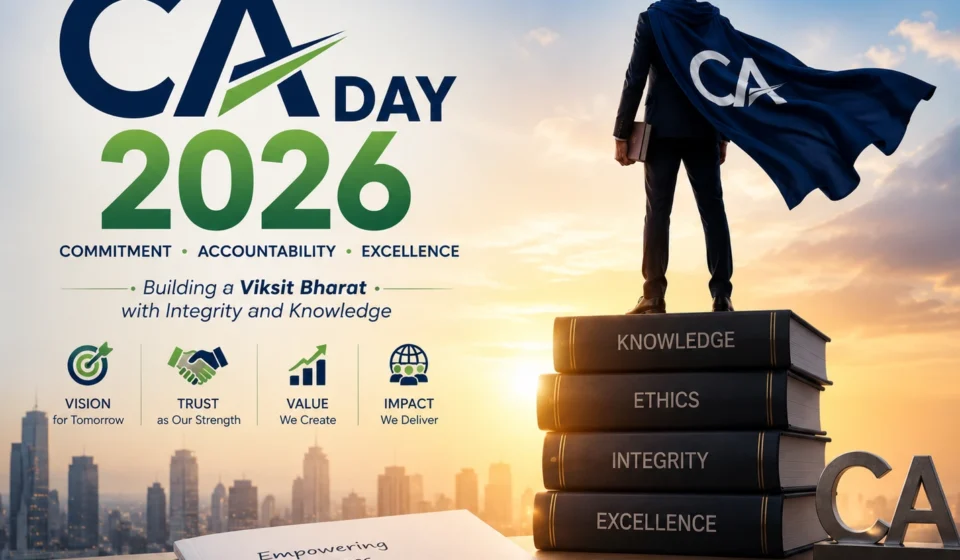

Ask a Chartered Accountant what July 1 means to them, and you’ll rarely get a textbook answer. You’ll get a story — about the 3 a.m. balance sheets during audit season, the exam they cleared on the third attempt, the client who called them at 11 p.m. before a GST deadline, or the quiet pride of signing their name after “CA” for the first time. That’s what CA Day actually is. Not a corporate holiday. A profession pausing, once a year, to look back at how far it’s come.
July 1, 2026 marks 77 years since the Institute of Chartered Accountants of India (ICAI) was born — and it’s as good a day as any to actually understand the people behind the profession, not just wish them a “Happy CA Day” on LinkedIn and move on.
This post walks through the history of CA Day, why it’s celebrated on this particular date, what the CA profession really looks like from the inside, how it’s evolving in 2026, and — because no CA Day post should skip it — a proper FAQ section at the end.

What Is CA Day and Why Is It Celebrated on July 1?
CA Day, officially known as Chartered Accountants Day or ICAI Foundation Day, commemorates the establishment of the Institute of Chartered Accountants of India on July 1, 1949, through an Act of Parliament — the Chartered Accountants Act, 1949. Before that Act, India simply didn’t have a dedicated, statutory body regulating who could call themselves an accountant or on what standards they operated. Bookkeeping and auditing existed, but there was no single authority ensuring consistency, ethics, or accountability across the profession.
ICAI changed that. It became the sole licensing and regulatory authority for the CA profession in India, and over 77 years it has grown into the second-largest professional accounting body in the world, with more than 3.5 lakh members today. Every year on July 1, ICAI branches, CA firms, coaching institutes, and individual professionals across the country mark the occasion with seminars, panel discussions, social media tributes, CSR drives, and award ceremonies honouring outstanding contributions to the profession.
It’s worth noting: ICAI usually announces an official theme for CA Day closer to the date itself, often reflecting where the profession is headed that year — think financial excellence, ethics, or digital transformation. Keep an eye on ICAI’s official channels for the confirmed 2026 theme.
A Short History Worth Knowing
The story of CA Day is really the story of India building its financial backbone right after independence. In the late 1940s, a newly independent country needed institutions it could trust — courts, a central bank, and yes, a regulator for the people who would eventually certify whether a company’s books were honest.
The Chartered Accountants Act, 1949 replaced the earlier, informal Register of Accountants system that operated under British administration. It gave India something it didn’t have before: a professional body with the legal power to set standards, conduct examinations, enforce a code of conduct, and take disciplinary action when needed. ICAI was built on that foundation, under the early leadership of Gopaldas P. Kapadia, and has been led by successive presidents ever since, shaping how audits, taxation, and financial reporting work in India.
What started as a fairly narrow mandate — auditing and taxation — has expanded dramatically. Today’s ICAI also oversees standard-setting bodies and works alongside institutions like the National Financial Reporting Authority (NFRA), extending its influence well beyond what its 1949 founders might have imagined.
You May Also Like To Read:
The CA Profession: What It Actually Takes
Here’s the part most “Happy CA Day” posts skip entirely — the sheer grind behind those three letters.
Becoming a Chartered Accountant in India is widely regarded as one of the most demanding professional qualification journeys anywhere. It typically involves:
- Multiple rigorous exam levels — Foundation, Intermediate, and Final — each with pass percentages that keep the profession’s credibility intact
- Three years of mandatory articleship, essentially an apprenticeship where students work under practicing CAs, often doing real audits, real tax filings, and real client work long before they’re qualified
- Continuing professional education, because tax laws, accounting standards, and compliance requirements change constantly
- An ethical code that CAs are bound by for their entire career, with real consequences for violations
It’s common for CA aspirants to attempt a level more than once. That’s not failure — it’s simply how difficult the filter is. Every CA you meet has, at some point, sat with a mark sheet that didn’t go their way and decided to try again anyway. That persistence is arguably as much a part of “CA Day” as the ICAI’s founding itself.
Why CAs Matter More Than Most People Realise
It’s easy to reduce the profession to “people who do taxes.” In reality, Chartered Accountants sit at the intersection of almost every major financial decision a business or individual makes:
- Auditing — verifying that a company’s financial statements actually reflect reality, which protects investors, lenders, and employees alike
- Taxation — navigating an Indian tax system that changes almost every budget cycle, from GST filings to income tax compliance
- Financial advisory and risk management — helping businesses plan expansion, manage cash flow, and avoid decisions that look good on paper but collapse under real-world pressure
- Corporate governance — ensuring companies follow the rules that keep markets functioning and fraud in check
- Nation-building, quite literally — CAs are involved in everything from MSME compliance to the financial due diligence behind major infrastructure and policy decisions
When a company’s books are trusted, it’s usually because a CA staked their signature on it. That’s a bigger responsibility than it sounds.
The CA Profession in 2026: What’s Changing
If you’d asked a Chartered Accountant in 1990 what their job looked like, they’d describe ledgers, physical vouching, and manual tax computation. Ask one in 2026, and the answer looks very different.
Artificial intelligence and automation have taken over a lot of the repetitive, transactional work — data entry, basic reconciliations, even first-pass anomaly detection in audits. Rather than replacing CAs, this has pushed the profession further up the value chain, toward interpretation, judgment, and advisory work that software genuinely cannot replicate.
GST and digital tax compliance continue to evolve rapidly, meaning CAs today spend as much time staying updated on regulatory changes as they do applying accounting fundamentals.
ESG reporting is becoming a real, billable part of many CA practices, as businesses face growing pressure to disclose environmental and social impact alongside financial performance.
Startups and MSMEs increasingly rely on CAs not just for compliance, but as informal financial co-pilots — helping first-time founders understand cash flow, funding structures, and investor-ready reporting.
The throughline is simple: the accountant who only “does the numbers” is a shrinking role. The accountant who explains what the numbers mean, and what to do about them, is more valuable than ever.
How CA Day Is Actually Celebrated
Across India, CA Day tends to look like a mix of the professional and the personal:
- ICAI’s regional and branch offices hold technical sessions, workshops, and award functions recognising outstanding members and firms
- CA firms often organise small in-office celebrations — cake, photos, a rare moment where the whole team isn’t buried in a filing deadline
- Coaching institutes and CA students post tributes, share exam journeys, and use the day to motivate the next batch of aspirants
- Social media fills up with congratulatory posts, quotes, and “Happy CA Day” wishes tagged with #CADay2026 and #ICAI
- Some branches run CSR initiatives — free tax literacy camps, financial planning sessions for small business owners, or support for underprivileged students interested in commerce
It’s a day that manages to be both formal (ICAI functions under the Ministry of Corporate Affairs, after all) and genuinely warm — because at its core, it’s colleagues and mentors acknowledging each other’s work.
My Take
Professions rarely get days that actually mean something — most turn into marketing opportunities within a decade. CA Day has mostly avoided that trap, and I think it’s because the profession itself is so unglamorous in the day-to-day. Nobody becomes a CA for applause. They do it for a stable, respected career that rewards precision and integrity — two things that are genuinely undervalued in most industries right now.
What stands out to me isn’t the 3.5 lakh membership number or the “second-largest accounting body” statistic, impressive as they are. It’s that this is a profession where your reputation is your only real currency. A CA’s signature on an audit report is a promise. Break that promise once, and the consequences aren’t just professional — they’re legal. In a world of AI-generated everything and shortcuts dressed up as “efficiency,” that kind of accountability feels almost old-fashioned. It shouldn’t. It should be the standard everyone else is held to.
So if you know a CA — a friend, a family member, someone who’s helped your business stay compliant without you ever noticing the effort — July 1 is a good day to actually tell them that. Not a template message. An honest one.
Frequently Asked Questions About CA Day
1. Why is CA Day celebrated on July 1? Because the Institute of Chartered Accountants of India (ICAI) was formally established on July 1, 1949, under the Chartered Accountants Act passed by the Indian Parliament. The date marks ICAI’s foundation, not the birth of the profession itself, which existed informally even earlier.
2. What is CA Day 2026 celebrating? CA Day 2026 marks the 77th anniversary of ICAI’s founding. It honours Chartered Accountants’ contributions to India’s economy, celebrates the profession’s evolution, and recognises members and firms for their work over the past year.
3. Is CA Day an official government holiday? No. CA Day is a professional observance recognised by ICAI and the accounting community, not a public or bank holiday. Offices, markets, and government institutions function normally on this date.
4. What is the theme for CA Day 2026? ICAI typically announces the official theme closer to the celebration date each year. Past themes have focused on ideas like financial excellence and ethical leadership. Check ICAI’s official website or social channels for the confirmed 2026 theme.
5. How is CA Day different from World Accountants Day? CA Day, celebrated on July 1, is specific to India and ICAI’s founding. There isn’t a single globally recognised “World Accountants Day” in the same formal sense — different countries and accounting bodies mark their own foundation dates separately.
6. How can I wish someone a Happy CA Day? Beyond the standard message, the most meaningful gesture is specific: acknowledge something they actually did — a deadline they hit, advice that helped you, or the sheer effort behind clearing their exams. Generic wishes are fine; specific ones land better.
7. Is becoming a Chartered Accountant still worth it in 2026? For those who want a credential with genuine authority, strong earning potential, and relevance across industries — yes. The profession is evolving with automation and AI, but the demand for judgment, ethics, and advisory skill that only a qualified professional can offer isn’t going anywhere.
8. Who regulates Chartered Accountants in India? ICAI is the sole statutory body regulating the CA profession in India. It functions under the administrative oversight of the Ministry of Corporate Affairs, Government of India, and sets examination standards, a code of conduct, and disciplinary mechanisms for its members.
Happy CA Day 2026 — to the ones who’ve earned it, and the ones still working toward it.

Shuchi founded Finance Checks after spending 16+ years working in corporate, managing operations and distribution. She managed her own finances, learned and read regularly and helped people make sense of their savings, loans, insurance, and investments.
She started this site to offer the kind of clear, honest financial guidance she wished was more available when she was learning to manage her own money. Every article is researched personally, checked against official sources such as the Reserve Bank of India, SEBI, or the Income Tax Department, and revisited whenever regulations or figures change. She is upfront about how the site earns money through ads and select affiliate partnerships, and she does not let either influence what she actually recommends to readers.



[…] And it forces you to actually look at your finances once a year instead of ignoring them until your CA sends a panicked […]