
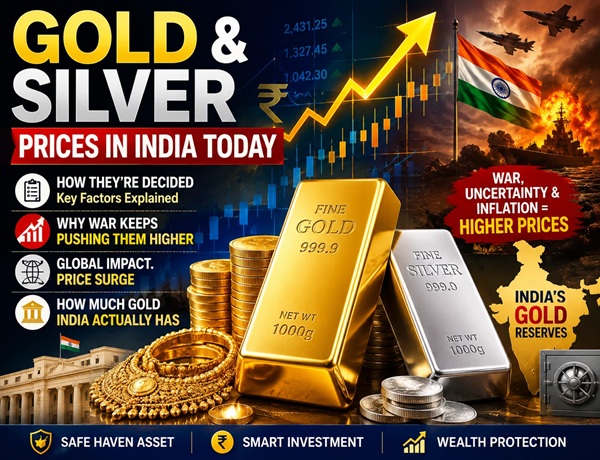
Gold and Silver Prices in India Today: How They’re Decided, Why War Keeps Pushing Them Higher, and How Much Gold India Actually Has

Walk into any Indian household, and gold is rarely just an investment. It is the coin gifted at a baby’s naming ceremony, the chain bought for a daughter’s wedding, the small bar tucked away in a locker “for emergencies,” and the topic of a very specific kind of conversation that happens every single morning in millions of homes: “what’s the rate today?”
That question turns out to have a far more interesting answer than most people realise. The price you see quoted at your local jeweller is not some number that India sets on its own. It is the end result of a long chain of events, starting in London and New York trading floors, running through wars and central bank vaults on the other side of the planet, and finally landing on a board outside your neighbourhood gold shop. This chapter walks through exactly how that number is built, why it has been moving so dramatically over the past couple of years, how much gold India actually holds as a nation, where all that gold physically comes from, and how you can check today’s price for your own state.
A quick note before we dive in, because precision matters enormously with a topic like this: gold and silver prices change by the second on international markets and can shift meaningfully even within a single trading day. Every specific number in this chapter reflects publicly available data at the time of writing and should be treated as a snapshot, not a live figure. Always check a current rate from a trusted source, or the live checker tool below, before making any actual buying or selling decision.

What the gold price actually looked like recently, and why it keeps moving
As of late June 2026, 24 karat gold in India has been trading somewhere in the broad range of roughly ₹13,900 to ₹14,300 per gram, which works out to somewhere around ₹1,39,000 to ₹1,43,000 for 10 grams, while 22 karat gold, the purity most commonly used in jewellery, has been trading somewhere around ₹12,800 to ₹13,100 per gram. Silver has been trading in the range of roughly ₹221 to ₹235 per gram, or roughly ₹2,21,000 to ₹2,35,000 per kilogram.
Notice the ranges rather than single fixed numbers here, and that is deliberate, not vague writing. Different trusted price sources, MCX-linked trackers, jewellers’ association rates, and individual retailer boards, routinely show figures that differ by a few hundred rupees from each other on the very same day, because each pulls from a slightly different reference point and adds its own margin. The headline takeaway that matters more than any single figure: gold has had one of its strongest runs in nearly half a century. Global gold prices rose by roughly forty to fifty percent through 2025 alone, marking the strongest annual gain since the late 1970s, and silver touched record highs of around fifty-four dollars an ounce in October 2025 before settling into a still-elevated range. Several major banks, including JPMorgan’s research desk, have projected gold could push toward six thousand dollars an ounce by the end of 2026, though it is worth being clear that any such forecast is exactly that, a forecast, and not a guarantee of where prices will actually land.
How the price you see at the jeweller is actually built, step by step
This is the part almost nobody explains clearly, so let’s break it down layer by layer, the way the price genuinely gets constructed.
It starts with the international spot price. Gold and silver are globally traded commodities, priced primarily out of the London Bullion Market and reinforced by trading on exchanges like COMEX in New York, and quoted in US dollars per troy ounce. This international spot price is the foundation everything else is built on top of, and it moves constantly based on global supply, demand, interest rates and investor sentiment.
That dollar price then has to be converted into rupees, which means the USD to INR exchange rate is the second major ingredient. When the rupee weakens against the dollar, gold becomes more expensive in India even if the international dollar price has not moved at all, and this single factor surprises a lot of people who assume gold prices only reflect what is happening to gold itself.
Next comes import duty. Since India produces only a tiny fraction of the gold it consumes, almost all of it has to be imported, and the government charges a basic customs duty on that import, which currently stands at six percent following a meaningful cut from fifteen percent in the 2024 Union Budget, a move specifically aimed at curbing gold smuggling by making legal imports more competitive.
On top of that sits GST, the Goods and Services Tax, charged at three percent uniformly across the country on gold and silver purchases, regardless of which state you are buying in.
Then comes the MCX, the Multi Commodity Exchange of India, where domestic gold and silver futures are actively traded. MCX prices serve as the key domestic benchmark that most Indian price trackers and even individual jewellers reference when setting their daily rate, since it reflects all of the above factors, international price, exchange rate and duties, already baked into a single domestic number.
Finally, individual jewellers and city-level jewellers’ associations add their own small layer on top: a modest premium or margin, transportation and handling costs, and, separately, making charges if you are buying finished jewellery rather than a plain coin or bar. This final layer is exactly why you will see slightly different numbers in Mumbai versus Lucknow versus Kochi on the same day, even though the underlying gold itself is identical. The good news, especially compared to popular assumption, is that this state-to-state variation tends to be genuinely modest, typically a matter of a few rupees per gram rather than any dramatic difference, since GST is uniform nationwide and the underlying MCX-linked benchmark is the same everywhere. Larger gaps mostly show up in making charges on finished jewellery, not in the base metal price itself.
You May Also Like:
Why the global war scenario keeps pushing prices higher
If you have noticed gold prices climbing relentlessly over the past few years and wondered why, the honest answer is that gold is doing exactly what it has always done throughout history: acting as the world’s most trusted safe haven the moment geopolitical confidence starts to crack.
The current rally traces back largely to early 2022, when Russia’s invasion of Ukraine triggered Western sanctions that froze a significant chunk of Russia’s foreign currency reserves. That single event sent a powerful signal to central banks around the world, particularly in emerging and non-Western economies: holding your national reserves purely in US dollars or other Western currencies carries real political risk if relations sour, since those reserves can effectively be frozen by a foreign government’s decision. Gold, by contrast, has no counterparty risk; nobody can freeze a vault of physical gold sitting inside your own country’s borders the way they can freeze a digital dollar account. That realisation kicked off a wave of central bank gold buying that has not meaningfully slowed since, running at more than a thousand tonnes a year in aggregate since 2022, roughly double the pace seen in the years before.
Layered on top of that has been a near-constant string of fresh geopolitical flashpoints: the prolonged Russia-Ukraine war itself, repeated escalations across the Middle East including direct confrontation involving Iran, Israel and the United States through 2025 and into 2026, persistently strained relations between the US and China, and a broader global mood of fragmentation often described as a new cold war dynamic. Each fresh escalation tends to send investors and central banks alike rushing toward gold and, to a lesser extent, silver, as a hedge against the kind of chaos that can rattle currencies, stock markets and oil prices all at once. Add in a weaker US dollar through much of this period and interest rate cuts by the US Federal Reserve, both of which historically tend to support gold prices, and you get the combination behind the sharpest gold rally since the late 1970s oil-shock era.
It is worth being clear-eyed about one nuance here too: gold does not always move in a straight line upward even during active conflict. There have been sharp pullbacks of fifteen to twenty percent within this broader rally, often when investors holding leveraged positions need to sell something quickly to raise cash during periods of extreme volatility, a pattern sometimes described as “selling what you can, not what you want.” The broader trend across this multi-year stretch has nonetheless been a series of progressively higher price floors, with each new bout of geopolitical stress tending to push prices toward a new range above where the previous calm period had settled.
Silver has ridden much of this same wave, but with an added ingredient: unlike gold, silver has substantial industrial demand, particularly from solar panel manufacturing, electronics and semiconductor production, which now accounts for more than half of total silver demand globally. This means silver prices respond to both the same safe-haven forces driving gold and to the health of global manufacturing and the renewable energy buildout, which is part of why silver has at times moved even more sharply than gold in percentage terms.
How much gold does India actually have, and where is it kept
This question genuinely has two very different answers, depending on whether you mean the government’s gold or the gold sitting in Indian households, and the gap between the two is enormous.
On the official side, the Reserve Bank of India held approximately 880 tonnes of gold as of early 2026, placing India among the top ten gold-holding central banks in the world. Gold now makes up roughly fourteen to fifteen percent of India’s total foreign exchange reserves, a share that has nearly doubled over the past decade as the RBI has steadily added to its holdings, including significant purchases since 2024. Of this total, the majority is now held domestically within India’s own vaults, with the remainder held abroad with the Bank of England and the Bank for International Settlements, plus a small portion held as gold deposits. Notably, the RBI has been actively repatriating gold back to Indian soil in recent years, bringing back tens of tonnes from overseas vaults between 2025 and 2026 alone, a move widely read as part of a broader strategy to reduce reliance on foreign custodians amid a more fractured geopolitical environment, echoing lessons many emerging economies drew from watching Russia’s reserves get frozen.
Then there is household gold, and this is where the numbers become genuinely staggering. Indian households are widely regarded as the largest private holders of gold anywhere on earth. Estimates vary considerably depending on methodology, with the World Gold Council’s more conservative figure sitting around 25,000 to 28,000 tonnes, while a more recent and considerably higher estimate from Morgan Stanley puts the figure closer to 34,600 tonnes. Even taking the lower end of that range, Indian household gold dramatically exceeds the official gold reserves of the United States, the world’s largest sovereign holder, and easily surpasses the combined official reserves of several major economies put together. Valued at current elevated prices, this household stockpile has been estimated at anywhere between roughly two and a half and nearly four trillion US dollars, a number that, depending on which estimate you use, can rival or exceed India’s entire annual GDP. The wide range between these estimates is worth being upfront about; unlike a central bank’s reserves, which are published and audited, nobody can precisely count gold sitting in millions of private lockers, bank vaults and temple treasuries across the country, so every figure here is necessarily an estimate, not an exact count.
This vast household stockpile is overwhelmingly jewellery rather than investment-grade bars or coins, deeply tied to weddings, religious occasions and generational inheritance rather than active financial planning, and the vast majority of it sits idle rather than being used productively, for instance as collateral for a loan, with under two percent of household gold currently being used this way despite gold loans being a fast-growing lending category through banks and NBFCs.
Where India’s gold physically comes from
Here is a fact that surprises a lot of people: despite being one of the largest gold consumers on the planet, India barely mines any gold of its own. Domestic gold mining output is extremely small, well under a single tonne in most recent years, drawn mainly from a handful of legacy mines such as the Hutti Gold Mines in Karnataka. This means the overwhelming majority of the gold flowing into India every year, typically somewhere in the range of 700 to 800 tonnes annually depending on the year and prevailing prices, has to be imported from abroad.
Switzerland has consistently been India’s single largest source of gold imports, typically accounting for somewhere between a quarter and forty percent of the total depending on the year. This is a little misleading at first glance, since Switzerland itself mines essentially no gold; what it has instead is some of the world’s most sophisticated gold refineries, which take raw gold mined in countries like South Africa, Australia and various parts of Latin America, refine it to the highest purity standards, and export it onward as refined bullion. So when India imports gold “from Switzerland,” it is really importing globally sourced gold that has simply passed through Swiss refining first.
The United Arab Emirates has become the second-largest source in recent years, and its share has grown rapidly, partly due to preferential tariff treatment under the India-UAE Comprehensive Economic Partnership Agreement, which came into force in 2022 and allows a certain quota of gold to enter India at a slightly lower duty than the standard rate. This has drawn some scrutiny, since the UAE itself neither mines nor significantly refines gold, raising questions about how much of this trade is genuine UAE-origin gold versus gold from other countries simply routed through Dubai to take advantage of the lower tariff.
South Africa, historically one of the world’s most important gold-mining nations, remains a consistent and significant direct source for India as well, typically supplying somewhere around eight to ten percent of total imports, alongside smaller but steady volumes from Peru, Australia and Hong Kong. Beyond these primary import channels, recycled gold, mainly old jewellery melted down and reformed, contributes a meaningful additional slice of total domestic supply, generally estimated at somewhere around ten to fifteen percent in a typical year.
This heavy reliance on imports carries genuine economic weight. Gold imports now account for somewhere around nine percent of India’s total merchandise imports and represent a substantial contributor to the country’s overall trade deficit, the gap between what India sells abroad and what it buys, since large amounts of foreign currency leave the country specifically to pay for gold that does not, by itself, generate any export revenue. This is precisely why successive Indian governments have periodically adjusted import duties on gold and pushed alternatives like Sovereign Gold Bonds and the Gold Monetisation Scheme, both designed to encourage Indians to hold their gold wealth in a form the financial system can actually put to productive use, rather than locked away as physical metal that the broader economy never benefits from.
What all of this means for you, practically
If you are reading this because you are thinking about buying gold or silver, whether as jewellery, coins, bars, or through paper instruments like gold ETFs and Sovereign Gold Bonds, a few practical threads run through everything covered above. The price you pay on any given day genuinely is shaped by forces far beyond India’s own borders: a flashpoint in the Middle East, a Federal Reserve interest rate decision in Washington, or a fresh wave of central bank buying out of Beijing can all move the rate at your local jeweller within hours. State-to-state price differences within India tend to be modest and driven mostly by local making charges rather than any large structural gap, so chasing a slightly cheaper rate in a neighbouring state for jewellery is rarely worth the travel once making charges are factored in. And the dramatic, headline-grabbing price surges of the past couple of years have been driven overwhelmingly by structural, global forces, sustained geopolitical conflict, central banks diversifying away from a dollar-only reserve strategy, and a weaker dollar, rather than anything specific to Indian demand alone, even though Indian demand itself remains one of the largest single forces in the global gold market.
How to actually check an accurate, current rate before you buy
Given everything covered above, the most sensible habit is this: treat any specific number you read in an article, including this one, as directional and educational, and pull the actual live rate from a dedicated, frequently updated source on the morning you intend to buy. Most major Indian financial news sites, your bank’s app if you are buying gold coins through them, and the website of your local jewellers’ association all publish same-day rates, and cross-checking two of these sources before a significant purchase is a simple habit that protects you from relying on a single, potentially stale number.
Frequently Asked Questions
Why does the gold price at my local jeweller differ slightly from the rate I see online? Online trackers typically show a benchmark rate derived from MCX or international spot prices converted to rupees, while your jeweller’s board reflects that same benchmark plus their own small margin, transportation costs, and sometimes a slightly different reference time of day, since prices move continuously through the trading session. A difference of a few hundred rupees per 10 grams between two genuinely honest sources is completely normal and not a sign that either one is wrong.
Is 24 karat gold or 22 karat gold the “real” price I should compare against what I see in the news? Most daily news headlines and tracker websites quote the 24 karat, 99.9 percent pure rate, since that is the purest, most directly comparable figure across sources. However, 24 karat gold is too soft for everyday jewellery and is mainly used for coins, bars and investment purposes. Almost all gold jewellery sold in India is 22 karat, 91.6 percent pure, mixed with a small amount of other metals like copper for durability, which is why the jewellery price you actually pay is meaningfully lower than the 24 karat headline figure you see quoted in the news.
Does the price of gold really change differently across Indian states? The underlying metal price itself varies only modestly between states, typically a matter of a few rupees per gram, since GST is charged uniformly nationwide at three percent and the core benchmark rate derived from MCX and international prices is the same everywhere. The bigger differences you may notice when comparing two cities usually come from making charges on finished jewellery, which vary by region, by individual jeweller, and by the complexity of the design, rather than from the raw gold or silver price itself.
Why has gold gone up so much in the last couple of years specifically? The biggest single driver has been a sustained wave of central bank gold buying, running at over a thousand tonnes a year globally since 2022, largely triggered by the freezing of Russia’s foreign reserves after its invasion of Ukraine, which pushed many countries to reduce their reliance on holding reserves purely in US dollars. This has been compounded by a near-continuous string of geopolitical flashpoints since, including renewed Middle East conflict, a weaker US dollar, and interest rate cuts by the US Federal Reserve, all of which historically tend to support gold prices.
Should I buy gold right now given how high prices already are? This is a personal financial decision that depends on your own goals, timeline and how gold fits into your broader portfolio, and this chapter is not in a position to tell you whether today specifically is a good entry point, since nobody can reliably predict short-term price movements. What can be said with confidence is that gold has historically performed best as a long-term hedge held through market cycles rather than something timed for short-term gains, and that buying purely because prices have been rising sharply carries its own risk of buying near a temporary peak. If you are uncertain, consider speaking with a SEBI-registered financial adviser about how gold might fit your specific situation.
Is it better to buy physical gold, gold ETFs, or Sovereign Gold Bonds? Each serves a different purpose. Physical gold, jewellery, coins or bars, gives you something tangible and culturally significant but comes with making charges, storage concerns and a buy-sell spread that eats into returns. Gold ETFs let you invest in gold price movements through your regular stock trading account without worrying about storage or purity, with returns closely tracking the actual gold price. Sovereign Gold Bonds, issued by the RBI on behalf of the government, additionally pay a small fixed annual interest on top of any gold price appreciation and are exempt from capital gains tax if held to maturity, though they have historically been issued in limited tranches rather than being available to buy at any time. A detailed comparison of all three deserves its own dedicated chapter, since each has genuinely different tax treatment and liquidity.
Why does India import so much gold instead of mining its own? India simply does not have large, easily accessible gold deposits the way countries like South Africa, Australia, Russia or China do. The handful of legacy mines India does have, such as the Hutti Gold Mines in Karnataka, produce a tiny fraction of what the country actually consumes each year, leaving imports as the only practical way to meet the enormous and culturally deep-rooted domestic demand for gold.
How accurate are the household gold holding estimates mentioned in this chapter? They should be read as informed estimates rather than precise counts, and this chapter has been deliberately upfront about that. Unlike a central bank’s reserves, which are published, audited figures, gold sitting in private lockers, bank safe deposit boxes and temple treasuries across hundreds of millions of households cannot be directly measured, only modelled using surveys, import data and consumption trends over many decades. This is exactly why you will see credible estimates ranging from roughly 25,000 to nearly 35,000 tonnes depending on which research organisation’s methodology you look at.
Does gold actually protect my money during a war or economic crisis, or is that just a popular belief? Historically, gold has tended to hold or gain value during periods of geopolitical and financial stress, which is exactly why central banks and investors turn to it during such periods, and why it is often called a safe-haven asset. That said, gold is not immune to volatility even during crises, and this chapter has noted that sharp short-term pullbacks of fifteen to twenty percent have occurred even during the recent geopolitically driven rally, often when investors need to sell quickly to raise cash elsewhere. Treating gold as a useful hedge within a diversified portfolio is a reasonable, historically supported view; treating it as a guaranteed, risk-free safeguard in every single scenario is not.
Why does the silver price sometimes move even more sharply than gold? Silver is influenced by everything that moves gold, safe-haven demand during uncertainty, a weaker dollar, central bank-adjacent buying, but it carries an additional layer of industrial demand from electronics, solar panel manufacturing and semiconductor production that gold simply does not have. This dual nature means silver can swing more sharply in percentage terms than gold in either direction, since it responds to both investment sentiment and the health of global manufacturing simultaneously.
Disclaimer
This chapter has been written purely for general educational and informational purposes and does not constitute financial, investment, tax or legal advice. All gold and silver price figures, percentages, tonnage estimates and forecasts mentioned in this chapter reflect publicly available data and reporting at the time of writing and are explicitly approximate; precious metal prices change continuously throughout each trading day and can differ meaningfully by the time you are reading this. Forecasts attributed to financial institutions in this chapter, including any projected future price levels, are their own published estimates, not predictions made or endorsed by this publication, and actual prices may turn out very differently. Figures relating to RBI gold reserves, household gold holdings and import sources are drawn from public sources including the Reserve Bank of India, the World Gold Council, government trade data and reputable financial research, and have been presented as ranges or with clear attribution wherever underlying estimates vary, since some of these figures, particularly household gold holdings, cannot be measured with full precision and are based on modelling rather than a direct count. The price checker tool provided alongside this chapter offers an indicative estimate for general planning purposes only and should never be treated as a binding quote; always confirm the exact, current rate with your jeweller, bank or bullion dealer before making any purchase or sale. Nothing in this chapter should be read as a recommendation to buy, sell or hold gold, silver or any related financial instrument. Before making any actual investment decision involving precious metals, please consider consulting a SEBI-registered investment adviser or a qualified financial planner who can assess your personal circumstances. Neither the author nor the publisher accepts any responsibility or liability for losses or consequences arising from reliance on the information in this chapter.

Shuchi founded Finance Checks after spending 16+ years working in corporate, managing operations and distribution. She managed her own finances, learned and read regularly and helped people make sense of their savings, loans, insurance, and investments.
She started this site to offer the kind of clear, honest financial guidance she wished was more available when she was learning to manage her own money. Every article is researched personally, checked against official sources such as the Reserve Bank of India, SEBI, or the Income Tax Department, and revisited whenever regulations or figures change. She is upfront about how the site earns money through ads and select affiliate partnerships, and she does not let either influence what she actually recommends to readers.



[…] How Are Gold and Silver Prices Decided […]