
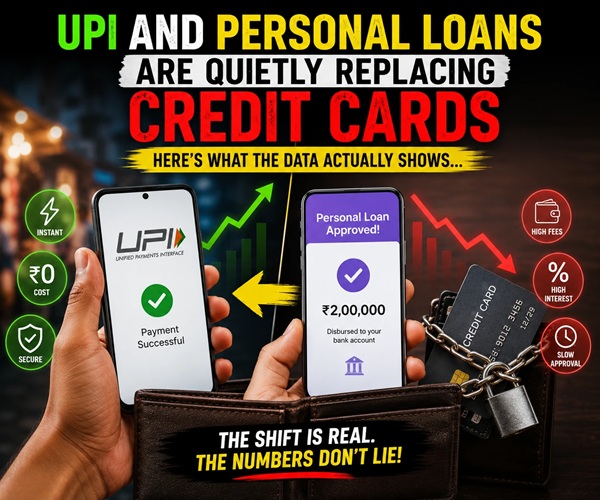
UPI and Personal Loans Are Quietly Replacing Credit Cards in Indian Wallets — Here’s What the Data Actually Shows

Last updated: July 2026
I still remember the first time I applied for a credit card back in the day — the paperwork, the branch visit, the two-week wait, and the slight thrill of finally holding that plastic in my hand. Fast forward to today, and my nephew who just started his first job hasn’t even bothered applying for one. He pays for everything on UPI and took a small personal loan on an app to buy his laptop. When I asked him why not a credit card, he just shrugged: “Why would I need one?”
That one conversation sums up a shift that’s now backed by hard numbers, not just anecdotes. According to TransUnion CIBIL‘s latest industry report, credit cards have quietly stopped being the default “go-to” unsecured credit product in an average Indian’s wallet. In their own words, credit cards have “ceased to hold the dominant” position — and the reason isn’t that Indians have stopped borrowing or spending. It’s that UPI and personal loans have become faster, cheaper, and frankly more convenient alternatives.
In this post, I want to walk you through exactly what’s happening, why it’s happening, what the numbers say, and — more importantly — what it means for you as a borrower, a spender, or someone simply trying to make sense of where India’s payments and credit ecosystem is headed.
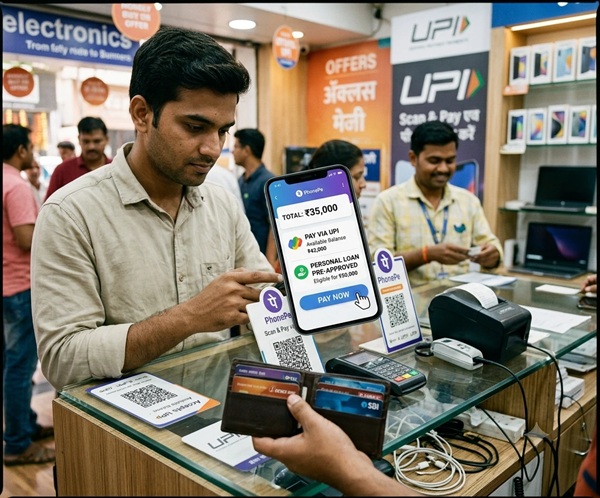
The CIBIL Report: What Actually Changed
Let’s start with the source that kicked off this conversation. TransUnion CIBIL, India’s largest credit bureau, pointed out something worth sitting with: even though credit card usage has grown massively over the last decade, it’s no longer the primary unsecured lending product competing for space in your wallet. The competition now comes from two very different corners — UPI (for day-to-day spending) and personal loans (for bigger-ticket needs).
To be fair, credit cards haven’t disappeared. The bureau’s own numbers show the category has expanded a lot over ten years:
- Outstanding credit card balances are up roughly 8.3 times, touching around ₹3.1 lakh crore
- The number of people holding at least one credit card has grown about 3.6 times, to roughly 5.2 crore consumers
- The total number of cards in circulation has grown around 5.1 times, crossing 10.7 crore cards
So cards are growing in absolute terms — just not fast enough to stay the dominant unsecured credit product anymore. That’s an important distinction. This isn’t a story of credit cards dying. It’s a story of credit cards losing their monopoly.
There’s also a structural reason cards are fighting an uphill battle: merchants pay a Merchant Discount Rate (MDR) of up to roughly 2% on every credit card swipe, which many small and mid-sized businesses quietly resent, while UPI transactions remain free for peer-to-peer and largely free for most merchant payments. And here’s a detail a lot of people don’t realise — you still can’t add a Visa or Mastercard-branded credit card directly to most UPI apps in India. Only RuPay credit cards can be linked to UPI right now. That single restriction has slowed down “credit card on UPI” adoption and pushed more everyday spending onto debit-linked UPI instead.
UPI Isn’t Just Winning — It’s Dominating
If you want proof that UPI has become the default payment rail for the country, look no further than NPCI’s own numbers. In June 2026 alone, UPI processed roughly 22.72 billion transactions worth close to ₹28.92 lakh crore. That works out to an average of about 75.7 crore transactions every single day. Year-on-year, that’s a jump of around 23% in volume and 20% in value — and this is happening on a base that’s already enormous, which makes the growth even more remarkable.
What’s telling is that even a small month-on-month dip (UPI slipped about 2% in volume between May and June) barely dents the bigger story. A platform processing tens of billions of transactions a month simply doesn’t behave like something running out of steam. If anything, the record-breaking daily average tells you the opposite — people aren’t just adopting UPI, they’re building daily habits around it. Groceries, chai, rent, EMIs, splitting a restaurant bill with friends — UPI has embedded itself into all of it.
And UPI’s ambitions don’t stop at India’s borders. The rail is now live in more than eight countries including the UAE, Singapore, France, Mauritius, Sri Lanka and Greece, with new remittance tie-ups (like the one enabling transfers from Greece to India) expanding its footprint further. When your everyday payment app becomes an export product for the country, that tells you something about how deeply it has been engineered into daily life.
Why Personal Loans Are Eating Into Credit Card Territory
Here’s the part that surprises people the most. It’s not just UPI that’s competing with credit cards — personal loans are doing it too, and from a completely different angle.
Think about how most people actually used a credit card in the past: not just for daily spends, but for that slightly bigger purchase — a phone, a wedding expense, a medical bill, a home renovation — paid off over a few EMIs. That exact use case is now being served, often faster and more transparently, by instant personal loan apps.
A few numbers explain why this shift is happening:
- India’s overall personal loan market has grown from roughly ₹6 lakh crore in 2020 to more than ₹12 lakh crore in 2026 — essentially doubling in about six years
- Fintech lenders alone disbursed over 10 crore personal loans in FY 2024-25
- Some industry estimates put the personal loan segment on a path to a 32% CAGR through 2035, driven largely by digital-first, younger borrowers
- Instant approval times have dropped dramatically — many apps now approve smaller loans within 10 to 30 minutes, with disbursal often the same day
Why would someone choose a personal loan over a credit card for a big expense? A few honest reasons:
- No revolving debt trap. A credit card’s minimum-due structure can quietly balloon into a mountain of interest if you’re not disciplined. A personal loan comes with a fixed EMI, a fixed tenure, and a clear end date.
- Transparent pricing. Personal loan interest rates currently range roughly between 9.75% and 24% depending on your CIBIL score and income profile — and you know that rate upfront, unlike a credit card where the effective cost can be murky if you carry a balance.
- Credit access for thin-file borrowers. A lot of fintech NBFCs are now using alternative data — salary account history, spending patterns, even app usage — to lend to people who don’t have an established CIBIL score yet. That’s a door credit card issuers have traditionally kept shut for first-time borrowers.
- Everything on one app. Between UPI for daily spends and a loan app for big-ticket purchases, many young Indians simply don’t feel the itch to carry a physical card anymore.
It’s worth being upfront here too — this shift comes with a genuine watch-out. Cheap, fast, minimal-documentation credit is exactly the kind of product that can quietly build up into a debt burden if used carelessly. Debt-to-income limits exist for a reason — most lenders won’t let your total EMI outgo cross 50-60% of your monthly income — and that’s a good personal rule to hold yourself to even if a lender is willing to stretch it.
What This Means for the Average Indian Household
If you’re reading this trying to figure out what to actually do with this information, here’s how I’d frame it in plain terms:
For everyday spending, UPI has essentially won. It’s free, instant, works across every bank, and doesn’t require you to manage a credit limit or worry about interest. If your spending habits are mostly small, frequent transactions — groceries, transport, subscriptions, splitting bills — there’s very little reason to route that through a credit card anymore.
For planned, bigger expenses, a personal loan is increasingly the more disciplined choice, precisely because it forces structure on you. A fixed EMI schedule tends to be a healthier financial habit than an open-ended credit line that lets you keep spending as long as the minimum due is paid.
Credit cards still have a place, though — and it would be misleading to write them off entirely. If you travel often, want airport lounge access, reward points, extended warranties, or purchase protection, cards still do things UPI and personal loans simply don’t. Cards also remain one of the most effective tools for building a strong credit history over time, provided you pay your full statement balance and not just the minimum due.
The real takeaway from the CIBIL data isn’t “credit cards are dying.” It’s that Indian consumers finally have more than one lane to choose from, and they’re picking the lane that fits the purchase — UPI for the small stuff, personal loans for the big stuff, and credit cards for the specific perks and credit-building use case they’re genuinely good at.
You May Also Like:
A Quick Reality Check on the Numbers
It helps to hold two things in your head at once here. Credit card outstanding balances growing 8.3x over a decade is still a big number in isolation — this is not a shrinking industry. But UPI processing over 22 billion transactions in a single month, and the personal loan book doubling in six years, shows you where the incremental growth in India’s credit and payments story is actually happening. Credit cards are growing steadily; UPI and personal loans are growing explosively. That gap is what CIBIL is really pointing to.
Frequently Asked Questions
1. Is UPI actually replacing credit cards in India, or is this overstated? UPI is replacing credit cards for day-to-day, low-value spending — groceries, food delivery, transport, bill payments — where cards were never particularly efficient anyway. It isn’t replacing the reward points, travel benefits, or credit-building function that cards still serve. Think of it as UPI taking over one use case, not the entire category.
2. Why can’t I add my Visa or Mastercard credit card to UPI apps like Google Pay or PhonePe? Currently, only RuPay-network credit cards can be linked to UPI in India. Visa and Mastercard credit cards aren’t supported for UPI linkage yet, which is one reason a large chunk of credit card spending still happens the traditional way (swipe or online checkout) rather than through UPI.
3. Are personal loans a better option than credit cards for big purchases? It depends on your discipline and the purchase. Personal loans give you a fixed EMI and a clear end date, which tends to be more predictable than carrying a credit card balance. But personal loans usually come with processing fees and are a fresh loan account on your credit report, so they’re best used for planned, one-time expenses rather than frequent borrowing.
4. Will taking multiple personal loans hurt my CIBIL score? Yes, potentially. Every loan application usually triggers a hard inquiry on your credit report, and applying to several apps at once in a short window can pull your score down and make future approvals harder. It’s better to check your eligibility first and apply selectively.
5. Is it safe to use instant personal loan apps? Many are perfectly safe, but only if the app is a registered partner of an RBI-regulated bank or NBFC. The RBI has repeatedly flagged unlicensed digital lending apps for predatory practices, so always verify the lender’s credentials, read the fee structure carefully, and be wary of apps that promise loans with no verification at all.
6. Does using UPI more often affect my credit score? Not directly. UPI transactions are debit-based (linked to your bank account), so they don’t get reported to credit bureaus the way credit card or loan repayments do. Your credit score is built through credit products — cards, loans, EMIs — not UPI spending itself.
7. Should I close my credit card and switch entirely to UPI and personal loans? Not necessarily. A well-managed credit card, paid in full every month, remains one of the better tools for building a long, healthy credit history, and it’s still useful for larger reward-linked or protected purchases. The smarter approach for most people is using each product for what it’s actually good at, rather than abandoning one entirely.
Final Thoughts
What’s happening in India’s payments and credit space right now isn’t a single product beating another — it’s a market maturing into specialisation. UPI took over the “I need to pay for this right now” moment. Personal loans took over the “I need to fund something bigger, and I want a clear repayment plan” moment. Credit cards are being pushed toward the moments where their specific strengths — rewards, protection, credit-building — actually matter.
If you’re managing your own money, the practical move isn’t picking a side. It’s understanding which tool fits which situation, and being honest with yourself about your own spending discipline before you reach for any of them — a UPI app, a loan app, or a credit card.
Disclaimer: This article is for general informational and educational purposes only and should not be treated as financial, investment, credit, or legal advice. Interest rates, loan terms, transaction data, and industry figures mentioned above are sourced from publicly available reports (including TransUnion CIBIL and NPCI data) and third-party fintech publications current as of the stated dates, and are subject to change without notice. Please verify current rates, eligibility criteria, and terms directly with RBI-regulated banks, NBFCs, or lending platforms before making any financial decision, and consult a certified financial advisor for guidance specific to your personal situation. The author and publisher are not liable for any financial decisions made based on the information in this article.

Shuchi founded Finance Checks after spending 16+ years working in corporate, managing operations and distribution. She managed her own finances, learned and read regularly and helped people make sense of their savings, loans, insurance, and investments.
She started this site to offer the kind of clear, honest financial guidance she wished was more available when she was learning to manage her own money. Every article is researched personally, checked against official sources such as the Reserve Bank of India, SEBI, or the Income Tax Department, and revisited whenever regulations or figures change. She is upfront about how the site earns money through ads and select affiliate partnerships, and she does not let either influence what she actually recommends to readers.



[…] think about whether UPI support matters to you. Since RuPay credit cards started linking with UPI, a growing number of […]
[…] UPI and Personal Loans Are Quietly Replacing Credit Cards in Indian Wallets — Here’s What the Da… […]