
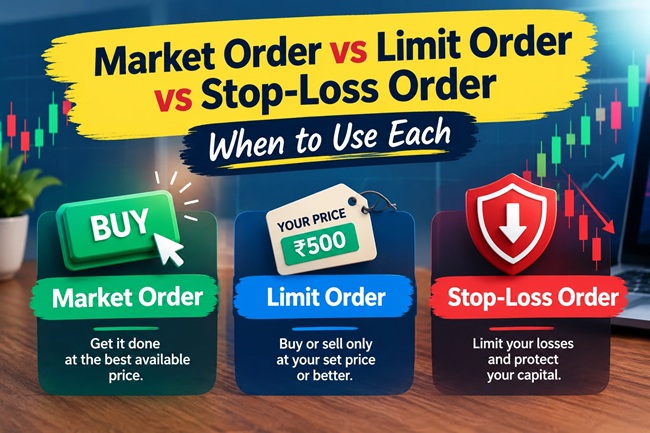
Market Order vs Limit Order vs Stop-Loss Order: When to Use Each

Divya had never lost sleep over a stop-loss order until the one time it mattered most.
She’d bought into a small-cap stock a few months earlier, and when a sudden bout of bad news hit the sector, she watched the price crater in real time. Her stop-loss, an SL-M order set well above where the stock eventually landed, should have protected her. Instead, because the order book was thin and buyers had all but vanished at that price level, her “safety net” order executed nearly 8% below her intended trigger price. The stop-loss did its job of exiting the position. It just didn’t do it at anywhere close to the price she expected.
Divya’s experience is exactly why NSE and BSE have, over the past few years, tightened the rules around which stop-loss order types are even available, and it’s exactly why understanding the real mechanical differences between a market order, a limit order, and a stop-loss order matters more than most beginner guides let on. These aren’t interchangeable settings on a dropdown menu. Each one trades off speed, price control, and the risk of non-execution differently, and picking the wrong one at the wrong moment is one of the more expensive, avoidable mistakes a trader can make.
Quick Answer
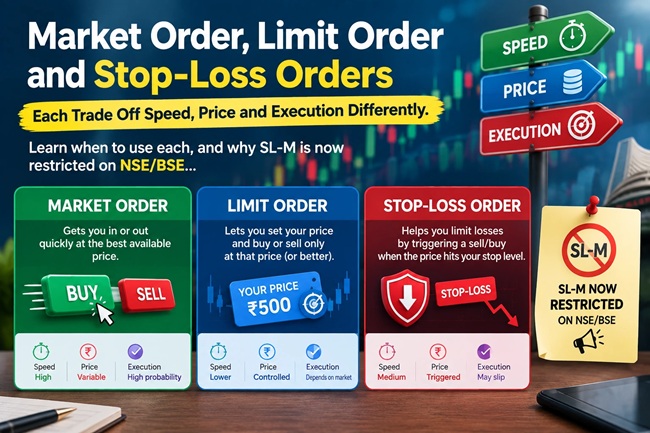
A market order executes immediately at the best currently available price, guaranteeing execution but not the exact price. A limit order executes only at your specified price or better, guaranteeing the price but not that it will execute at all. A stop-loss order sits inactive until a trigger price is hit, then converts into either a market order (SL-M, guaranteeing exit but not price) or a limit order (SL-L, guaranteeing price but not exit). As of recent exchange rules, BSE has discontinued SL-M orders entirely across equity, derivatives, currency, and commodity segments, while NSE has discontinued SL-M only for options, keeping it available for equity cash and futures trading.
About This Guide
This guide has been researched and written by the FinanceChecks editorial team, based on NSE and BSE trading system documentation and official exchange circulars on stop-loss order discontinuation.
FinanceChecks is an independent Indian personal finance publication. We are not SEBI-registered investment advisers, and nothing in this article is a recommendation regarding any specific trade or trading strategy. Please read the disclaimer at the end of this guide.
Last reviewed: September 2026
Market Order: Speed Guaranteed, Price Not
A market order tells your broker to buy or sell immediately at whatever price the market is currently offering. There’s no price you specify, only the instruction to execute right now.
How it behaves. The order goes straight into the exchange’s order book and matches against the best available counter-order. In a liquid stock like a Nifty 50 constituent, this typically means execution within a fraction of a second, at a price extremely close to what you saw on your screen a moment earlier.
Where it can go wrong. In an illiquid stock, or during a sudden, sharp price move, there might not be enough buyers or sellers at the price you expected. Your order keeps matching against progressively worse prices in the order book until it’s fully filled, a phenomenon called slippage. In extreme cases, this can mean executing at a price meaningfully different from what you saw when you clicked buy or sell.
When it makes sense. Market orders suit situations where getting the trade done matters more than getting it done at an exact price, typically in highly liquid, large-cap stocks or index futures where the bid-ask spread is tight and slippage risk is minimal.
Limit Order: Price Guaranteed, Execution Not
A limit order specifies the exact price, or better, at which you’re willing to buy or sell. A buy limit order will only execute at your specified price or lower; a sell limit order will only execute at your specified price or higher.
How it behaves. The order sits in the exchange’s order book, waiting. If the market reaches your specified price, it executes, potentially at an even better price if available. If the market never reaches your price, the order simply sits unfilled until you cancel it or, depending on your broker’s settings, it expires at the end of the trading session.
Where it can go wrong. The market can move sharply through your specified price without ever trading exactly at it, particularly in illiquid stocks with wide gaps between available price levels, leaving your order completely unfilled while the price runs away from you.
When it makes sense. Limit orders suit situations where the exact entry or exit price matters more than certainty of execution, such as buying into an illiquid small-cap stock where you don’t want to overpay, or setting a specific target sell price you’re comfortable waiting for.
Stop-Loss Order: A Conditional Order That Waits, Then Acts
A stop-loss order is fundamentally different from the first two, because it doesn’t sit in the regular, visible order book at all when you first place it. Instead, it waits in a separate “triggered pending” state until the last traded price reaches a trigger price you specify. Only then does it activate and convert into either a market order or a limit order, depending on which type you chose.
There are two variants, and the distinction between them is the single most important thing to understand in this entire topic.
SL-M (Stop-Loss Market). You specify only a trigger price. Once the last traded price hits that trigger, the order converts into a market order and executes at whatever the current best price happens to be. This guarantees your exit but not the price you exit at, exactly the scenario that caught Divya out in a thin order book.
SL-L (Stop-Loss Limit), also written as SL. You specify both a trigger price and a limit price. Once the trigger is hit, the order converts into a limit order at your specified limit price, not a market order. This guarantees you won’t get a worse price than your limit, but it means the order might not execute at all if the market moves past your limit price too quickly without trading at it.
| Feature | SL-M (Stop-Loss Market) | SL-L (Stop-Loss Limit) |
|---|---|---|
| Prices you specify | Trigger price only | Trigger price and limit price |
| On trigger, converts to | Market order | Limit order |
| Execution guaranteed? | Yes, virtually always in liquid stocks | No, depends on available buyers/sellers at your limit |
| Price guaranteed? | No, subject to slippage | Yes, executes at your limit or better, or not at all |
| Best suited for | Highly liquid large-cap stocks | Illiquid stocks or highly volatile, gappy price action |
The Rule Change Every Indian Trader Should Know About
This is where a lot of older guides on this topic have gone stale, and it’s worth being precise about the current state of play across both major exchanges.
NSE discontinued SL-M orders for options trading in September 2021. The reason was straightforward: options, particularly out-of-the-money strikes and weekly expiries, often have very thin order books. A stop-loss market order triggering in that environment could execute at a wildly different price from the trigger, sometimes 30, 50, even close to 100 percent away from the last reasonable trade, turning a risk-management tool into the exact loss it was meant to prevent. NSE still permits SL-M orders for equity cash and futures trading.
BSE discontinued SL-M orders entirely, across every segment, effective October 2023. Following a series of “freak trade” incidents, unusual, erroneous trades that deviate sharply from normal price levels, BSE removed the SL-M option across equity, equity derivatives, currency derivatives, and commodity derivatives altogether. On BSE today, SL-L is the only stop-loss order type available for any of these segments; traders who want SL-M-like behaviour there generally set an SL-L order with a limit price set meaningfully beyond the trigger, deliberately widening the acceptable execution range to approximate a guaranteed exit.
The practical upshot: if you trade options on NSE, or trade anything at all on BSE, SL-M simply isn’t on the menu anymore. You’ll be using SL-L whether you prefer it or not, which makes understanding how to set a sensible limit price buffer, not too tight that it risks non-execution, not so wide it defeats the purpose of having a limit at all, a genuinely useful skill rather than an optional one.
You May Also Like To Read About:
- When Should You Sell a Stock? A Strategy-Based Guide to Making the Right Exit Decision
- Jio Platforms Gets SEBI Nod for Its ₹35,000+ Crore IPO — Here’s What It Means for You
- How to Use AI for Trading in 2026: A Complete No-Code AI Trading Guide for Absolute Beginners
- Bull Market vs Bear Market: How to Actually Behave in Each
- P/E Ratio, ROE, and EPS Explained: The Numbers That Actually Matter Beyond the Balance Sheet
Choosing the Right Order Type: A Practical Framework
| Your situation | Best order type | Why |
|---|---|---|
| Buying or selling a large-cap, highly liquid stock, speed matters most | Market order | Minimal slippage risk in liquid names; you want the trade done now |
| Buying an illiquid small-cap, you have a specific price target | Limit order | Avoids overpaying or underselling; you’re willing to wait |
| Setting a stop-loss on a liquid large-cap stock you can’t monitor constantly | SL-M, where available | Guarantees you’re out; minor slippage is an acceptable trade-off for certainty |
| Setting a stop-loss on an illiquid or highly volatile stock | SL-L with a sensible buffer | Protects against a catastrophic slippage price; some non-execution risk is preferable to an extreme fill |
| Trading options, or trading anything on BSE | SL-L (your only stop-loss option) | SL-M has been discontinued in these contexts |
Common Mistakes Traders Make With Order Types
Assuming SL-M is always available. As covered above, it isn’t, not for options on NSE, and not for anything at all on BSE. Placing an order under the wrong assumption can leave you confused when the platform rejects it or defaults to a type you didn’t intend.
Setting an SL-L limit price too close to the trigger price. In a fast-moving market, the price can blow straight past a tight limit buffer without ever trading at it, leaving your “stop-loss” completely unfilled at the exact moment you needed protection most.
Using a market order in a thinly traded stock without checking the order book depth first. What looks like a reasonable price on screen can mask a very shallow book, and a market order in that situation can fill at a surprisingly poor average price.
Treating a limit order as a guarantee of a trade happening. A limit order guarantees price, not execution. If the market never revisits your level, your order simply sits there, unfilled, while the opportunity potentially passes.
Forgetting that a triggered stop-loss order is not visible in the regular order book until it fires. This occasionally confuses traders checking market depth, wondering why their pending stop-loss doesn’t show up anywhere, when it’s simply sitting in a separate, inactive queue until the trigger condition is met.
My Take
I think the most useful mental shift here is realising that every order type is a trade-off, not a free upgrade. There’s no version of “guaranteed price and guaranteed execution” available anywhere on this menu. A market order buys you certainty of execution at the cost of price control. A limit order buys you price control at the cost of certainty. Stop-loss orders just inherit whichever trade-off their underlying type carries, once triggered.
What genuinely surprised me researching the exchange rule changes here is how directly they were driven by real, painful incidents, freak trades and slippage disasters that were significant enough to push both NSE and BSE to actually remove an order type from the menu rather than just warn traders about it. That’s a meaningful signal about how real the risk in SL-M orders can be in illiquid conditions, and it’s exactly the risk Divya ran into before BSE tightened its own rules.
My honest suggestion for anyone setting up stop-losses regularly: default to thinking about liquidity first, before you even pick an order type. A Nifty 50 stock and a thinly traded small-cap deserve genuinely different stop-loss strategies, and the “right” order type for one can be a poor choice for the other. Don’t set a stop-loss and assume it behaves identically everywhere; check what the stock’s typical trading volume actually looks like, and size your limit buffer, or your tolerance for slippage, accordingly.
Frequently Asked Questions
1. What is the main difference between a market order and a limit order?
A market order executes immediately at the best available current price, guaranteeing that the trade happens but not the exact price. A limit order executes only at your specified price or better, guaranteeing the price but not that the trade will happen at all.
2. What is a stop-loss order and how is it different from a regular order?
A stop-loss order stays inactive until a specified trigger price is reached, and only then converts into either a market order (SL-M) or a limit order (SL-L). Regular market and limit orders are active in the order book immediately upon placement.
3. What is the difference between SL-M and SL-L stop-loss orders?
SL-M requires only a trigger price and converts to a market order once triggered, guaranteeing exit but not price. SL-L requires both a trigger price and a limit price and converts to a limit order once triggered, guaranteeing price but not that the order will execute.
4. Is SL-M still available for trading in India?
It depends on the exchange and segment. NSE discontinued SL-M for options trading in September 2021 but still allows it for equity cash and futures. BSE discontinued SL-M entirely, across equity, derivatives, currency, and commodity segments, from October 2023.
5. Why did exchanges discontinue SL-M orders in some segments?
To prevent “freak trades,” erroneous executions that occur far from reasonable market prices when an SL-M order triggers in a thin order book with few buyers or sellers available, which was causing significant, unexpected losses for traders relying on them as a safety net.
6. Which order type should I use for a highly liquid, large-cap stock?
A market order generally works well for entry or exit in highly liquid stocks, since the tight bid-ask spread means slippage risk is minimal. For a stop-loss on the same stock, SL-M, where available, offers a reasonable balance of certainty and minimal price risk.
7. Which order type should I use for an illiquid or highly volatile stock?
A limit order for entry or exit, and an SL-L stop-loss with a sensible price buffer, generally offer better protection, since they prevent your order from filling at an extreme, unexpected price in a thin market.
8. Can a limit order execute at a better price than what I specified?
Yes. A buy limit order can execute at your specified price or lower, and a sell limit order can execute at your specified price or higher, if better prices happen to be available when the order becomes eligible for execution.
9. Does a limit order guarantee my trade will happen?
No. If the market price never reaches your specified limit, your order remains unfilled until you cancel it or it expires, depending on your broker’s order validity settings.
10. What happens if I set my SL-L limit price too close to the trigger price?
In a fast-moving market, the price can move past both your trigger and your limit price before the order can be matched, leaving your stop-loss order unfilled at exactly the moment you needed it to execute.
Key Takeaways
- A market order guarantees execution but not price; a limit order guarantees price but not execution.
- A stop-loss order stays inactive until a trigger price is hit, then converts into either a market order (SL-M) or a limit order (SL-L).
- SL-M has been discontinued for options on NSE since September 2021, and entirely on BSE across all segments since October 2023, both in response to freak-trade risk in thin order books.
- Where SL-M is unavailable, SL-L with a deliberately wide limit buffer is the practical substitute for a near-guaranteed exit.
- Choosing the right order type depends heavily on the liquidity of the specific stock or contract you’re trading, not on a single default preference.
Disclaimer
The information provided in this article is for educational and informational purposes only and should not be construed as investment or trading advice, or a recommendation regarding any specific security, order type, or trading strategy.
FinanceChecks.com is not a SEBI-registered investment adviser or research analyst. Exchange rules regarding order types, including the availability of SL-M orders, reflect NSE and BSE circulars as understood in September 2026 and are subject to change by the exchanges at any time.
Trading in equities, derivatives, and other securities carries risk, including the risk of loss due to slippage, non-execution, and market volatility, regardless of the order type used. Please consult your broker’s current order type documentation and a qualified financial adviser before making trading decisions.
FinanceChecks.com and its authors accept no liability for any loss arising from reliance on the information presented in this article.

Shuchi founded Finance Checks after spending 16+ years working in corporate, managing operations and distribution. She managed her own finances, learned and read regularly and helped people make sense of their savings, loans, insurance, and investments.
She started this site to offer the kind of clear, honest financial guidance she wished was more available when she was learning to manage her own money. Every article is researched personally, checked against official sources such as the Reserve Bank of India, SEBI, or the Income Tax Department, and revisited whenever regulations or figures change. She is upfront about how the site earns money through ads and select affiliate partnerships, and she does not let either influence what she actually recommends to readers.



[…] Market Order vs Limit Order vs Stop-Loss Order: When to Use Each […]